

When employees are spread across Melbourne and appointments need to fit around different shifts, coordinating health assessments can become an operational challenge. Choosing enterprise occupational health solutions Melbourne employers can rely on means matching appropriate clinical services with practical delivery and clear, confidential reporting.
If you’re coordinating medical assessments or health surveillance across multiple sites, you need more than a list of services. You need a delivery model that suits employees’ roles and workplace risks, minimises disruption and gives your team relevant information while protecting personal health details.
This guide explains how to compare service scope, clinic appointments and on-site delivery, then match reporting to your workforce and operational needs. It also outlines how Persona Health supports employers through Melbourne clinic locations in Cairnlea and Craigieburn, Australia-wide mobile workplace services and a network of 100 affiliate clinics nationwide. You’ll learn what to consider when planning pre-employment medicals, health surveillance and drug and alcohol testing, and how responsive coordination and modern digital reporting can help keep the process manageable. The same planning principles can help organisations coordinating teams across Melbourne, Sydney, Gregory Hills and Parramatta.
Key Takeaways
- Map workforce roles, locations and health risks before selecting assessments, so services address real operational needs.
- Compare clinic, mobile and combined delivery against employee locations and rosters.
- Assess service scope, reporting and employer support using consistent criteria across sites.
- Set clear reporting requirements and access controls to support programme oversight while protecting employee health information.
- Persona Health’s Cairnlea and Craigieburn clinics, Australia-wide mobile services and network of 100 affiliate clinics can support a coordinated approach as workforce needs change.
What enterprise occupational health solutions should cover for Melbourne employers
For an employer with staff across multiple sites, shifts or job types, arranging isolated appointments can make coordination difficult and leave gaps in a programme. Enterprise occupational health solutions Melbourne employers use should connect appropriate clinical services with workforce roles, locations and operational needs, rather than treating every employee as though they do the same work.
Occupational health services assess and monitor how work tasks and workplace exposures relate to employee health and fitness for work. General wellbeing support focuses more broadly on employees’ health and wellbeing. The two can complement each other, but they have different purposes. Defining this distinction helps you set a practical programme scope. For Victorian workplace context, see WorkSafe Victoria’s guidance on employers’ OHS duties.
Use these questions to define what your programme needs before selecting assessments:
Which services may form part of an enterprise programme?
Start with the roles and tasks, then identify the assessments that are relevant. A programme may include Melbourne occupational health services such as pre-employment medicals, drug and alcohol testing, health surveillance, or specialised medicals for silica or asbestos exposure. Each assessment should relate to the role’s requirements or identified workplace risks, rather than being added as a generic bundle.
For example, consider whether a role involves exposure that warrants health surveillance, or whether a pre-employment assessment should reflect the work’s functional demands. Be clear about what each assessment is intended to inform and how its results will be used. This helps keep the programme relevant to the people doing the work.
Why Melbourne workforce structure changes the service brief
A single-site team may be able to coordinate appointments around one location. Multiple worksites may need a mix of clinic access and on-site services. Shift patterns matter too: if employees work different rosters, plan appointments around when staff are available and how much time away from duties is manageable.
Consider job mix and travel as well. Staff who move between locations may need a consistent process, while a concentrated group at one workplace may suit a different delivery arrangement. Persona Health provides Melbourne clinic access in Cairnlea and Craigieburn, alongside on-site workplace services. Mapping roles, sites and attendance patterns first helps shape a programme that works for the workforce without relying on a one-size-fits-all plan.
How to compare enterprise occupational health providers against workforce needs
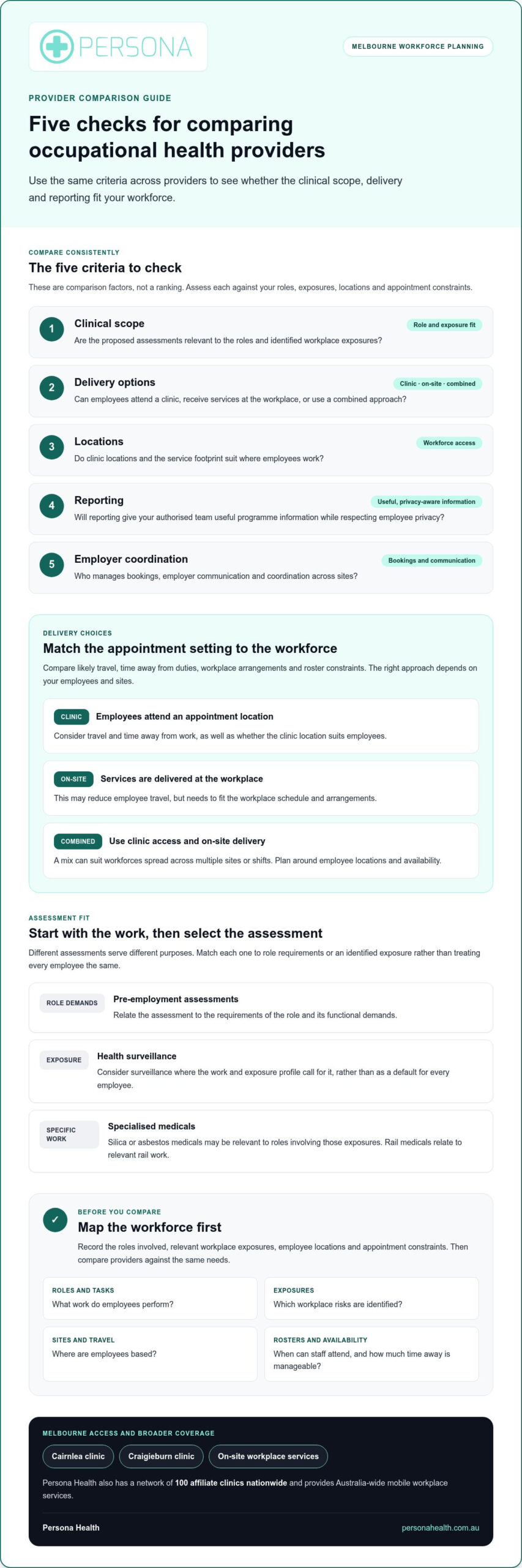
A useful comparison starts with your workforce, not a provider’s broad service list. Record the roles involved, relevant workplace exposures, locations and appointment constraints. Then assess how the service scope and delivery approach fit those needs. Service fit depends on job demands, exposure profile and delivery logistics.
Use the same criteria to compare options consistently:
| Compare | What to consider |
|---|---|
| Clinical scope | Are the proposed assessments relevant to the roles and identified exposures? |
| Delivery options | Can employees attend a clinic, receive on-site services, or use a combined approach? |
| Locations | Do the clinic locations and service footprint suit where employees work? |
| Reporting | Will reporting give your authorised team useful programme information while respecting employee privacy? |
| Employer coordination | Who manages bookings, employer communication and coordination across sites? |
Appointment access is an operational consideration. Clinic visits involve travel and time away from work, while on-site delivery may reduce employee travel but needs to fit the workplace schedule and arrangements. Compare the likely disruption for your workforce rather than relying on assumed outcomes or unverified turnaround promises. For Victorian context, refer to WorkSafe Victoria’s legal duties for employers.
Match medical assessments to roles and exposure profiles
Routine pre-employment assessments and ongoing health surveillance serve different purposes. A pre-employment assessment should relate to the requirements of the role. Specialist surveillance is relevant where the work and exposure profile call for it, rather than as a default for every employee. For example, silica or asbestos medicals may be relevant to roles involving those exposures, while rail medicals relate to relevant rail work. Persona Health provides a dedicated Melbourne pre-employment medicals pathway.
Assess coordination, turnaround and reporting
For a dispersed workforce, clarify how bookings and employer communication are coordinated across sites, and what reporting will support your programme. Persona Health offers responsive customer service, an employer-focused approach, fast turnaround times and modern digital reporting. These strengths can help make administration more manageable. Set reporting expectations around your programme needs rather than assuming a particular timeframe, report format or system integration.
To discuss a coordinated approach for your workforce, speak with Persona Health’s team.
Clinic, on-site or combined delivery: what suits a Melbourne workforce?
The most practical delivery model depends on where employees work, how their rosters run and how much time they can spend away from their usual duties. Clinic appointments can suit scheduled individual assessments. On-site services can help coordinate assessments at an operational workplace, while a combined model can accommodate employees spread across different locations.
Persona Health has Melbourne clinic locations in Cairnlea and Craigieburn, Australia-wide mobile workplace services and a network of 100 affiliate clinics nationwide. These options can support different workforce footprints. The Melbourne clinic information outlines local services.
| Delivery model | May suit | Practical trade-off |
|---|---|---|
| Clinic appointments | Employees who can travel to a scheduled appointment, including individuals or smaller groups. | Employees need time to travel and attend away from the worksite. |
| On-site mobile services | Groups at an operational site, or workers for whom travelling to a clinic is difficult. | The workplace needs to plan around service delivery and its operational requirements. |
| Combined model | Teams split across sites, roles or rosters, where one arrangement may not suit everyone. | Coordination needs to account for more than one location or delivery pathway. |
When Melbourne clinic appointments may fit best
Clinic-based appointments can work well when employees can attend at planned times and travel does not create an unreasonable interruption to site operations. For example, an employer could schedule individual assessments around roster patterns instead of taking a whole team away from a worksite at once. Cairnlea and Craigieburn give Melbourne employers clinic locations to consider when planning attendance.
When on-site and affiliate clinic access may help
On-site delivery may suit a group based at one workplace or employees whose work makes clinic travel difficult to coordinate. It can also be used alongside clinic appointments, rather than as a replacement for them. Persona Health provides on-site health surveillance and Australia-wide mobile workplace services, as well as access to its network of 100 affiliate clinics nationwide.
To compare delivery options against your workforce locations and rosters, speak with Persona Health. Safe Work Australia’s national framework for managing health and safety also provides context for planning workplace health activities around identified risks and consultation.
How to plan reporting, privacy and workplace injury response
Good reporting helps you coordinate assessments and understand programme activity. It should also distinguish information an employer needs to manage a programme from confidential details of an individual clinical assessment. Employer-level reporting can support oversight of programme activity, while individual clinical information should be handled separately and shared only in line with applicable privacy requirements.
Set up a clear process before services begin:
- Define reporting needs: Decide what information helps your team coordinate appointments, follow up assessments and review programme activity.
- Set access controls: Identify which staff need access to which information, keeping access appropriate to their responsibilities.
- Clarify communication: Agree how appointment coordination and relevant updates will be handled across sites.
- Review programme information: Use reporting to identify operational follow-up needs and consider whether the programme remains relevant to your workforce.
The Privacy Act 1988 and Australian Privacy Principles (APPs) are relevant to the handling of personal information for organisations covered by the Act. Applicability depends on the organisation and circumstances, so consult current guidance from the Office of the Australian Information Commissioner. For Victorian workplace health and safety context, refer to current WorkSafe Victoria guidance and relevant Victorian requirements. Persona Health’s modern digital reporting supports employer coordination. Agree how reporting will be used without assuming a particular format or system feature.
What useful occupational health reporting should help employers understand
Reporting can help your team track programme activity, coordinate follow-up and see whether planned services are progressing across locations. For health surveillance, use reporting as part of a considered programme, not as a substitute for clinical judgement. Persona Health provides on-site health surveillance that can be incorporated into an employer-focused plan.
How InjuryQR fits a workplace injury response
InjuryQR is a free AI-powered workplace injury triage service available to all Australian businesses. Employers can access free posters, stickers, keyrings and fridge magnets. A worker scans a QR code, with no app download required, describes the injury by voice, then responds to AI follow-up questions. Depending on the information provided, the service may give self-care advice, offer a telehealth appointment typically within 3 to 4 hours, direct the worker to an Emergency Department or instruct them to call 000.
Where appropriate, a Certificate of Capacity can be issued immediately. Earlier triage and clearer reporting can support suitable next steps, improve incident reporting and help reduce Lost Time Injuries (LTIs). InjuryQR does not replace emergency care or workplace response procedures.
Discuss reporting and injury response support with Persona Health
Choosing an enterprise occupational health partner in Melbourne: next steps
A clear brief makes it easier to build a programme around the way your workforce operates. Before comparing options, document what employees do, where they work and what your organisation needs from assessments and reporting. This helps turn enterprise occupational health solutions Melbourne employers need into a practical plan, rather than a collection of disconnected appointments.
A practical brief to prepare before engaging a provider
Use this sequence to organise your requirements:
- Map roles and sites: Note the main job types, work locations and assessment needs associated with the work.
- Describe operational schedules: Include shift patterns, site activity and how much time employees can reasonably spend away from duties for appointments.
- Prioritise services: Separate routine assessments from health surveillance or specialist assessments relevant to particular roles and exposures.
- Select delivery: Decide whether clinic appointments, on-site services or access to clinics across a wider footprint should form part of the plan.
- Agree reporting and review: Define what programme information will help your team coordinate and review services, who needs access, and when to revisit the programme.
Keep the brief focused on the decisions the programme needs to support. For example, a workforce with several Melbourne sites and varied rosters may need different appointment pathways for different teams. Clear reporting expectations also help separate employer-level coordination from personal clinical information, subject to applicable privacy requirements.
How Persona Health can support Melbourne employers
Persona Health takes an employer-focused approach to coordinating assessments, health surveillance and workplace services. Melbourne clinic access in Cairnlea and Craigieburn, Australia-wide mobile workplace services and a network of 100 affiliate clinics nationwide provide delivery options for employers with different workforce footprints. Plan the service mix around your programme and workforce needs.
Persona Health offers responsive customer service, fast turnaround times and modern digital reporting. These strengths can support coordination from assessment selection through to delivery and review. Read the Melbourne workplace health overview for local service information.
Bring your role, location, scheduling and reporting priorities together before settling on a model. This gives the discussion a practical starting point and helps tailor the plan to your workforce.
Build a coordinated plan for your Melbourne workforce
The right occupational health programme starts with your workforce: its roles, health risks, locations and schedules. Match assessments to those needs, then choose clinic, on-site or combined delivery that works for employees and operations. Set clear reporting expectations so programme information helps your team coordinate services while personal health information is handled carefully.
Persona Health brings an employer-focused approach to occupational health support, backed by responsive customer service, fast turnaround times and modern digital reporting. Melbourne clinic access, Australia-wide mobile workplace services and a network of 100 affiliate clinics nationwide offer options for workforces across different locations. Enterprise occupational health solutions Melbourne employers can shape around their requirements can support coordination as needs evolve.
Start with a practical brief covering roles, sites, schedules, priority services and reporting needs. A clear starting point makes it easier to plan support that fits your people and operations.
Contact Persona Health to discuss a coordinated occupational health plan for your workforce in Melbourne, Sydney, Gregory Hills or Parramatta.
Frequently Asked Questions
What do enterprise occupational health solutions typically include?
Enterprise occupational health solutions can bring together assessments and services matched to employee roles, work locations and identified health risks. Depending on the workforce, these may include pre-employment medicals, drug and alcohol testing, health surveillance, specialised silica or asbestos medicals, and rail medicals for relevant roles. Define the purpose of each service and how it relates to the work, rather than assuming every employee needs the same assessment.
How do Melbourne employers choose between clinic and on-site occupational health services?
Choose based on where employees work, their rosters and how easily they can attend appointments without disrupting operations. Clinic appointments may suit individuals or employees who can travel at scheduled times. On-site services may be practical for a group at an operational site or workers who cannot easily travel. A combined model can suit teams spread across locations. Persona Health has Melbourne clinic locations in Cairnlea and Craigieburn, as well as mobile workplace services.
Can occupational health services be delivered across multiple Melbourne worksites?
Yes. A programme can combine delivery options according to workforce locations, roles and schedules. For example, employees near a clinic may attend appointments, while a group at another site may use on-site services. Plan how bookings and employer communication will work across locations to keep the process coordinated. Persona Health supports Melbourne employers through clinic access and Australia-wide mobile workplace services, with 100 affiliate clinics nationwide for broader workforce footprints.
What should employers expect from occupational health reporting?
Reporting should help employers coordinate appointments, follow up relevant programme activity and review whether services remain suited to workforce needs. Agree what information your organisation needs, who should have access and how communication will be managed. Personal clinical information requires careful handling. Keep employer-level programme insights distinct from individual clinical details, subject to applicable privacy requirements. Persona Health provides modern digital reporting, without assuming a particular report format or system integration.
How does InjuryQR help when a workplace injury occurs?
InjuryQR is a free AI-powered workplace injury triage service available to all Australian businesses. A worker scans a QR code without downloading an app, describes the injury by voice, then answers AI follow-up questions. Depending on the information provided, they may receive self-care advice, a telehealth appointment typically within 3 to 4 hours, direction to an Emergency Department or instructions to call 000. Free posters, stickers, keyrings and fridge magnets are also available to businesses.
How does InjuryQR support workplace injury reporting and reduce lost time injuries?
InjuryQR gives workers a straightforward way to describe an injury and receive triage guidance, supporting timely and clearer reporting. Its outcomes can help direct a worker to an appropriate next step, from self-care advice to emergency care. A Certificate of Capacity can be issued immediately where appropriate. Prompt triage and improved reporting can support early follow-up and help reduce Lost Time Injuries (LTIs), while workplace and emergency response procedures remain important.
Which Australian requirements should Melbourne employers consider when arranging occupational health services?
Melbourne employers should consider Victorian occupational health and safety requirements, including the Occupational Health and Safety Act 2004 and relevant regulations, alongside current WorkSafe Victoria guidance. Privacy also matters: consider the Privacy Act 1988 and Australian Privacy Principles where they apply to your organisation and the information handled. Requirements depend on the circumstances, so use current regulator and government guidance when planning assessments, health surveillance, reporting and information handling.
Does Persona Health provide occupational health support outside Melbourne?
Yes. Persona Health provides occupational health support beyond Melbourne through Australia-wide mobile workplace services and a network of 100 affiliate clinics nationwide. In Sydney, Gregory Hills and Parramatta are local options. Melbourne clinic locations include Cairnlea and Craigieburn. Service delivery can be coordinated around workforce locations and needs.

Article by
Ian Nicholson
Ian is the Business Support Manager at Persona Health, where he plays a key role across IT, sales, marketing and business operations. With a broad skill set and a practical, solutions-focused approach, Ian helps drive the systems, communication and commercial strategy that support Persona Health’s continued growth across Australia.