

What helps make a return to work smoother? Often, it is clear coordination rather than faster paperwork. After an injury, the worker, employer and treating practitioners may each have information to share, while the employer also needs to understand work capacity and possible suitable duties. An injury management consultant Parramatta employers can work with helps bring these moving parts together and clarify practical next steps. This guide explains what a consultant does, how to assess local support and what an individualised process can involve.
Early reporting can help identify an appropriate immediate response. InjuryQR is a free AI-powered triage service for all Australian businesses. A worker scans a QR code without downloading an app, describes the injury by voice and answers AI follow-up questions. Depending on the responses, the service can provide self-care advice, arrange a telehealth appointment, typically within 3-4 hours, direct the worker to an Emergency Department or instruct them to call 000. A Certificate of Capacity can be issued immediately where appropriate. Free posters, stickers, keyrings and fridge magnets help make reporting accessible. Timely reporting can improve incident visibility and help reduce Lost Time Injuries (LTIs). Injury triage is an early response; coordinated injury management connects the worker, treating practitioners and employer around recovery and suitable work.
Key Takeaways
- An injury management consultant coordinates communication and recovery planning so the worker, workplace and treating practitioners can work towards clear next steps.
- When assessing an injury management consultant Parramatta employers can use, look for clear role boundaries, individualised planning, responsive communication, suitable-duty coordination and useful reporting.
- Match possible duties to the worker’s current capacity and the actual demands of their role, rather than relying on a one-size-fits-all plan.
- A clear response sequence moves from injury reporting and immediate needs to coordinated follow-up. InjuryQR can support early triage.
- Compare support options by how well they fit your workplace’s location, job demands and coordination needs, including access to digital reporting and local support.
What does a Parramatta injury management consultant do?
A workplace injury can put pressure on the worker and the employer. The worker may be dealing with pain or uncertainty, while the employer needs to understand work capacity, suitable duties and who should be kept informed. A clear coordination process helps everyone understand what happens next.
An injury management consultant coordinates communication and recovery planning between the worker, employer and relevant treating practitioners. The work may include clarifying responsibilities, considering work options in light of available capacity information and organising follow-up. Good planning reflects the person, their injury, the demands of their role and the duties available at the workplace. It is not a one-size-fits-all process.
Injury triage helps identify an appropriate immediate response; ongoing injury management coordinates communication, recovery planning and workplace participation over time. Triage does not replace emergency care, and coordination does not replace clinical treatment or determine a compensation claim.
How is an injury management consultant different from a treating clinician?
A treating practitioner provides clinical advice within their professional role, including assessment and treatment recommendations. An injury management consultant supports coordination with the worker and relevant workplace contacts, but does not replace clinical care, diagnose an injury or guarantee a return-to-work date. For example, a consultant may help communicate relevant work-capacity information so the employer can consider suitable duties. Clinical advice remains with the treating practitioner.
When might a Parramatta employer seek injury management support?
An employer may seek support when an injury affects a worker’s usual tasks and communication or follow-up becomes difficult to manage. For example, a worker who normally performs physical duties may need a discussion about alternative tasks while their capacity is being considered. A consultant can help organise the relevant conversations and clarify next steps without making clinical decisions.
When information is spread across several contacts, a clear coordination process helps the employer consider the worker’s needs alongside the actual demands of the role. Persona Health provides workplace injury management support in Parramatta. Learn more about Persona Health’s Parramatta clinic and services.
For early triage, InjuryQR is a free AI-powered workplace injury triage service available to all Australian businesses. Workers scan a QR code without downloading an app, describe the injury by voice and answer AI follow-up questions. Possible outcomes include self-care advice, a telehealth appointment, typically within 3-4 hours, direction to an Emergency Department or instructions to call 000. A Certificate of Capacity can be issued immediately where appropriate. Free posters, stickers, keyrings and fridge magnets make the reporting option visible. InjuryQR supports the initial response; ongoing injury management coordinates communication and workplace planning.
How to assess an injury management consultant: five practical criteria
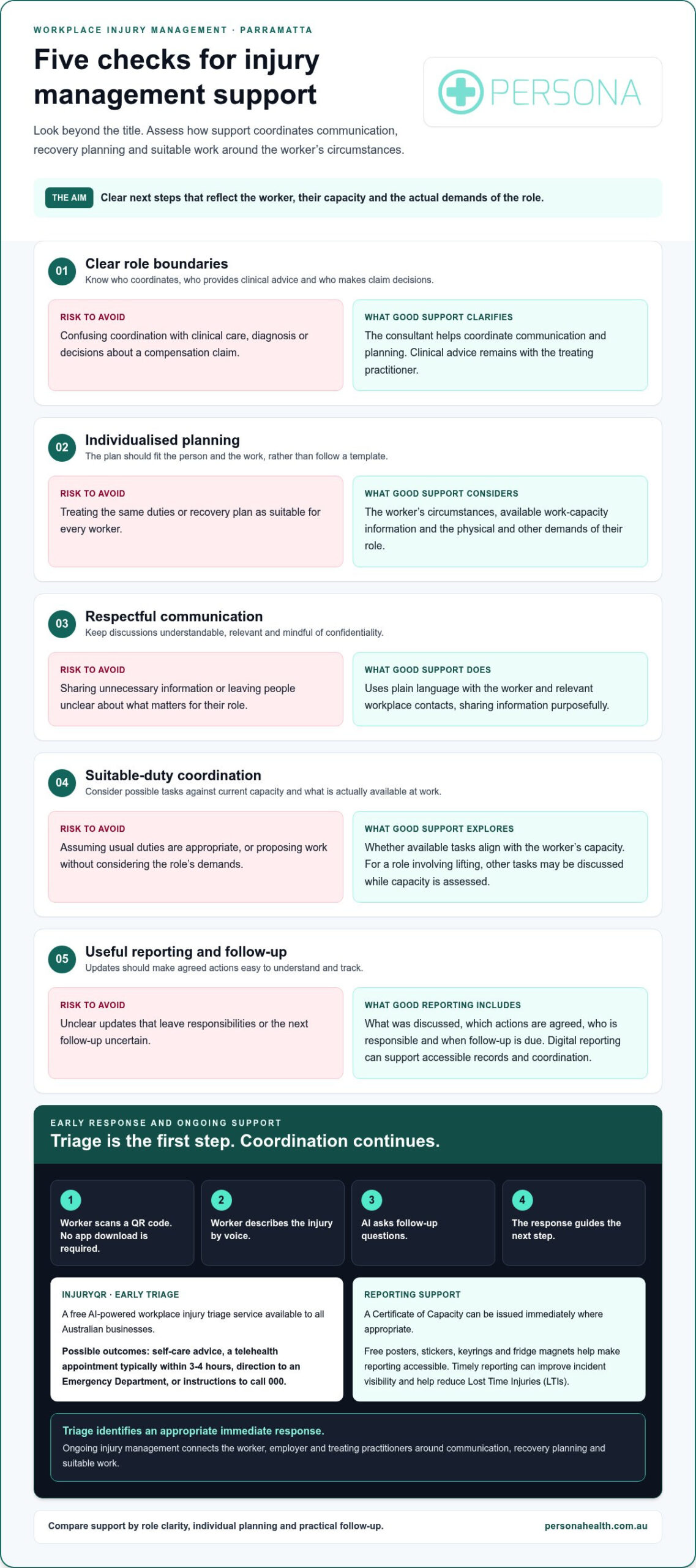
When choosing an injury management consultant Parramatta employers can rely on, assess how the service works in practice, not just the title or a broad promise of support. A useful approach keeps the worker’s circumstances, recovery needs and actual job demands in view. These five criteria can help you compare support clearly.
- Clear role boundaries. The consultant should explain what they coordinate, who provides clinical advice and who makes claim decisions. Don’t treat an organisation’s accreditation as proof of an individual consultant’s qualifications. Persona Health reports ISO accreditations at an organisational level; these are separate from an individual’s professional credentials.
- Individualised planning. A plan should reflect the worker’s circumstances and relevant work-capacity information, as well as the physical and other demands of the role. A suitable option for one worker may not be appropriate for another.
- Respectful communication. Look for plain-language discussions with the worker and relevant workplace contacts. Information-sharing should be purposeful and respect appropriate confidentiality. People need to understand what is relevant to their role without unnecessary disclosure.
- Suitable-duty coordination. The process should help consider duties that align with the worker’s capacity and the tasks available at the workplace. If a role involves lifting, for example, planning may consider whether other tasks are available while the treating practitioner assesses the worker’s capacity.
- Useful reporting. Updates should make clear what has been discussed, which actions are agreed, who is responsible and when follow-up is due. Modern digital reporting can support accessible records and coordination. The most useful format depends on the case and workplace.
What should a clear injury management process include?
Start by agreeing on points of contact, a practical way to share relevant information and documented next steps. Planning should take account of the worker’s recovery needs and available work-capacity information. The process depends on the circumstances of the case and applicable NSW requirements. Safe Work Australia’s National Return to Work Strategy provides broader context for return-to-work approaches across Australia.
How can employers assess communication and reporting?
Ask how updates help the people involved understand their actions and responsibilities. Clear records make follow-up easier to manage, particularly when information comes from several contacts. For initial injury reporting and triage, InjuryQR lets workers scan a QR code without downloading an app, describe an injury by voice and respond to AI follow-up questions. This free service is available to all Australian businesses. Outcomes may include self-care advice, telehealth, typically within 3-4 hours, direction to an Emergency Department or instructions to call 000. InjuryQR supports triage, not ongoing coordination.
Persona Health’s injury management consultant service supports practical coordination and reporting, helping employers organise communication and follow-up around the worker’s circumstances.
Injury management support in Parramatta: what happens after a workplace injury?
After an injury, a clear sequence helps the workplace respond to the worker’s immediate needs and coordinate what happens next. Adapt the steps to the incident and the person rather than treating them as a fixed formula.
- Report the injury. Record the incident through the workplace’s reporting process and make sure the relevant person knows what has happened.
- Address immediate needs. Arrange an appropriate response. If there is an emergency, call 000. Do not delay emergency care to complete routine reporting.
- Assess next steps. Clarify what support is needed and, where relevant, consider work-capacity information provided by the treating practitioner.
- Coordinate follow-up. Agree who will communicate with the worker and relevant workplace contacts, what suitable duties may be considered and when the plan should be reviewed.
InjuryQR is a free AI-powered workplace injury triage service available to all Australian businesses. Workers scan a QR code without downloading an app, describe the injury by voice and answer follow-up questions from the AI. Depending on the responses, the service can provide self-care advice, arrange a telehealth appointment, direct the worker to an Emergency Department or instruct them to call 000. Telehealth appointments are typically within 3-4 hours.
What does InjuryQR add to workplace injury reporting?
Workplaces can use free InjuryQR posters, stickers, keyrings and fridge magnets to make the reporting pathway visible. A worker can report an injury and receive triage guidance through an accessible process, helping the employer understand what has happened and consider timely next steps. Prompt reporting can improve incident visibility and help reduce Lost Time Injuries (LTIs), although outcomes depend on the circumstances and follow-up.
Triage is an early response, not a substitute for emergency care, clinical treatment or ongoing injury management. An injury management consultant Parramatta employers engage can help coordinate the communication and workplace planning that follow, including suitable-duty discussions informed by work capacity and treating advice.
How do return-to-work planning and NSW requirements fit together?
Suitable duties need to be considered case by case. The worker’s current capacity, treating advice, job demands and duties available at the workplace all matter. For current NSW guidance, consult SafeWork NSW on work health and safety and SIRA on workers’ compensation and return-to-work information. Requirements depend on the circumstances and applicable rules. This overview is general information, not legal or medical advice.
How to compare injury management options for your workplace
The right support depends on your team’s work, location and the coordination a case requires. A single-site workplace with straightforward duties may need a different arrangement from an employer managing physically demanding roles across several locations. Use the comparison below to focus on practical fit, not just a service label.
| What to compare | What useful support looks like |
|---|---|
| Coordination | Responsibilities and points of contact are clear, with follow-up connecting the worker, workplace and relevant practitioners. |
| Worker communication | Updates are respectful, accessible and in plain language, with appropriate confidentiality considered. |
| Reporting | Information is recorded so relevant people can understand actions, responsibilities and next steps. |
| Local access | Support takes account of where the worker and workplace are based, alongside available clinic access. |
| Workplace-wide support | The approach accounts for job demands, available suitable duties and coordination across sites where needed. |
For a Parramatta employer, local access is one part of the picture. Persona Health has a Parramatta service presence, alongside Sydney clinics in Rosebery, Gregory Hills and Dee Why. Its Melbourne locations include Cairnlea and Craigieburn. These local options can be considered alongside the worker’s circumstances and the workplace’s coordination needs.
When might a workplace need mobile or networked support?
When employees work across multiple sites or regions, Australia-wide mobile workplace services can help employers consider support in the context of a dispersed team. Persona Health also has a nationwide network of 100 affiliate clinics, supporting access across locations. These options provide a broader geographic framework, while the right arrangement for an individual case depends on its requirements.
InjuryQR can complement local or mobile arrangements as a free AI-powered triage and reporting service for all Australian businesses. It is not a substitute for ongoing injury management. Possible outcomes include self-care advice, telehealth appointments, typically within 3-4 hours, direction to an Emergency Department or instructions to call 000. Free posters, stickers, keyrings and fridge magnets help make the reporting option visible. Prompt reporting can improve incident visibility and help reduce Lost Time Injuries without guaranteeing a particular outcome.
When comparing options, consider how each supports clear communication, practical reporting and coordinated follow-up from initial triage through workplace planning.
Discuss injury management support for your workplace
Persona Health injury management in Parramatta: practical next steps
Choosing support is only the start. Look for clear role boundaries, planning tailored to the worker and workplace, respectful communication, useful reporting and practical local access. These elements help keep relevant people aligned, while clinical decisions remain with treating practitioners and outcomes depend on the individual case.
Persona Health provides injury management support in Parramatta, with an employer-focused approach, responsive customer service, fast turnaround times and modern digital reporting. Support is tailored to the worker’s circumstances and workplace context. Clear reporting and coordination can make actions easier to follow, but cannot guarantee a claim decision, recovery result or return-to-work date.
What information helps start an injury management discussion?
A concise summary helps make an initial conversation more focused. Prepare what you can about:
- the incident and when it occurred
- how the injury is affecting the worker’s usual tasks
- relevant workplace contacts and any duties being considered
- work-capacity information or treating advice that can appropriately be shared.
Share information through appropriate channels and limit personal details to what is relevant. If someone needs urgent help, seek appropriate emergency assistance. Call 000 when instructed, and do not use routine reporting or coordination as a substitute for an emergency response.
How can a coordinated approach support the next step?
Once immediate needs are addressed, clear communication can identify who will follow up, what information is still needed and how the workplace can consider suitable duties in light of the worker’s capacity. Persona Health’s digital reporting supports accessible records and coordination, while the plan remains specific to the person and the work involved.
For early triage, InjuryQR is a free AI-powered service for all Australian businesses. Possible outcomes include self-care advice, telehealth appointments, typically within 3-4 hours, direction to an Emergency Department or instructions to call 000. InjuryQR supports initial triage and reporting; it does not replace coordinated injury management.
For local information and a practical next step, explore Persona Health’s Parramatta clinic information and discuss injury management support.
Build a clearer path from injury to suitable work
Effective injury management depends on clear roles, individualised planning and communication that keeps the worker’s recovery and workplace needs in view. When assessing an injury management consultant Parramatta employers can work with, consider how coordination, reporting and suitable-duty discussions will fit the specific case.
Persona Health supports workplaces through injury management, modern digital reporting, Australia-wide mobile workplace services and a nationwide network of 100 affiliate clinics. Its local presence includes Parramatta and Sydney locations in Rosebery, Gregory Hills and Dee Why, as well as Melbourne locations in Cairnlea and Craigieburn. InjuryQR supports early triage and reporting, while ongoing injury management coordinates follow-up and workplace participation. Neither approach guarantees a particular claim or recovery outcome, but clear communication can help everyone understand the next step.
Every worker and workplace is different. A practical conversation can help identify the support that fits your circumstances.
With clear coordination, you can approach the process with greater clarity and support a considered return-to-work plan.
Frequently Asked Questions
What does an injury management consultant do?
An injury management consultant coordinates communication and recovery planning between an injured worker, their employer and relevant treating practitioners. They can help clarify next steps, share relevant work-capacity information and consider suitable duties in the workplace. The consultant does not replace emergency care or clinical treatment, diagnose an injury or decide a workers’ compensation claim. Their role is to support coordination around the worker’s circumstances and work.
When should an employer contact an injury management consultant?
Consider contacting a consultant when an injury has affected a worker’s usual duties and communication or follow-up is becoming difficult to coordinate. For example, an employer may need help discussing suitable duties while respecting treating advice and the worker’s privacy. Early coordination can clarify who is responsible for each next step. It does not replace urgent medical care or determine a claim outcome.
How does InjuryQR work for workplace injuries?
InjuryQR lets a worker scan a workplace QR code without downloading an app, describe the injury by voice and answer follow-up questions from AI. Depending on the responses, it can provide self-care advice, arrange a telehealth appointment, direct the worker to an Emergency Department or instruct them to call 000. Telehealth appointments are typically within 3-4 hours. InjuryQR supports early triage and reporting, not ongoing injury management coordination.
Is InjuryQR free for Australian businesses?
Yes. InjuryQR is a free AI-powered workplace injury triage service available to all Australian businesses. Workplaces can also access free posters, stickers, keyrings and fridge magnets to make the reporting option visible. Prompt reporting can help employers understand what has happened and consider next steps. Clearer reporting may improve incident visibility and help reduce Lost Time Injuries, but cannot guarantee a particular reporting or recovery outcome.
Can an injury management consultant help with return to work?
Yes. A consultant can help coordinate return-to-work communication and discussions about suitable duties, taking account of the worker’s circumstances, work-capacity information and actual job demands. Treating practitioners provide clinical advice within their professional role, while the employer considers duties available in the workplace. Coordination can clarify responsibilities and follow-up, but a consultant cannot guarantee a return-to-work date or replace clinical advice.
What should I look for when choosing injury management support in Parramatta?
Look for clear role boundaries, individualised planning, respectful communication, suitable-duty coordination and useful reporting. A considered approach takes account of the worker’s recovery needs and the practical demands of their role. Persona Health provides workplace injury management support in Parramatta, with responsive customer service and modern digital reporting. The right support should clarify coordination and next steps without promising a particular claim or recovery outcome.
Can a Certificate of Capacity be issued through InjuryQR?
A Certificate of Capacity can be issued immediately through InjuryQR where appropriate. It is not automatic; whether one is appropriate depends on the circumstances. InjuryQR uses the worker’s voice description and AI follow-up questions to guide triage, with possible outcomes including self-care advice, telehealth or direction to urgent care. A Certificate of Capacity is distinct from ongoing workplace coordination about work capacity and suitable duties.

Article by
Ian Nicholson
Ian is the Business Support Manager at Persona Health, where he plays a key role across IT, sales, marketing and business operations. With a broad skill set and a practical, solutions-focused approach, Ian helps drive the systems, communication and commercial strategy that support Persona Health’s continued growth across Australia.