

How can health screening support worker wellbeing without bringing dispatch to a standstill? For warehouse managers balancing shift coverage, vehicle movements and delivery schedules, the answer starts with planning. On-site health screening for Marsden Park warehouse staff can be organised around the work, with assessments matched to job roles and relevant workplace exposures rather than applied as a one-size-fits-all package.
You also need clarity about what to assess and how employee health information will be handled. Screening should complement risk controls, not replace them. Workers should understand why information is collected and how it will be used. A well-organised programme makes these responsibilities clearer while keeping the process practical for the workforce.
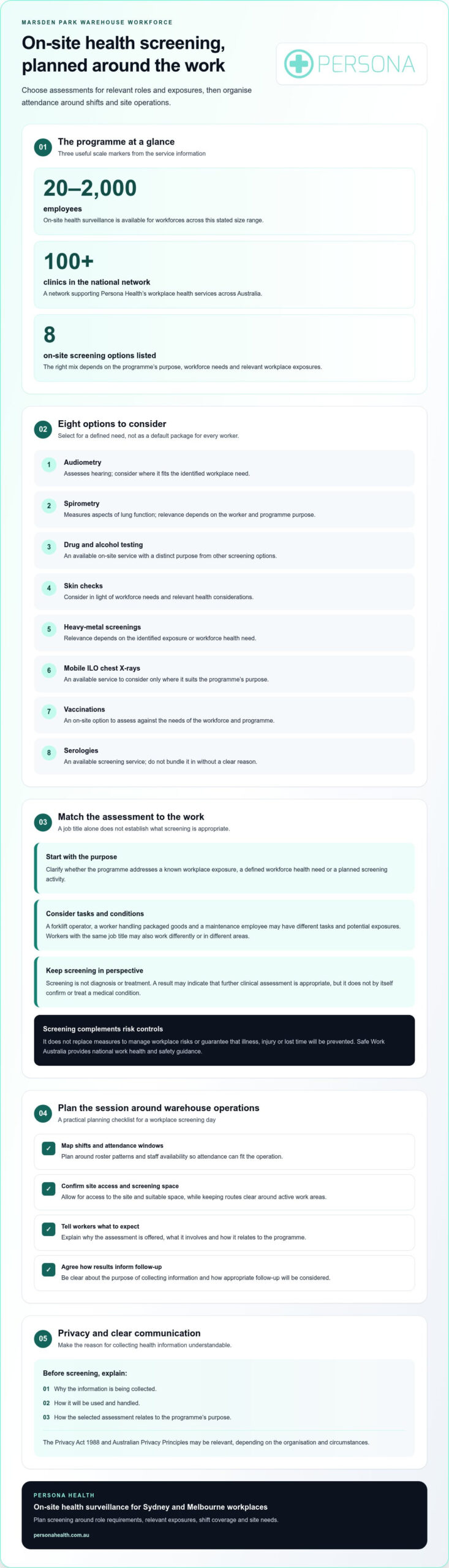
This article explains how to select screening options for different warehouse roles, schedule an on-site programme around shifts and operational needs, and plan worker communication and privacy. Persona Health provides on-site health surveillance in Sydney and Melbourne, with services for workforces of 20-2000 employees and a national network of over 100 clinics.
Key Takeaways
- Plan on-site health screening for Marsden Park warehouse staff around role requirements and relevant workplace exposures, rather than using the same assessments for everyone.
- Options available through Persona Health’s on-site health surveillance include audiometry, spirometry, drug and alcohol testing, skin checks, heavy-metal screenings, mobile ILO chest X-rays, vaccinations and serologies.
- Before scheduling, map shift patterns, site access, screening space and worker communications so the programme fits day-to-day operations.
- Explain why health information is collected and how it will be handled. The Privacy Act 1988 and Australian Privacy Principles may be relevant, depending on the organisation and circumstances.
- Persona Health provides on-site health surveillance for workforces of 20-2000 employees, supported by a national network of over 100 clinics.
What on-site health screening can do for Marsden Park warehouse staff
Arranging health assessments away from the workplace can mean travel, time away from duties and extra appointment coordination. On-site screening brings selected assessments to the workplace, making it easier to organise attendance around the operation. The programme should reflect its purpose and the work people actually do, rather than assume every warehouse role has the same needs.
In brief: On-site health screening involves selected health assessments at a workplace to address an agreed workforce or exposure-related need. Screening is not a diagnosis or treatment service. A result may indicate that further clinical assessment is appropriate, but it does not by itself confirm or treat a medical condition.
This distinction matters when planning on-site health screening for Marsden Park warehouse staff. Occupational health surveillance is generally linked to a particular work-related exposure or health risk, while a general wellbeing check may focus on broader aspects of a person’s health. The assessment should fit the programme’s purpose, with workers given a clear explanation of what it involves.
Why bring workplace screening to a Marsden Park warehouse?
A scheduled workplace session can reduce the need for workers to travel to separate appointments and simplify coordination for managers. The practical benefit depends on the site and its operating pattern. A warehouse with staggered shifts, for example, can plan attendance windows around the roster while keeping routes clear around active work areas.
That does not mean every worker should attend the same assessment. A forklift operator, a worker handling packaged goods and a maintenance employee may have different tasks and potential exposures. Understanding those differences helps shape a relevant programme. Job titles alone do not describe all the work being done.
Screening is most useful when it has a clear purpose
Start by stating what the programme is intended to address. Is it linked to a known workplace exposure, a defined workforce health need or a planned screening activity? A clear objective helps identify which workers may be included and which assessments are relevant. It also makes the programme easier to explain and reduces the risk of collecting information without a clear purpose.
One standard assessment may not suit every role or exposure. A plan for workers with relevant noise exposure, for instance, may differ from one for a group with another identified exposure. Screening information can inform follow-up, but it does not replace measures to manage workplace risks or guarantee that illness, injury or lost time will be prevented.
Consider how the session will work at the site, including roster coverage, staff availability and the space needed for assessments. For Marsden Park employers, sharing workforce details and operational requirements with Persona Health’s occupational health team is a practical starting point for planning.
Which on-site health screening options may suit warehouse roles?
The right mix depends on the programme’s purpose, workforce needs and relevant exposures identified at the site. A warehouse name or job title alone is not enough to determine an appropriate assessment. Two workers with the same title may perform different tasks or work in different areas, so screening should reflect the work and the reason for assessing it.
Persona Health’s on-site health surveillance includes a range of services that can be considered in a planned programme. Select assessments that fit the identified need rather than treating every available option as necessary for every employee.
Match assessments to the work and its relevant exposures
Audiometry assesses hearing, while spirometry measures aspects of lung function. These assessments may be relevant where they fit the worker’s circumstances and the programme’s purpose. They should not be assumed to apply to every warehouse employee. Safe Work Australia provides national work health and safety guidance, while employers need to consider the tasks and conditions at their own site.
Other on-site options include heavy-metal screenings and skin checks. Their relevance depends on the workforce need and any identified exposure or health consideration. Do not infer a particular hazard from a location or industry label. Understanding the work and its exposures gives the programme a more useful basis.
Choose a practical mix of on-site services
Persona Health’s on-site health surveillance also includes drug and alcohol testing, mobile ILO chest X-rays, vaccinations and serologies. These services have different purposes, so they should not be bundled together by default. An employer may be considering one service for a defined workforce need while other assessments are not relevant to that group.
Before selecting services, clarify who the programme is for, what it is intended to address and how results will inform appropriate follow-up. Explain the chosen assessments in straightforward language so workers can understand why they are being offered and how they relate to the programme.
- Audiometry: consider where hearing assessment is relevant to the identified workplace need.
- Spirometry: consider where a lung-function assessment fits the programme’s purpose.
- Other services: assess the relevance of heavy-metal screenings, skin checks, drug and alcohol testing, mobile ILO chest X-rays, vaccinations or serologies against the actual workforce need.
This role-led approach avoids a generic package that does not reflect the work. For more information about planning workplace screening, read about Persona Health’s on-site health surveillance and discuss the workforce and site requirements with the team.
Privacy, communication and Australian workplace responsibilities
Health screening works best when workers understand its purpose and how their information will be handled. Health information is sensitive, so plan communications and information handling before inviting staff to participate. The Privacy Act 1988 and Australian Privacy Principles may be relevant, but their application depends on the organisation and circumstances. Do not assume the same rules or process apply to every employer.
Explain the purpose and process before screening day
Tell workers what the programme is intended to address, which assessments are planned and what participation involves. Use plain language, allow time for questions and nominate a clear contact person. Explain whether an assessment relates to a particular workplace exposure or another defined workforce need, without suggesting that screening diagnoses or treats a condition.
Be precise about information handling. Explain the arrangements documented between the employer and provider, including what information is collected and how results will be communicated. Do not promise confidentiality, access limits or retention arrangements unless those details are established and can be accurately described.
Handle results carefully and avoid overclaiming
Individual health information and broader workforce planning are not the same thing. Employers may need relevant information to consider workplace health planning, but that does not mean every individual result should be treated as general workforce data. Agree on reporting and communication arrangements before screening begins, and share only information appropriate to the stated purpose.
For on-site health screening for Marsden Park warehouse staff, screening can inform workplace health planning, but it does not replace risk assessment or measures to manage identified hazards. Check current guidance from SafeWork NSW and relevant NSW WHS legislation and Codes of Practice for the work and exposures involved. Safe Work Australia also provides national WHS policy and guidance. For advice on how privacy obligations apply to a specific organisation, seek appropriate legal or privacy advice.
For workplace injury triage, InjuryQR is a free, voice-activated, AI-assisted service available to Australian businesses. Workers scan a QR code without downloading an app, describe an injury by voice and answer AI follow-up questions. Depending on the situation, InjuryQR can provide self-care advice, arrange a telehealth appointment, typically within 3 to 4 hours, direct a worker to an Emergency Department or instruct them to call 000. A Certificate of Capacity may be issued immediately where appropriate. Free InjuryQR posters, stickers, keyrings and fridge magnets help make the service visible to workers. Early triage and clear reporting can support timely care and help reduce Lost Time Injuries.
Before screening day, give staff a written explanation and a contact for questions. Persona Health can help employers plan clear communication as part of an on-site programme. Discuss your workplace screening requirements with the team.
How to plan an on-site screening day around warehouse shifts
A screening day is easier to coordinate when the plan reflects the roster, site layout and programme purpose. Preparing these details helps workers know where to go and allows supervisors to plan coverage alongside normal warehouse activity. Persona Health provides on-site health surveillance for workforces of 20-2000 employees, with planning shaped around employer and workforce requirements.
Prepare the workforce and site
Start with a clear picture of who may participate and how the site operates. One appointment window may not suit every shift. Map the roster, likely participation and suitable session windows, then consider how workers can attend without disrupting essential tasks or causing congestion around busy areas.
- Define the workforce need. Identify the groups in scope and the reason for screening, then agree which assessments are relevant.
- Map shifts and access. Note shift start and finish times, handovers, site entry arrangements and periods when operational demand is highest.
- Choose a suitable space. Arrange a practical area for the planned assessments, taking account of privacy, access and the movement of people and equipment around the site.
- Brief supervisors and workers. Share the session arrangements, explain who should attend and provide a contact for questions. Give supervisors enough information to plan staff coverage.
- Confirm follow-up arrangements. Agree how results and any recommended next steps will be communicated before screening begins.
Estimate participation to support scheduling, but do not assign a fixed appointment duration unless it has been agreed for the specific assessment. If the warehouse has several shifts, separate attendance windows may help staff participate without everyone leaving their work area at once. The right arrangement depends on the site and the services being delivered.
Coordinate screening, reporting and next steps
Before the session, align the screening scope with the occupational health team. Confirm the groups to be assessed, site arrangements and reporting process. Make sure workers know what to expect and whom to approach with questions. This is especially useful when supervisors are coordinating attendance across several areas or shifts.
Reports are often returned the same day, but this is not guaranteed. Agree on reporting arrangements for the programme and how any follow-up will be managed. Treat screening findings as one input to workplace health planning, not as a replacement for appropriate risk management.
For injury reporting or workplace triage alongside screening, employers can also make InjuryQR available to staff as a separate support resource.
Arrange Persona Health on-site screening for your Marsden Park workforce
Planning screening across a warehouse workforce takes more than selecting assessments. The programme needs a clear purpose, a workable fit with shift arrangements and straightforward information for staff. Persona Health provides mobile workplace health surveillance for workforces of 20-2000 employees, helping employers plan around workforce and operational requirements.
What employers can expect from Persona Health
Persona Health’s on-site services include audiometry, spirometry, drug and alcohol testing, heavy-metal screenings, skin checks, mobile ILO chest X-rays, vaccinations and serologies. The appropriate combination depends on the programme’s purpose and relevant work or exposures, rather than applying the same package to every role.
Clear communication helps employers organise the day and workers understand the process. Persona Health takes an employer-focused approach and provides modern digital reporting. Reports are often returned the same day, although this is not guaranteed. Persona Health is accredited to ISO 9001, ISO 14001 and ISO 45001. Its guiding principle is Your Success Matters, with attention to the needs of each workplace and its people.
For Marsden Park businesses, Persona Health has a Gregory Hills clinic. Sydney clinic locations also include Parramatta, Rosebery and Dee Why, while Melbourne locations include Cairnlea and Craigieburn. On-site services can help employers coordinate screening around shifts and across worksites, while the national network of over 100 clinics supports access beyond the workplace.
Take the next step for your warehouse team
To start planning, outline how many employees may participate, which shift patterns affect attendance and what the screening is intended to address. Describe the work groups involved and any relevant exposures already identified. This gives the occupational health team a practical basis for discussing programme scope, site arrangements and worker communications.
For employers coordinating care across locations, Persona Health’s national network of over 100 clinics complements its on-site services. Consider both options when planning occupational health support for a local team or a workforce operating across multiple sites.
With a clear objective and a realistic picture of the workday, on-site health screening for Marsden Park warehouse staff can be organised around employee needs and operational demands. Discuss your workforce, shifts and screening priorities with Persona Health.
Turn your screening plan into a confident next step
Turn your screening objective into a short workplace brief. Note what the programme should address, which work groups are relevant and what staff need to know about the process. This gives planning a clear starting point and keeps decisions connected to the needs of your people and the realities of the site.
With on-site health screening for Marsden Park warehouse staff, a considered plan is more useful than a broad checklist. Focus on relevant assessments, clear responsibilities and a process your team can understand. Review the programme as work and workforce needs change.
Persona Health can help shape practical next steps for your workplace. Share your screening objective and the operational considerations that matter to your team.
A considered approach can help you move forward with clarity and care for your workforce.
Frequently Asked Questions
Can health screening be conducted on-site for warehouse staff in Marsden Park?
Yes. Persona Health provides on-site health surveillance, so screening can be arranged at a Marsden Park warehouse. Employers can discuss the workforce groups involved, the purpose of screening and practical site arrangements, including access and suitable space. For a warehouse operating across several shifts, attendance windows planned around the roster can help staff participate while supervisors coordinate coverage.
What health screening can warehouse employees receive at work?
Persona Health’s on-site options include audiometry, spirometry, drug and alcohol testing, heavy-metal screenings, skin checks, mobile ILO chest X-rays, vaccinations and serologies. The appropriate mix depends on the programme’s purpose and relevant workforce needs. Discuss which services suit the workers and circumstances involved rather than assuming every option is needed for every employee.
How many employees can Persona Health screen on-site?
Persona Health provides on-site health surveillance for workforces of 20-2000 employees. When discussing a programme, outline how many employees may participate and how the workforce is organised. This information helps shape practical arrangements for the site and participating staff.
How should employers protect employee health information during workplace screening?
Explain the screening purpose and process before the session, and describe information handling in line with documented arrangements. Health information is sensitive. The Privacy Act 1988 and Australian Privacy Principles may be relevant, depending on the organisation and circumstances. Employers can consult current guidance from the Office of the Australian Information Commissioner and seek advice if they need to determine how privacy obligations apply to their situation.
Does on-site screening mean every warehouse employee needs the same tests?
No. Screening should reflect the programme’s purpose and relevant work or exposures, not simply a shared workplace or job title. Different tasks within one warehouse may lead an employer to consider different screening needs. Identify the workforce groups and reason for screening, then discuss which assessments fit. A screening plan is not a substitute for managing workplace risks.
Does Persona Health provide on-site health surveillance for large workforces?
Yes. Persona Health’s on-site health surveillance supports workforces of 20-2000 employees. Employers can outline how many workers are involved, their shifts and whether the programme covers one site or several. This helps the team plan coordination and communication with supervisors and participating staff.
How quickly are on-site screening reports returned?
Reports are often returned the same day, but this is not a guaranteed timeframe. Reporting arrangements depend on the screening programme and should be discussed during planning. Agree how results will be communicated and who should receive relevant information before the screening session, so expectations and follow-up arrangements are clear.
Where can Marsden Park employers access Persona Health services?
Persona Health provides on-site workplace services for Marsden Park employers, as well as clinic options in Sydney and Melbourne. Sydney locations include Gregory Hills, Parramatta, Rosebery and Dee Why. Melbourne clinic locations include Cairnlea and Craigieburn, and the national network includes over 100 clinics. Contact Persona Health to discuss on-site or clinic-based arrangements for your workforce.

Article by
Ian Nicholson
Ian is the Business Support Manager at Persona Health, where he plays a key role across IT, sales, marketing and business operations. With a broad skill set and a practical, solutions-focused approach, Ian helps drive the systems, communication and commercial strategy that support Persona Health’s continued growth across Australia.