

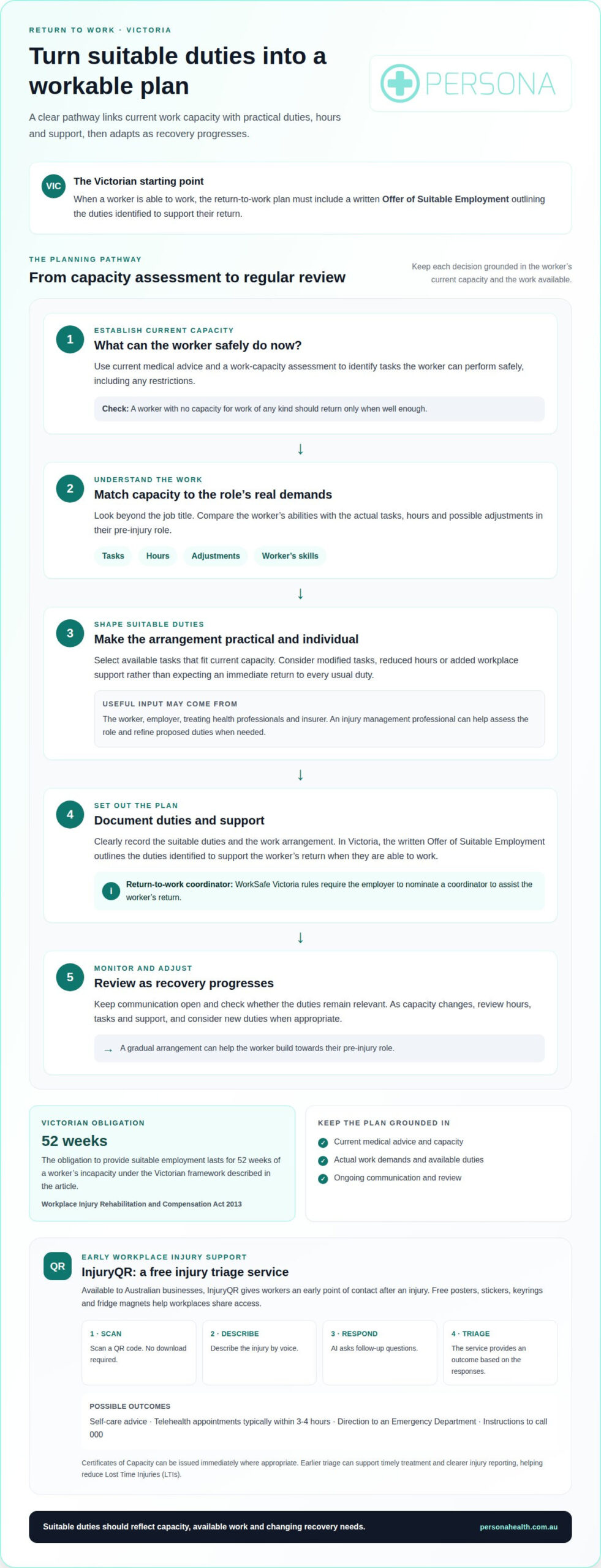
Identifying suitable duties is only the start. A suitable duties plan for an injured worker in Melbourne turns those tasks into a structured return-to-work arrangement, matched to the worker’s current capacity and medical restrictions. In Victoria, when a worker is able to work, the return-to-work plan must include a written Offer of Suitable Employment outlining the duties identified to support their return.
It’s understandable to want a clear path forward when a worker’s usual role may not yet be manageable. Suitable duties can be tailored to the worker and workplace, including tasks, hours and support, then reviewed as their capacity changes.
This article explains what happens after suitable duties are identified, how employers can tailor them safely, and how a considered plan can support a gradual return to the pre-injury role. You’ll also learn how planning, communication and monitoring help keep the arrangement relevant throughout recovery.
Key Takeaways
- A suitable duties plan connects a worker’s current capacity with practical tasks, hours and workplace support.
- In Victoria, suitable employment should reflect the worker’s abilities and circumstances, not just the job title.
- Regular communication and monitoring help employers adjust duties as recovery progresses and plan a return to the pre-injury role.
- WorkSafe Victoria rules require employers to nominate a return-to-work coordinator to assist an injured worker’s return.
- When suitable duties are difficult to identify, an injury management professional can help assess the role and shape a workable plan.
Was there a duty to rehabilitate the employee?
In Victoria, return-to-work obligations depend on the injury, the worker’s certified capacity and the duties available. For a work-related injury, suitable duties should be offered when they are medically appropriate and available.
Employer rehabilitation responsibilities
Workers’ compensation law requires employers to take all reasonable steps to assist or provide rehabilitation for an injured worker. In Victoria, the obligation to provide suitable employment lasts for 52 weeks of a worker’s incapacity. The Workplace Injury Rehabilitation and Compensation Act 2013 sets out Victorian obligations to provide suitable or pre-injury employment.
NSW has a separate framework: section 49 of the Work Injury Management Act and Workers Compensation Act 1998 (NSW) sets out an employer’s obligation to provide suitable work or duties. Suitable work must account for the injury and the worker’s ongoing ability to perform tasks. If an employer cannot provide duties, that does not itself explain whether the Victorian obligation has been met.
Assessing work capacity
A work-capacity assessment considers which tasks a worker can perform safely, based on their injury and current medical advice. It compares those limits with the role’s actual demands, including tasks, hours and possible adjustments. For example, a worker who cannot yet manage all usual duties may still be able to perform a modified set of tasks.
A worker recovering from a work-related injury should return to work only when well enough. If they have no capacity for work of any kind, the Fair Work Commission has held that an employer has no ability and no duty to rehabilitate that employee. Employers also have no specific legal obligation to provide rehabilitation or suitable duties for an injury or illness that is not work-related.
Changing duties and resolving disagreements
An injury management professional can assess the role and the worker’s current capacity, then help the employer and worker revise proposed duties or resolve a disagreement. In NSW, an injured worker can first contact the insurer for help if the employer does not provide suitable duties. In Victoria, an injured worker can access an occupational rehabilitation program if needed.
Where the worker’s capacity allows, a different employer may offer a route back to work. That possibility does not replace the original Victorian employer’s obligations during the applicable employment obligation period. For Melbourne employers, local occupational health support can help assess work demands and capacity.
Effects on payments and wages
Suitable duties do not automatically mean a return to full pre-injury duties or wages. In Victoria, the worker’s capacity and the duties they can perform inform the return-to-work arrangement, while weekly compensation is managed through the workers’ compensation claim.
An injury management professional can help clarify proposed duties and support communication when there is disagreement. InjuryQR is a free, AI-powered workplace injury triage service for Australian businesses. Workers scan a QR code without downloading an app, describe their injury by voice and answer AI follow-up questions. Free posters, stickers, keyrings and fridge magnets help workplaces share access to the service.
InjuryQR outcomes include self-care advice, telehealth appointments typically within 3-4 hours, direction to an Emergency Department, or instructions to call 000. Certificates of Capacity can be issued immediately where appropriate. Earlier triage can support timely treatment and clearer injury reporting, helping reduce Lost Time Injuries (LTIs). InjuryQR provides an early point of contact after a workplace injury.
What are the benefits of a Suitable Duties Plan?
A suitable duties plan can make work part of recovery by matching tasks to a worker’s current capacity. Its value depends on keeping the arrangements practical as that capacity changes.
Supporting recovery through suitable duties
A suitable duties plan sets out work a recovering employee can perform within their current abilities. Reduced hours, modified tasks or added support can help the worker maintain a routine without requiring an immediate return to every usual duty.
For example, an employee who cannot yet manage a full workload may begin with selected tasks suited to their capacity. As recovery progresses, duties can be reviewed and adjusted, with new tasks considered when appropriate. This gradual approach can help the worker rebuild confidence, maintain workplace connections and work towards their pre-injury role.
Injury management and insurer support
An injury management plan coordinates the worker’s recovery and return-to-work arrangements with relevant health professionals and the insurer. A clear plan helps everyone involved understand the proposed duties and the support needed at work.
To prepare a suitable duties plan, an injury management professional needs information about the worker’s capacity and medical restrictions, their pre-injury role, and the tasks available at work. Possible hours, task modifications and the worker’s skills also help shape realistic duties. The worker, employer, treating health professionals and insurer may each contribute relevant information.
Free return-to-work support
WorkSafe Victoria’s Advisory Service provides workers and employers with information about return-to-work rights and obligations. Melbourne workers can call 1800 136 089 or (03) 9641 1555 for guidance about the Victorian process.
This support can clarify responsibilities, but the workplace plan still needs to reflect the worker’s capacity and the duties available. If circumstances change, those involved can discuss current restrictions and whether tasks or hours need adjusting. Early, clear communication helps keep the plan grounded in what the worker can safely do.
Monitoring throughout a claim helps identify when a plan no longer fits. A change in certified capacity, for instance, may call for different hours, added tasks or a review of current duties. The employer and worker can focus discussions on the arrangement, practical barriers and progress towards the pre-injury role.
Insurer involvement can support coordination between the worker, employer and treating health providers. An injury management professional can help interpret work-related information and keep proposed duties aligned with the worker’s capacity. InjuryQR can also support workplace injury reporting and triage, providing information that may inform subsequent injury management.
A well-maintained plan gives the worker and employer a shared reference point instead of relying on assumptions about recovery. Reviewing duties as circumstances change can help sustain workplace participation while keeping the return-to-work goal in view.
Planning a return to the pre-injury role
A return-to-work plan should connect the worker’s current capacity with the demands of their substantive role. In Victoria, employers must plan for return to work, including assessing and proposing suitable or pre-injury employment. When the worker can perform their pre-injury job, the employer must help them return within 12 months of injury. Planning early gives everyone a clearer view of possible duties and workplace changes.
Start with information about the worker’s capacity, medical restrictions and pre-injury tasks. A job task analysis can map physical, cognitive and psychological demands, as well as equipment, hazards and the work environment. For example, a warehouse role may involve lifting, standing and operating equipment. Understanding these demands helps identify which tasks the worker can do now and which may need to wait.
Next, the employer assesses suitable employment options and consults with the worker. In Victoria, suitable employment should reflect the worker’s current ability, work capacity, medical condition, skills, experience, residence and pre-injury employment. A proposed arrangement might adjust duties or hours while retaining tasks connected to the worker’s usual role. The treating health practitioner can provide capacity information to inform the proposal.
Where a worker has current work capacity, the employer must provide suitable employment for the duration of the employment obligation period. If the worker no longer has an incapacity for work, the employer must provide pre-injury employment to the extent reasonable. The employer must also hold the worker’s position open for 12 months. These requirements make it important to consider both immediate capacity and the path back to usual duties.
A written Offer of Suitable Employment should outline the duties identified to support the worker’s return. Employers can also use WorkSafe Victoria’s return-to-work arrangements template to communicate current arrangements to the worker, treating practitioner and others involved. The template is not mandatory, but clear written details help avoid uncertainty about tasks, hours and support.
Injury management support can help turn capacity information into realistic, progressive goals. The employer and worker can discuss barriers, workplace modifications and how progress will be monitored. If capacity changes, review the duties against the role’s demands. InjuryQR can support injury triage and reporting, while the return-to-work plan sets out work arrangements and progress.
Keep communication regular and focused on what the worker can do, what remains difficult and which duties may be added next. A review might find, for example, that the worker can resume a usual task with modified hours, or needs a different task temporarily. This ongoing guidance keeps the plan connected to recovery and the pre-injury role.
Tailoring duties to the worker and workplace
An injury management professional matches proposed duties to the worker’s current capacity and the actual demands of the workplace. A suitable duties plan for an injured worker in Melbourne can include modified tasks, adjusted hours or days, and support to help the person participate safely while recovering.
The assessment considers the worker’s medical condition, work capacity, skills, experience, residence and pre-injury employment. It also examines the role itself, not just its title. For example, a job task analysis can describe the work environment, physical and cognitive demands, equipment, hazards and task-level movements. This detail helps identify tasks that fit the worker’s abilities and restrictions.
In practice, a professional compares each core task with the worker’s current capacity. If lifting is restricted, the plan might remove lifting tasks while retaining other suitable work. If standing is difficult, duties may be reorganised to allow work in a different position. Restrictions in the plan should reflect medical advice and support safe work practices.
The plan can also tailor the structure of the workday. Depending on the worker’s capacity, it may set suitable hours, work-pacing guidance, micro-breaks or stretching routines. A worker who cannot manage their usual shift might begin with shorter hours or fewer workdays. Review these arrangements as capacity changes instead of treating them as fixed throughout recovery.
Workplace conditions matter too. An injury management professional considers available equipment, task allocation and whether modified equipment could make a task suitable. Duties should be useful and appropriate to the worker’s skills and experience. Training opportunities may also be considered if they support participation and progress towards the pre-injury role.
Suitable duties an injury management professional can help Melbourne employers offer include modified tasks, adjusted hours or workdays, paced duties and tasks supported by useful equipment. For an injured worker in Melbourne, the plan should reflect their restrictions, abilities and the work available, rather than assume one arrangement suits everyone. For example, an employee who cannot perform a physically demanding task may be able to complete other work using existing skills.
Clear task descriptions make the plan easier to follow. Rather than saying “light duties”, specify which tasks are included, which restrictions apply, and what hours or breaks are arranged. This helps the worker and supervisor follow the same expectations. As capacity improves, review these details against the job’s demands and adjust the plan accordingly.
Who is responsible for preparing and approving a return-to-work plan under WorkSafe Victoria rules?
In Victoria, the employer is responsible for planning an injured worker’s return to work and assessing suitable employment options. The employer must nominate a return-to-work coordinator to assist the worker with preparation. The coordinator supports the process, while the employer remains responsible for proposing work arrangements that fit the worker’s capacity and workplace.
The coordinator can help gather information, communicate with the worker and organise planning discussions. Information from the treating health practitioner helps establish the worker’s current capacity and restrictions. The employer then considers those restrictions alongside the duties available. If a worker can perform some tasks but not their usual role, for example, the employer assesses suitable alternatives.
Where the worker is able to work, the return-to-work plan must include a written Offer of Suitable Employment. It outlines the suitable duties identified to support the worker’s return. The employer makes the offer, rather than the coordinator or treating practitioner deciding the workplace duties. Clear written details help everyone understand the proposed tasks and arrangements.
Consultation helps make the proposal practical. The employer should discuss the worker’s capacity, possible duties and workplace support with those involved in return-to-work planning. The treating practitioner provides health information, while the worker can explain how proposed tasks relate to their experience and recovery. The employer assesses whether the tasks can be provided safely and reasonably.
WorkSafe Victoria’s return-to-work arrangements template can help communicate current arrangements to the worker, treating practitioner and others involved. The template is not mandatory, but written details can help ensure everyone has clear, accurate and current information. Revise the plan if the worker’s capacity changes or workplace arrangements prove impractical.
The employer’s suitable employment obligation applies for 52 weeks of the worker’s incapacity. The employer must hold the worker’s position open for 12 months. Within 12 months of injury, the employer must help a worker return to different or modified duties if they are fit for work but cannot perform previous duties. These timeframes make early coordination important.
Responsibilities in the process are shared, but distinct: the employer organises the plan and work offer, the coordinator assists, and treating health practitioners provide information about capacity. An injury management professional can help translate medical restrictions and job demands into a workable proposal. InjuryQR can support workplace injury triage and reporting, while the return-to-work plan sets out duties and support.
Persona Health
Persona Health supports employers with workplace injury management and return-to-work planning, using a practical, employer-focused approach. Its Sydney clinics include Rosebery and Dee Why, with Gregory Hills also available to support employers across the region. The network also includes Parramatta and Melbourne, alongside 100 affiliate clinics nationwide and Australia-wide mobile workplace services.
Responsive customer service, fast turnaround times and modern digital reporting help employers coordinate occupational health needs. If you need support with workplace injury management or return-to-work planning, contact Persona Health.
Make the next return-to-work decision practical
A suitable duties plan for an injured worker in Melbourne should be a working arrangement, not a document left unchanged as recovery progresses. Start by connecting the worker’s current abilities with the real demands of their role, then keep communication open as circumstances shift. This gives the worker and employer a shared basis for discussing what is manageable now and what may become possible later.
For employers, careful planning also means making space for the worker’s perspective. A task that appears suitable on paper may feel different in the workplace, while a small adjustment may make participation more practical. Listening, reviewing and responding to these details can keep the return-to-work process focused on the person, not just the position.
If you need professional support to work through suitable duties or return-to-work planning, take the next step when it feels useful.
A clear conversation can help bring the next stage of planning into focus.
Frequently Asked Questions
What happens when suitable duties are identified?
The employer records the proposed duties and communicates the work arrangements to the worker. In Victoria, if the worker is able to work, the return-to-work plan must include a written Offer of Suitable Employment. For example, an offer can clarify which tasks are proposed and how they differ from usual duties. The employer, worker and relevant treating practitioner can then discuss whether the arrangement reflects the worker’s current capacity.
I’m not getting better, what do I do?
Tell your employer and treating health practitioner that your recovery or capacity has changed. Explain which tasks are difficult, what has changed at work, and whether current restrictions still fit. Your treating practitioner can assess your capacity and update medical information, which can inform a review of the proposed duties. If you’re in Victoria and need information about return-to-work rights, contact the WorkSafe Advisory Service on 1800 136 089.
Was there a duty to offer a different job?
In Victoria, an employer must help an injured worker return to different or modified duties within 12 months of an injury if they are fit for work but cannot perform their previous duties. The work should suit the worker’s current abilities and circumstances. A different role is not simply a theoretical option: the employer considers actual duties available and whether they fit the worker’s capacity and skills.
What are ‘job task analyses’ and why are they so important?
A job task analysis describes what a role actually involves, including its environment, physical and cognitive demands, equipment and hazards. It helps distinguish tasks that may be suitable from those that conflict with current restrictions. A role title may hide frequent lifting or prolonged standing, for example. Recording these demands gives the employer and injury management professionals a clearer basis for considering modified tasks.
What does the law say about the obligation to provide suitable duties?
In Victoria, the Workplace Injury Rehabilitation and Compensation Act 2013 sets out employer obligations to provide suitable or pre-injury employment. The suitable-employment obligation lasts for 52 weeks of a worker’s incapacity. Employers must provide suitable employment while the worker has current work capacity, and pre-injury employment if the worker no longer has an incapacity for work, to the extent reasonable.
What is a suitable duties plan for an injured worker in Victoria?
A suitable duties plan is a written arrangement describing work a worker can perform while recovering, based on current capacity and available workplace duties. It can clarify tasks, restrictions, hours and support. For example, a worker may temporarily perform selected duties rather than their full usual role. In Victoria, an Offer of Suitable Employment outlines identified duties when the worker is able to work.
How should suitable duties be matched to an injured worker’s medical capacity and certificate?
Match each proposed task and work arrangement to the worker’s current capacity and stated medical restrictions. Compare those restrictions with the role’s actual demands, including hours, physical tasks and equipment. For instance, if a certificate limits lifting, do not assign a task requiring lifting that conflicts with the restriction. Review the arrangement when updated capacity information or workplace changes affect the match.
What are the employer’s return-to-work obligations in Victoria, including timeframes?
Victorian employers must plan for an injured worker’s return, assess and propose suitable or pre-injury employment, and nominate a return-to-work coordinator to assist. The suitable-employment obligation lasts 52 weeks of incapacity, and the employer must hold the worker’s position open for 12 months. Within 12 months of injury, the employer must help a worker who is fit for work but unable to perform previous duties return to modified or different duties.

Article by
Ian Nicholson
Ian is the Business Support Manager at Persona Health, where he plays a key role across IT, sales, marketing and business operations. With a broad skill set and a practical, solutions-focused approach, Ian helps drive the systems, communication and commercial strategy that support Persona Health’s continued growth across Australia.