
Discover the critical differences between urine, saliva, and blood testing to ensure your workplace remains compliant with Australian safety standards.
The Role of Biological Samples in Australian Occupational Health
In any high-risk industry, managing workplace safety is paramount. Drug and alcohol screening forms a cornerstone of this risk management strategy, providing a clear, objective measure of a worker’s fitness for duty. The three mediums most commonly discussed for this purpose are urine, saliva, and blood. However, for routine occupational health in Australia, the choice is almost always between urine and saliva. Understanding why is key to developing a robust and respectful workplace safety programme.
- Introduction to the primary mediums: Urine and saliva are the two primary samples used for workplace drug and alcohol screening in Australia, each serving a different purpose.
- Why biological testing is essential: It is a critical tool for risk management in sectors like transport, mining, and construction, helping to prevent incidents before they occur.
- Selecting the right sample type: The choice of test for pre-employment medicals or ongoing screening depends on the specific risks and requirements of the job role.
- Supporting a culture of safety: Professional testing underpins a workplace culture that prioritises health, safety, and accountability for everyone.
Defining Urine, Saliva, and Blood Testing
Each sample type provides a different kind of information, making them suitable for different scenarios.
According to Drug test, this is a well-documented area of ongoing research and practical application.
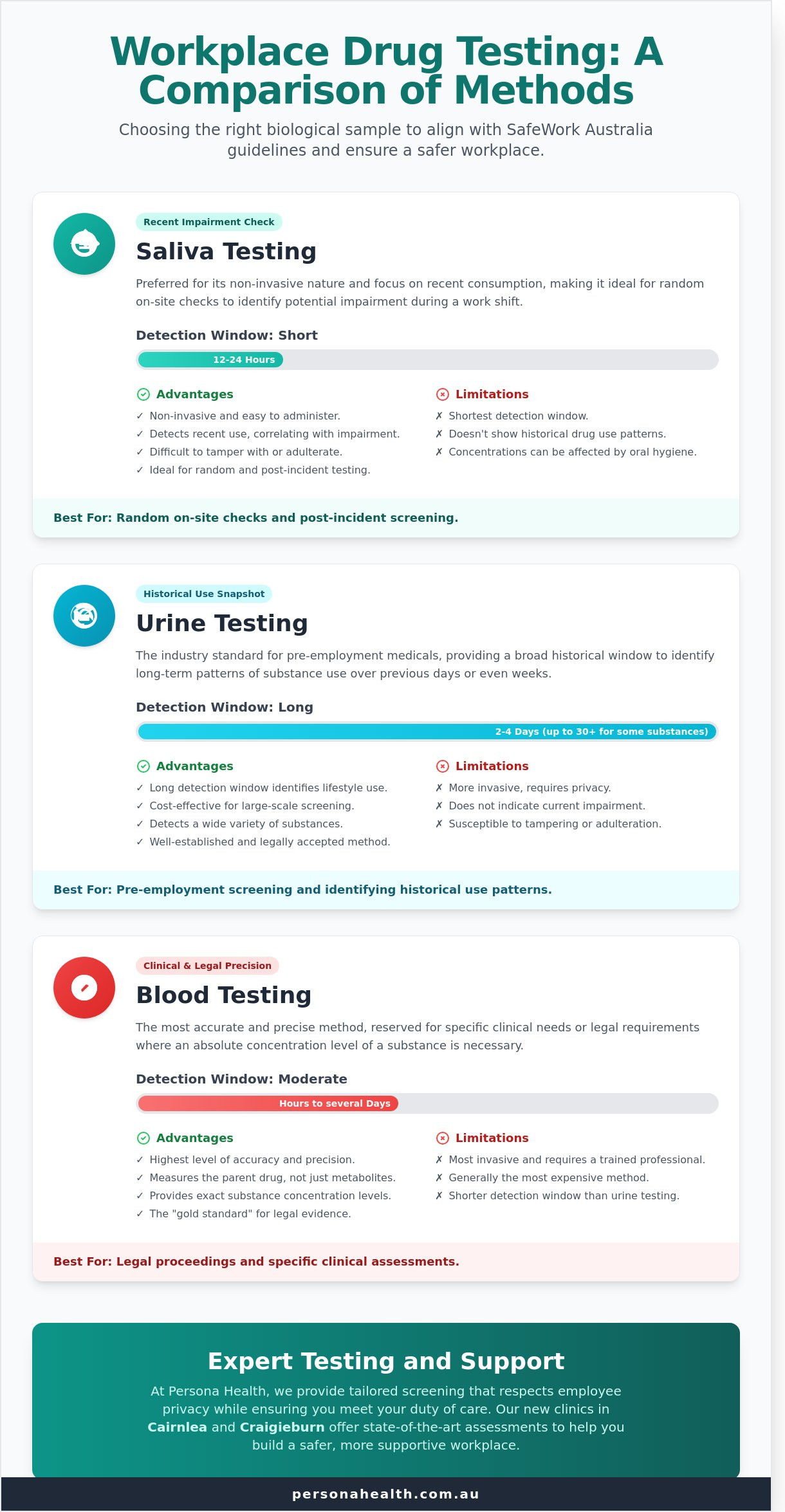
- Urine testing: The long-standing industry standard for detecting historical substance use. It reveals what a person has consumed over the past few days or, in some cases, weeks.
- Saliva testing: A non-invasive method focused on detecting very recent consumption. It is the best indicator of potential impairment at the time of the test.
- Blood testing: While it is the most accurate method for identifying substances currently in a person’s system, it is highly invasive, expensive, and not used for workplace screening in Australia. Its application is generally reserved for specific legal or clinical situations, not occupational health.
Why Method Selection Matters for Sydney and Melbourne Businesses
Making an informed choice between urine and saliva testing is a strategic decision that impacts safety, culture, and compliance.
- Matching protocols to job roles: A truck driver’s risk profile (recent impairment) is different from an office worker’s, and the testing method should reflect that.
- Employee privacy and morale: Saliva testing is often seen as less invasive than urine testing, which can positively impact employee perception and workplace morale.
- Reducing liability: Implementing a testing programme that aligns with Australian Standards and industry best practices is crucial for reducing the risk of workplace injuries and associated legal liability.
Comparing Detection Windows: Urine vs Saliva vs Blood
The most significant difference between testing methods is the “detection window”, which is the period during which a substance can be detected after consumption. This window varies dramatically between sample types and is influenced by factors like an individual’s metabolism, the substance used, and the frequency of use. Understanding these windows is essential for correctly interpreting results and making fair, safety-focused decisions.
Urine Detection Windows and Historical Use
Urine testing provides a broad overview of a person’s recent substance use history, making it a powerful tool for pre-employment screening.
Research published by drug detection windows shows that this is a well-documented area of ongoing research and practical application.
- Typical detection periods: Cannabis can be detected for up to 30 days in chronic users, while substances like opiates and amphetamines are typically detectable for 2 to 4 days.
- Identifying patterns of use: Because it has a longer detection window, urinalysis is the preferred method for identifying habitual use rather than a single instance.
- Comprehensive screening: This method is a standard component of many pre-employment medicals in Parramatta and Sydney, providing employers with a comprehensive health baseline.
Saliva Detection and Recent Impairment
Saliva, or oral fluid, testing is focused on the here and now. It is the best method for determining if an employee may be under the influence while on the job.
- Shorter detection window: Most substances are only detectable in saliva for 12 to 24 hours, closely mirroring the period of potential impairment.
- Gold standard for post-incident testing: Its focus on recent use makes it the ideal choice for roadside and post-incident testing, where current fitness for duty is the primary concern.
- The science: Substances are transferred from the bloodstream into the oral fluid, providing a reliable, non-invasive snapshot of what is currently active in the body.
Blood Testing: The Clinical and Legal Standard
While blood testing is often mentioned, it is important to understand its specific and limited role. It is not a method used for occupational health screening.
- Narrow and precise window: Blood tests detect the parent drug itself, offering a very precise but extremely short window of detection, often just a few hours.
- When is it used? It is typically reserved for legal purposes, such as in DUI cases, or for specific clinical assessments like fitness for duty (FFD) medicals where a precise blood-alcohol concentration is required.
- Why not for workplaces? The combination of its invasive nature, high cost, and short detection window makes it impractical and unsuitable for routine pre-employment or random workplace screening.
Practical Advantages and Limitations of Each Testing Method
Beyond detection windows, employers in Melbourne and Sydney must consider the practical aspects of each method. This includes cost, logistics, and the integrity of the collection process when planning their safety programmes.
Efficiency and Logistics in the Workplace
The ease and speed of testing can significantly impact your operations, especially when screening multiple employees.
Research published by Comparing drug detection windows shows that this is a well-documented area of ongoing research and practical application.
- Speed of results: Saliva tests can often provide an instant point-of-care result, while urine tests typically require laboratory analysis for a confirmed outcome.
- On-site convenience: Both methods can be integrated into an on-site health surveillance programme, minimising disruption and employee downtime.
- Professional collection: Proper collection requires a controlled environment and trained personnel to ensure privacy and sample integrity, regardless of the method chosen.
Accuracy and Reliability Concerns
All accredited testing methods are highly reliable, but understanding the process for confirming results is crucial for legal defensibility.
- Non-negative results: It is important to know that initial point-of-care tests are screeners. A “non-negative” result is not a “positive” result; it simply means the sample requires further analysis.
- The importance of confirmatory testing: All non-negative results must be sent to a NATA-accredited laboratory for definitive gas chromatography/mass spectrometry (GC/MS) testing to confirm the substance and its concentration.
- Ensuring integrity: Persona Health adheres to strict chain-of-custody protocols for all samples, guaranteeing that the results are accurate, confidential, and legally defensible.
Regulatory Compliance and Australian Standards for Workplace Safety
A workplace drug and alcohol testing policy is only effective if it is compliant with Australian law. Navigating the guidelines set by bodies like SafeWork Australia and adhering to specific Australian Standards is not optional; it is a fundamental requirement for protecting your business and your people.
Australian Standards: AS/NZS 4308 and AS 4760
These two standards provide the framework for legally defensible workplace testing in Australia.
- AS/NZS 4308:2008: This is the standard for urine drug testing. It specifies the procedures for specimen collection, detection, and quantification of substances in urine.
- AS/NZS 4760:2019: This is the equivalent standard for oral fluid (saliva). It outlines the requirements for collecting, screening, and confirming the presence of drugs in oral fluid.
- NATA-accredited laboratories: Using a NATA-accredited laboratory for confirmatory testing is essential. It ensures that your results meet the highest scientific and legal standards.
Industry Specific Requirements in Victoria and NSW
Certain safety-critical industries have specific, mandated testing requirements that go beyond general workplace policies.
- Rail safety workers: Comprehensive drug and alcohol testing is a mandatory part of Cat 3 rail medicals in Sydney and Melbourne, governed by strict national regulations.
- Commercial vehicle drivers: Drivers of heavy vehicles, buses, and other commercial transport are subject to stringent testing protocols to ensure public safety.
- Local influence: Workplace policies in Melbourne and Sydney must align not only with national standards but also with state-specific occupational health and safety (OHS) legislation.
Expert Testing at Our New Melbourne and Sydney Clinics
Choosing a specialised occupational health provider like Persona Health ensures your drug and alcohol screening programme is managed with professionalism, accuracy, and care. We support businesses across Melbourne and Sydney in creating safer workplaces through expert testing and clear, actionable advice.
New Clinic Locations in Cairnlea and Craigieburn
We are excited to expand our services in Melbourne with two new, state-of-the-art clinics.
- State-of-the-art facilities: Our new clinics in Cairnlea and Craigieburn bring expert occupational health services to Melbourne’s growing northern and western suburbs.
- Convenient local testing: We provide easy access for businesses and employees in these key industrial and transport corridors, reducing travel time and operational disruption.
- Supporting Melbourne’s growth: This expansion reflects our commitment to providing accessible, high-quality health surveillance and medicals to the industries that drive Victoria’s economy.
Comprehensive Occupational Health in Parramatta and Sydney
Our established presence in Parramatta continues to provide reliable, comprehensive testing services for the greater Sydney region.
- A trusted Sydney partner: For years, businesses have relied on our Parramatta clinic for professional and efficient occupational health services.
- Integrated health services: We seamlessly integrate drug testing with other critical assessments, such as crystalline silica medicals and pre-employment checks.
- Book with confidence: To arrange your next assessment, you can explore our full range of workplace drug and alcohol testing services online or contact our team today.
Frequently Asked Questions
How long does cannabis stay in your system for a urine, saliva, or blood test?
For a saliva test, cannabis is typically detectable for about 12 to 24 hours. For a urine test, it varies greatly with usage: a one-off user may be clear in a few days, while a chronic, heavy user could test positive for 30 days or more. In blood, it is usually only detectable for a few hours after use.
Can a saliva test detect drugs as accurately as a urine test?
Yes, when performed according to Australian Standard AS/NZS 4760. Saliva and urine tests are designed to find different things. Saliva testing is highly accurate for detecting recent use and potential impairment, while urine testing is highly accurate for detecting historical use patterns over days or weeks.
What happens if an employee provides a non-negative result during a workplace test?
An initial non-negative result is not a final positive. The sample is securely sent to a NATA-accredited laboratory for rigorous confirmatory testing. The employee is typically stood down from safety-sensitive duties pending the final, legally-defensible laboratory result. Actions are then taken according to the company’s specific drug and alcohol policy.
Are there specific Australian Standards for workplace drug and alcohol testing?
Absolutely. AS/NZS 4308:2008 covers the procedures for urine testing, and AS/NZS 4760:2019 covers the procedures for oral fluid (saliva) testing. Compliance with these standards is essential for a testing programme to be considered legally defensible.
Do you offer drug and alcohol testing at your new Cairnlea and Craigieburn clinics?
Yes, both our new Melbourne clinics in Cairnlea and Craigieburn are fully equipped to provide professional urine and saliva drug and alcohol testing for pre-employment, random, and post-incident screening.
Is blood testing commonly used for pre-employment medical checks in Australia?
No, blood testing is not used for pre-employment or routine workplace drug screening in Australia. Its invasive nature, high cost, and very short detection window make it unsuitable for occupational health purposes. Workplaces exclusively use urine and/or saliva testing.
How can employers ensure their drug testing policy is legally compliant with SafeWork Australia?
Employers should develop a formal policy in consultation with employees, ensure it is clearly communicated, and base all testing procedures on the relevant Australian Standards (AS/NZS 4308 and AS/NZS 4760). The policy should be applied fairly and consistently. Partnering with an experienced occupational health provider like Persona Health can help ensure full compliance.
What is the difference between a point-of-care test and a laboratory-confirmed test?
A point-of-care test is a rapid screening device used on-site that gives an immediate negative or non-negative result. A laboratory-confirmed test is a much more precise analysis (using methods like GC/MS) performed in a NATA-accredited lab to confirm the presence and concentration of a specific substance in a non-negative sample. Only a laboratory-confirmed result is considered a definitive positive.

Article by
Ian Nicholson
Ian is the Business Support Manager at Persona Health, where he plays a key role across IT, sales, marketing and business operations. With a broad skill set and a practical, solutions-focused approach, Ian helps drive the systems, communication and commercial strategy that support Persona Health’s continued growth across Australia.