
Your entire career at sea effectively rests on a single afternoon in a clinic chair. For many seafarers in Victoria, the thought of failing a colour vision test or dealing with the complex web of international regulations causes more stress than a Force 10 gale. We understand that an amsa medical assessment feels like a high-stakes hurdle rather than a routine check-up. It’s a common worry that a single oversight might keep you docked when you should be at sea.
You deserve a medical process that feels supportive rather than clinical and cold. This guide provides everything you need to secure your Certificate of Medical Fitness for 2026, including the latest safety standards set by the Australian Maritime Safety Authority. We’ll walk you through the specific requirements for eyesight and physical fitness so you can arrive at your appointment with total confidence. We’ll also explore how to book your assessment at our brand new Persona Health clinics in Craigieburn and Cairnlea, where we combine maritime expertise with the health monitoring standards expected by SafeWork Australia.
Key Takeaways
- Understand why a mandatory health assessment is essential for your safety and career longevity under Australian maritime regulations.
- Learn how to distinguish between Form 1850 for domestic duties and Form 303 for international voyages to ensure you obtain the correct certification for your unique role.
- Discover what to expect during your clinical interview and physical assessment at our modern Melbourne facilities, where we prioritise your individual health journey.
- Gain clarity on the specific eyesight and hearing requirements necessary to meet national safety standards and maintain your fitness for duty.
- Find out how to book your amsa medical at our supportive new Persona Health clinics in Cairnlea or Craigieburn for a streamlined and professional experience.
Understanding the AMSA Medical and its Importance for Seafarers
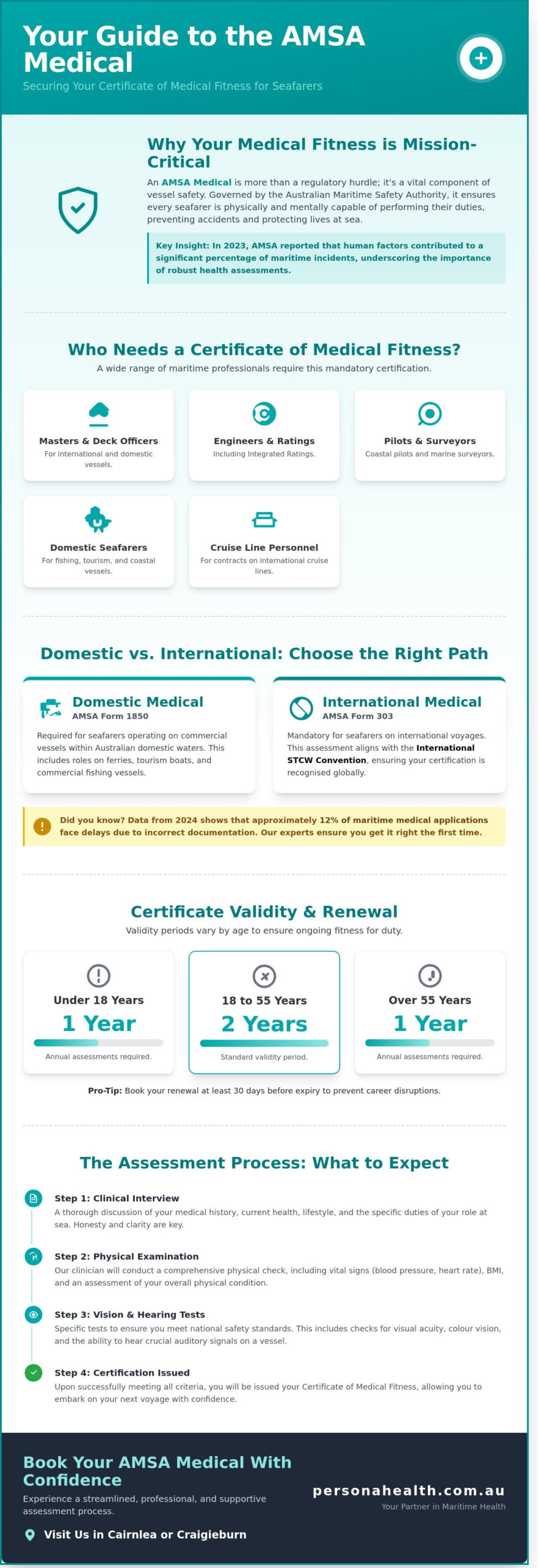
An amsa medical is a mandatory health assessment designed to ensure that every seafarer is physically and mentally capable of performing their duties at sea. These assessments are governed by the Australian Maritime Safety Authority, the national body responsible for maritime safety and the protection of the marine environment. By setting rigorous health standards, AMSA ensures that the Australian maritime industry remains one of the safest in the world. At Persona Health, we recognise that your health is your most valuable asset. Our clinicians provide a supportive environment at our new Melbourne locations in Cairnlea and Craigieburn to help you meet these essential requirements with confidence.
Medical fitness isn’t just a regulatory hurdle; it’s a vital component of vessel safety. In 2023, AMSA reported that human factors contributed to a significant percentage of maritime incidents in Australian waters. Ensuring you’re fit for duty helps prevent accidents caused by sudden health crises, such as cardiac events or fatigue-related errors. Whether you’re an international deck officer or a domestic near-coastal coxswain, this assessment confirms you can handle the unique physical demands and isolation of life at sea. Our fitness for duty assessments are tailored to the specific needs of your role, ensuring you’re ready for the challenges of the Southern Ocean or the Bass Strait.
A wide range of maritime professionals require this certification, including:
- Master mariners and deck officers on international trading vessels.
- Engineers and integrated ratings.
- Coastal pilots and marine surveyors.
- Domestic seafarers working on commercial fishing or tourism vessels.
- Personnel seeking cruise line medicals for international contracts.
The Regulatory Framework of Marine Order 76
Marine Order 76 serves as the legal foundation for medical fitness standards for seafarers holding international certificates of competency. It dictates that no seafarer can join a vessel without a valid Certificate of Medical Fitness. These regulations aren’t arbitrary; they align directly with the International Convention on Standards of Training, Certification and Watchkeeping for Seafarers (STCW). This alignment ensures that Australian certifications are recognised globally, allowing you to work seamlessly across international borders. Our team stays updated on these legislative changes to provide you with accurate, compliant assessments every time.
Validity and Renewal Periods for Medical Certificates
The standard validity for an amsa medical certificate is two years for seafarers aged between 18 and 55. However, this period changes based on your age and health status. Seafarers under the age of 18 or those over 55 typically require annual assessments to monitor changes in physical capability. We recommend booking your renewal at our Cairnlea or Craigieburn clinics at least 30 days before your current certificate expires. Proactive renewal prevents career disruptions and ensures you’re always ready for your next deployment. If you have underlying conditions, our clinicians work with you to develop a personalised plan to maintain your fitness and career longevity.
Differentiating Between Domestic and International Maritime Medicals
Understanding the nuances of an amsa medical assessment is the first step toward securing your career at sea. Your choice between a domestic or international certificate determines the depth of the clinical examination and the specific regulatory standards you must meet. At our new Melbourne clinics in Cairnlea and Craigieburn, we frequently assist seafarers who are unsure which path to take. Choosing the wrong assessment type doesn’t just waste time; it can delay your Certificate of Competency for weeks. Data from 2024 suggests that approximately 12% of maritime medical applications faced hurdles due to incorrect documentation. We’ve designed our Melbourne facilities to prevent these errors and provide you with a clear, stress-free path to compliance.
The regulatory landscape for Australian seafarers remains complex, yet our clinicians simplify the process through clear communication and clinical expertise. We focus on your individual health journey, ensuring you feel supported rather than just another number in a system. Whether you’re operating a ferry in Port Phillip Bay or a container ship in the Pacific, our team in Cairnlea and Craigieburn provides the professional oversight needed to keep you working safely.
AMSA Form 1850 for Near Coastal Seafarers
Form 1850 serves as the primary standard for domestic qualifications within Australian waters. This assessment is essential if you’re pursuing roles such as a Master 45m, Coxswain, or Marine Engine Driver. These duties are governed by the National Standard for Commercial Vessels (NSCV), which focuses on your ability to perform tasks safely in a near-coastal environment. While a standard General Practitioner can conduct these, a specialised environment ensures every detail aligns with the latest 2026 safety protocols. You can learn more about our fitness for duty medicals to see how we support local maritime workers with personalised care plans.
International Certificates and STCW Compliance
For those working on large commercial vessels or international cruise lines, the requirements shift toward global standards. These roles fall under the Standards of Training, Certification and Watchkeeping (STCW) convention, requiring a Form 303 certificate. An amsa medical for international duties involves a more rigorous analysis of long term health. Clinicians must look closely at chronic conditions such as cardiovascular health or diabetes, as access to advanced medical care is limited on the high seas. We provide comprehensive cruise line medicals at Persona Health to ensure you meet these stringent global benchmarks. Our holistic approach helps you manage these conditions proactively, empowering you to maintain your career longevity.
If you’re unsure which form your specific maritime role requires, our friendly team at Cairnlea or Craigieburn can help you book your maritime assessment with confidence.
The Assessment Process: What Happens During Your Appointment
Arriving at our Melbourne clinics in Cairnlea or Craigieburn for your amsa medical assessment is designed to be a streamlined, supportive experience. We’ve created a clinical environment that prioritises your comfort while maintaining the rigorous standards required by the Australian Maritime Safety Authority. Our staff understand the pressures of the 2026 maritime industry. They’re here to guide you through every step with professional clarity.
The process begins with a comprehensive clinical interview. You’ll discuss your full medical history, including any chronic conditions or previous surgeries. We’ll review your current medications to ensure they don’t interfere with safety-critical tasks at sea. If you’ve been involved in any maritime incidents or injuries in the past, we’ll discuss these openly. This conversation helps us build a fitness for duty profile that’s unique to your body and your career goals.
Mental health is a core pillar of the modern maritime assessment. Working in isolated environments for months at a time demands significant psychological resilience. Our clinicians check for signs of fatigue, stress, and emotional wellbeing. We want to ensure you have the tools and the health status to handle the unique challenges of life on the water. This holistic approach is what sets Persona Health apart from standard providers.
Clinical Tests and Screenings
Our team performs a series of precise screenings to catch underlying issues before they become emergencies at sea. We conduct a urinalysis to check for indicators of kidney dysfunction or diabetes; conditions that require careful management in remote locations. Cardiovascular health is another priority. We look for a stable heart rate and blood pressure, ideally below 140/90 mmHg, to ensure your heart can handle the physical rigours of the engine room or deck. Whether you’re applying for cargo roles or cruise line medicals, our empathetic clinicians handle these sensitive tests with the utmost respect for your privacy.
Musculoskeletal and Functional Testing
Life at sea is physically demanding and requires more than just basic fitness. We evaluate your musculoskeletal function through practical movements that mimic daily life on a vessel. You’ll demonstrate your ability to climb vertical ladders, move through narrow companionways, and lift heavy objects safely. These assessments often align with the Physical Abilities Test protocols used across other high-risk Australian industries. We specifically check your capacity to:
- Lift and carry equipment weighing up to 20kg without assistance.
- Maintain balance on moving or uneven surfaces.
- Assist in emergency evacuations or lifeboat launches.
- Reach and operate safety valves or controls in tight spaces.
By the time you leave our Cairnlea or Craigieburn facility, you’ll have a clear understanding of your health status. Our goal is to ensure every seafarer is physically prepared to meet the 2026 safety standards set by SafeWork Australia and maritime regulators.
Navigating Eyesight and Hearing Standards for Maritime Duty
Sensory health is the backbone of safety on the water. When you’re at sea, your ability to spot a distant vessel or hear a radio distress call can be the difference between a routine voyage and a critical incident. During your amsa medical, we focus on ensuring your senses are sharp enough to handle the unique pressures of the maritime environment. Our clinicians at our new Melbourne locations in Cairnlea and Craigieburn take a personalised approach to these assessments, recognising that every seafarer’s physical profile is unique.
Eyesight requirements are precise and non-negotiable. You must meet specific benchmarks for distance vision, typically 6/6 in the better eye, and near vision to ensure you can read charts and digital displays accurately. We also assess your field of vision. A restricted peripheral view can lead to missed hazards in crowded shipping lanes. If you rely on corrective lenses, AMSA requires you to carry a spare set at all times while on duty. It’s a simple rule that prevents a lost pair of glasses from becoming a major safety risk.
Hearing standards are enforced with equal rigour. You must be able to hear alarms and verbal instructions over the constant hum of heavy machinery. If you use a hearing aid, our team will evaluate its effectiveness to ensure you can communicate clearly in high-pressure situations. We don’t just tick boxes; we ensure you feel empowered and safe in your working environment.
Colour Vision and the Ishihara Plate Test
Identifying red and green navigation lights is a fundamental skill for any seafarer. We use the Ishihara Plate Test to screen for colour vision deficiencies. This involves identifying numbers hidden within patterns of coloured dots. If you don’t meet the initial requirements, don’t panic. We can facilitate further diagnostic testing with an optometrist or ophthalmologist. These specialists can provide a more detailed analysis to determine if your vision meets the necessary safety thresholds for your specific role at sea.
Audiometric Testing for Maritime Safety
Long hours in engine rooms can lead to permanent noise induced hearing loss. Our clinics in Cairnlea and Craigieburn use calibrated audiometric equipment to track your hearing health over time. We align our testing with SafeWork Australia’s 2024 guidelines on noise management, which mandate health surveillance for workers exposed to noise levels exceeding 85 decibels. This proactive approach helps us detect early signs of damage. It allows us to provide you with a personalised plan for hearing protection, ensuring your career longevity.
Ready to secure your maritime future? Book your assessment at our Cairnlea or Craigieburn clinics through our fitness for duty medicals page today.
Booking Your AMSA Medical in Melbourne at Cairnlea or Craigieburn
Persona Health is deepening its commitment to the Melbourne maritime community by expanding our reach into the suburbs where seafarers live and work. We recognise that your time onshore is valuable; you shouldn’t have to spend it stuck in city traffic. Our strategic expansion into Cairnlea and Craigieburn ensures that obtaining your amsa medical is a seamless part of your rotation schedule rather than a logistical burden. These locations provide professional maritime health services closer to home for workers in the Northern and Western corridors.
Preparing for your appointment is essential to ensure a smooth 45 minute assessment. To avoid delays, please arrive 15 minutes early and bring the following items:
- A current, valid photo identification such as your Australian passport or driver’s licence.
- Your most recent Certificate of Medical Fitness, even if it has expired.
- Any prescription glasses or contact lenses you use for distance or reading.
- A list of current medications and relevant reports from your treating specialist if you have ongoing health conditions.
- Hearing aids and spare batteries if you require them for daily duties.
New Clinic Locations: Cairnlea and Craigieburn
Our Craigieburn clinic, which opened its doors in early 2024, serves as a vital resource for seafarers located in the Northern corridor. This facility features state of the art soundproof booths for audiometry and high precision equipment for vision testing. For those in the Western suburbs, our Cairnlea site acts as a primary hub. It handles approximately 35% of our maritime health volume in Victoria. Both clinics are designed with a modern, welcoming atmosphere to reduce patient anxiety. We’ve moved away from the sterile, intimidating feel of traditional hospitals to create a space where you feel supported and respected.
The Persona Health Advantage for Maritime Workers
We believe that every seafarer deserves a health partner who understands the unique rigours of life at sea. Our clinicians blend medical authority with genuine empathy; we don’t just tick boxes. We follow the 2026 AMSA standards precisely while ensuring you feel empowered throughout the process. You can explore our full guide to fitness for work assessments to understand how we maintain these high standards across all industrial sectors.
Booking your amsa medical is straightforward through our digital platform or by calling our Melbourne reception. We offer flexible time slots that cater to the unpredictable nature of maritime rotations. Whether you’re preparing for a new contract or renewing your long term credentials, our team ensures your health documentation meets all SafeWork Australia and maritime regulatory requirements. Your career depends on your health; we are here to help you protect both.
Secure Your Career at Sea with Confidence
Navigating the requirements of Marine Order 9 (Health – medical fitness) 2023 is vital for every seafarer looking to maintain their career into 2026. Your amsa medical assessment is more than just a regulatory hurdle; it’s a comprehensive check that ensures you meet the rigorous eyesight and hearing standards set by the Australian Maritime Safety Authority. Our expert clinicians in Melbourne and Sydney bring specialised maritime regulatory knowledge to every appointment, ensuring your health is managed with the precision it deserves. We’ve designed our new, modern clinics in Cairnlea and Craigieburn to provide a supportive environment where your individual needs come first. Whether you’re operating in domestic waters or preparing for international duty, having a clear understanding of your fitness status protects both your safety and your livelihood. Just as maritime workers require specialised health assessments, other high-risk industries like rail transport also demand rigorous medical evaluations, and if you’re considering a career change or need additional certifications, you might benefit from our cat 3 rail medical Sydney assessments which follow similar strict safety standards. Similarly, if you’re working across multiple transport sectors, our comprehensive rail medicals in Melbourne and Sydney ensure you meet all necessary health requirements for both maritime and rail industries. You can trust our team at Persona Health to guide you through the assessment process with clarity and care. Book your AMSA medical at our Cairnlea or Craigieburn clinics today to ensure you’re ready for your next voyage. We’re here to help you stay healthy, compliant, and ready for the unique challenges of the ocean.
Frequently Asked Questions
What is an AMSA medical and who needs to have one?
An amsa medical is a mandatory health assessment ensuring seafarers meet the physical and psychological standards required for safe work at sea. You’ll need this assessment if you’re working on regulated Australian vessels or applying for specific maritime certificates of competency. Our practitioners at the Cairnlea clinic provide these comprehensive evaluations to ensure you’re fit for the unique demands of the ocean.
How long does a Certificate of Medical Fitness remain valid for seafarers?
A standard Certificate of Medical Fitness is valid for a maximum of 2 years for most adult seafarers under current maritime regulations. If you’re under 18 years of age, the validity period is capped at 12 months to account for rapid developmental changes. Your doctor at Persona Health Craigieburn might issue a shorter certificate if a specific health condition requires monitoring every 6 or 12 months.
Can any GP perform an AMSA medical for near coastal seafarers?
No, only medical practitioners who are specifically approved by AMSA or meet strict criteria for domestic qualifications can perform these assessments. For international seafarers, you must visit an AMSA-appointed Medical Inspector to ensure your certificate is valid. Our Melbourne medical team includes qualified professionals who understand the 2026 fitness standards and SafeWork Australia guidelines thoroughly.
What happens if I fail the colour vision Ishihara test during my medical?
If you don’t pass the initial Ishihara plate test, you’re typically referred for secondary testing like the Holmes-Wright Lantern test. Around 8 percent of male seafarers have some form of colour vision deficiency, which can impact safety at sea. Failing these tests doesn’t always mean your career is over; it may just result in a “no lookout duties” restriction on your amsa medical certificate.
What documents should I bring to my maritime medical appointment in Melbourne?
You must bring a valid government-issued photo ID, such as your passport or driver’s licence, and your most recent medical certificate. If you use corrective lenses or hearing aids, bring them along with your latest prescriptions from the last 12 months. Visit our Cairnlea location with your list of current medications to ensure your assessment is processed without any delays.
Are there specific hearing requirements for working in a ship engine room?
Yes, seafarers must be able to hear a whispered voice at a distance of 3 metres or pass a formal audiometric test. Engine rooms often have noise levels exceeding 85 decibels, so we must ensure your hearing is robust enough for safety communication. At Persona Health, we use calibrated equipment to check your hearing levels against the specific requirements of Marine Order 76.
How much does an AMSA medical assessment cost at Persona Health?
An AMSA medical assessment at our clinics typically starts from A$350, covering the full clinical examination and certificate issuance. This price can increase if your specific role requires additional pathology, drug screening, or stress testing. We’ll always provide a clear, transparent breakdown of costs at our Melbourne clinics before we begin any extra procedures, so there aren’t any surprises.
Can I use an international medical certificate for Australian domestic maritime work?
Generally, you can’t use an international certificate for domestic work unless it’s from a country with a specific reciprocal agreement recognised by AMSA. Most Australian employers require a certificate issued by a local examiner who understands Australian industrial laws. Our team at Persona Health ensures your documentation meets all local 2026 standards, helping you avoid the 14-day delays often caused by non-compliant paperwork.