

We believe that protecting your team and meeting the asbestos health monitoring requirements australia mandates should be a clear, supportive process rather than a source of stress. You deserve a partner who understands the clinical necessity of these assessments while prioritising the wellbeing of your individual workers. This guide provides a comprehensive roadmap through your legal obligations for 2026. We’ll explore the specific trigger points for health surveillance, explain the medical assessment process in plain English, and show you how to foster a safety culture that reduces risk for everyone involved.
Key Takeaways
- Understand your legal duties under the Model WHS Regulations to ensure worker safety through early detection and proactive health surveillance.
- Identify the specific trigger points for asbestos health monitoring requirements australia, including licensed removal work and ongoing exposure risks.
- Learn what a professional medical assessment entails, from comprehensive respiratory examinations to detailed occupational history reviews conducted by expert physicians.
- Clarify your long-term obligations as an employer, such as the mandatory 40-year record-keeping period and the standard two-year monitoring cycle.
- Discover how to streamline compliance and improve workplace safety culture using modern digital reporting and tools like the free InjuryQR triage service.
Understanding Asbestos Health Monitoring Requirements in Australia
Under Australian Work Health and Safety (WHS) laws, protecting your team from the invisible risks of hazardous fibres is a non-negotiable duty. Understanding the asbestos health monitoring requirements australia mandates is the first step in creating a truly safe workplace. This monitoring isn’t just an administrative task; it’s a vital medical safety net. It’s designed to identify changes in a worker’s health status long before they become critical, ensuring that your current safety protocols are performing as they should. While it provides an essential layer of protection, it never replaces the primary need for robust dust control and high-quality personal protective equipment (PPE).
Before diving into the clinical specifics, it helps to understand the history and nature of the material itself. What is Asbestos? It is a group of naturally occurring minerals that were once widely used in construction for their durability. We now know that even small amounts of inhaled fibres can lead to serious lung conditions over several decades. Because these diseases often have such long latency periods, consistent surveillance is the only reliable way to ensure your control measures are actually keeping people safe over the long term.
To better understand the clinical importance of this surveillance, watch this helpful video regarding occupational health monitoring:
The Role of the PCBU
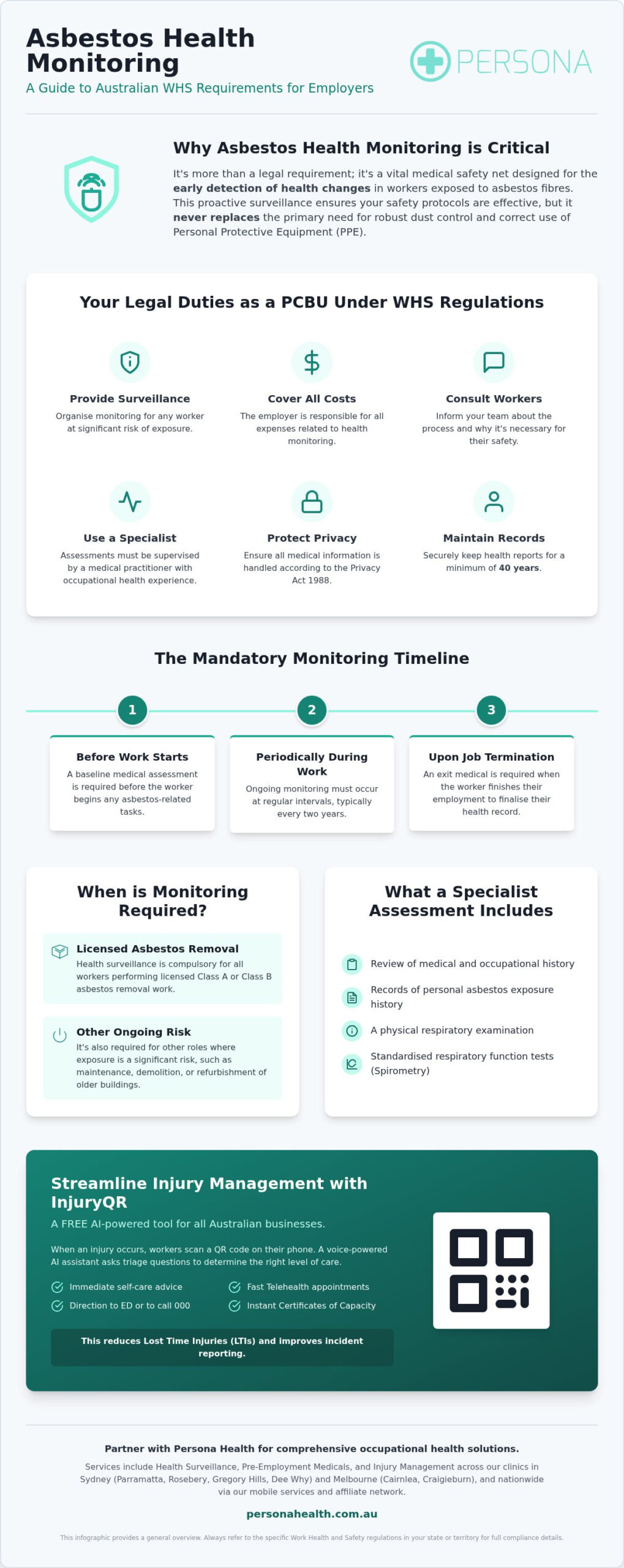
In Australia, the responsibility falls on the Person Conducting a Business or Undertaking (PCBU). This is usually you, the employer or business owner. You have a legal duty of care to provide health surveillance for any worker at risk of exposure, and this must be organised and paid for at your expense. You’re also required to consult with your team about the monitoring process. This means ensuring they understand why the tests are happening and how their sensitive medical information will be protected under the Privacy Act 1988 and the Australian Privacy Principles. Clear communication helps build a culture of trust where health is prioritised over simple compliance.
Why a Standard GP is Often Not Enough
While your local family doctor is excellent for general wellness, asbestos-related surveillance requires a specific clinical lens. Australian law mandates that these assessments are carried out or supervised by a registered medical practitioner with specific experience in occupational health. Interpreting complex respiratory function tests and understanding unique workplace exposure profiles requires specialised training that most general practitioners don’t use in their daily practice. By choosing dedicated Occupational Health Services, you ensure the physician understands the nuances of your specific industry. This expert oversight provides peace of mind that any subtle changes in lung health are identified accurately and managed with the necessary professional authority.
The Legal Framework: WHS Regulations and Your Duties
The legal landscape for asbestos health monitoring requirements australia is grounded in national consistency. Most states and territories have adopted the Model WHS Regulations, specifically Regulation 435, which outlines the mandatory duties for a Person Conducting a Business or Undertaking (PCBU). The primary trigger is clear: if your workers are performing licensed asbestos removal work, health surveillance is compulsory. However, the law also covers any worker where exposure is likely to occur through other activities. This includes maintenance, demolition, or refurbishment where fibres might be disturbed. It is your responsibility to ensure that these assessments are conducted by a registered medical practitioner with specific experience in occupational health, ensuring the results are interpreted with the necessary clinical authority.
To ensure a complete medical picture, the timeline is rigid. You must provide monitoring at three distinct stages:
- Before work commences: A baseline assessment must be established before a worker starts asbestos-related tasks.
- Periodically: Monitoring must occur at regular intervals while the work continues, typically every two years.
- Upon termination: An exit medical is required when a worker finishes their role or leaves the business to document their health status at the end of their exposure period.
Compliance with SafeWork Australia Standards
SafeWork Australia sets high standards for data management and worker protection. Because asbestos-related diseases can take decades to appear, you are legally required to keep health monitoring records for a minimum of 40 years. This long-term commitment ensures that if a health issue arises later in life, the worker’s history is documented and accessible. You must provide a copy of the health monitoring report to the worker as soon as it’s available. If the physician recommends remedial action or identifies a disease, you are also obligated to provide the report to your state regulator. For a broader look at maintaining a healthy workforce, our Pillar Guide on Fitness for Work offers additional context. These WorkSafe ACT health monitoring guidelines provide a robust example of how these national standards are applied by local regulators.
State-Specific Variations: NSW and Victoria
While the Model WHS laws provide the foundation, SafeWork NSW and WorkSafe Victoria have specific reporting portals and nuances in their Codes of Practice. It’s vital to use accredited clinics that understand these regional differences. Whether you are operating out of Sydney or Melbourne, your provider must be well-versed in local regulator expectations to prevent non-compliance fines. Handling this data also brings obligations under the Privacy Act 1988. Medical reports contain sensitive information that must be stored securely and only shared with authorised parties. Managing these complex legal layers can feel overwhelming, but you don’t have to do it alone. If you need help staying compliant, speak with our occupational health team for tailored advice on your specific industry needs.
What Does a Professional Asbestos Medical Assessment Involve?
Walking into a medical clinic can feel daunting for many workers, so we ensure the process for meeting asbestos health monitoring requirements australia is as transparent and reassuring as possible. A professional assessment is far more than a simple check-up; it’s a specialised clinical evaluation designed to protect long-term health. The goal is to establish a clear picture of the individual’s respiratory wellbeing, providing both the employer and the worker with confidence that their safety is being managed with expert care.
The physician’s first task is to build a detailed picture of the individual’s life through a comprehensive occupational and medical history. This conversation doesn’t just look at the current job; it explores every role the worker has held, including those in the construction, maritime, or manufacturing sectors where asbestos was once prevalent. This is critical given the long latency of asbestos-related conditions. Following this, a targeted physical examination focuses on the chest and respiratory system. The doctor listens for subtle clinical signs like ‘crackles’ and checks for other indicators, such as clubbing of the fingers, which can sometimes be associated with chronic lung disease.
The Importance of Spirometry
Spirometry is a non-invasive but vital part of meeting asbestos health monitoring requirements australia protocols. This test measures how much air a person can breathe out and how fast they can do it, which helps the physician detect restrictive lung patterns at an early stage. The results are compared against predicted values based on the worker’s age, height, and ethnicity, ensuring the assessment is tailored to their unique physiology. To get the most accurate results, we ask workers to prepare by avoiding smoking for at least one hour and skipping large meals or vigorous exercise immediately before the test. At Persona Health, we pride ourselves on our expertise in Spirometry, using modern equipment to provide precise, digital reporting that helps you manage your compliance obligations efficiently.
Chest X-rays and ILO Classification
While every worker requires a physical exam and lung function testing, chest X-rays are not always a mandatory part of every screening. The medical practitioner will determine the need for imaging based on the worker’s specific risk profile, age, and exposure history. When an X-ray is required, it must be interpreted using the International Labour Office (ILO) scale. This is a globally standardised system for classifying the severity of pneumoconiosis and other dust-related diseases, ensuring that the results are consistent and legally robust. In some complex cases, the physician may recommend high-resolution computed tomography (HRCT). This technology provides a much more detailed view of the lung tissue than a standard X-ray can offer, allowing for the detection of very subtle changes that might otherwise be missed.
Trigger Points: When Must an Employer Provide Health Surveillance?
Identifying the specific moments when surveillance becomes mandatory is essential for maintaining compliance with the asbestos health monitoring requirements australia framework. While the law is clear about licensed removal work, other triggers often catch employers off guard. A proactive approach involves four key stages: pre-employment, periodic checks, exit medicals, and incident-based responses. Each stage serves as a clinical checkpoint to ensure your workplace remains a safe environment for every individual. By understanding these trigger points, you can move from reactive compliance to a culture of genuine care.
Periodic monitoring is typically required every two years for those in ongoing asbestos-related roles. However, the supervising physician may recommend more frequent checks based on individual health factors or the intensity of the exposure. Equally important is the exit medical. When a worker leaves your employment, documenting their health status provides a final bookend to their exposure history. This prevents future liability confusion and ensures the worker has a clear record of their wellbeing as they move on to their next chapter. Finally, incident-based monitoring is triggered following an accidental or uncontrolled release of asbestos fibres, ensuring any incidental exposure is documented immediately.
Baseline Monitoring and Pre-Employment
Establishing baseline data is the most significant legal protection a PCBU can have. Without a documented starting point, it is difficult to determine whether a respiratory issue was pre-existing or caused by recent workplace exposure. This initial assessment provides the necessary evidence to protect both the business and the worker. For a deeper look at how these fit into your hiring process, see our Complete Guide to Pre-Employment Medicals. We frequently assist businesses with these specialised Pre-Employment Medicals in Parramatta, ensuring a smooth transition for new team members before they ever step onto a site.
Managing Results and Notifications
If a health report indicates that a worker has potentially contracted an asbestos-related condition, the PCBU has an immediate duty to act. You must review your workplace control measures and risk assessments to identify where the failure occurred. This isn’t just about ticking a box; it’s about refining your safety protocols to prevent further harm. The Occupational Physician plays a critical role here, providing expert advice on fitness for duty and suggesting necessary workplace adjustments. Their clinical authority helps you navigate these sensitive situations with empathy and professionalism, ensuring the individual receives the support they need while the business remains compliant with regulator notification requirements.
Streamlining Compliance with Persona Health and InjuryQR
Managing the asbestos health monitoring requirements australia mandates is a significant long-term commitment for any business. Protecting your team requires more than just clinical skill; it requires a partner who understands the operational pressures of modern industry. Our responsive, employer-focused approach is designed to take the guesswork out of compliance. With modern digital reporting, we ensure that your 40-year record-keeping obligation is handled with precision. Results are delivered with fast turnaround times, allowing you to focus on project delivery while we manage the clinical details. For large-scale infrastructure projects, our mobile on-site services bring the clinic to your team, ensuring minimal disruption to your schedule across the country.
The InjuryQR Advantage
To further support your safety culture, we provide all Australian businesses with access to InjuryQR, a free AI-powered workplace injury triage service. This tool simplifies incident management by providing immediate, professional guidance at the point of injury. We offer free posters, stickers, keyrings, and fridge magnets to ensure the service is always within reach. When an incident occurs, the worker simply scans a QR code with their phone. No app download is required. They describe the injury using their voice, and the AI asks targeted follow-up questions to assess the situation.
The outcomes are clear and immediate: self-care advice, a telehealth appointment typically within 3 to 4 hours, or direction to an Emergency Department or 000. This streamlined process significantly reduces Lost Time Injuries (LTIs) and ensures that reporting compliance is maintained. Certificates of Capacity can even be issued immediately where appropriate, supporting a faster, safer return to work and improving overall reporting accuracy for your business.
Booking Your Health Surveillance
Our specialised clinics in Gregory Hills and Rosebery are specifically equipped to handle high-volume asbestos medicals for Sydney-based teams. These locations offer the advanced diagnostic tools required for thorough respiratory surveillance, including spirometry and ILO-standard imaging. For businesses with a national footprint, our network of 100 affiliate clinics ensures that your workers receive the same high standard of care regardless of their location. Whether you need a single pre-employment assessment or a comprehensive ongoing monitoring program for a national team, we provide the stability and expertise you need to protect your people and your business.
Securing Your Workplace Health for the Future
Protecting your workforce from the long-term risks of asbestos is a profound responsibility that requires more than just administrative compliance. By prioritising baseline medicals and a consistent two-year monitoring cycle, you create a workplace where safety is a core value rather than a checklist. Navigating the asbestos health monitoring requirements australia mandates becomes a streamlined, stress-free process when you partner with a clinical team that understands the unique latency of these conditions. Our expert Occupational Physicians provide the clinical authority you need, while our fast turnaround times and modern digital reporting keep your business moving forward.
We also empower your team with free InjuryQR triage, ensuring professional guidance is available the moment an incident occurs. You don’t have to manage these complex legal and medical obligations on your own. We are here to support your journey towards a safer, more compliant future for every individual in your care.
Taking this step today ensures your team is protected by the highest standards of occupational care. We look forward to helping you build a healthier, more resilient workplace.
Frequently Asked Questions
Is asbestos health monitoring mandatory for all construction workers?
Health monitoring isn’t mandatory for every construction worker; it’s specific to those at risk. Under the asbestos health monitoring requirements australia framework, you must provide surveillance if a worker is performing licensed removal work or if exposure is likely in their specific role. This includes demolition or maintenance tasks. If you’re unsure about your team’s risk profile in Sydney or Melbourne, consulting an occupational physician is the best way to ensure you’re meeting your legal duties.
How long must an employer keep asbestos health monitoring records?
You must keep health monitoring records for a minimum of 40 years. This long-term requirement exists because asbestos-related diseases often have a latency period of 20 to 60 years. These records must be kept confidential and should be easily accessible if a regulator or the worker requests them in the future. At our clinics in Gregory Hills and Rosebery, we use modern digital reporting to help you manage this significant record-keeping obligation securely and efficiently.
Who pays for the asbestos medical examination in Australia?
The Person Conducting a Business or Undertaking (PCBU) is legally responsible for all costs. This includes the medical examination itself, any required tests like spirometry or X-rays, and the worker’s time spent attending the appointment. You can’t pass these costs on to the employee or use their private health insurance. Providing these assessments at your expense is a fundamental part of your duty of care under Australian Work Health and Safety legislation.
Can a worker refuse to undergo asbestos health monitoring?
While workers have a right to refuse, a PCBU has a concurrent duty to ensure a safe workplace. If a worker refuses mandatory monitoring, you may be unable to allow them to continue performing asbestos-related work because you can’t verify their safety. We recommend a supportive approach, explaining that the assessment is a protective measure for their long-term wellbeing. Clear communication about the clinical process often helps ease any anxiety or hesitation they might feel.
What happens if a worker is diagnosed with an asbestos-related condition?
You must immediately review your workplace control measures and risk assessments. If a report identifies a disease or recommends remedial action, you’re also required to notify your state regulator, such as SafeWork NSW or WorkSafe Victoria. The Occupational Physician will provide guidance on the worker’s fitness for duty and any necessary workplace adjustments. Our team works closely with employers to navigate these sensitive results with professionalism and empathy for the individual involved.
How often should periodic asbestos medicals be conducted?
Periodic medicals are typically conducted every two years for workers with ongoing exposure risk. This frequency ensures that any subtle changes in respiratory health are identified early. However, the supervising medical practitioner may recommend more frequent assessments based on the worker’s medical history or the intensity of the hazards they face on-site. Establishing a regular schedule across your Sydney or Melbourne operations is vital for maintaining high-quality asbestos health monitoring requirements australia compliance.
What is the difference between asbestos health monitoring and a regular check-up?
Asbestos monitoring is a targeted clinical evaluation, whereas a regular check-up focuses on general wellness. These specialised medicals include a deep dive into occupational history and specific respiratory function tests like spirometry. A general GP might not have the expertise to interpret these results against workplace exposure profiles. Our occupational health specialists focus on the unique physiological impacts of hazardous fibres, providing a level of detail that standard health checks simply don’t offer.
Does InjuryQR provide medical certificates for asbestos-related issues?
InjuryQR is designed for acute workplace injury triage rather than chronic disease management. While it can issue Certificates of Capacity immediately where appropriate for sudden injuries, asbestos-related conditions require long-term surveillance by an Occupational Physician. However, if a worker is involved in an acute incident like an accidental fibre release, InjuryQR can provide immediate triage advice. This helps reduce Lost Time Injuries (LTIs) by directing the worker to the most appropriate level of care.

Article by
Ian Nicholson
Ian is the Business Support Manager at Persona Health, where he plays a key role across IT, sales, marketing and business operations. With a broad skill set and a practical, solutions-focused approach, Ian helps drive the systems, communication and commercial strategy that support Persona Health’s continued growth across Australia.