

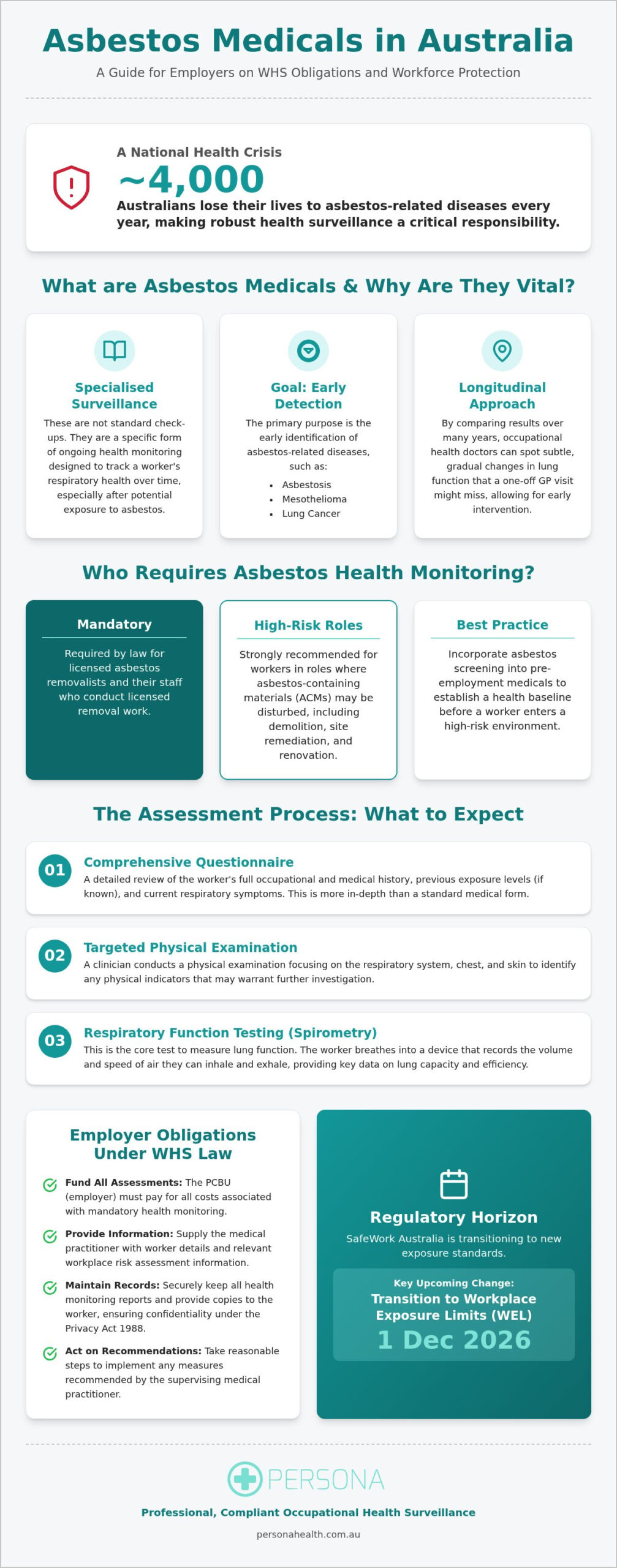
With approximately 4,000 Australians losing their lives to asbestos-related diseases every year, the importance of robust health surveillance has never been more critical. Ensuring your team undergoes regular asbestos medicals isn’t just a box-ticking exercise; it’s a vital safeguard for their long-term well-being and your business’s legal standing. We understand that navigating the shifting landscape of SafeWork Australia regulations can feel overwhelming, especially with the transition to Workplace Exposure Limits (WEL) approaching in late 2026. You want to protect your workers without getting lost in a maze of clinical jargon and legislative fine print.
This guide will show you exactly what happens during a clinical assessment, when the law mandates health monitoring, and how to organise streamlined surveillance that keeps you compliant. We’ll provide the clarity you need to lead with confidence, from understanding the role of accredited doctors to managing digital reports efficiently. By the end of this article, you’ll have a practical roadmap for managing worker health with the professional care your team deserves.
Key Takeaways
- Understand that asbestos medicals are a specialised form of health surveillance designed to detect early signs of respiratory conditions such as asbestosis or mesothelioma.
- Learn exactly what to expect during the clinical assessment process, including detailed occupational history questionnaires and targeted examinations of the lungs and skin.
- Clarify your legal responsibilities as an employer under Australian WHS law, including the requirement to fund all assessments and provide essential workplace information.
- Discover practical strategies for organising health monitoring for your workforce to ensure minimal disruption and high-quality clinical data.
- Stay ahead of 2026 regulatory changes by leveraging modern digital reporting systems and expert medical interpretation for your health surveillance requirements.
What are Asbestos Medicals and Why are They Vital?
In the context of Australian occupational health, asbestos medicals represent much more than a legislative requirement. They are a specialised form of health surveillance designed to monitor the well-being of workers who are exposed, or likely to be exposed, to airborne asbestos fibres. Unlike a standard physical, these assessments are longitudinal, meaning they track a worker’s health over time to identify subtle changes in respiratory function that could indicate the onset of serious illness.
The primary goal of this surveillance is the early detection of asbestos-related diseases, including mesothelioma and lung cancer. Understanding What is Asbestosis? helps illustrate why these medicals are vital; this chronic lung condition results from the inhalation of fibres that cause progressive scarring of lung tissue. Early identification through professional asbestos medicals allows for immediate workplace intervention and medical management, which is something a standard GP check-up might miss. General practitioners often lack the specific occupational history tools and the comparative data needed to identify industrial disease patterns in their earliest, most treatable stages.
A Registered Medical Practitioner (RMP) with expertise in occupational health must oversee these surveillance programs. This specialist oversight ensures that clinical findings are interpreted accurately against the worker’s specific exposure profile. At Persona Health, our medical team provides this high level of clinical authority, ensuring that both the worker’s health and the employer’s liability are managed with professional precision.
The Legal Framework: SafeWork Australia and WHS Regulations
SafeWork Australia sets the model Work Health and Safety (WHS) Regulations that define how businesses must manage hazardous substances. Under these regulations, health monitoring is mandatory if there is a “significant risk” to a worker’s health due to exposure. State-based regulators, such as SafeWork NSW and WorkSafe Victoria, enforce these standards and can issue heavy penalties for non-compliance. With the transition to the new Workplace Exposure Limits (WEL) taking effect on 1 December 2026, businesses must ensure their surveillance programs meet the updated clinical and reporting benchmarks to remain compliant.
Who Needs Asbestos Health Monitoring?
Determining who requires monitoring is a critical step for any PCBU (Person Conducting a Business or Undertaking). While it is mandatory for licensed asbestos removalists and their staff, the requirement often extends to workers in demolition, site remediation, and renovation. Any role where asbestos-containing materials (ACMs) might be disturbed requires a risk assessment. In many instances, it’s best practice to include asbestos-specific screening as part of a pre-employment medical. This establishes a clear health baseline before a worker ever enters a high-risk environment, providing essential protection for both the individual and the organisation.
The Asbestos Medical Process: What to Expect During an Assessment
Understanding the steps involved in asbestos medicals helps alleviate worker anxiety and ensures that the data collected is both accurate and actionable. The assessment is a methodical process designed to capture a snapshot of a worker’s current health while building a historical record for future comparison. Because asbestos-related conditions often have long latency periods, this longitudinal approach is essential for effective health monitoring.
The journey begins with a comprehensive questionnaire. This isn’t a simple tick-box exercise; it’s a deep dive into the individual’s occupational history, previous exposure levels, and current respiratory symptoms. Our clinicians also examine the skin and chest to look for physical indicators that might require further investigation. Standardised protocols are used throughout to ensure that results remain consistent, whether the worker is seen in one of our Sydney clinics or via our on-site health surveillance mobile units. This consistency allows us to track small changes over many years, which is the key to early intervention.
Respiratory Function Testing (Spirometry)
Spirometry is the primary tool used to measure how well the lungs are functioning. During this test, the worker breathes into a mouthpiece connected to a computer, which records the volume and speed of the air they can inhale and exhale. It measures specific metrics like Forced Vital Capacity (FVC) and Forced Expiratory Volume in one second (FEV1). These numbers tell us if there’s any evidence of lung scarring or airway obstruction.
- Accuracy: To get the most reliable results, workers should avoid smoking or heavy exercise for several hours before the test.
- Instruction: Our technicians guide the worker through the process, as it requires a maximal, forceful effort to accurately capture lung capacity.
- Analysis: We compare these results against predicted values based on age, height, and gender to identify any obstructive or restrictive patterns that may indicate underlying issues.
Chest X-Rays and Advanced Imaging
While spirometry looks at function, imaging looks at structure. A chest X-ray is not typically required at every annual check-up but is mandated by SafeWork Australia guidelines at specific intervals or if clinical symptoms arise. These radiographs are interpreted using the International Labour Organization (ILO) scale, a specialised system for classifying the severity of dust-related lung changes. This ensures that even the smallest abnormalities are documented correctly and consistently across the industry. We prioritise radiation safety, only requesting imaging when it is clinically necessary and legally required, providing a balanced approach to worker well-being.
Once the assessment is complete, the results are processed through our modern digital reporting systems. This allows for a fast turnaround, ensuring that the worker receives their report and the employer is notified of their fitness for duty without unnecessary delays. Clear communication ensures that everyone involved understands the next steps for ongoing safety.
Employer Obligations for Asbestos Health Surveillance
As an employer or PCBU (Person Conducting a Business or Undertaking) in Australia, your responsibilities regarding asbestos medicals are clearly defined under model WHS laws. You are legally required to cover all financial costs associated with health surveillance. This includes the clinical assessment, respiratory testing, and any necessary imaging. By removing financial barriers, the legislation ensures that every worker at risk receives the monitoring they need to stay safe over the long term.
Your duty extends beyond just paying for the appointment. You must provide the medical practitioner with detailed information about the worker’s specific duties, the estimated duration of their exposure, and the control measures currently in place. This context is vital; it allows the doctor to make an informed clinical judgement based on the actual risks present on your worksite. If a health monitoring report indicates that a worker has contracted an illness or recommends remedial action, you must notify your state regulator, such as SafeWork NSW or WorkSafe Victoria, typically within 14 days of receiving the report.
For new employees, health monitoring should ideally commence before they start work in a high-risk environment. Establishing this baseline is a critical protective measure for your business, as it documents the worker’s respiratory health at the point of entry. To manage broader workplace safety and incident reporting, many businesses now use InjuryQR. This free AI-powered triage service allows workers to scan a QR code and describe an injury by voice, receiving immediate guidance that helps reduce Lost Time Injuries (LTIs) and improves the accuracy of your safety records.
Record Keeping and Confidentiality
The Australian legal requirement for storing health monitoring records is strict: you must keep these documents for 40 years. Because asbestos-related diseases often have a long latency period, these records are essential for future medical and legal reference. During this time, you must adhere to the Privacy Act 1988, ensuring that sensitive medical data is stored securely and only accessed by authorised personnel. Workers have a legal right to access their own health records at any time, and you should have a clear process in place to facilitate these requests promptly.
Selecting a Registered Medical Practitioner
Choosing the right clinical partner is essential for maintaining high-quality surveillance data. You need a doctor with specific experience in occupational health who understands how to interpret complex respiratory metrics. Partnering with a specialised provider like Persona Health ensures that your surveillance program is overseen by experts who prioritising both worker well-being and employer compliance. Using a consistent provider across your clinic-based or mobile assessments helps maintain a reliable longitudinal record, making it much easier to identify subtle health trends across your entire workforce.
Organising Asbestos Medicals for Your Workforce
Managing the logistics of health surveillance shouldn’t be a burden for your HR or safety teams. Organising asbestos medicals for a large workforce requires a methodical approach to ensure every individual is assessed without compromising site productivity. The first step is identifying all workers who meet the “significant risk” threshold based on your recent air monitoring data and risk assessments. Once identified, coordinating these appointments through a single provider ensures that clinical data remains centralised and easy to manage.
Preparing your team is essential for obtaining high-quality clinical results. Workers should be briefed that a lung function test requires significant physical effort and can be tiring. To ensure the most accurate data, they should avoid smoking, vaping, or engaging in heavy exercise for at least four hours before their appointment. For new hires, it’s highly efficient to integrate these specific checks into a broader pre-employment medical program. This proactive approach establishes a clear health baseline before the worker ever enters a potentially hazardous environment, protecting both the individual and the business.
On-Site vs. Clinic-Based Assessments
For businesses with large numbers of workers in Sydney or Melbourne, on-site health surveillance is often the most practical choice. Our mobile units come directly to your site, reducing travel time and keeping your team on the job. This is particularly beneficial for demolition and removal projects where time is a critical factor. However, visiting one of our dedicated occupational health centres in Parramatta, Rosebery, Gregory Hills, Dee Why, Cairnlea, or Craigieburn offers a more controlled clinical environment. This is often preferred for more complex cases or when workers require additional specialised assessments alongside their asbestos screening.
Frequency of Ongoing Health Monitoring
Under current SafeWork Australia guidelines, the standard interval for ongoing asbestos medicals is typically every two years. However, this is a minimum requirement. If a worker reports new respiratory symptoms or if a significant incident of exposure occurs on-site, more frequent assessments may be necessary. Managing these timelines manually is prone to error; we recommend using an automated recall system. At Persona Health, we manage this process for you, sending digital reminders to your team to ensure no worker misses their mandatory assessment. This keeps your business compliant and ensures that any changes in respiratory health are caught as early as possible.
If you are ready to streamline your compliance and protect your team, you can book your asbestos medicals with Persona Health today.
Comprehensive Workplace Safety with Persona Health
Persona Health operates as a modern professional partner for businesses across Sydney and Melbourne, providing much more than just a clinical assessment. Our approach to asbestos medicals is built on the foundation of expert clinical interpretation. We understand that raw respiratory data requires a specialist lens to be truly useful. Our medical team focuses on providing clear, employer-focused reporting that helps you make informed decisions about workplace safety and worker placement.
By managing your health surveillance through our clinics in Parramatta, Rosebery, Gregory Hills, and Dee Why, or our Melbourne sites in Cairnlea and Craigieburn, you gain access to a unified health record. This is particularly valuable when managing multiple respiratory hazards simultaneously. We often integrate crystalline silica medicals into the same surveillance schedule, ensuring your team is protected against a variety of airborne contaminants. This holistic view is essential for reducing long-term liability and lowering the rate of Lost Time Injuries (LTIs) within your organisation.
Instant Injury Management with InjuryQR
Effective safety management doesn’t end when the medical appointment is over. To support immediate incident response, we provide our clients with InjuryQR, a free AI-powered triage service. In the event of a workplace injury, a worker simply scans a QR code with their smartphone. There is no app to download and no complex forms to fill out. The worker describes the injury using their voice, and the AI provides immediate, guided next steps, whether that involves self-care, a telehealth consultation, or emergency direction.
This system streamlines the reporting process and can facilitate the immediate issuance of Certificates of Capacity where appropriate. By providing instant guidance, InjuryQR helps businesses maintain accurate safety records and ensures that injured workers receive the right care at the right time. Businesses can also order physical assets like posters and magnets to ensure the QR code is always visible in high-risk zones, further strengthening the site safety culture.
Partnering for Long-Term Employee Wellbeing
We pride ourselves on being a modern, approachable partner in your safety journey. While our physical clinics serve the major hubs of Sydney and Melbourne, our reach extends across the country through a network of over 100 affiliate clinics. This ensures that even if your projects take your team interstate, their health surveillance remains consistent and professional. Our digital systems provide fast turnaround times, allowing you to manage your workforce with confidence. We invite you to contact our team for a tailored health surveillance quote that addresses the unique needs of your workforce and ensures your compliance with the 2026 standards remains absolute.
Protecting Your People and Your Business
Managing asbestos medicals effectively is about more than meeting the 2026 SafeWork standards; it’s about safeguarding the long-term well-being of your team through specialised surveillance and clear clinical interpretation. We’ve explored the necessity of baseline testing, the technical role of spirometry, and the strict record-keeping duties that protect your organisation over many decades. Proactive health monitoring ensures that potential issues are identified early, allowing for intervention before they become life-altering conditions.
With clinics conveniently located across Sydney and Melbourne, Persona Health provides the expert interpretation and fast digital reporting you need to make compliance seamless. We also offer free InjuryQR triage assets for your workplace, ensuring your site is equipped with immediate AI-guided support for any incident. This integrated approach to occupational health reduces your liability while fostering a genuine culture of safety and care.
Our team is ready to provide the clinical authority and practical support you need to lead with confidence. Book your asbestos medical with Persona Health today and ensure your workforce remains healthy, safe, and fully protected for years to come.
Frequently Asked Questions
How long does an asbestos medical appointment take?
An asbestos medical appointment typically takes between 30 and 45 minutes to complete. This timeframe includes the detailed occupational history questionnaire, the physical examination of the respiratory system, and the spirometry testing. If a chest X-ray is required, you’ll need to allow additional time at a radiology clinic, though the primary clinical consultation is designed to be efficient and thorough.
Is a chest X-ray always required for an asbestos medical?
A chest X-ray isn’t required at every check-up. Generally, a baseline X-ray is performed at the start of the surveillance program, with subsequent imaging occurring at intervals determined by the medical practitioner, often every five to ten years. This approach follows SafeWork Australia guidelines to monitor structural lung changes while protecting workers from unnecessary radiation exposure.
Who pays for the asbestos health monitoring?
The employer or PCBU is legally responsible for all costs associated with health surveillance. This includes the medical consultation fees, diagnostic tests like spirometry, and any required imaging. Additionally, the employer must cover the worker’s travel costs and ensure the assessment occurs during the worker’s normal paid hours.
What happens if a worker refuses to undergo health monitoring?
If a worker refuses to participate, they may be unable to perform tasks that involve a significant risk of asbestos exposure. While you can’t force a worker to undergo a medical, you have a legal duty of care to prevent them from being harmed at work. In these cases, you should explain the health benefits and legal requirements, but the worker shouldn’t be allowed to continue in a high-risk role without a current assessment.
How long must an employer keep asbestos medical records?
You must keep asbestos medical records for at least 40 years from the date the record was made. This long duration is necessary because asbestos-related diseases often take decades to manifest after the initial exposure. These records must be stored securely to comply with the Privacy Act 1988 and must be provided to the worker if they leave the business or request a copy.
Can my regular family GP perform an asbestos medical?
A regular family GP shouldn’t perform these assessments unless they are a Registered Medical Practitioner with specific experience in occupational health monitoring. Asbestos medicals require a doctor who understands industrial exposure patterns and can accurately interpret complex respiratory data. Using a specialised provider ensures the surveillance meets the strict clinical standards required by state regulators.
What is the difference between a lead medical and an asbestos medical?
The primary difference is the physiological system being monitored. A lead medical focuses on blood lead levels and kidney function through regular blood and urine testing. In contrast, asbestos medicals are focused on the respiratory system, using lung function tests and imaging to detect scarring or tumours. While both are mandatory under WHS laws for certain roles, the clinical protocols are entirely different.
What should a worker bring to their asbestos medical appointment?
Workers should bring photo identification, such as a driver’s licence, and a summary of their previous work history involving hazardous substances. It’s also important to bring any previous health monitoring reports and a list of current medications. If the worker uses glasses or hearing aids, they should have these present to ensure the physical examination is accurate and complete.

Article by
Ian Nicholson
Ian is the Business Support Manager at Persona Health, where he plays a key role across IT, sales, marketing and business operations. With a broad skill set and a practical, solutions-focused approach, Ian helps drive the systems, communication and commercial strategy that support Persona Health’s continued growth across Australia.