
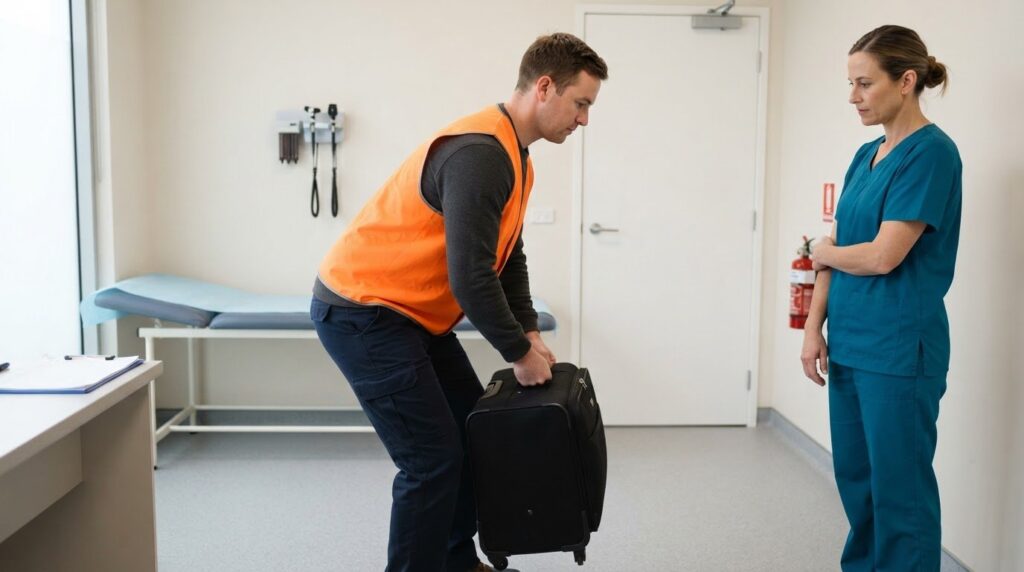
A baggage-handler medical is about more than completing a pre-employment form: it helps assess whether you can meet the physical demands of the role. Some Tullamarine baggage-handler positions involve lifting and moving bags weighing up to 32 kg, so understanding what the assessment involves can help you feel prepared.
If you’re arranging baggage handler medicals in Tullamarine, you’ll want clear information about the checks, the clinic location and where to park. The assessment focuses on your fitness for the work, with the details shaped by the requirements of the position.
This guide explains what to expect before and during the medical, what information to bring, and how the assessment process works. It also covers how to find the Tullamarine clinic and plan your arrival, including parking, so you can focus on your appointment rather than the logistics.
Key Takeaways
- Learn how a pre-employment medical relates to the physical demands of baggage handling, including roles that involve moving bags weighing up to 32 kg.
- Understand what information can shape the medical assessment and why requirements may differ between roles and employers.
- Get practical guidance on finding the Tullamarine clinic and planning your arrival, including parking.
- See how employer-arranged medical assessments and drug and alcohol screening may fit into the recruitment process.
- Find out when a pre-employment medical or an independent medical examination may be relevant to your next step.
Pre-employment medicals
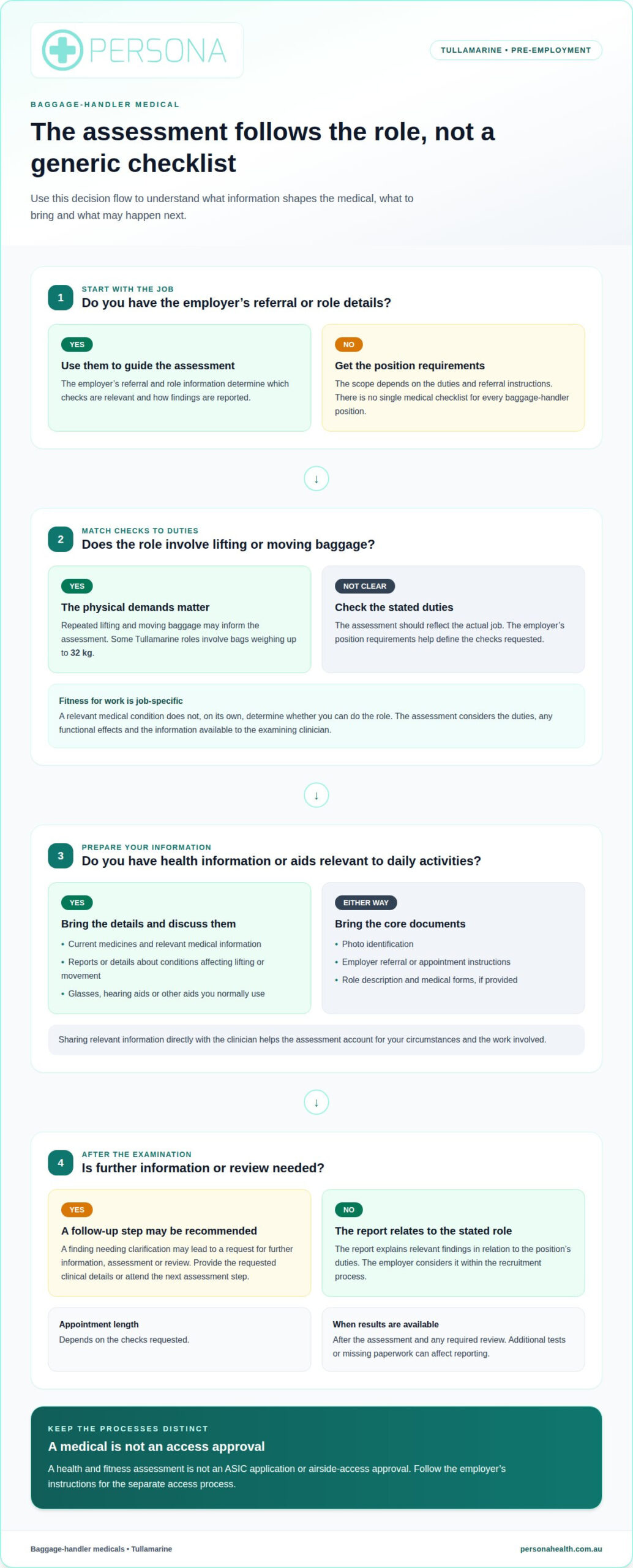
A pre-employment medical considers how your health and functional capacity relate to a particular job. For baggage handlers, the assessment should reflect the actual duties, not a generic airport job description.
Some Tullamarine baggage-handler roles involve handling bags weighing up to 32 kg. The employer’s role requirements guide which checks are relevant and how findings are reported.
Medical examination requirements
The examination considers the physical and health demands described for the position. Repeated lifting, moving baggage and working around airport operations may inform the assessment. The employer’s referral and role information determine the requested scope.
There isn’t one set medical checklist that applies to every baggage-handler position. A pre-employment assessment may consider relevant medical history and functional ability, with further checks shaped by the duties and referral instructions. A Melbourne pre-employment medical can be arranged around the requirements provided for the role.
Are there special medical requirements for ASIC or airside access at Melbourne Airport? A medical assessment considers health and fitness for work; it is not itself an ASIC application or airside-access approval. The employer’s instructions determine the separate access process.
Fitness for work means considering how your health relates to the tasks you’ll perform. A relevant medical condition does not, on its own, determine whether you can do a role. The assessment focuses on the duties, any functional effects and the information available to the examining clinician.
Identification and documents to bring
Bring photo identification and the employer’s referral or appointment instructions. Include any role description or medical forms provided for the baggage-handler position. These documents help the clinic match the assessment to the requested checks and record the correct details.
What identification or documents should you bring to a baggage handler medical? Take your photo ID, employer paperwork, and a current list of medicines or relevant medical information. Bring glasses, hearing aids or other aids you normally use for daily activities.
Bring reports or details about any condition that affects lifting or movement. Share this information directly with the clinician instead of relying on an incomplete form. It helps the assessment account for your circumstances and the work involved.
Results and follow-up steps
How long does a baggage handler medical take, and when are results available? Appointment length depends on the checks requested, while results follow completion of the assessment and any required review. Additional tests or missing paperwork can affect the reporting process.
What happens if you fail or need follow-up after a baggage handler medical? A finding that needs clarification may lead to a request for further information, assessment or review. The report explains the relevant findings and their relationship to the role’s stated duties.
A result is not simply a judgement of your overall health. It relates to the specific position and the information assessed. If follow-up is recommended, provide the requested clinical details or attend the next assessment step. The employer then considers the report within its recruitment process.
Clinic location and parking
Melbourne Airport is 23 kilometres from Melbourne, but a baggage-handler medical takes place at a clinic, not automatically at an airport terminal. Use the street address in your appointment details as the destination. Airport terminals and airport parking serve travellers; they may not be near the clinic or suitable for your appointment.
Before travelling, enter the clinic address into your navigation app and check the route from your starting point. A trip from central Melbourne may involve different roads and travel time from one starting in Tullamarine. Allow for local traffic and follow directions to the clinic entrance, not a Melbourne Airport terminal.
Parking arrangements depend on the clinic site. Read your appointment information for parking instructions, then check nearby signs for restrictions, payment requirements and time limits. If using a parking facility, confirm its location against the clinic address before leaving your car. Airport parking may not be the closest option just because the job is at an airport.
Plan your arrival
Use this simple sequence to reduce last-minute confusion:
- Save the clinic’s street address from your appointment details.
- Check the route and expected traffic before setting out.
- Look for parking near that address, not solely around Melbourne Airport.
- Allow time to walk from your parking spot to the clinic entrance.
- Keep your appointment details accessible in case you need to confirm the destination.
If your appointment information names a building, suite or entrance, include that detail in your navigation. A street address may cover a larger site, while a specific entrance helps you reach the correct reception. Keep your phone available for directions, and don’t rely on a terminal sign to guide you to a separate clinic.
Airport parking or clinic parking?
Melbourne Airport’s terminals and airport parking serve people using the airport. They are distinct from parking at a medical clinic. Parking beside a terminal may add an unnecessary trip if your appointment is elsewhere in Tullamarine. Match the parking location to the clinic address first.
If the route or parking instructions remain unclear, use the appointment details as your reference and get help with your appointment location. This is particularly useful if your booking lists a site name as well as a street address. Confirming the destination before leaving helps you avoid arriving at the wrong terminal or parking area.
The House lounge is located in Terminal 2 Departures at Melbourne International Airport. Melbourne Airport’s lost property service is located at the Visitor Information desk in the ground-floor Terminal 2 Arrivals Hall. These are airport locations, so use the street address in your appointment details to navigate to the clinic rather than relying on either location as your destination.
Dr Edmond Ng has over 30 years of international clinical practice experience. Confirm your clinic address and any site or entrance details in your appointment information before setting out, and match your parking choice to that destination.
Medical checks for Tullamarine Airport baggage handlers?
The employer’s referral guides the medical examination for a Tullamarine Airport baggage-handler role. It identifies the position, relevant duties and requested assessment. The clinician uses that scope to focus the appointment on the job, rather than treating it as a general health review. For baggage handler medicals in Tullamarine, clear role details help define what the assessment needs to address.
There isn’t one checklist that automatically applies to every airport employer. A referral for baggage handling should describe the physical tasks involved. If the role includes lifting, moving or loading baggage, those duties give the clinician useful context. A clear description of the work provides more detail than a job title alone.
The assessment starts with the referral and relevant health information. The clinician reviews the requested scope, discusses information relevant to the position and records findings. Any specific component requested in the referral helps determine what the appointment covers. Don’t assume the assessment includes tests the employer hasn’t requested.
For a useful assessment, the employer’s information should distinguish essential duties from occasional tasks. Handling baggage throughout a shift, for example, differs from moving an item once. Details about task frequency, equipment and work conditions help explain the role and give the clinician a clearer basis for interpreting the assessment.
The employer’s referral should make clear:
- The exact job title and work location at Tullamarine Airport.
- The duties the baggage handler performs during a typical shift.
- Any specific assessment components the employer has requested.
- Where the completed report should be sent and who receives it.
These details matter because medical findings need to be considered against the role’s stated requirements. A finding alone doesn’t describe every task someone can perform. The assessment report gives the employer information relevant to its recruitment decision, and the employer applies that information to the position.
An unclear referral can make it harder to focus the appointment. A general reference to “airport work”, for example, doesn’t explain whether the role involves baggage handling or another task. Clear role information helps the clinician understand what is being assessed and helps the employer interpret the report appropriately.
The examination is the one specified for the position and supported by its duties. If you’re arranging baggage handler medicals in Tullamarine, attend with the employer’s referral and provide relevant information accurately. This gives the assessment a job-specific basis without assuming every baggage-handler role has identical checks.
Which employers or agencies arrange baggage handler medicals at Melbourne Airport?
At Melbourne Airport, the hiring employer sets the recruitment process and identifies any required medical assessment. The airport location alone does not identify who arranges it. Check the job advertisement, offer or appointment instructions for the organisation issuing the referral and the contact managing your recruitment.
Virgin Australia advertises Airport Baggage Handler roles in Tullamarine, while dnata Airport Services has Ramp and Baggage Agent roles there. Both role types can involve handling baggage weighing up to 32 kg. These examples show why the employer’s description matters: a medical assessment should relate to the duties and requirements for the specific position.
Swissport Cargo Handling is located at 25-29 Mace Way, Tullamarine, 3045 Melbourne, Australia. That address identifies a cargo-handling location, but it does not establish who arranges an applicant’s medical. Use the hiring organisation named in your own recruitment documents, rather than assuming every airport employer follows the same process.
Recruitment may involve an employer, a recruitment agency or a medical clinic. Start with the organisation that sent the referral or booking instructions. If an agency contacts you for an employer, check which organisation is named on the referral and where the report must go. This helps keep the assessment aligned with the correct job.
Before attending, use these details to understand who is coordinating your appointment:
- Job advertisement: note the employer and exact baggage-handler role title.
- Recruitment correspondence: identify who issued the medical referral or booking.
- Assessment instructions: check the requested examination and any forms to bring.
- Reporting details: note the organisation named to receive the assessment outcome.
A Virgin Australia applicant and a dnata applicant should follow their own employer’s instructions, even when both roles are based at Tullamarine. The assessment may vary according to the position’s stated duties and the employer’s referral. A shared airport location does not mean shared paperwork, medical criteria or reporting arrangements.
If your recruitment contact and referral name different organisations, clarify which instructions apply before attending. Keep the job title, referral and booking information together. This links your appointment to the relevant role and helps the hiring organisation receive the report through its intended process.
In short, the employer named in your recruitment documents is the key reference for who arranges your baggage-handler medical. Virgin Australia, dnata Airport Services and Swissport Cargo Handling are connected with airport work in Tullamarine, but your referral determines the arrangements for your application.
Drug and alcohol tests for Tullamarine baggage handlers?
Drug and alcohol screening for a baggage-handler position depends on the hiring employer’s requirements. A role at Melbourne Airport does not, by itself, establish which screening steps apply. Follow the instructions attached to your application or appointment, which identify what the employer has requested.
An employer may include screening with a pre-employment assessment or provide separate instructions. The process can differ between a Virgin Australia application and a dnata Airport Services application. Applicants at Tullamarine should not assume that a shared location means identical instructions.
Check the referral for the screening scope, appointment details and any preparation directions. If the employer sends separate medical and screening paperwork, keep both documents available. If instructions name different dates or locations, use the latest recruitment communication to clarify the sequence before attending.
Screening follows a defined process, so appointment information matters. It should explain where to attend and what identification or documents to bring. Follow any preparation instructions as written. Don’t assume requirements for one employer or role also apply to another baggage-handling position.
The result is handled through the employer’s recruitment process. Your referral or screening instructions should indicate how results are reported and which organisation receives them. If you’re unsure, use the recruitment contact named in your application documents. This directs questions about privacy and reporting to the appropriate contact.
Screening and a general medical examination address different parts of an employer’s assessment process. An employer may request a medical assessment and outline drug and alcohol screening separately. Read each instruction on its own terms rather than assuming one appointment covers every requirement.
Before attending, make sure you can identify:
- The employer or recruitment agency named in your correspondence.
- Whether screening is included with the medical or arranged separately.
- The appointment location, date and any stated preparation steps.
- How the employer says results will be received.
If instructions change during recruitment, follow the updated message from the employer or agency. A revised appointment notice, for example, may replace an earlier booking detail. Keep the relevant correspondence together so the clinic can follow the correct referral and the employer can receive the requested information.
Drug and alcohol screening may form part of baggage-handler recruitment, but the employer’s instructions determine what applies to your application. Read the referral carefully and raise any uncertainty with your recruitment contact before the appointment. Clear instructions help avoid confusion about timing, paperwork and reporting.
Persona Health: Independent Medical Examiner
Persona Health provides Pre-Employment Medicals for employer-led recruitment assessments and Independent Medical Examiner services when an independent opinion is needed. Its employer-focused occupational health services include clear communication, fast turnaround and digital reporting.
Appointments are available at clinics in Parramatta, Rosebery, Gregory Hills and Dee Why in Sydney, and Cairnlea and Craigieburn in Melbourne. A network of 100 affiliate clinics supports nationwide access, alongside Australia-wide mobile workplace services for employers. Consider booking at Persona Health’s Gregory Hills or Rosebery clinic for your next assessment.
For a baggage-handler recruitment assessment, the employer’s referral helps establish the appropriate next step. For an independent medical examination, the referral should set out the question to be assessed. Contact Persona Health to discuss your requirements.
Take the next step with confidence
Follow your recruitment instructions and arrange the assessment specified for your role. Persona Health provides Pre-Employment Medicals, Workplace Injury Management and Crystalline Silica Medicals for workplace health needs.
For workplace injury triage, InjuryQR is a free AI-powered service available to all Australian businesses, providing free posters, stickers, keyrings and fridge magnets. Workers scan a QR code without downloading an app, describe an injury by voice, then answer AI follow-up questions. It can provide self-care advice, arrange telehealth appointments typically within 3-4 hours, direct a worker to an Emergency Department or instruct them to call 000. Where appropriate, a Certificate of Capacity can be issued immediately. Clearer, earlier reporting can help reduce Lost Time Injuries and improve injury reporting.
With the right information and a clear next step, you can approach the process prepared.
Frequently Asked Questions
What tests are included in a baggage handler pre-employment medical in Australia?
A baggage-handler pre-employment medical can include a medical history assessment, physical examination with a musculoskeletal exam, drug and alcohol screening, and vision, hearing and respiratory tests. A cardiovascular fitness test may also be included. Industry-specific components depend on the job. A rail position, for example, may require a rail medical component, which is separate from an airport baggage-handler assessment.
What fitness and manual handling standards must baggage handlers meet?
There isn’t one universal lifting threshold that applies to every baggage-handler job in Australia. The employer’s stated duties and assessment requirements guide how fitness for work is considered. Some Tullamarine roles involve handling bags weighing up to 32 kg, but that figure describes particular roles, not a national manual-handling standard. The employer’s role description provides the relevant context for assessing capacity.
Where can I get a baggage handler medical near Tullamarine, Victoria?
For Melbourne appointments, Persona Health’s clinic locations include Cairnlea and Craigieburn. Use the address in your booking information when planning travel from Tullamarine. Persona Health also has locations in Sydney, including Parramatta and Gregory Hills. Follow the employer’s referral instructions so the assessment matches the role and recruitment process.

Article by
Ian Nicholson
Ian is the Business Support Manager at Persona Health, where he plays a key role across IT, sales, marketing and business operations. With a broad skill set and a practical, solutions-focused approach, Ian helps drive the systems, communication and commercial strategy that support Persona Health’s continued growth across Australia.