
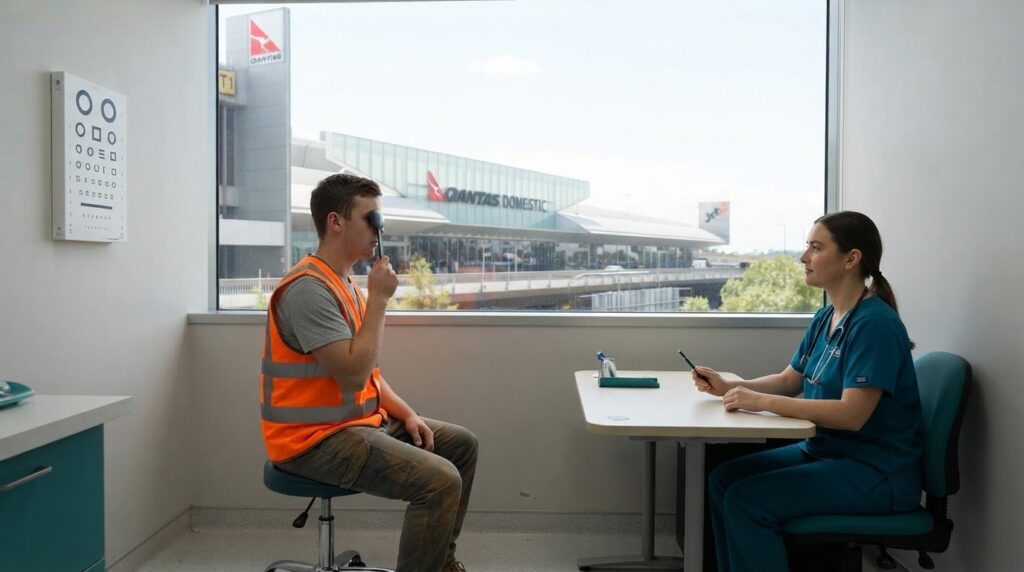
The first step is knowing which medical your role requires. If you’re arranging aviation ground crew medicals at Melbourne Airport, distinguish between a CASA aviation medical certificate and an employer-requested medical assessment before applying.
It’s understandable to want clear steps when a medical is part of starting work or meeting a role requirement. CASA requires pilots, aircrew and air traffic controllers to hold a medical certificate specific to their role. For ground crew, requirements depend on the position and employer.
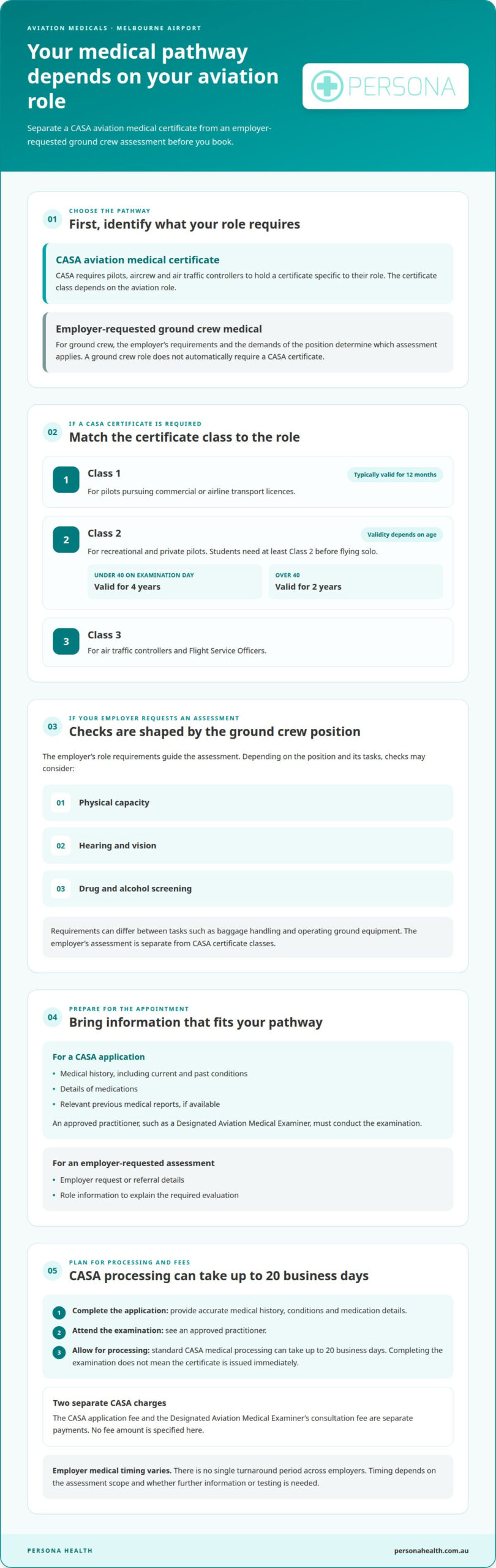
If you need a CASA certificate, the application includes your medical history, current and past conditions, and medications. The examination must be completed by an approved practitioner, and standard CASA medical processing can take up to 20 business days. This guide explains how to apply, what the different certificates involve, and what to expect from onsite medicals for ground crew at Melbourne Airport, so you can understand the process and plan your next step.
Key Takeaways
- Separate a CASA aviation medical certificate from an employer’s pre-employment medical, as they serve different purposes.
- Allow up to 20 business days for standard CASA medical processing, and prepare your medical history, conditions and medication details for the application.
- Match the certificate to the aviation role: Class 1, Class 2 and Class 3 certificates apply to different licence holders and positions.
- Onsite medical arrangements can help employers coordinate assessments for ground crew, with checks shaped by the requirements of each role.
- An Independent Medical Examiner may be relevant when an independent medical assessment is needed; understand how this differs from a pre-employment assessment.
Applying for a medical certificate
First, confirm whether you need a CASA certificate or an employer-requested medical. For ground crew, the employer’s role requirements determine which assessment applies.
Booking a Ground Crew Medical
A ground crew medical is an employer-requested assessment of your suitability for a particular position. To arrange one near Melbourne Airport, follow your employer’s booking instructions and have the role details ready. If you need a CASA aviation certificate instead, book an examination with an approved practitioner, such as a Designated Aviation Medical Examiner. These are separate processes, so identify the correct assessment before making an appointment.
For an employer assessment, take the employer’s request or referral details to your appointment. Melbourne information for medical services in Melbourne can help you understand the local setting.
Documents to Bring
For a CASA application, prepare details of your medical history, current and past conditions, and medications. For a ground crew assessment, bring any employer-provided request or role information so the practitioner understands what evaluation is required. Keep medication names and relevant dates accurate when completing your medical history.
If you have previous medical reports relevant to a condition, have them available to help explain your history. Follow the instructions for your appointment, as the required information depends on whether you need a CASA certificate or an employer assessment.
Starting a CASA application
A CASA medical application records your health information for an aviation medical assessment. Complete the medical history section with details of current and past conditions, plus medications. Answer each item accurately and include relevant details rather than relying on memory during the examination. An approved practitioner, such as a Designated Aviation Medical Examiner or Designated Aviation Ophthalmologist, must conduct the examination.
Ground crew should not assume that every airport position requires a CASA certificate. CASA requires pilots, aircrew and air traffic controllers to hold a certificate specific to their role. An employer may request a different pre-employment medical for a ground-based transport role.
Fees and processing time
A CASA medical application involves two separate charges: the CASA application fee and the Designated Aviation Medical Examiner’s consultation fee. Account for both when planning the application, as they are separate payments. No fee amount is given here, and the charges should not be treated as one combined fee.
Standard CASA medical processing can take up to 20 business days. Allow for that processing period when planning around a job start or role requirement. An appointment and completed examination do not mean the certificate is issued immediately; processing follows the assessment and application.
Learning about aviation medical certificates
CASA certificates apply to specific aviation roles, while ground crew employment assessments address the demands of a particular job. Knowing which process applies helps you understand the relevant checks and result timeframes.
Fitness and Screening Standards
Fitness and screening standards are checks matched to a role’s health and task demands. For airport ground staff, an employer assessment may consider physical capacity, hearing, vision, and drug and alcohol screening. Requirements depend on the position, such as baggage handling or operating ground equipment. These checks are separate from CASA certificate classes, which apply to defined aviation roles.
Workplace risks for ground crew can include moving vehicles, equipment, noise and physically demanding tasks. The assessment considers whether a worker’s health may affect their ability to perform the role safely. Employers set the role requirements, and a ground crew assessment is not automatically a CASA medical examination.
CASA requires pilots, aircrew and air traffic controllers to hold a certificate specific to their role. A Class 1 certificate is for pilots pursuing commercial or airline transport licences; Class 2 applies to recreational and private pilots; Class 3 covers air traffic controllers and Flight Service Officers. Students need at least Class 2 before flying solo.
Result Timing and Validity
Result timing is the period between completing an employment medical and receiving its outcome. For Melbourne airport employment medicals, no single turnaround period applies across all employers. The time depends on the assessment scope and whether further information or testing is needed. Standard CASA medical processing can take up to 20 business days, which is separate from an employer’s employment medical process.
Validity is how long an assessment or certificate remains current for its purpose. Employment medical results do not have one universal validity period in the facts available here; the employer’s role requirements determine whether a repeat assessment is needed. CASA certificate validity differs by class and age: Class 1 is typically valid for 12 months, while Class 2 is valid for 4 years for pilots under 40 on examination day, and 2 years for pilots over 40.
Air traffic controllers and Flight Service Officers use Class 3 certificates. The relevant certificate class and validity period depend on the aviation role, not simply the airport where someone works.
Conditions and Medications Affecting Fitness
Conditions or medications may affect fitness if they influence the tasks a ground crew member must perform. The assessment considers the person’s health information alongside the job’s physical and operational demands. For example, a condition affecting movement may be relevant to a role involving frequent lifting or walking. Medication effects on alertness may matter for safety-sensitive duties.
For a CASA application, applicants provide their medical history, current and past conditions, and medications. This information helps the aviation assessment consider the certificate requirements. Ground crew applicants should provide accurate details relevant to their employer’s assessment, including any treatment or medication that may affect their work tasks.
If you need help understanding which role-based assessment applies, discuss the assessment requirements.
Onsite aviation medicals
An onsite aviation medical is an occupational health assessment arranged at an employer’s workplace. For aviation ground crew medicals at Melbourne Airport, planning starts with the role requirements and assessment scope. Bringing assessments closer to the worksite may reduce separate clinic trips. The employer still needs a suitable private room, clear role information and an agreed process for handling results.
Start by identifying which positions need assessment and what each job involves. A baggage-handling role, for example, may have different physical demands from a dispatch position. Role descriptions help the practitioner understand the tasks and consider relevant checks. They also help avoid assessments with no clear connection to the work.
Before the visit, the employer and medical team agree on the location, appointment sequence and documentation process. The site needs a private room for confidential discussions and examinations, with space for any practical activities in the agreed scope. A quiet room can support conversations about medical history and hearing assessments.
Scheduling should account for airport operations. Employers can group appointments by team or shift, then assign times to workers. A roster, appointment list and role information help the onsite team manage attendance. For example, a ground crew member finishing a night shift may need a different appointment time from someone starting an afternoon shift.
At each appointment, the process follows the agreed assessment scope. The worker provides relevant health information, completes the required checks and discusses any details needing clarification. If a functional task is included, the practitioner explains what it assesses beforehand. Checks should relate to the worker’s actual duties, rather than assume all airport roles are alike.
Onsite arrangements also need a clear approach to privacy and reporting. Employers should define how role information is provided and work-related outcomes are received. Medical details are sensitive, so reporting should be limited to information relevant to the employment decision. A clear process helps workers understand what the assessment covers and how results will be communicated.
These arrangements can suit employers coordinating several workers at one location or across shifts. They may be less practical if a role requires specialist equipment, a separate clinical investigation or an assessment that cannot be completed in the available workplace space. In those cases, the plan can separate onsite checks from any further appointment.
For aviation ground crew medicals at Melbourne Airport, practical preparation means defining job tasks, agreeing on the assessment scope, setting aside a private room and scheduling around shifts. These steps support an organised process and keep the assessment relevant to each worker and position.
Which aviation ground crew roles require a pre-employment medical in Australia?
A pre-employment medical helps an employer consider a worker’s health alongside a job’s demands. In Australia, there is no single ground crew medical requirement for every airport position. Whether an assessment is requested depends on the employer, the role and its tasks.
Ground crew is a broad term for jobs that support aircraft and airport operations. Examples include baggage handlers, ramp staff, aircraft cleaners, ground equipment operators and cargo handlers. Their work can involve different combinations of lifting, walking, equipment use and time near aircraft or vehicles. An employer may request an assessment relevant to those duties before employment.
For a baggage-handling role, the assessment may focus on the physical demands described by the employer. For a ground equipment operator, role information may emphasise operating equipment in an active airport environment. Cargo work may involve handling freight. These examples show why assessments should reflect the position, rather than apply one assumed standard to all ground crew.
Passenger-facing roles, such as check-in or gate staff, also differ from ramp positions. Their day-to-day duties may not involve the same physical tasks as baggage handling or equipment operation. An employer’s assessment scope should follow the actual role description. A job title alone may not show the full range of tasks involved.
CASA medical certificates are separate. CASA requires pilots, aircrew and air traffic controllers to hold a certificate specific to their role. A baggage handler or ramp worker does not need a CASA certificate simply because they work at an airport. Ground crew employment assessments and aviation certificates serve different purposes.
For an employer arranging assessment, useful role details include:
- The main duties, such as baggage handling, cargo work or equipment operation.
- Whether the role includes physical tasks or work around moving equipment.
- Any specific assessment requested as part of recruitment.
- Whether the position has separate aviation licensing or medical requirements.
These details help match the assessment to the job and clarify whether the request concerns employment fitness or a CASA certificate. For example, a new ramp worker’s pre-employment assessment is not interchangeable with a pilot’s Class 1 medical. The relevant process depends on the position’s actual requirements.
Applicants should follow their employer’s instructions to identify the requested assessment and provide accurate, role-related health information. Employers can explain the purpose and scope of the assessment. This keeps the process grounded in the work being offered, rather than assumptions about every aviation ground crew role in Australia.
What fitness, hearing, vision, and drug and alcohol standards apply to airport ground staff?
Ground staff fitness standards are role-based checks of a worker’s ability to perform relevant duties. There is no single set of thresholds for every Melbourne Airport position. An employer’s assessment scope should reflect the job, its tasks and workplace screening requirements.
Fitness means the physical capacity relevant to the work being assessed. For baggage handling, the role description may include lifting and repeated movement. Ground equipment work may involve entering, operating and exiting machinery. The assessment considers the duties actually required, rather than treating every airport position as equally demanding. Employers should describe essential tasks clearly so checks focus on relevant capabilities.
Hearing is the ability to detect and understand sounds relevant to a worker’s duties. A ramp role, for example, may involve radio communication and audible instructions in a noisy operational area. Vision is the visual ability needed for the tasks performed. Employers may identify duties involving equipment, vehicles or visual signals. Checks should relate to the position, with requirements explained to the worker.
Drug and alcohol screening is testing arranged under an employer’s workplace requirements. Employers set the applicable policy and process; there is no universal airport-wide threshold provided here. The assessment should explain what testing is included and how results relate to the role. Drug and alcohol screening is a distinct occupational health service.
Comprehensive workplace injury triage and management services can support Australian businesses in maintaining safe operations. Accessible reporting pathways help capture injury details early, supporting clearer documentation and helping reduce Lost Time Injuries across aviation operations.
For airport assessments, employers should document the role’s duties and screening requirements before appointments begin. A baggage handler and a gate agent, for example, may have different physical, hearing and vision demands. Clear criteria help workers understand the assessment and support a consistent process.
Separately, specific airline travel policies may require medical clearance requests and reports to be submitted well in advance of travel. These travel requirements are distinct from an employer’s role-based aviation ground crew medicals Melbourne Airport assessment.
Persona Health: Independent Medical Examiner
Persona Health provides Independent Medical Examiner assessments when an impartial medical opinion is needed for a workplace matter. For recruitment, its Pre-Employment Medicals consider health in relation to a specific job. Services are supported by clinics in Parramatta, Rosebery, Gregory Hills and Dee Why in Sydney, and Cairnlea and Craigieburn in Melbourne, alongside a network of 100 affiliate clinics nationwide and Australia-wide mobile workplace services.
Persona Health takes an employer-focused approach, with responsive customer service, modern digital reporting and an emphasis on fast turnaround times. Its occupational health services can support employers coordinating work-related assessments, while keeping them distinct from CASA aviation medical certificates.
Make the next step clear
Start by making sure the medical request matches the role and its purpose. For aviation ground crew medicals at Melbourne Airport, distinguish an employer’s assessment from a CASA certificate process before arranging the appointment. A clear request keeps recruitment planning focused on the actual position, rather than assumptions based on the airport setting alone.
For employers, this is an opportunity to make the process easier to understand: explain why the assessment is needed, what information is relevant, and how the outcome will be used. For applicants, understanding the purpose helps you prepare accurate health information and know what the assessment covers. A considered process supports clear communication between worker and employer, while keeping the focus on the job requirements.
If you’re unsure which workplace medical pathway fits your needs, Persona Health can help you discuss the right next step.
A clear starting point can make the process feel more manageable.
Frequently Asked Questions
What medical assessments are required for aviation ground crew in Australia?
There is no single medical assessment required for every ground crew role in Australia. The employer’s requirements depend on the position and its duties. CASA certificates apply to pilots, aircrew and air traffic controllers, not automatically to baggage handlers or ramp workers. A pre-employment assessment may include a medical history, physical examination, screening tests and components relevant to the job, such as rail assessments where applicable.
Where can I get an aviation or occupational medical near Melbourne Airport?
For occupational medicals in Melbourne, Persona Health has clinics in Cairnlea and Craigieburn. These are Melbourne clinic locations, not a claim that a clinic is inside Melbourne Airport. Before arranging an appointment, use your employer’s request to identify whether you need an occupational assessment or a CASA aviation medical. CASA certificates require examination by an approved practitioner, such as a Designated Aviation Medical Examiner.
What tests are included in a ground crew pre-employment medical?
A ground crew pre-employment medical can include a medical history assessment and physical examination, including a musculoskeletal examination. It may also include drug and alcohol screening, vision, hearing and respiratory tests. A cardiovascular fitness test is an optional component. The assessment is tailored to the role, so a baggage-handling position and an equipment-operation role may require different considerations. Your employer’s referral outlines the assessment requested.

Article by
Ian Nicholson
Ian is the Business Support Manager at Persona Health, where he plays a key role across IT, sales, marketing and business operations. With a broad skill set and a practical, solutions-focused approach, Ian helps drive the systems, communication and commercial strategy that support Persona Health’s continued growth across Australia.