

A medical condition does not automatically have to be disclosed when applying for a job or while employed. Medical disclosure obligations for employers in Victoria depend on whether the condition could affect your ability to perform the role’s inherent requirements or create a workplace safety concern.
It’s understandable to want clarity about what you must share and what an employer can ask. In Victoria, relevant information may need to be disclosed when a health condition affects essential job tasks, but that does not mean you must share your full medical history. Requests should relate to the specific role.
This article explains when applicants and employees may need to share health information, what employers can reasonably request, and how fitness for work and safety are assessed. It also explains how reasonable adjustments fit into the process, so you can understand what information is relevant and why.
Key Takeaways
- You generally don’t need to share your full medical history. Health information may be relevant when a condition affects your ability to perform the role’s essential tasks.
- Medical questions and examinations should relate to the specific job, including its core duties and relevant health or safety requirements.
- Before declining a request for health information, consider whether it relates to a genuine work requirement or a safety concern.
- An employer generally needs your consent to speak with your doctor, and should not attend your medical appointment unless you ask them to.
- Fitness-for-work decisions should focus on your capacity to do the job and whether reasonable adjustments could help you work safely.
Should employees disclose a health problem if they don’t need to?
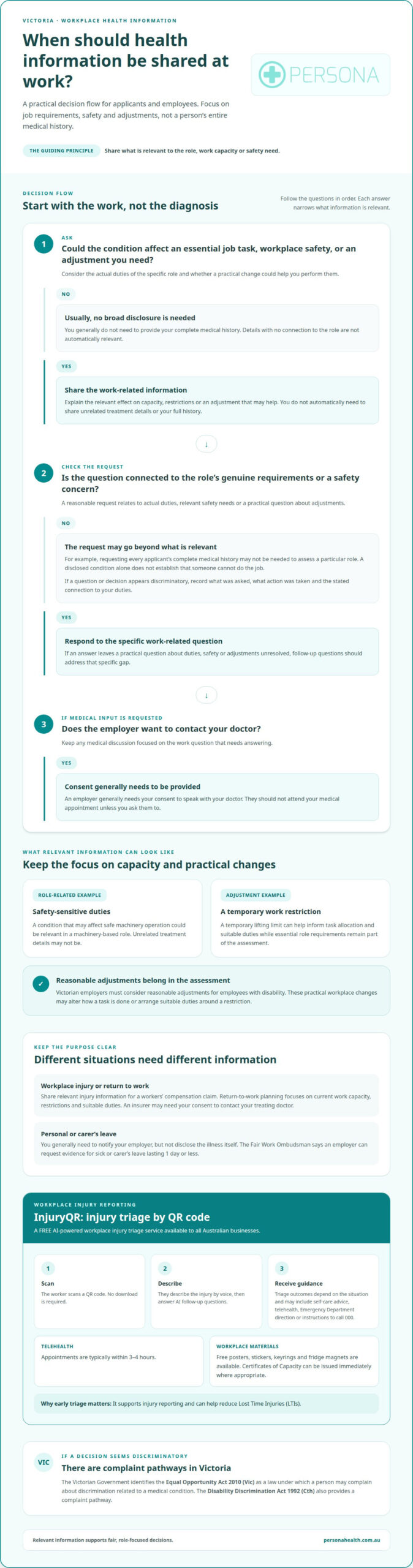
You generally need to share relevant health information when a condition affects essential job tasks, workplace safety or an adjustment you need. You do not usually need to provide your complete medical history. Understanding medical disclosure obligations for employers in Victoria means distinguishing work-related information from private details.
When disclosure may be necessary
Disclosure may be necessary when an illness or disability affects your ability to perform the inherent requirements of your role. For example, a condition affecting safe machinery operation may matter in a machinery-based position, while unrelated treatment details may not.
For a workers’ compensation claim, relevant injury information supports the process, and an insurer may need your consent to contact your treating doctor. A return-to-work plan should focus on current work capacity and restrictions affecting duties. Share information that informs those decisions, not automatically every health detail.
Adjustments and inherent job requirements
Reasonable adjustments are practical workplace changes that help a person with disability perform essential tasks. They may involve changing how a task is done or arranging suitable duties around a restriction.
Victorian employers must consider reasonable adjustments for employees with disability. Relevant medical information can explain a restriction and what change may help. For example, a temporary lifting limit may inform task allocation while essential duties remain part of the assessment. Employers with teams in Victoria and sites in Sydney, Melbourne, Parramatta or Gregory Hills should consider the role and the jurisdiction that applies at each workplace.
Discrimination and complaint options
Disability discrimination involves unfavourable treatment because of disability, rather than fair assessment against a role’s requirements. The Victorian Government identifies the Equal Opportunity Act 2010 (Vic) as a law under which a person may complain about discrimination related to a medical condition.
The Disability Discrimination Act 1992 (Cth) also provides a complaint pathway. Medical questions should relate to the job, not seek unrelated personal details. If a question or decision appears discriminatory, record what was asked, the action taken and its stated connection to your duties.
Workplace injury reporting, workers’ compensation claims and return-to-work planning have different purposes: report the injury, provide relevant claim information, and identify suitable duties or restrictions. For personal leave, you generally need to notify your employer, but not disclose the illness itself. According to the Fair Work Ombudsman, an employer can request evidence for sick or carer’s leave lasting 1 day or less.
For workplace injury reporting, InjuryQR is a FREE AI-powered triage service available to all Australian businesses. Workers scan a QR code without downloading an app, describe the injury by voice, then answer AI follow-up questions. Outcomes include self-care advice, telehealth appointments typically within 3-4 hours, Emergency Department direction or instructions to call 000. Free posters, stickers, keyrings and fridge magnets are available. Certificates of Capacity can be issued immediately where appropriate. Early triage supports reporting and can help reduce Lost Time Injuries.
Medical disclosure obligations for employers in Victoria are best managed through relevant questions and decisions based on actual duties, safety needs and possible adjustments.
What counts as a reasonable request for medical information?
A reasonable request connects health information to the actual duties, safety requirements or genuine requirements of a specific role. For applicants and employees, the focus should be on what they can perform and whether relevant adjustments may help.
Relevant information for job duties
Relevant medical information explains how an illness or condition may affect a person’s ability to perform essential tasks. An employer may ask an applicant about a health issue when it relates to the position’s genuine requirements.
For example, a question about safely completing a core physical task may be relevant if that task is unavoidable. An employer may also ask whether an adjustment could support performance. The assessment should relate to the role, not seek a general account of someone’s health.
An employer may request more information when an initial answer leaves a practical question about duties, safety or adjustments unresolved. Follow-up questions should address that specific gap. A request for unrelated medical history does not become relevant simply because an applicant or employee has disclosed an illness.
Potentially discriminatory requests
A potentially discriminatory request seeks health information without a reasonable connection to the job or treats a person unfavourably because of disability. For example, asking every applicant for a complete medical history may go beyond what is needed to assess a particular role.
Questions about mental health should also relate to the employment and a condition likely to affect the person’s work. The same principle applies to physical health: ask about capacity for relevant duties or possible adjustments, not diagnosis details without a work-related reason. A condition alone does not establish that someone cannot perform the job.
Keep the circumstances in view. A safety-sensitive task may justify a focused question, while a condition with no connection to the role may not. Before drawing conclusions about suitability, employers should consider whether reasonable adjustments could address the concern.
Refusing to disclose information
Refusing a relevant request can affect an employer’s ability to assess capacity, safety or adjustments. For an applicant, missing information may prevent an employer from deciding whether essential duties can be performed. For an employee, it may make planning suitable duties more difficult.
However, refusal does not automatically justify dismissal or rejection. The request must have a genuine and reasonable connection to the role; a decision based on irrelevant health information may raise discrimination concerns. If you’re unsure how to respond, clarify which task or safety issue the information relates to and what information is needed.
Where a workplace request remains unclear, discuss the medical information needed for a role in the context of its duties and assessment requirements.
Can my employer speak to my doctor?
In Victoria, an employer may speak with your treating doctor only with your consent. A direction to attend an employer-nominated medical examination is different and may be lawful in some circumstances, including a genuine health and safety concern.
Your consent should define what information the doctor can share and why it’s needed. For example, you might authorise answers about an injury’s effect on specific work tasks without agreeing to release unrelated treatment history. An employer should not contact your doctor for further information without your consent.
Before signing a release, clarify its purpose, the questions and the scope of disclosure. Ask whether the doctor will discuss current work capacity, restrictions or likely adjustments. This helps workers understand what medical information is being requested and how it relates to their duties.
In some circumstances, an employer may lawfully direct you to attend an examination with a nominated doctor. A genuine safety concern may justify that direction, but the assessment should focus on your capacity to perform your role. It is not an unrestricted review of your general health.
Agree beforehand on the questions the doctor will address and the information they may provide. You may suggest your own specialist when discussing which doctor to see. An employer should not attend your appointment unless you ask them to. If an Independent Medical Examination is arranged, the employer may access the report only with your consent.
Privacy also applies after health information reaches the workplace. Under Victoria’s Health Records Act 2001, you have a right to access health information about you held in Victoria, including records held by an employer. Employers should limit access to people who need the information for their work and protect stored records with strong data safeguards.
Keep a record of what you consented to share, with whom and for what purpose. If you’re asked to sign a broad release, seek clarification about whether a narrower authorisation can answer the employer’s work-related questions. The circumstances matter, particularly when an injury affects safe duties or a return-to-work plan.
A medical disagreement does not by itself mean you can be dismissed. Workers who believe they faced adverse action for using sick leave may have options under the Fair Work Act, and strict time limits apply. A doctor’s report should inform a work-related decision, not replace consideration of relevant restrictions and adjustments.
For a workplace health assessment, discuss the information needed for a work-related medical assessment.
Job-related pre-employment medical assessments
A pre-employment medical assessment can help establish whether an applicant can perform the inherent requirements of a particular role. In Victoria, its questions and examination should relate to the job’s core requirements or workers’ compensation insurance, not general health without a work-related purpose.
The role should guide the assessment. For a position involving regular lifting, relevant questions may explore the applicant’s capacity for those tasks. For a safety-sensitive role, the assessment may consider whether a medical condition could affect safe performance. The same examination would not automatically suit a different position with different duties.
Before requesting medical information, employers should identify the duties the assessment needs to address. This gives the examining clinician a clear scope and helps keep questions relevant. It also lets the applicant understand why particular information is being requested and how it relates to the work.
Some employers, including the Victorian Government, require pre-employment medical checks. The assessment must still focus on the specific role applied for. Its results should remain confidential, rather than being shared broadly across the workplace or used to assess unrelated aspects of an applicant’s health.
A medical condition does not, by itself, show that a person cannot do a job. If an assessment raises an unclear concern, the employer should seek relevant clarification rather than rely on assumptions. The next question is whether the applicant can meet the role’s inherent requirements, including with reasonable adjustments where appropriate.
Independent medical assessments may help clarify a specific concern about capacity, restrictions or work-related risk. The questions should be defined around the position’s actual duties. For example, if the concern is whether an applicant can safely complete a core task, the assessment should address that capacity rather than produce a general health profile.
Applicants can benefit from understanding the assessment’s scope before attending. Ask which role duties the examination addresses and what information will be reported to the employer. The assessment should inform a job-related decision, not require disclosure of every diagnosis or treatment detail.
Employers should consider the assessment alongside the role description and any relevant adjustment options. A finding of restriction may lead to further questions about modified duties or practical changes, rather than an automatic decision against hiring. The key issue is whether the essential tasks can be performed safely and reasonably.
Pre-employment medical assessments can be structured around the role’s duties, helping employers obtain relevant information about capacity and applicants understand the examination’s purpose.
Employee fitness for work and safety
An employer may require a medical examination when necessary to assess an employee’s ability to work safely. In Victoria, an employer may also direct an employee to provide medical information or attend an Independent Medical Examination in some circumstances, such as a genuine health and safety concern.
Fitness for work means being able to perform the inherent requirements of a position safely, considering current capacity and relevant restrictions. It is not a judgement about someone’s general health. The practical question is how an illness or injury affects specific duties, risks and available work arrangements.
A change in duties can make an earlier assessment less useful. For example, an employee whose position now involves heavier lifting may need their capacity assessed against those changed tasks. A doctor’s information should address the duties in question, relevant restrictions and whether adjustments could support safe work.
Employers must consider workplace safety alongside reasonable adjustments. This means identifying the hazard, understanding how the employee’s condition affects exposure or task performance, and then considering workable controls. A restriction may call for altered duties or a different work arrangement, rather than an immediate conclusion that the employee cannot work.
For a pre-existing injury or disease that may be affected by the job, Victorian workers’ compensation law requires disclosure. The Workplace Injury Rehabilitation and Compensation Act 2013 (Vic) is relevant to injury and compensation matters. Information should help assess the interaction between the condition and the work, not invite assumptions based on a diagnosis alone.
When an assessment finds an unclear or intermediate concern, further investigation is preferable to automatic rejection or exclusion. The employer can seek focused medical information about the employee’s ability to perform essential tasks and the safety risk involved. An employer may also seek a second medical opinion, particularly when adjustments are proposed.
Some roles have specific fitness standards. Under the National Standard for Health Assessment of Rail Safety Workers, a worker who has had a stroke must be declared temporarily unfit for duty for at least three months afterwards. This shows why the relevant position and its governing requirements matter; a rail safety assessment does not automatically set the standard for other jobs.
For workplace injuries, prompt reporting helps employers assess capacity and suitable duties. InjuryQR can support early injury triage and reporting. Fitness decisions should then rely on relevant information, current work restrictions and genuine safety requirements, not speculation about an employee’s condition.
Persona Health: Independent Medical Examiner
Persona Health provides Independent Medical Examiner assessments when an employer needs an independent view of an employee’s work capacity. This can help clarify how an illness or injury relates to specific duties, restrictions or fitness-for-work concerns. The assessment should focus on questions relevant to the role, giving employers information to support practical decisions about safe work and suitable duties.
For hiring decisions, Persona Health’s Pre-Employment Medicals assess capacity against the requirements of the position. Persona Health also provides Workplace Injury Management, Crystalline Silica Medicals and other role-related assessments. The appropriate option depends on the workplace question that needs to be answered.
Contact Persona Health to discuss an independent medical assessment.
Make health decisions part of a fair workplace process
A useful next step is to build role-related health questions into recruitment and workplace procedures. Decide what information is genuinely needed for each position, who may access it, and how it will inform decisions about duties or adjustments. A clear process helps keep conversations focused on work capacity rather than personal medical history.
For employers, documenting the reason for a request makes its purpose easier to explain. For workers, understanding how a question connects to the role can help you share relevant information with greater confidence. The medical disclosure obligations for employers in Victoria are best approached with care for both safe work and individual privacy.
When a capacity question is difficult to resolve, a structured occupational health assessment can help clarify the work-related issue. The aim is practical: support informed decisions while treating each person and their circumstances fairly.
With a clear, respectful process, employers and workers can move forward with greater confidence.
Frequently Asked Questions
Do I have to disclose a medical condition when applying for a job?
No general Australian law requires you to volunteer a diagnosis simply because you’re applying for work. The relevant issue is whether the condition could affect your ability to meet the position’s essential requirements or create a safety concern. You may be able to explain relevant work restrictions or adjustments without sharing unrelated personal health details. For example, describe the impact on a required task rather than providing your complete medical history.
Can I refuse to provide my medical information?
You can question a request that seems unrelated to the job, overly broad or unclear. Ask what work requirement the information will help assess and whether a narrower response would address it. Refusing a relevant request may leave an employer unable to assess capacity or safety, which can affect a hiring or workplace decision. Refusal alone does not automatically make dismissal or rejection lawful; consider the request and decision in context.
What are an employer’s duties under the Disability Discrimination Act 1992 and Equal Opportunity Act 2010 (Vic)?
These laws protect people from unlawful discrimination related to disability, including a medical condition. Employers must consider reasonable adjustments and assess whether the person can perform the position’s essential requirements with those changes. A condition may be relevant if the person still cannot perform those requirements after reasonable adjustments, or hiring them would breach occupational health and safety laws. The Victorian Equal Opportunity Act also provides a basis for making a discrimination complaint.

Article by
Ian Nicholson
Ian is the Business Support Manager at Persona Health, where he plays a key role across IT, sales, marketing and business operations. With a broad skill set and a practical, solutions-focused approach, Ian helps drive the systems, communication and commercial strategy that support Persona Health’s continued growth across Australia.