
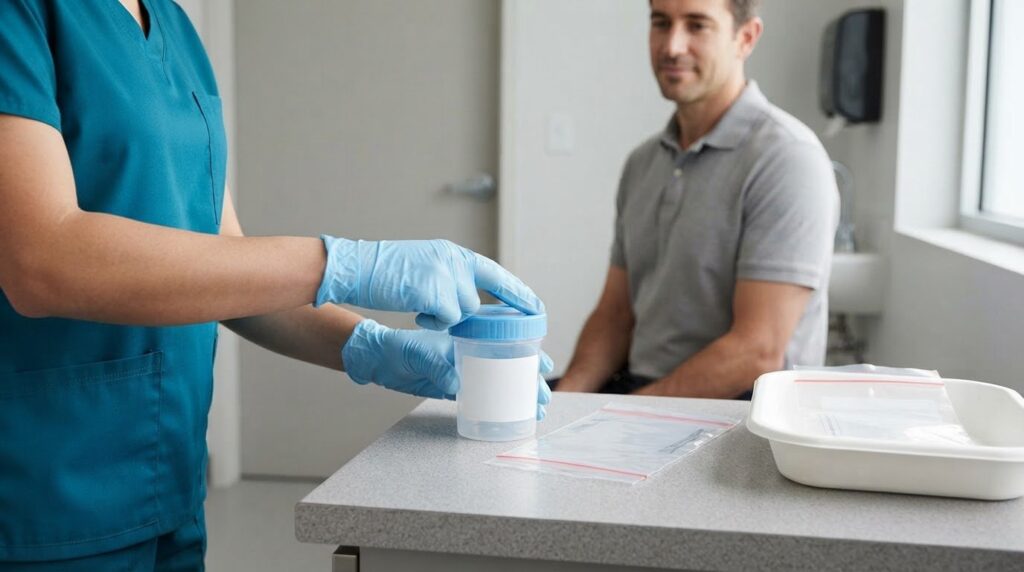
A non-negative screen is not a final finding. If you’re looking for the failed pre-employment drug test procedure in Australia, the key point is that an initial result should be followed by confirmatory laboratory testing before it is treated as a confirmed positive. What happens next depends on the employer’s policy, and a job offer may be withdrawn.
It’s understandable to feel concerned, especially when a result could affect a role you hope to start. Pre-employment tests commonly screen for cannabis, amphetamines, cocaine, opiates and alcohol. Prescription medicines or other legitimate substances may also be relevant when interpreting a result. This article explains how non-negative screens are confirmed, what a confirmed result could mean for your application, and why the employer’s policy and the role’s requirements matter. It also outlines what you can do if you believe a result is inaccurate.
Key Takeaways
- An initial non-negative screen is not a confirmed positive; confirmatory laboratory testing is the important next step.
- Learn which substances pre-employment tests commonly screen for and why legitimate medicines may be relevant when interpreting a result.
- A failed result does not trigger one automatic outcome. The employer’s policy and the requirements of the role can affect what happens to your application.
- If you believe a result is inaccurate, understand how to raise your concerns and ask about confirmation or review.
- Drug testing practices can vary with the industry and safety-sensitive nature of the work, so the role’s requirements matter.
Initial non-negative screening and confirmatory laboratory testing
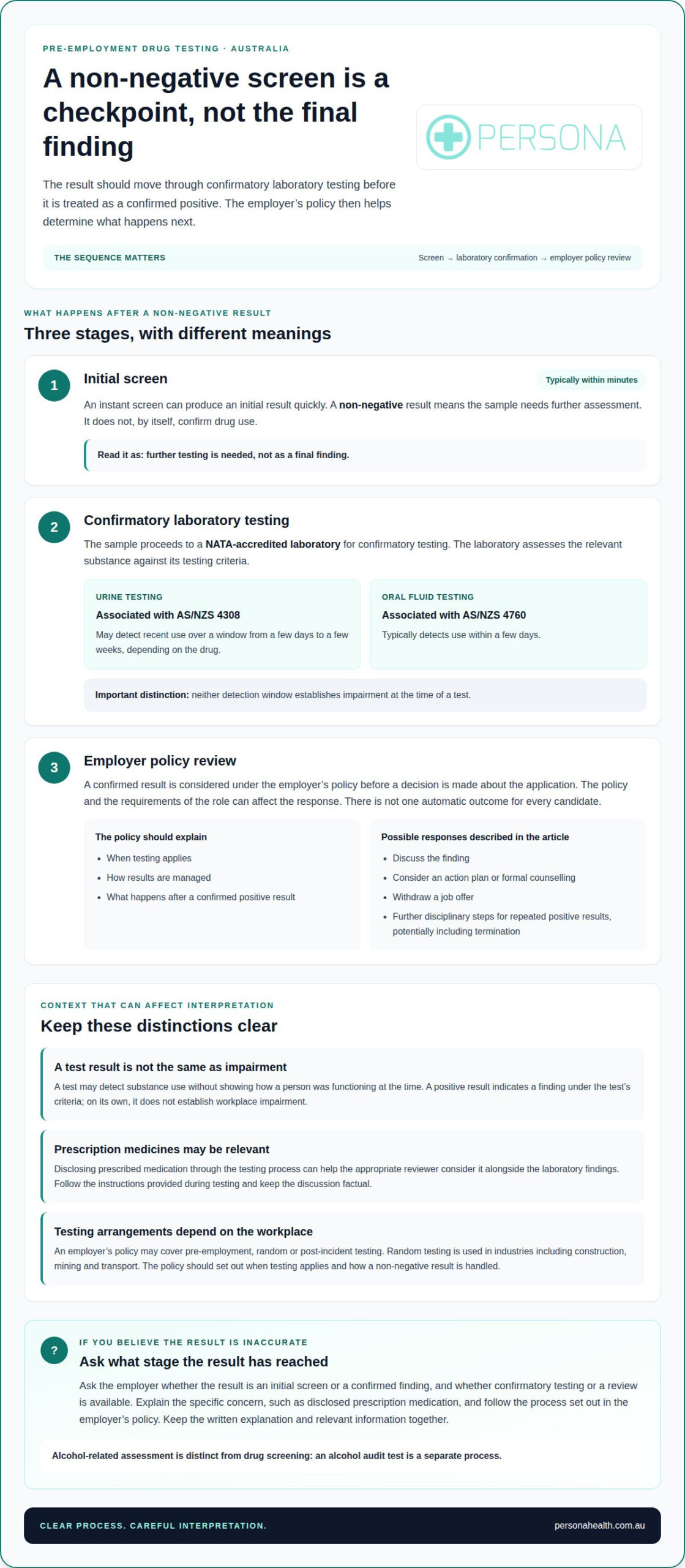
In Australia, an instant drug and alcohol screen typically produces an initial result within minutes. A non-negative screen does not, by itself, confirm drug use. It means the sample needs further assessment, so the result should proceed to confirmatory testing by a NATA-accredited laboratory. This distinction matters in pre-employment testing: an initial screening result should not be treated as the laboratory’s final finding.
Urine testing is commonly conducted under AS/NZS 4308, while oral fluid testing is associated with AS/NZS 4760. The sample type and testing method shape what the screen can detect. Urine testing may detect recent use over a window ranging from a few days to a few weeks, depending on the drug. Oral fluid testing typically detects use within a few days. Neither window establishes impairment at the time of a test.
Employers may arrange testing at different points in the employment relationship. Pre-employment testing is part of recruitment. Random testing may be set out in a workplace drug and alcohol policy. Post-incident testing may follow a workplace event if the employer’s procedure provides for it. The relevant policy should explain when each type of testing applies, how a non-negative result is handled and what happens next.
For a candidate, the practical steps after a non-negative screen are generally:
- The initial screen records a result requiring further analysis, rather than confirming drug use.
- A sample is sent for confirmatory laboratory testing, with the laboratory assessing the relevant substance against its testing criteria.
- The confirmed result is considered under the employer’s policy before the employer decides on the application.
Prescription medicines and other legitimate substances can be relevant when a result is reviewed. Disclosing prescribed medication through the testing process helps the appropriate reviewer consider that information alongside the laboratory findings. Keep the discussion factual: identify the medication and follow the instructions provided during testing. For alcohol-related assessment, an alcohol audit test is distinct from drug screening.
A clear policy explains the employer’s approach to drug and alcohol testing and workplace safety. It should state whether pre-employment, random or post-incident testing applies, how results are managed, and the consequences of a confirmed positive result. Random testing is used in industries including construction, mining and transport. In these workplaces, the policy sets expectations before testing and helps candidates understand the process.
What Employees Should Know About Non Negatives vs Positive Results?
A non-negative screen and a confirmed positive result are different stages, and the distinction can affect your application. If you believe a pre-employment result is inaccurate, ask the employer to explain the result and the process, including whether confirmatory testing or a review is available.
Accuracy and confidentiality of results
Accurate testing means interpreting a result through the relevant testing process. Confidentiality means handling personal test information discreetly. Both matter because a result may influence recruitment or employment decisions. An employer’s drug and alcohol policy should explain how results are reviewed, who handles them and what information is shared. If you disclosed prescription medication, make sure that information is considered during the review.
Results and workplace impairment
A positive test result indicates a finding under the test’s criteria; on its own, it does not establish that someone was impaired at work. A test can detect substance use without showing how a person was functioning at the time. The Fair Work Commission has found that a positive drug or alcohol test can be a valid reason for dismissal without proof of workplace impairment. The employer’s policy and the role’s requirements also inform its response.
Responses and possible outcomes
A positive result can lead to different responses under the employer’s policy, rather than one automatic penalty. An employer may discuss the finding, consider an action plan or provide formal counselling; a candidate may have a job offer withdrawn. Repeated positive results can lead to further disciplinary steps, potentially including termination. Under Australia’s Fair Work Act 2009, immediate dismissal after a positive workplace drug test can be challenged, according to the Federal Register of Legislation.
Retesting disputed results
If you dispute a result, ask the employer whether it was an initial screen or a confirmed finding, and whether confirmatory testing or a review is available. Explain the specific concern, such as disclosed prescription medication, and provide relevant details through the process set out in the employer’s policy. A challenge may be harder if testing procedures followed applicable guidelines, so it is important to distinguish screening from confirmation.
Keep the employer’s written explanation and any information about the result together. Note whether the decision relates to a confirmed result, the role’s requirements or a stated policy consequence. These details can help you understand the basis for the outcome and make a clear request for review.
If you need help understanding workplace testing processes, discuss your concerns with the appropriate occupational health team.
Commonly screened substances
Australian pre-employment drug testing commonly screens for cannabis, amphetamines, cocaine, opiates and alcohol. These are substance categories, not a guaranteed checklist for every role. The employer’s drug and alcohol policy sets out the testing approach and the substances in scope. A transport role and an office-based role may therefore have different testing requirements.
Substance names can refer to broad categories. For example, “opiates” identifies a drug group, while “cannabis” and “cocaine” identify other categories. Interpret a report according to the substance or category it actually records, rather than assumptions based on a broad label. This helps keep the discussion accurate if you’re responding to a result during recruitment.
Common screening categories include:
- Cannabis: one of the substances commonly included in Australian workplace screening.
- Amphetamines: a category that may appear on a workplace test panel.
- Cocaine: a substance category commonly screened during pre-employment testing.
- Opiates: a group that may be included in the employer’s testing scope.
- Alcohol: may be assessed alongside drug testing under a workplace policy.
The testing panel matters because a test can only report on the substances it is designed to assess. Employers set their approach through workplace drug and alcohol policies. The policy can explain which categories are included and how the employer considers a reported result. For an applicant, this helps clarify what the test was intended to identify.
Prescription medicines can also be relevant when interpreting a result. Disclose prescribed medication or other legitimate substances that could affect the outcome through the testing process. For example, provide details of a prescribed medicine when asked rather than assuming the report will explain its relevance. This gives the appropriate reviewer information to consider alongside the result.
A substance category on a report does not, by itself, explain every detail behind a finding. The result needs to be considered in context, including the test type, the substance reported and the employer’s policy. If the report uses a broad term such as “amphetamines”, ask the employer what it means under its process. This gives you a clearer basis for discussing any concerns.
Knowing the five commonly screened drug categories and alcohol can help you understand the scope of a pre-employment test. It can also help you identify relevant medication information and read the result without drawing conclusions beyond what it says. The employer’s policy and the report’s wording are practical starting points for understanding which substances were assessed.
Consequences of a failed pre-employment drug test
A confirmed positive result can affect whether an Australian employer proceeds with your application. The employer may withdraw a job offer, particularly for a safety-sensitive role, but the outcome depends on the organisation’s drug and alcohol policy and the position’s requirements. There is no single automatic consequence for every candidate.
For a role involving heavy machinery, passenger transport or other safety-critical duties, an employer may decide that a positive result conflicts with the role’s requirements. The employer’s policy should explain what happens after a positive result, including whether there is an opportunity to discuss the finding or access support. Outcomes can differ between workplaces because their policies and job risks differ.
Possible outcomes for a candidate include:
- Offer withdrawn: the employer may decide not to proceed, depending on its policy and the role.
- Further discussion: the employer may explain the result and consider relevant information before deciding.
- Support or training: a candidate may seek drug and alcohol support or training before applying for future roles.
- Reapplication: after taking steps to address concerns, a candidate may apply for jobs again.
Employers should consider whether their response is justified and proportionate. Relevant factors include the role’s demands, whether the position requires a worker to be drug free, evidence of impairment and the person’s work history. A new applicant may have no employment record to consider, making the stated policy and role requirements especially important.
A Fair Work Commission case illustrates why circumstances matter, although it concerned an existing employee rather than a job applicant. Reece Goodsell had worked for Sydney Trains for 26 years when he was dismissed after a positive drug test. The Commission found his dismissal unfair and reinstated him, considering his spotless employment record and the absence of impairment on the day of testing. His case does not determine every recruitment decision, but shows that context can matter when an employer assesses consequences.
If an offer is withdrawn, ask for the decision and its policy basis in writing. Keep the employer’s communication and relevant testing information together. If you believe the result or process was inaccurate, raise the specific issue through the employer’s review process. A clear record can help you understand whether the outcome followed the policy and what information informed the decision.
A failed test can end one application without determining your prospects with every future employer. Employers set their own policies and role requirements, so a later application may involve a different process. Appropriate support or training may help you prepare for future opportunities and understand the expectations of safety-sensitive work.
Do drug testing rules differ by Australian state, industry, or safety-sensitive role?
Across Australia, drug testing practices are shaped by the employer’s policy, industry and role. Employers do not have an automatic right to test workers in every circumstance. Work health and safety grounds may support testing where it is needed to meet a duty of care. The relevant workplace policy and job requirements help explain when testing applies.
State and territory context can matter, but Australian employers do not all follow one routine. An employer’s policy should set out its approach, including whether testing occurs before employment, randomly or after an incident. It should also explain the procedure and possible consequences. For an applicant, the policy is a practical starting point for understanding what a test means for a particular role.
Industry can influence the approach. Pre-employment testing is used in sectors such as construction, mining and transport. Random testing is more likely in work involving heavy machinery, including some manufacturing, mining, transport, heavy-vehicle and passenger-transport roles, and Corrections. These settings can involve tasks where a worker’s ability to perform safely matters to others.
A role’s demands can matter as much as its industry. A safety-sensitive position may involve operating machinery, driving a heavy vehicle or carrying passengers. The Fair Work Commission has considered drug testing a fair and reasonable safety measure in safety-sensitive workplaces where there is no practical way to assess impairment directly. This relates to the workplace context, not a blanket rule for every job.
To understand how a policy applies, focus on the specific features of the role:
- Tasks: identify whether duties involve machinery, driving or passenger transport.
- Testing point: establish whether the policy covers pre-employment, random or post-incident testing.
- Process: note how the employer handles a non-negative screen and a confirmed result.
- Consequences: understand what the policy says about a positive result and the job offer.
For example, a transport employer may use random testing for a passenger-transport role, while a different position follows another policy. The role’s duties and the employer’s stated process explain the difference better than assuming one rule applies across every industry or Australian state.
Employers also need to balance health and safety with privacy. Courts and tribunals generally recognise that random testing intrudes on individual privacy, while safety-sensitive duties may provide a workplace reason for testing. A clearly communicated policy helps candidates understand the employer’s approach before testing occurs. Employers seeking to discuss how these considerations apply can discuss workplace drug testing requirements.
Persona Health: Pre-Employment Medicals
Persona Health provides Pre-Employment Medicals and Drug and Alcohol Testing to support recruitment and workplace health requirements. In Sydney, employers can access clinics at Gregory Hills and Rosebery, as well as Parramatta and Dee Why. Melbourne clinics are located in Cairnlea and Craigieburn. Its network includes 100 affiliate clinics nationwide, with Australia-wide mobile workplace services for employers needing assessments at their sites.
Fast turnaround times, responsive customer service, an employer-focused approach and modern digital reporting help keep the process organised. These services may suit employers planning role-based screening, or applicants who need to complete an assessment as part of recruitment.
For support with your pre-employment medical or workplace testing needs, contact Persona Health.
Choose a clear next step
A difficult result can leave you unsure how to move forward. Understanding the failed pre-employment drug test procedure in Australia can help you prepare focused questions about the result, the employer’s policy and your next steps.
Persona Health provides Pre-Employment Medicals, Workplace Injury Management and Crystalline Silica Medicals. For workplace injuries, InjuryQR is a free AI-powered triage service for Australian businesses, with free posters, stickers, keyrings and fridge magnets. Workers scan a QR code without downloading an app, describe an injury by voice, then answer AI follow-up questions. Outcomes can include self-care advice, telehealth appointments typically within 3-4 hours, direction to an Emergency Department or instructions to call 000. Certificates of Capacity can be issued immediately where appropriate. This supports clearer reporting and can help reduce Lost Time Injuries.
A considered next step can help you regain a sense of direction.
You can move forward with clearer questions and a better understanding of your options.
Frequently Asked Questions
What Happens If You Fail a Pre-Employment Drug Test in Australia?
An employer may withdraw the offer, depending on its policy and the role’s requirements. The procedure after a failed pre-employment drug test in Australia depends on whether the result is confirmed and how the employer applies its policy. For example, a heavy-vehicle driving role may have different requirements from an administrative position. Ask for an explanation of the decision and the information behind it, especially if you believe relevant details were missed.
If an employee fails a drug test, is dismissal the right move?
Dismissal is not an automatic consequence, and the employer should consider the circumstances and its policy. Relevant factors include the role’s safety requirements, whether the employee was impaired, the policy’s terms and the person’s work history. The Fair Work Act 2009 may be relevant to a dismissal challenge, according to the Federal Register of Legislation. A candidate who has not started employment faces a different situation from a current employee.
What if I test positive?
Ask whether the result is an initial screen or a confirmed finding, then follow the employer’s stated process. If you take prescription medication, disclose it through the testing process and provide accurate details when requested. You can also ask what the result means for your application and which policy provisions apply. Keep communications factual and retain the employer’s response so you can refer to the same information in any follow-up discussion.
Can I refuse a test?
You can refuse, but doing so may put a job opportunity at risk. For current employees, refusal may lead to disciplinary action, including termination. If an employment contract or policy explicitly requires testing, refusal may be argued before the Fair Work Commission as failure to follow a lawful and reasonable direction. Before deciding, consider the role, the written policy and the consequences it describes, and ask the employer to explain the process.
How to Resolve Drug Testing Issues?
Start by identifying the specific issue: for example, a result you believe is inaccurate, medication information that was not considered, or uncertainty about the employer’s decision. Explain your concern clearly to the employer and ask how its policy allows the matter to be reviewed. Keep relevant correspondence and test information together. If the issue concerns an employment decision, the circumstances and applicable workplace arrangements will shape your options.
What are the Employee Rights?
Employees can raise concerns about accuracy, ask how a result was assessed and seek clarification about the employer’s policy. Drug testing can affect privacy, and employers cannot dictate what drugs or alcohol employees use in their own time. At work, however, employers may have safety responsibilities and policies addressing testing. The policy, role and circumstances all matter, so ask what information informed the decision and how it was handled.
What happens after a failed pre-employment drug test in Australia?
The procedure following a failed pre-employment drug test in Australia begins with the employer considering the result under its recruitment policy. The employer may decide not to proceed, depending on the role’s duties and stated requirements. If you are told an offer has been withdrawn, ask which policy provision informed the decision and whether your explanation was considered. This gives you a practical record and helps clarify what to address in future applications.
What are the steps for confirming a non-negative pre-employment drug test in Australia?
A non-negative initial screen should lead to confirmatory testing by a NATA-accredited laboratory; it is not itself confirmation of drug use. The laboratory analyses the sample, then the confirmed finding is considered through the employer’s process. Ask whether the result is still at screening stage or has been confirmed, and how relevant medication information can be considered. The sample type and testing method determine which standard applies, such as AS/NZS 4308 for urine testing.

Article by
Ian Nicholson
Ian is the Business Support Manager at Persona Health, where he plays a key role across IT, sales, marketing and business operations. With a broad skill set and a practical, solutions-focused approach, Ian helps drive the systems, communication and commercial strategy that support Persona Health’s continued growth across Australia.