

What if signing a medical release form doesn’t mean handing over your entire health history? For candidates and employers, candidate consent medical records release Australia is not a blank cheque. Before signing or requesting consent, identify the purpose, the information covered, who will receive it and how it relates to the role.
It’s understandable to feel uncertain when a form uses broad wording or doesn’t explain what happens next. A pre-employment assessment report about a candidate’s capacity for a role is not the same as access to their clinical records. Australian privacy protections, including the Privacy Act 1988 and relevant state or territory laws, shape how health information is handled.
This guide explains what consent can cover, how assessment findings differ from clinical records, and what candidates and employers can clarify before requesting or signing a release. A few practical questions can help everyone understand the purpose and limits of consent before information is shared.
Key Takeaways
- Before signing a release, identify its purpose, the information covered and the intended recipient so you understand what you’re agreeing to.
- Candidate consent medical records release Australia should be specific to the proposed disclosure, not treated as permission to share an entire medical history.
- Distinguish an occupational assessment report about role-related capacity from a candidate’s underlying clinical records.
- Privacy requirements can depend on the organisation and circumstances. Consider how the Privacy Act 1988 and relevant state or territory rules may apply.
- Employers can make requests clearer by linking the assessment to the role. Candidates can ask questions and keep a copy of the consent form.
Candidate consent for medical records release in Australia: what are you agreeing to?
Signing a medical release during recruitment can feel consequential, particularly when a form refers to health information without explaining exactly what will be shared. In practical terms, consent is permission for specified information to be handled or disclosed for a stated purpose, subject to the privacy laws that apply. It doesn’t automatically authorise access to every medical record.
The distinction between an assessment report and a clinical record matters. A pre-employment assessment report may outline findings relevant to the role, such as functional considerations or whether further assessment may be relevant. A clinical record is broader and may contain detailed information gathered during healthcare. The form, assessment purpose and information requested help define what is in scope. A report is not necessarily a copy of a candidate’s full clinical history.
Consent should make clear the purpose of a disclosure, the information within its scope and who is meant to receive it. The Office of the Australian Information Commissioner’s (OAIC) guidance on the Privacy Act 1988 (Cth) is one reference point for understanding Australian privacy protections. Which rules apply depends on the organisation and circumstances.
Why an employer may request a pre-employment medical
A role-related assessment can help an employer understand whether a candidate can perform the role’s stated requirements safely, and whether relevant adjustments may need consideration. The assessment should relate to the work, not become a general investigation into a person’s health.
For example, a position involving regular manual handling may call for an assessment focused on relevant functional capacity. That doesn’t mean every applicant, or every role involving physical work, needs the same tests. The assessment scope should reflect the actual requirements of the particular position. Persona Health’s pre-employment medical assessments provide an occupational health pathway for employers arranging role-related assessments.
Consent is not automatically permission for every record
Before signing, check the form’s wording carefully. Look for the information it covers, the reason it’s requested and the person or organisation that will receive it. A request for a role-related assessment outcome is different from a request to obtain records from a treating doctor or another health service. A general phrase such as “medical information” may not explain the intended scope.
If you’re an employer, describe the job-related question the assessment needs to address and keep the request aligned with it. If you’re a candidate, ask for plain-language clarification if the form doesn’t identify what will be disclosed or to whom. You can also ask whether the request concerns an assessment report, particular records or another defined type of information.
Consent and disclosure are subject to applicable law and the specific circumstances. Avoid assuming that consent can always be refused or withdrawn without consequence. If the wording remains unclear, establish what the form is intended to cover before signing or requesting disclosure.
What can a medical records release cover, and who may receive it?
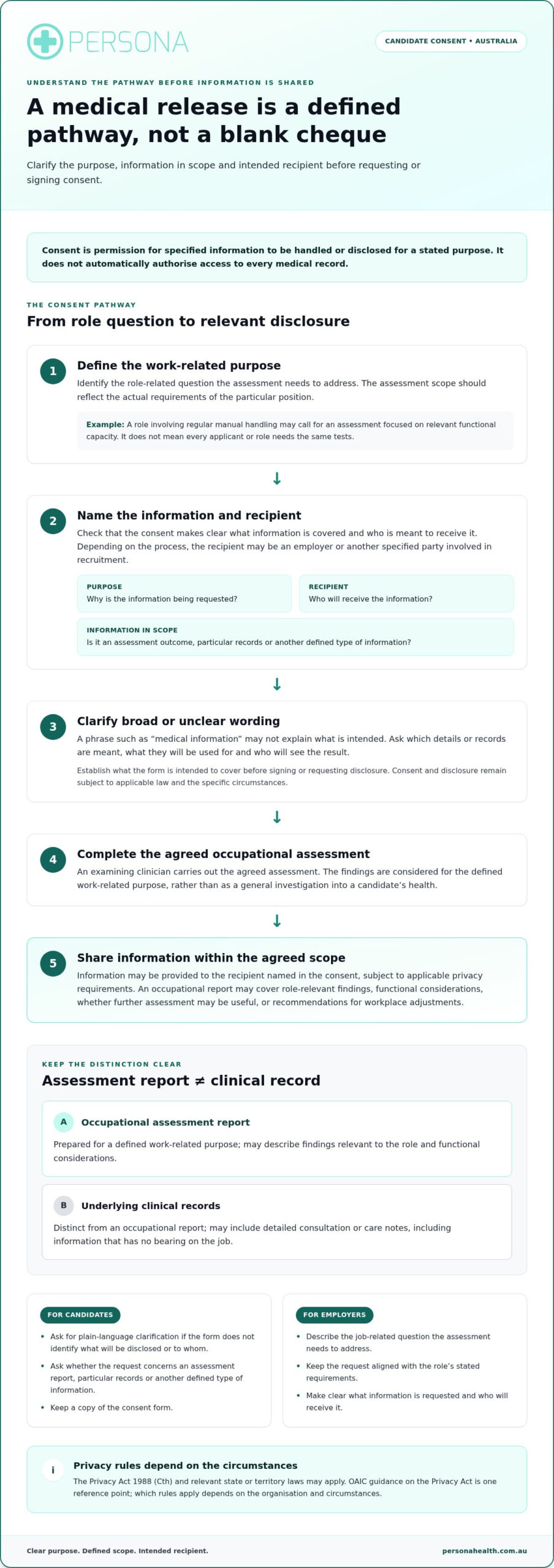
A release is best understood as a pathway, not just a signature. The candidate provides consent for the scope described in the relevant form; an examining clinician carries out the agreed assessment; and information may then be provided to the recipient named in the consent, subject to applicable privacy requirements. Depending on the process, that recipient might be an employer or another specified party involved in recruitment.
The information shared can vary. An occupational assessment may communicate findings relevant to the role, functional considerations, whether further assessment may be useful, or recommendations for workplace adjustments. These are examples, not a promise of a standard report format. The purpose of the assessment and the consent document help define what is requested and reported.
Assessment report versus underlying clinical records
An employer may need an outcome relevant to the role, not every clinical note in a candidate’s health history. An occupational assessment report is prepared for a defined work-related purpose. Underlying clinical records are distinct and can include detailed notes from consultations or care that may have no bearing on the job. The pre-employment medical process provides an occupational health assessment, but the release form still helps define the agreed scope of disclosure.
Check the purpose, recipient and information requested
Before information is released, look for three specifics in the consent: why it is being requested, what information is covered and who will receive it. Consider how the recipient says the information will be used. The Office of the Australian Information Commissioner (OAIC) guidance on the Privacy Act provides a federal privacy reference, though the rules that apply can depend on the organisation and circumstances.
If a form refers broadly to “medical records”, ask which records or details that means, whether the request is for an assessment outcome or information from another health provider, and who will see the result. Employers can make requests clearer by stating the role-related question the assessment needs to address. Candidates can ask for plain-language clarification before signing or authorising a disclosure. These questions help both sides understand the proposed information pathway without assuming every disclosure is appropriate in every employment context.
To make the pathway easier to follow, consider it in stages:
- Candidate: reviews the consent and gives permission for the described handling or disclosure.
- Examining clinician: conducts the agreed assessment and considers information relevant to its purpose.
- Named recipient: receives the information covered by the consent, subject to applicable requirements.
Keep the assessment purpose, consent wording and intended recipient aligned. A release should not be treated as automatic authority to circulate information beyond its stated scope. If you’re arranging a role-focused assessment, speak with Persona Health about pre-employment medicals.
Which Australian privacy rules may apply to candidate medical information?
Candidate health information is sensitive, but the privacy rules that apply depend on who collects or holds it, the type of information and the circumstances. For candidate consent medical records release Australia, there isn’t always one simple rule that answers every question. Employers and health providers should identify the relevant organisation and jurisdiction before relying on a general privacy statement.
The Privacy Act and Australian Privacy Principles
The federal Privacy Act 1988 and its Australian Privacy Principles (APPs) are important references for organisations covered by the Act. The APPs address how personal information is collected, used and disclosed, as well as matters such as security and individual access, subject to applicable requirements and exceptions. Coverage isn’t identical for every employer or provider. The Office of the Australian Information Commissioner (OAIC) guidance on the Privacy Act explains the federal framework and can help readers understand its scope.
In recruitment, this framework is relevant to questions such as whether a candidate has been told why health information is being collected, how it may be used and which parties may receive it. It doesn’t mean that every organisation is covered in the same way, or that a consent form alone settles every privacy question. The organisation’s status, the information involved and the circumstances all matter.
Why state and territory context matters
State or territory health-records laws may also be relevant. NSW and Victoria, for example, have specific health information frameworks. Whether a particular law applies depends on the organisation and situation, so don’t assume that a rule for one state applies across Australia. For a disputed or high-stakes interpretation, seek advice from a qualified Australian legal professional.
The table below offers a starting point, not a legal determination for an individual case. Check current guidance and legislation for the relevant jurisdiction.
| Framework | What it may help clarify | Important context |
|---|---|---|
| Federal: Privacy Act 1988 and APPs | Standards for collecting, using and disclosing personal information, including health information, by organisations covered by the Act. | Coverage depends on the organisation and circumstances. The Act includes exceptions and other rules that may affect how it applies. |
| NSW: Health Records and Information Privacy Act 2002 | NSW’s health information framework, including requirements relevant to handling health records. | Its application depends on the organisation, information and situation. Check current NSW guidance. |
| Victoria: Health Records Act 2001 | Victoria’s framework for handling health information. | It may apply in relevant Victorian circumstances, but shouldn’t be assumed to govern every employer or provider. |
One national privacy rule shouldn’t be assumed to answer every candidate medical information case. For candidates and employers, identify which organisation holds the information and where the relevant handling takes place. Then check the applicable guidance before drawing conclusions about a release.
How candidates and employers can handle a consent request clearly
A clear consent process gives the candidate and employer a shared understanding of what is being requested and why. Candidates can read the form and raise questions before information is released. Employers can define the request so the assessment remains focused on the role rather than becoming a broad enquiry into a person’s health.
Use this sequence to work through a consent request:
- Identify the purpose. Find out what work-related question the assessment or release is intended to address.
- Read the scope. Check which assessment information or records the form describes. Note broad terms that don’t identify what is covered.
- Confirm the recipient. Look for the person or organisation that will receive the information, and whether the form describes any further disclosure.
- Ask questions. If the wording is unclear, request an explanation before signing or seeking disclosure. Keep the discussion focused on the form’s purpose and scope.
- Keep a copy. Retain the completed consent and any written clarification, so you can refer back to what was agreed.
Questions to clarify before signing
Ask who will receive the report and what decision it will inform. Check whether the release covers an occupational assessment outcome, specified information or broader clinical records. If the language is unclear, ask the employer or the person managing the assessment to explain it in plain English. You can also raise a concern about the wording or scope and request clarification before deciding how to proceed.
A practical process for employers
Start with the inherent or stated requirements of the particular role. Identify the tasks or work conditions the assessment needs to address, rather than applying an identical request to every position. Share relevant role information with the occupational health provider so the assessment can be planned around those requirements. Persona Health provides pre-employment medical assessments for employers arranging role-related assessments.
Next, make the consent process easy to understand. Explain the assessment’s purpose, identify the intended report recipient and use clear wording about the information requested. Limit access to people with a genuine work-related need to see the report, and handle it in line with the privacy requirements that apply to the organisation and circumstances. Avoid requesting unrelated health details simply because a form could be written broadly.
For candidates, it’s reasonable to ask how the report will be used and who will see it. This is not advice to conceal relevant information or a conclusion about whether consent can be refused. If you have a concern about the consequences of signing or the wording’s legal effect, consider seeking independent legal advice.
A careful, documented process helps prevent misunderstandings and supports a proportionate assessment. Clear communication matters at each step.
How Persona Health supports clear pre-employment medical reporting
Clear consent is one part of a well-organised pre-employment medical process. The assessment also needs a defined purpose, relevant role information and a reporting pathway the employer understands. Persona Health provides occupational health assessments and reporting to support employer decision-making. This is an occupational health service, not legal advice, and it doesn’t replace advice about how privacy or employment laws apply in a particular situation.
A role-focused assessment and reporting pathway
Employers can help shape a useful assessment by setting out the role’s duties and the specific work-related questions they need considered. This gives the occupational health team context to plan an appropriate assessment, rather than relying on a generic request. Persona Health’s pre-employment medicals support this practical pathway. The findings and any recommendations depend on the individual assessment.
For example, where a role involves particular physical tasks, an employer can describe those tasks so the assessment is relevant to the job. A clear scope helps keep the process focused. Reporting is intended to inform employer decision-making, not to guarantee a particular outcome or replace the employer’s consideration of the role’s requirements.
Consent remains important throughout. The candidate should understand the assessment and reporting arrangements, while the employer should ensure the request is consistent with the agreed purpose and applicable privacy requirements. Persona Health delivers occupational health services and reporting, but does not determine the legal effect of a consent form. For questions about legal obligations or a disputed interpretation, obtain advice from a qualified legal professional.
Accessing services across Sydney and Australia
Persona Health provides occupational health services in Sydney, including Parramatta and Gregory Hills, and in Melbourne. Candidates and employers can discuss a pre-employment medical pathway that fits the role and recruitment process.
For organisations coordinating health needs across their workforce, Persona Health also provides on-site health surveillance. This can support workplace health monitoring while keeping the assessment purpose and reporting process clear.
Whether you’re arranging an assessment for one candidate or coordinating a recruitment process across Sydney, Melbourne, Parramatta or Gregory Hills, a clear scope is a practical place to begin. Persona Health can discuss a suitable occupational health pathway based on the role and your organisation’s needs.
Build a clearer consent process into your next recruitment round
Make consent part of a thoughtful, consistent process, rather than a form candidates encounter without context. A well-planned approach to candidate consent medical records release Australia can help everyone understand how the assessment fits into recruitment and where questions should be directed.
For employers, set out the work-related purpose before requesting an assessment and give candidates a clear way to raise questions about the process. For candidates, understanding the proposed pathway can make it easier to discuss concerns early. If a question turns on the legal effect of a form or a particular privacy obligation, seek advice from a qualified legal professional.
Persona Health provides pre-employment medicals for employers planning occupational health assessments. A clear starting point can support a more considered experience for both the organisation and the candidate.
With the right process in place, candidates and employers can move forward with a shared understanding of what comes next.
Frequently Asked Questions
Does a candidate have to consent to the release of medical records in Australia?
A candidate’s medical information shouldn’t be disclosed to an employer simply because they’re applying for a job. The applicable privacy rules and circumstances determine what authority is needed, and specific consent may be required for a release. For candidate consent medical records release Australia, check whether the request concerns an assessment arranged for recruitment or records held by another clinician. Ask who is seeking the information and what basis they’re relying on if this is unclear.
Can an employer access a candidate’s full medical records?
A job application alone doesn’t give an employer access to a candidate’s complete clinical history. Specific consent or another lawful basis may be relevant, but what can be disclosed depends on the circumstances and applicable law. For example, an employer seeking information about task-related capacity shouldn’t assume that this means it can obtain unrelated consultation notes. Candidates can ask the organisation to explain the precise records or information it wants.
What information can be included in a pre-employment medical report?
There isn’t one report format for every assessment. Depending on the agreed assessment and role, a report may describe relevant findings, functional considerations, or whether further review or adjustments warrant consideration. For example, an assessment for a role with particular physical tasks may address those tasks rather than provide a general account of a candidate’s health. The clinician’s findings and the consent arrangements shape what is reported. Ask how the requested assessment relates to the job.
Can a candidate withdraw consent after signing a medical release?
A candidate who wishes to change or withdraw consent should contact the organisation managing the release promptly. Whether withdrawal is available, when it takes effect and what happens to information already disclosed can depend on the relevant law and circumstances. Don’t assume that a request will reverse a disclosure already made. Ask for an explanation of the process and, if the consequences may affect your recruitment or privacy rights, consider getting independent legal advice.
Does the Privacy Act 1988 apply to every employer and medical provider?
No. The Privacy Act 1988 and Australian Privacy Principles are important federal references, but the Act doesn’t apply identically to every organisation. Coverage can depend on factors such as the organisation’s type, the information and the circumstances; state or territory health-records laws may also be relevant. For instance, a candidate dealing with an organisation in NSW or Victoria may need to consider the relevant local framework. Check current OAIC and jurisdictional guidance for the situation.
Can a candidate refuse to sign a medical records release?
A candidate can raise concerns and ask for clearer wording before deciding whether to sign, but the legal position and practical consequences of not providing consent depend on the circumstances. An employer may explain why an assessment is relevant to a role, while the candidate can ask what information is needed and how it relates to the recruitment decision. If refusing or limiting consent could affect an application, seek independent advice rather than relying on a general rule.
How should an employer request consent for a pre-employment medical?
Explain the role-related reason for the assessment, provide consent information in a form the candidate can understand, and allow them to raise questions before the process proceeds. Keep the request connected to the position rather than using identical broad wording for every vacancy. Employers arranging assessments in Sydney, including Parramatta or Gregory Hills, or in Melbourne can discuss pre-employment medicals with Persona Health. A clear request helps candidates understand what participation involves.

Article by
Ian Nicholson
Ian is the Business Support Manager at Persona Health, where he plays a key role across IT, sales, marketing and business operations. With a broad skill set and a practical, solutions-focused approach, Ian helps drive the systems, communication and commercial strategy that support Persona Health’s continued growth across Australia.