

Could the same medical assessment suit a civil construction plant operator, a labourer and a worker exposed to silica dust? The practical starting point is the work each person will actually do. For employers arranging civil construction medicals Sydney, matching checks to role requirements and relevant hazards can make the process more useful than applying one standard assessment to every worker.
It’s understandable to want clear guidance on which checks are appropriate, especially when projects, shifts and worker locations make appointments harder to coordinate. Medical assessments should support informed employment decisions while respecting each worker’s individual circumstances and health information.
This guide explains how to align assessments with civil construction tasks, distinguish pre-employment medicals from ongoing health surveillance, and plan appointments around your Sydney workforce. You’ll also learn how Persona Health’s clinics in Gregory Hills and Rosebery, other Sydney locations, and Australia-wide mobile workplace services can help make coordination more straightforward. The aim is a practical, role-specific approach that supports safe and fair decisions without adding unnecessary complexity.
Key Takeaways
- For civil construction medicals Sydney, start with the worker’s actual tasks and relevant hazards rather than applying one assessment to every role.
- Keep pre-employment assessments distinct from ongoing health surveillance, which focuses on potential effects of specific workplace exposures.
- Compare assessment providers on role relevance, exposure scope, appointment access, reporting and workplace delivery, not a checklist alone.
- Define essential duties and share clear referral information to help workers understand the process and support a well-scoped assessment.
- Consider Persona Health’s Rosebery and Gregory Hills clinics, with Parramatta and Dee Why also available in Sydney, alongside digital reporting and mobile workplace services.
Civil construction medicals in Sydney: when does an employer need an assessment?
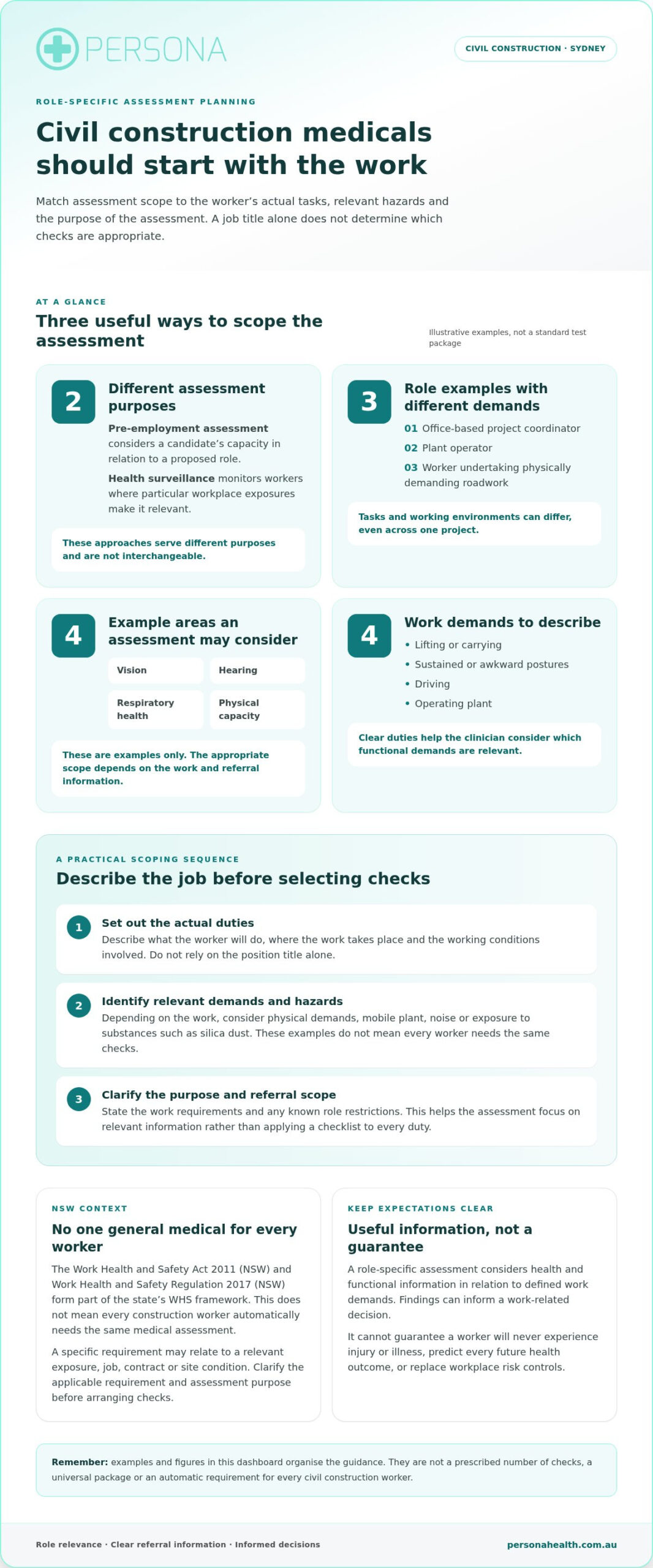
A civil construction medical is an occupational health assessment selected in light of a worker’s actual duties, the demands of the role and relevant workplace hazards. It isn’t a universal pass-or-fail template, and a job title alone doesn’t determine which checks are appropriate. The aim is to gather relevant information to support an informed employment or work decision.
Different assessment types serve different purposes. A pre-employment medical assessment considers a candidate’s capacity in relation to a proposed role. Health surveillance, by contrast, involves monitoring workers where particular workplace exposures make it relevant. Other job-specific assessments may apply to defined duties or site requirements. These approaches aren’t interchangeable, so it helps to be clear about the question each assessment is intended to address.
Civil projects can involve varied work, from roads and utilities to structures and earthworks. That variety is a useful reminder to assess the duties and working conditions involved, rather than assuming every worker on a project has the same needs. A project’s Sydney location doesn’t by itself establish a special medical rule.
Which civil construction roles may have different assessment needs?
Consider an office-based project coordinator, a plant operator and a worker undertaking physically demanding roadwork. Their tasks and working environments may differ, so the relevant assessment scope may differ too. Depending on the work, an employer may need to consider physical demands, mobile plant, noise or exposure to substances such as silica dust. These are examples to guide discussion, not automatic tests for every worker.
Start with the duties, not just the position name. Clarify what the worker will do, where the work takes place and which hazards are relevant. A plant operator’s role may involve different demands from a coordinator’s, while two workers with the same title may perform different tasks across projects. The assessment should be scoped to the role and relevant referral information.
Is a civil construction medical legally required in NSW?
Employers shouldn’t assume that NSW requires one general medical assessment for every construction worker. The Work Health and Safety Act 2011 (NSW) and Work Health and Safety Regulation 2017 (NSW) form part of the state’s WHS framework, but that doesn’t mean every worker automatically needs the same medical. General role screening is different from a specific requirement that may apply because of a relevant exposure, job, contract or site condition.
Before arranging an assessment, identify its purpose and check the requirements that apply to the work and project. Exposure-related health surveillance, for example, is not simply a more detailed pre-employment check. If a site or employer specifies an assessment, clarify its scope and the duties it relates to. This helps avoid unnecessary checks and gaps in information relevant to the role.
For workplace injury reporting and triage, InjuryQR is a free AI-powered service available to Australian businesses. Its QR resources include free posters, stickers, keyrings and fridge magnets. Certificates of Capacity can be issued immediately where appropriate. Timely triage can support better injury reporting and help reduce Lost Time Injuries by guiding workers towards an appropriate response.
What can a Sydney civil construction medical assessment cover?
There isn’t one fixed set of checks for every civil construction worker. Depending on the role and referral information, an assessment may consider relevant medical history and areas such as vision, hearing, respiratory health or physical capacity. These are examples, not a standard package: the appropriate scope depends on the tasks, work environment and purpose of the assessment.
A role-specific assessment considers health and functional information in relation to defined work demands, but it cannot guarantee that a worker will never experience an injury or illness. Findings can help inform a work-related decision. They don’t replace workplace risk controls, predict every future health outcome or remove the need to consider individual circumstances.
How do job demands shape the assessment?
Useful referrals describe what the worker will actually do, not just their position title. Depending on the role, relevant demands may include lifting or carrying, sustained or awkward postures, driving, or operating plant. A clear description helps the assessing clinician consider which areas are relevant and avoid treating every duty as if it carries the same physical demands.
For example, an assessment for a role involving frequent manual handling may consider different functional demands from one for a worker whose duties are primarily administrative. The employer can support a relevant assessment by setting out essential tasks, work patterns and any known restrictions on the role. Persona Health’s Sydney pre-employment medical assessments are one pathway for considering a candidate’s health information against proposed work requirements.
When might exposure-related health surveillance be relevant?
Health surveillance relates to a worker’s exposure to particular hazards. It isn’t a generic screening add-on, and a functional or physical assessment doesn’t replace exposure-related monitoring. Employers should consider the work and exposure context, including the materials and processes involved, rather than assuming that a job title alone determines the need.
For instance, silica or asbestos may be relevant where tasks and exposure circumstances involve those hazards. A worker’s potential exposure depends on what they do and the conditions in which they do it. The Australian Government Building and Construction WHS Accreditation Scheme provides a construction safety context, but accreditation information is not itself a medical assessment specification. Scope should remain connected to the worker’s actual duties and relevant referral details.
Keeping these purposes distinct helps employers request information that is relevant to the decision at hand. It also makes it easier to explain to workers why an assessment is being arranged and what its findings can, and cannot, establish.
If you’re defining assessment scope for a civil construction role, you can discuss the role’s requirements with Persona Health.
How to compare civil construction medical providers in Sydney
Appointment access matters, but it’s only one part of a useful comparison. For civil construction medicals Sydney employers can assess how well a provider’s process fits the work, workforce and reporting needs. A clearly scoped referral gives the clinician context to consider the relevant duties and hazards. A checklist alone may list tests without explaining why they suit a particular role.
| What to compare | Questions to consider |
|---|---|
| Role relevance | Can the referral capture essential tasks and explain the purpose of the assessment? |
| Exposure scope | Can the process distinguish job-specific health surveillance from general role screening? |
| Appointment access | Are clinic options practical for workers’ locations, shifts and travel? |
| Reporting | Are reporting arrangements clear, secure and useful for the employer’s decision? |
| Workplace delivery | Could mobile services suit the workforce and project’s operational requirements? |
What should employers compare beyond appointment availability?
Look for a process that captures the work context before the assessment, rather than relying on a generic list of checks. Clear employer communication, responsive service and modern digital reporting can also make coordination and access to outcomes more straightforward. Persona Health has a network of 100 affiliate clinics nationwide and provides Australia-wide mobile workplace services, giving employers options to consider across dispersed teams.
Ask how turnaround and reporting arrangements will work for your project, without assuming a fixed timeframe or outcome. Establish what information will be reported, who will receive it and how it will support the intended employment decision. Clear expectations help avoid confusion, particularly when assessment results inform a recruitment or mobilisation timeline.
Which Sydney locations may suit your workforce?
For Sydney-based workers, Rosebery and Gregory Hills are useful locations to consider, alongside Parramatta and Dee Why. The practical choice depends on where employees are based, their shift patterns and the travel involved. For a workforce spread across sites, mobile workplace services may also be worth considering as part of the coordination plan.
Persona Health’s nationwide affiliate clinic network can support access beyond a single Sydney location. Clinic appointments and workplace delivery serve different logistical needs: a clinic may suit individuals or smaller groups travelling from varied locations, while mobile delivery may help coordinate assessments around a project workforce. The best fit depends on numbers, site location and operational arrangements, not an assumption that one format suits every employer.
Use the comparison to assess the whole pathway: how the referral is scoped, how workers can attend, and how the employer receives relevant information. That gives you a more practical basis for arranging assessments than choosing solely by the first available appointment.
How to prepare workers and organise assessments for a civil project
A well-organised assessment starts before an appointment is booked. A clear referral helps the clinician understand the role, while straightforward instructions help workers know what to expect. For civil construction medicals Sydney employers can use a consistent process, then tailor it to each role and any relevant exposure context.
What information should an employer prepare?
Focus the referral on work-related information: the role’s essential requirements, relevant tasks and the project context. If a particular exposure is relevant, describe the work or process that gives rise to that concern. Avoid adding unrelated personal health questions or assuming a specific test or outcome in advance. A focused referral supports a more relevant assessment and a clearer decision-making process.
- Define the role. Record the essential duties and practical demands, such as lifting, driving, operating plant or working in a particular environment.
- Clarify the purpose. Identify whether the assessment relates to recruitment, specified role demands or a relevant exposure. Don’t treat these purposes as interchangeable.
- Provide relevant context. Include accurate task and exposure information that helps explain why the assessment is being arranged. For silica or asbestos, describe the work context rather than assuming exposure from a job title alone.
- Coordinate the logistics. Set out appointment arrangements, timing relevant to the project and a contact person who can answer practical questions.
- Share information appropriately. Give the clinician the referral details needed for the assessment, and manage resulting health information with care.
How can employers make the process clearer for workers?
Tell workers why the assessment is being arranged, how it relates to the role and how job-related findings may inform an employment decision. Provide clear appointment details and a named contact for practical questions. Avoid promising that a particular test will be performed or that an assessment guarantees clearance. Persona Health’s Sydney pre-employment medical pathway supports employers arranging assessments around proposed work requirements.
Health information is sensitive. The Privacy Act 1988 and Australian Privacy Principles may apply depending on the organisation and circumstances, so don’t assume the same privacy obligations apply in every case. As a practical approach, collect and share only information relevant to the assessment, restrict access to those who need it for their role, and explain how assessment information will be handled under your organisation’s privacy processes. Keep medical details separate from routine project communications where practicable.
Clear communication benefits both sides. Workers can prepare with a better understanding of the appointment, and employers can provide information that is relevant to the role without seeking unnecessary personal detail. For a workforce across multiple projects or shifts, nominate one coordinator to manage referrals and appointment queries, while ensuring each referral still reflects the individual’s actual duties.
Arrange civil construction medicals with Persona Health in Sydney
Organising assessments across a civil construction workforce takes more than booking appointments. You need a process that reflects each role, gives workers clear information and provides your team with useful reporting. Persona Health takes an employer-focused approach, helping you discuss the assessment purpose and referral context so the pathway can be considered in light of your project’s needs.
A coordinated approach for Sydney construction employers
Share the role requirements and relevant referral information when arranging an assessment. This gives the team useful context to discuss a suitable pathway, rather than relying on a one-size-fits-all process. Clear communication and modern digital reporting can help make the steps easier to coordinate and the resulting information practical for employment decisions.
For workers attending a clinic, Sydney options include Rosebery and Gregory Hills, as well as Parramatta and Dee Why. Persona Health also has Melbourne clinics in Cairnlea and Craigieburn. Consider where employees are based, their shift patterns and the travel involved. If coordinating attendance across a project workforce is difficult, mobile workplace services may provide another practical approach.
For workforces spread across locations, Persona Health’s nationwide affiliate clinic network and Australia-wide mobile workplace services offer additional ways to plan access. The team can discuss how these options may fit your coordination requirements. Fast turnaround times are a key service strength, while specific reporting arrangements and timing can be discussed in relation to the assessment pathway.
Whether you’re arranging an assessment for one new starter or coordinating a wider project workforce, a responsive point of contact can help you move through the practical steps. Share the purpose of the assessment, the relevant role details and any project logistics that could affect appointments. This supports a conversation grounded in the work you need assessed.
What happens when you contact Persona Health?
Start with the essentials: the type of role, the assessment purpose, relevant tasks or exposure context, and where workers are based. You can also outline shift or site coordination considerations. The team can discuss an appropriate service pathway and the next steps, without assuming a particular assessment outcome or promising an unprovided timeframe.
For employers arranging civil construction medicals Sydney-wide, the goal is a clear, workable process that respects workers’ individual circumstances and supports informed decisions. Gregory Hills occupational health services are one Sydney option to consider as you plan workforce access.
Make your next project’s assessment pathway practical
As project work evolves, role demands can change too. A mobilisation plan is a useful time to review whether the information used for an assessment still reflects the work a person is expected to perform. Changes to tasks, work locations or exposure context may prompt a fresh conversation about what information is relevant, rather than relying on an old referral by default.
For civil construction medicals Sydney employers can make the next step straightforward: bring together the role details, the reason for assessment and the practical needs of your workforce. A clear discussion can help shape an appropriate pathway and support considered decisions, while keeping each worker’s circumstances in view.
With a considered process in place, you can move forward with greater clarity and confidence as your workforce prepares for the work ahead.
Frequently Asked Questions
Can a civil construction worker be assessed as fit with restrictions?
An assessment may identify information relevant to particular duties, but the outcome and any recommendations depend on the individual and the assessment scope. A result isn’t necessarily a simple pass or fail. For example, if a finding relates to one task, consider it alongside the role’s essential requirements and relevant clinical advice. Handle any employment decision fairly, protect sensitive information and explain clearly how role requirements inform the decision.
Does every civil construction worker need a silica medical?
No. A silica medical shouldn’t be applied automatically to every construction role. Consider what tasks the worker performs and whether the work creates relevant exposure circumstances, then refer to current requirements and guidance. For example, the materials and processes involved may matter more than the position title alone. Persona Health provides crystalline silica medicals in Sydney for applicable workplace health needs.
Can an employer receive a worker’s full medical results?
Not automatically. Medical information is sensitive, and what may be shared depends on the assessment purpose, consent and applicable privacy requirements. An employer shouldn’t assume it should receive a worker’s complete clinical record. Before requesting or distributing information, establish what is needed for the employment-related decision and use secure, proportionate reporting. Check whether the Privacy Act 1988 and Australian Privacy Principles apply to your organisation and circumstances.
Can civil construction medicals be arranged at a Sydney workplace?
Workplace delivery can be useful where coordinating individual travel is difficult or a project team needs a practical arrangement. Suitability depends on the assessment scope, workforce and site context. For civil construction medicals Sydney employers can discuss whether mobile workplace delivery or clinic appointments better suit their project logistics. Persona Health provides Australia-wide mobile workplace services, as well as Sydney clinic access, including Gregory Hills and Rosebery.
How should a business prepare workers for a civil construction medical?
Explain the reason for the assessment and how the role’s essential tasks relate to the referral. Give workers the appointment details, including where to attend and who to contact with practical questions. For instance, clarify whether the assessment relates to proposed duties or a specific workplace exposure. Share only relevant referral information, and don’t promise a particular test or outcome. Clear, respectful instructions help workers know what to expect.
How much do civil construction medicals in Sydney cost?
There isn’t one price that suits every assessment, because the scope and workplace requirements can differ between roles and projects. Rather than comparing providers against an assumed standard package, outline the relevant duties, workforce needs and assessment purpose. Persona Health can discuss a tailored quote based on that context. To discuss your workforce’s requirements and take the next step, contact Persona Health for a tailored quote.

Article by
Ian Nicholson
Ian is the Business Support Manager at Persona Health, where he plays a key role across IT, sales, marketing and business operations. With a broad skill set and a practical, solutions-focused approach, Ian helps drive the systems, communication and commercial strategy that support Persona Health’s continued growth across Australia.