

A waste worker’s shift might move from sorting dusty materials to operating mobile plant, then handling heavy or awkward loads. Each task can bring different health considerations, so a one-size-fits-all programme may miss what matters. For Melbourne employers, occupational health for waste management sector Melbourne starts with understanding the work people actually do and the exposures they may encounter.
Vehicle movements, manual tasks, machinery and hazardous substances all deserve attention, but not every role involves the same risks. The practical challenge is working out which workers need an assessment or ongoing health surveillance, and how to arrange support around site operations.
This article explains how tasks and exposures can inform occupational health planning, compares common assessment and surveillance options, and outlines ways to support workers after an injury. It also covers Persona Health’s occupational health services for Melbourne employers, including workplace-based support and clinic options in Cairnlea and Craigieburn.
Key Takeaways
- Plan occupational health for waste management sector Melbourne around actual tasks, work locations and known exposures, not job titles alone.
- Map roles, review workplace information, identify relevant support, then revisit the plan when tasks or conditions change.
- Health surveillance, pre-employment medicals, drug and alcohol testing, and injury management address different workplace needs.
- InjuryQR is a free AI-powered injury triage service for Australian businesses. Workers scan a QR code without downloading an app, describe the injury by voice and answer AI follow-up questions. Free posters, stickers, keyrings and fridge magnets are available. Outcomes may include self-care guidance, telehealth typically within 3-4 hours, direction to an Emergency Department or instructions to call 000. Certificates of Capacity can be issued immediately where appropriate.
- Prepare an overview of roles, locations, known exposures and operational needs to help shape a practical plan for your Melbourne workplace.
What occupational health means for Melbourne’s waste management workforce
Occupational health connects a worker’s health with the demands and conditions of their work. It uses information about the role and workplace to identify relevant health support, rather than treating every employee as if they do the same job.
That distinction matters in waste management. A collection worker, sorter and plant operator may work for the same business but have different tasks, work patterns and potential exposures. Plan occupational health around the work being done, not a broad job title.
Worker health support is also distinct from environmental compliance and waste-contract management. In Victoria, WorkSafe Victoria regulates occupational health and safety under the Occupational Health and Safety Act 2004. Environmental and waste requirements sit within a separate framework, including the Environment Protection Act 2017 and EPA Victoria’s role. These areas can relate to the same operation, but health assessments don’t replace environmental controls, waste tracking or contract arrangements.
Which waste-sector tasks can shape health needs?
Start with the tasks and conditions a worker regularly encounters. A collection role may involve repeated handling and work across changing outdoor locations. Duties at a transfer station or resource recovery facility may include working near mobile plant or sorting materials. Dust, noise or biological exposure may be relevant for particular tasks, but shouldn’t be assumed for every worker or site.
- Manual handling: Record the loads, repetition and working positions involved in moving bins or materials.
- Mobile plant: Identify who operates vehicles or machinery, who works nearby and how their duties differ.
- Work environment: Note whether tasks take place outdoors, in enclosed areas or across changing locations.
- Potential exposures: Use workplace information to determine whether dust, noise or biological material is relevant to a specific role.
WorkSafe Victoria guidance can help employers consider how work conditions relate to worker health. Occupational hygiene also contributes by helping identify and assess potential workplace exposures as part of a broader health support plan.
Why Melbourne worksites need a role-specific view
A collection route, transfer station and resource recovery facility aren’t interchangeable work settings. Routes may involve changing locations and duties throughout a shift, while facility-based roles may involve particular sorting, processing or plant tasks. These are examples, not assumptions about every Melbourne site.
For each role, bring together the actual duties, available exposure information and work patterns, such as shifts or time spent on particular tasks. This gives an occupational health provider a clearer basis for discussing relevant support. Persona Health’s Melbourne occupational health services can be tailored to your workforce and work locations.
The aim isn’t to create a separate process for every employee. It’s to ensure the support considered is relevant to the work, while recognising that workers’ health needs can differ even when their roles appear similar.
How to build occupational health support around waste-sector tasks
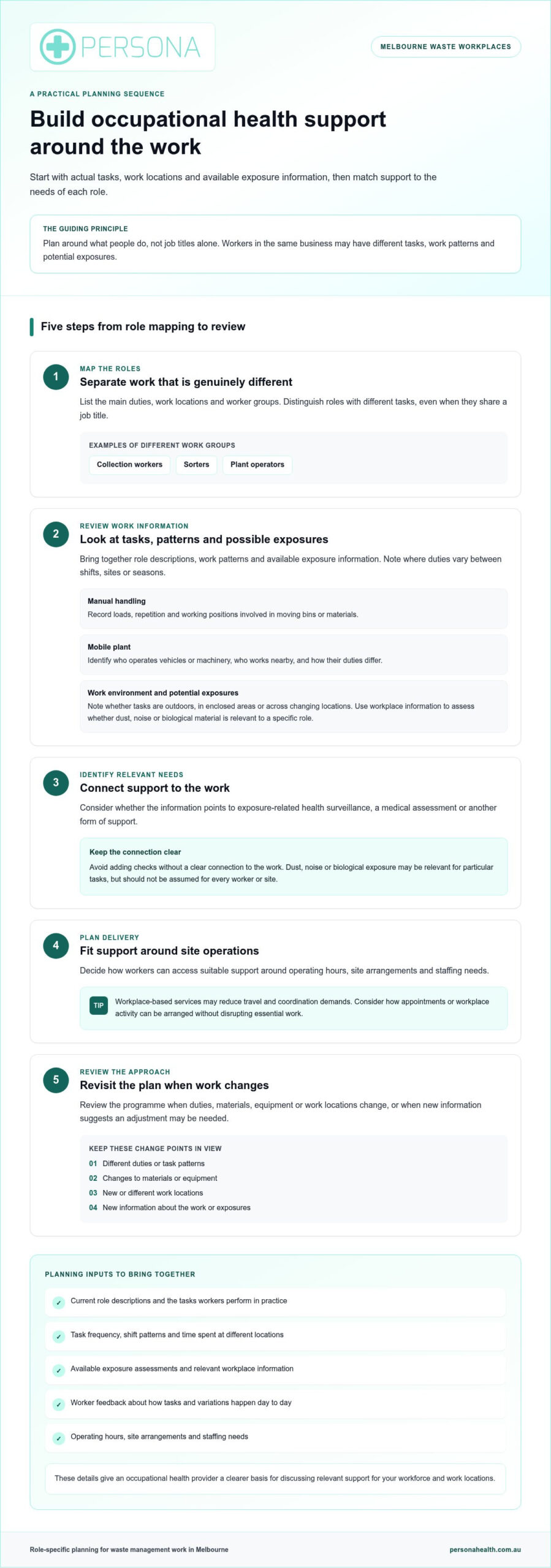
A useful programme starts with what people do, not assumptions attached to their job titles. For occupational health for waste management sector Melbourne, a clear sequence helps employers identify relevant needs, plan proportionate support and review it when duties or work conditions change.
- Map the roles. List the main duties, work locations and worker groups. Separate roles with different tasks, even if they share a title.
- Review work information. Bring together role descriptions, work patterns and available exposure information. Note where tasks vary between shifts, sites or seasons.
- Identify relevant needs. Consider whether the information points to exposure-related health surveillance, a medical assessment or another form of support. Avoid adding checks without a clear connection to the work.
- Plan delivery. Decide how workers can access suitable support around operating hours, site arrangements and staffing needs. Workplace-based services may reduce travel and coordination demands.
- Review the approach. Revisit the plan when duties, materials, equipment or work locations change, or when new information suggests it needs adjustment.
What information helps shape a suitable programme?
Useful planning inputs include current role descriptions, task frequency, shift patterns, time spent at different locations and available exposure assessments. Include worker feedback too. Employees can explain how tasks happen in practice, including variations that a written role description may miss.
Operational context matters. Consider how appointments or workplace-based activity can be arranged without disrupting essential work. For exposure questions, the Australian Institute of Occupational Hygienists (AIOH) offers professional information relevant to understanding and managing occupational exposures. Check WorkSafe Victoria guidance and applicable Victorian requirements against the actual work rather than relying on a generic checklist.
When may health surveillance or medical assessment be relevant?
Consider health surveillance in response to identified work-related exposure needs. It doesn’t replace managing the exposure itself, and it should be relevant to the hazard and the worker’s circumstances. If workplace information identifies a specific exposure concern, employers can seek advice on whether monitoring is appropriate and what form it should take.
Other assessments serve different purposes. A pre-employment medical assessment considers a person in relation to the requirements of a particular role. A fitness-for-work assessment may be relevant when there is a specific question about a worker’s capacity to perform duties safely. Neither replaces exposure-related surveillance.
Persona Health provides on-site health surveillance, planned around identified needs and site operations. To discuss how the planning steps could apply to your workplace, talk with Persona Health about your occupational health needs.
Choosing occupational health support for different waste-sector needs
The right support depends on the role, its requirements and the workplace circumstances. A collection driver, a worker with an identified exposure and someone recovering from an injury may need different support. The table outlines common options for occupational health for waste management sector Melbourne.
| Support type | Purpose | Possible context |
|---|---|---|
| Health surveillance | Monitor health in relation to a relevant workplace exposure. | Workplace information identifies an exposure for which health monitoring may be appropriate. |
| Pre-employment medical | Assess health in relation to the requirements of a particular role. | A role has defined functional or health requirements to consider before employment. |
| Drug and alcohol testing | Provide a testing service for a workplace’s context-specific programme. | An employer has established a workplace testing process relevant to its operations. |
| Injury management | Support a worker and employer following an injury and help coordinate next steps. | A worker needs support after a work-related injury or during recovery. |
How do surveillance, medicals and testing differ?
Health surveillance is exposure-related. Consider it in light of hazard information and relevant Victorian guidance, rather than using it as a general check for every worker. A pre-employment medical has a different purpose: it considers an individual’s health in relation to a role’s requirements, not as a blanket way to exclude people. Drug and alcohol testing is distinct again. Its use should reflect the employer’s workplace context and how its testing process is established.
Injury management supports a worker after an injury and helps the employer organise an appropriate response. InjuryQR is a free, AI-powered workplace injury triage service available to all Australian businesses. A worker scans a QR code without downloading an app, describes the injury by voice, then answers AI follow-up questions. Depending on the responses, InjuryQR may provide self-care advice, arrange a telehealth appointment, typically within 3-4 hours, direct the worker to an Emergency Department or instruct them to call 000. Certificates of Capacity can be issued immediately where appropriate. Prompt triage can support clearer reporting and may help reduce avoidable Lost Time Injuries, while not replacing emergency services when needed. Free posters, stickers, keyrings and fridge magnets are available to support workplace access.
Health information needs careful handling. Treat it as sensitive, limit access to people who need it for their work, and consider how results are communicated and stored. Privacy obligations depend on the organisation and circumstances. Employers should consider the Privacy Act 1988 and Australian Privacy Principles where applicable, and get advice on their specific obligations rather than assume one rule applies to every workplace.
How should Melbourne employers consider location and delivery?
Workers who can attend a clinic can use Persona Health’s Melbourne clinics in Cairnlea and Craigieburn. Persona Health also provides Australia-wide mobile workplace services, including on-site health surveillance where it suits the programme and site. Employers can explore occupational health services in Melbourne to consider how support can fit their workforce and locations.
Responding to injury and supporting workers in waste workplaces
A worker who reports pain after moving a heavy item, or an injury while carrying out a site task, needs a clear and considered response. Prompt, consistent reporting helps employers understand what happened, arrange suitable support and keep a useful record. It can also reveal patterns, such as repeated reports linked to a particular task or work area.
Make the reporting pathway easy to follow. Workers should know who to notify, how to raise a concern and what happens next. Follow workplace procedures, escalate urgent concerns appropriately and record relevant details as soon as practicable. A triage tool can guide initial next steps, but it doesn’t replace emergency care or established response processes.
How InjuryQR supports workplace injury triage
InjuryQR gives Australian businesses a free, AI-powered way to support initial workplace injury triage and reporting. It offers workers a clear starting point for describing an injury and helps employers receive information for follow-up. Use it as part of a considered response pathway, not as a substitute for emergency services, clinical judgement or workplace procedures.
Workers may be unsure whether a concern is worth reporting, particularly if symptoms seem minor at first. A consistent pathway can make it easier to raise an issue early and give managers a better basis for follow-up. Clear records also help employers review what happened and consider whether work arrangements or processes need attention. InjuryQR can support reporting, but no triage tool can guarantee an outcome or prevent every lost time injury.
How to connect incident information with ongoing support
After addressing immediate needs, record the incident in line with workplace procedures and identify what information will help organise further support. This may include the work activity, time and location, and relevant details about how the event occurred. Keep the record factual and handle personal health information with care.
Workplace injury management can help employers and workers maintain communication, understand relevant work capacity information and consider return-to-work planning when appropriate. Any plan should reflect the worker’s circumstances and be reviewed as those circumstances change. It should also align with the organisation’s reporting and injury-management arrangements.
For employers, a clear point of contact and agreed follow-up steps can reduce uncertainty. Persona Health provides workplace injury management support to help coordinate care after an injury. Communication between the worker, employer and relevant health professionals can help keep the process organised and responsive.
Discuss workplace injury support with Persona Health
Plan occupational health support for your Melbourne waste business
A productive first conversation is easier when you can describe how work is organised and where support is needed. You don’t need a finished programme or every answer. A concise overview helps shape a practical discussion about occupational health for waste management sector Melbourne.
What to prepare before discussing workplace health needs
Gather information about the work, rather than personal medical details. An initial outline can include:
- Worker groups and roles: Note the main duties and which teams perform them.
- Work locations: Identify relevant routes, depots and facilities.
- Known exposures: Share available workplace information relevant to the tasks.
- Current support: Describe existing health and injury-management processes.
- Operational considerations: Flag shift patterns, site access and practical limits on taking workers away from their duties.
Keep an initial enquiry focused on workplace planning. Avoid sharing identifiable worker health information unless it’s necessary and there is an appropriate process. For injury-related needs, consider how your existing response arrangements work alongside the InjuryQR triage option described earlier.
How Persona Health can support Melbourne employers
Persona Health works with employers on occupational assessments, workplace injury management and health surveillance relevant to work roles and site needs. Its employer-focused approach, responsive customer service, fast turnaround times and modern digital reporting support coordination without treating every worker or workplace as the same.
For Melbourne employers, Persona Health clinics are located in Cairnlea and Craigieburn. Sydney locations include Parramatta, Rosebery, Gregory Hills and Dee Why, with a particular focus on supporting employers in Gregory Hills and Rosebery. Australia-wide mobile workplace services can also suit organisations seeking workplace-based delivery.
Bring an overview of roles and sites, known exposure information, current processes and your main questions. This gives the team a useful starting point for shaping support around your workforce and operational needs.
Make your next occupational health step practical
A strong programme isn’t a document that sits on a shelf. It should stay useful as your workforce, tasks and operational needs evolve. A practical next step for occupational health for waste management sector Melbourne is to decide who will review the approach, what changes should prompt a review, and how workers can raise health concerns through established workplace channels.
Keep the process proportionate. Use the information available, identify what still needs clarification, then shape support around relevant work demands and individual circumstances. This gives your team a clear foundation without assuming every role requires the same assessment or follow-up.
Persona Health works with businesses on employer-focused support, with modern digital reporting to support clear coordination. A considered plan can make health support part of how your workplace adapts and improves over time.
Your workers’ needs are individual. Start with a practical, work-relevant plan and contact Persona Health to discuss occupational health support for your Melbourne waste business.
Frequently Asked Questions
Does occupational health support remove the need to control workplace hazards?
No. Health assessments and surveillance support worker health, but they don’t replace identifying and controlling workplace hazards. If a task creates an exposure concern, employers still need to consider the work conditions and controls, rather than rely on medical monitoring alone. Occupational health can inform a broader prevention approach alongside operational risk management and relevant WorkSafe Victoria guidance.
Are employee medical results automatically shared with an employer?
No. Don’t assume an employee’s full medical results are automatically shared with their employer. Before an assessment, clarify its purpose, who will receive the report and what information is relevant to the workplace decision. Health information needs careful handling, and privacy obligations depend on the organisation and circumstances. Avoid circulating detailed clinical information when a limited work-related outcome is sufficient for planning duties or support.
Can a small Melbourne waste business use occupational health services?
Yes. Support can be planned around the size of the workforce and the work actually undertaken, rather than requiring a large, uniform programme. A small operator can document worker groups, tasks and known exposure concerns, then discuss which assessment or surveillance options are relevant. This keeps planning focused and gives a Melbourne business a clearer basis for arranging suitable support as needs change.
Can workplace health surveillance be delivered at a waste facility?
Yes. Persona Health provides on-site health surveillance, and workplace-based delivery may reduce the need to coordinate individual travel away from a facility. Planning should account for the work area, access, operating schedules and workers who need monitoring. Surveillance should relate to relevant workplace exposure information, not simply take place because a facility is available.
What happens if a worker is injured during a waste-management shift?
Follow your workplace’s injury response procedures, arrange appropriate care and record the incident promptly. For an emergency, call 000. InjuryQR can support initial triage, as described earlier in this article, but it doesn’t replace emergency care or workplace procedures. Once immediate needs are addressed, the employer can organise follow-up and consider whether injury management support would help with communication and suitable work planning.
Does every waste-management worker need the same medical assessment?
No. The appropriate assessment depends on the role’s actual requirements and the worker’s circumstances. A pre-employment assessment for a position with defined physical demands has a different purpose from health surveillance related to an identified exposure. Employers should avoid assuming workers need identical checks because they share an employer or worksite. Match the assessment to a clear, relevant need.

Article by
Ian Nicholson
Ian is the Business Support Manager at Persona Health, where he plays a key role across IT, sales, marketing and business operations. With a broad skill set and a practical, solutions-focused approach, Ian helps drive the systems, communication and commercial strategy that support Persona Health’s continued growth across Australia.