
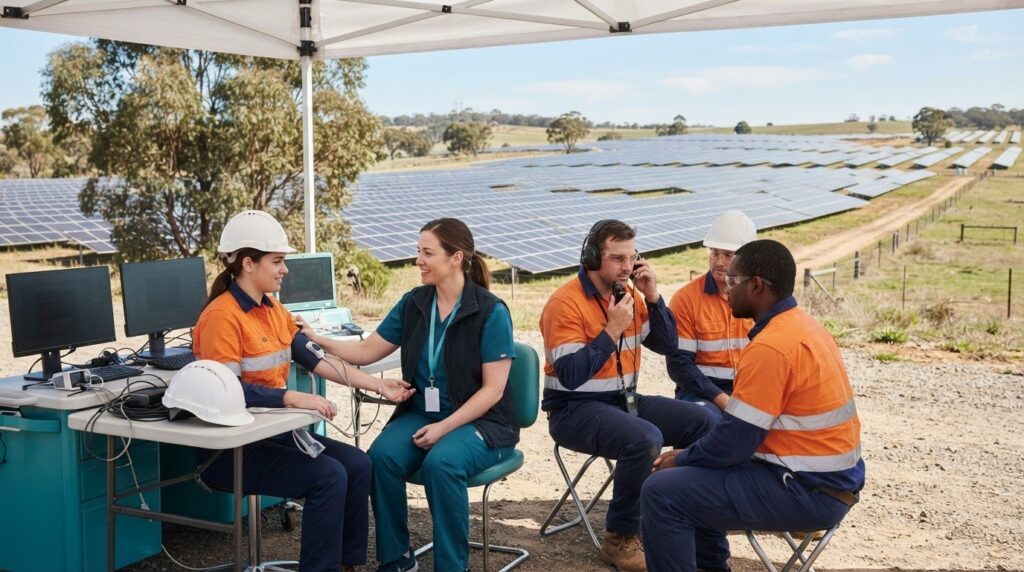
What health checks do solar farm workers need? The answer depends on what each person does and the exposures their work may involve. Planning health surveillance for solar farm workers in NSW means starting with tasks and risks, not a standard medical package. Construction crews, maintenance teams and workers carrying out civil works may face different hazards, and those risks can change as a project progresses.
When teams work across remote sites, choosing relevant assessments and arranging follow-up can take careful coordination. This guide explains how to identify exposures that may call for health surveillance, how surveillance differs from exposure monitoring, and how to consider NSW work health and safety requirements. It also covers organising assessments around site access and operations, protecting medical confidentiality, and planning follow-up. A considered approach helps focus on the risks that matter to each role instead of relying on one checklist for everyone.
Key Takeaways
- Plan health surveillance for solar farm workers in NSW around specific tasks, exposures and project phases, not job titles alone.
- Choose the right approach by distinguishing exposure measurement, health surveillance and general fitness-for-work assessments.
- Review relevant NSW WHS requirements and Codes of Practice to identify when hazard-specific health monitoring may be required.
- Build a practical programme that accounts for site access, worker follow-up, clear reporting and medical confidentiality.
- Consider on-site assessments to coordinate health surveillance with remote locations and project operations.
Health surveillance for solar farm workers in NSW: what it covers
Health surveillance is a planned way to assess whether a worker’s health may be affected by a work-related exposure. For a solar project, consider each person’s actual tasks, the hazards identified and any relevant legal requirements. Working at a solar farm alone does not mean every worker needs the same examination.
Health surveillance assesses a worker’s health in relation to an identified workplace exposure; exposure monitoring measures the hazard in the work environment. The distinction matters. A workplace measurement can help show what a worker may encounter, while a health assessment may help identify whether their health could be affected. Neither replaces controlling the hazard.
What does health surveillance mean at a solar farm?
Health surveillance is an organised process chosen for the exposure and the worker’s circumstances. Depending on the hazard, a clinically appropriate assessment may include questions about health and work history, a physical examination or a specific test. The risk assessment and relevant health advice should guide the method and timing, rather than a generic site checklist.
For example, workers carrying out dusty civil work may have different exposure considerations from staff doing administrative duties. If an assessment identifies potential exposure to a substance with a specific health monitoring requirement, check the applicable NSW WHS legislation and guidance to determine the required action. The solar farm setting itself does not establish that every worker needs surveillance.
How does it differ from exposure monitoring or a pre-employment medical?
Exposure monitoring measures workplace conditions; health surveillance assesses the worker; a pre-employment medical considers health in relation to a role’s requirements. These processes answer different questions and are not interchangeable.
- Exposure monitoring: Assesses a workplace hazard, such as airborne dust or noise. Results can help evaluate controls and inform decisions about worker health monitoring.
- Health surveillance: Checks for possible health effects associated with an identified exposure, using an assessment relevant to that hazard.
- Pre-employment medical: Assesses a person’s health in relation to the inherent requirements of a particular role. It does not replace ongoing, exposure-related surveillance where that is indicated.
For example, noise measurements during a task can help an employer understand exposure. An appropriate health assessment may also be needed when a worker’s exposure and circumstances meet relevant requirements. A pre-employment assessment provides information about a worker’s health in relation to their role, but it does not measure noise or monitor possible changes associated with ongoing exposure.
Workplace health surveillance should link an individual assessment to a defined occupational exposure. For practical information about arranging assessments around work tasks and site access, see Persona Health’s on-site health surveillance page.
Which health risks should NSW solar farm employers assess by project phase?
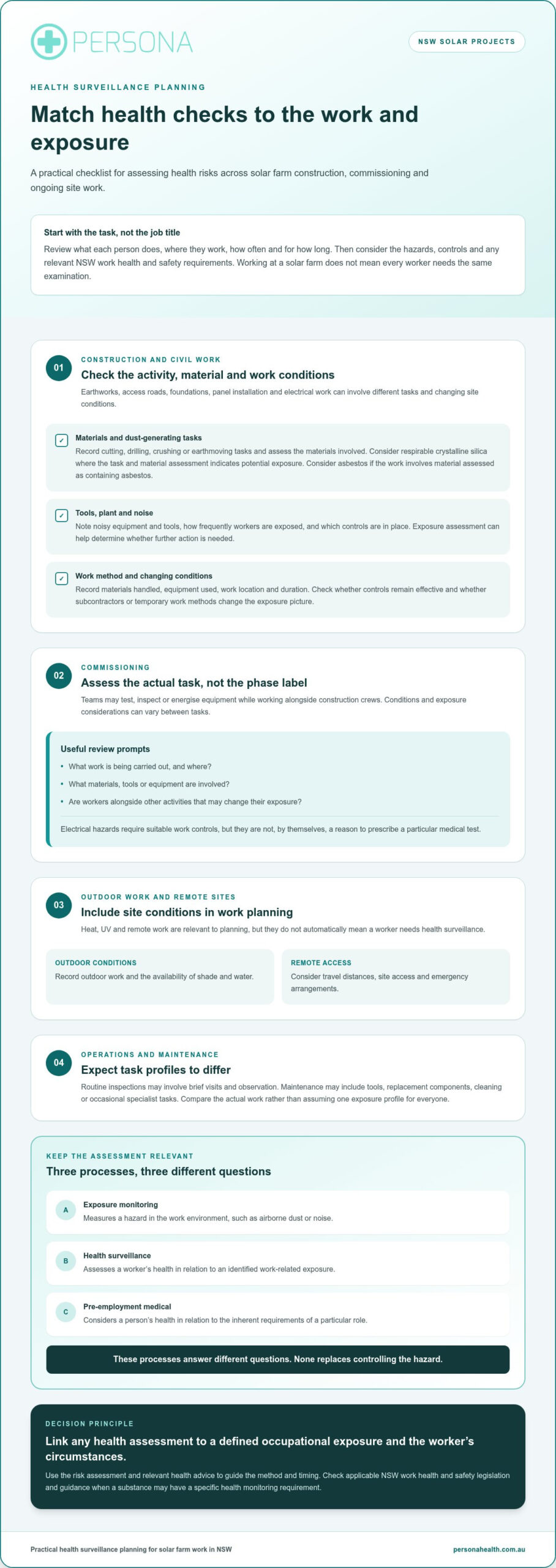
Start with what workers do, where they do it and how often. A job title such as “installer” or “technician” is too broad to determine exposure. Review work methods, materials, equipment, task duration, controls and changing site conditions. Then consider whether any exposure warrants health surveillance under applicable requirements.
Health surveillance decisions should reflect the exposure, how often and how long it occurs, and the worker’s specific tasks. This keeps assessments relevant without assuming everyone at a solar farm faces the same health risks.
What exposure questions matter during construction and commissioning?
Construction activities can change quickly as earthworks, access roads, foundations, panel installation and electrical work progress. For each activity, record the materials handled, tools and plant used, dust-generating tasks, work location and duration. Check whether controls are effective and whether subcontractors or temporary work methods change the exposure picture.
- Dust and materials: Identify cutting, drilling, crushing or earthmoving tasks, then assess the materials involved. Consider respirable crystalline silica where the task and material assessment indicates potential exposure. Consider asbestos if the work involves material assessed as containing asbestos.
- Noise and equipment: Note tasks using noisy plant or tools, how frequently workers are exposed and which controls are in place. Exposure assessment can help determine whether further action is needed.
- Heat, UV and remote work: Record outdoor work, shade, travel distances, access to water and emergency arrangements. These matter for work planning, but do not automatically mean a worker needs health surveillance.
During commissioning, teams may test, inspect or energise equipment while working alongside construction crews. Assess the actual tasks and conditions instead of treating “commissioning” as one exposure category. Electrical hazards require suitable work controls, but they are not, by themselves, a reason to prescribe a particular medical test.
How can operations and maintenance create different exposure profiles?
Routine inspections may involve brief visits and observation, while maintenance work may include tools, replacement components, cleaning or occasional specialist tasks. Compare the frequency, duration, location and controls for each task. A worker who rarely performs a dusty repair may have a different exposure profile from someone assigned to it regularly.
Review the assessment when activities, materials, equipment or site conditions change. For example, moving from visual inspections to regular component repairs may alter the tasks and exposures to consider. Keep work information current so health surveillance decisions remain proportionate and clinically relevant.
For remote-site injury triage, InjuryQR is a FREE AI-powered service available to all Australian businesses. Workers scan a QR code without downloading an app, describe an injury by voice, then respond to AI follow-up questions. Outcomes can include self-care advice, a telehealth appointment typically within 3 to 4 hours, direction to an Emergency Department, or instructions to call 000. Where appropriate, a Certificate of Capacity can be issued immediately. Free posters, stickers, keyrings and fridge magnets help make the service accessible at work. Timely triage can support prompt care, improve injury reporting and help reduce Lost Time Injuries. InjuryQR complements, but does not replace, emergency arrangements.
If you’re mapping work tasks and exposures across a solar project, discuss your health surveillance requirements with Persona Health.
How should employers compare health surveillance options for NSW solar sites?
Choose an assessment based on the decision you need to make, then consider how workers will access it and what follow-up may be needed. For health surveillance programmes for solar farm workers in NSW, the clinician’s role and assessment method should align with the identified hazard, worker information and current requirements. A broad medical package may not address the exposure you need to assess.
Which assessment approach answers the employer’s actual question?
First clarify whether you need to understand conditions at work, monitor a worker’s health in relation to an exposure, or assess a person’s capacity for a role. These aims can overlap, but they are not interchangeable. Use the table to frame the decision before planning an assessment.
| Approach | Main question | Useful considerations |
|---|---|---|
| Exposure measurement | What is present in the work environment, and what level of exposure may occur? | Match the measurement to the suspected hazard, task, location and relevant work conditions. Use findings to inform control decisions and whether health monitoring should be considered. |
| Health surveillance | Could an identified work exposure be affecting a worker’s health? | Use an assessment that is clinically appropriate to the hazard and worker. Check current NSW WHS requirements and applicable health monitoring triggers rather than assuming a standard test panel or interval. |
| Fitness-for-work assessment | Can the worker safely perform the role’s relevant duties at this time? | Focus on functional capacity and the role’s requirements. This does not measure workplace exposure or replace exposure-related health surveillance. |
For example, if a task raises concern about airborne contaminants, workplace measurement may help clarify the exposure conditions. Where a relevant health monitoring trigger applies, a clinician can advise on an appropriate worker assessment. A fitness-for-work assessment answers a different question, such as whether a worker can perform specified duties safely. Interpret findings in context and handle personal medical information confidentially.
What makes a delivery model workable for a regional NSW project?
Compare delivery options against travel time, roster patterns, site access and the likelihood that workers can attend follow-up. Clinic appointments may suit individuals or workers already near a clinic. On-site delivery can help coordinate groups around project operations and reduce the need for workers to travel away from a remote work location.
Before choosing an arrangement, map the workforce, including subcontractors and shift patterns, and decide who will coordinate attendance. Plan private spaces for clinical discussions and a clear process for sharing relevant outcomes with the employer without disclosing unnecessary clinical details. Consider how workers can access further assessment if an initial result needs follow-up.
Persona Health’s on-site health surveillance service supports planning around site access and project operations. A workable model links relevant clinical assessment with practical attendance and follow-up, while keeping the purpose of each assessment clear.
How can employers organise a practical health surveillance programme?
A well-organised programme follows a clear path from understanding work exposures to reviewing whether arrangements remain suitable. Employers planning health surveillance for solar farm workers in NSW should document why each assessment is being considered, how workers will access it and who will coordinate follow-up. Before describing an assessment as mandatory, check current NSW WHS legislation, relevant Codes of Practice and hazard-specific requirements through authoritative sources such as SafeWork NSW and Safe Work Australia.
What should the employer organise before assessments begin?
Bring together information that will help occupational health professionals understand the work, not just the workforce list. A practical starting sequence is:
- Describe the work: Record tasks, materials, equipment, work locations and how often or how long each activity occurs.
- Review exposure information: Gather available assessments and details of controls, including changes in work methods or site conditions.
- Map the workforce: Identify relevant roles, contractors and shifts, and plan how to notify workers and coordinate attendance.
- Agree the assessment and review point: Seek appropriate occupational health input on methods relevant to the identified hazard. Set a point to reconsider the plan if work or exposure changes.
Explain the purpose of an assessment to workers beforehand. They should understand what it relates to, how their information will be handled and how to raise questions. Make the distinction between individual clinical information and employer reporting clear. Employers may need relevant work-related recommendations and programme information to coordinate follow-up, but should not assume they need a worker’s full medical history.
Handle health information confidentially and in line with applicable privacy obligations, including the Privacy Act 1988 and Australian Privacy Principles where they apply. Keep appropriate clinical records with the responsible health service and maintain employer records needed to coordinate the programme. Agree who receives reports, how recommendations will be actioned and how workers can access follow-up. Clear responsibilities are especially useful when several contractors or changing work groups are involved.
How can remote-site injury response connect with health monitoring?
Exposure controls reduce workplace hazards; health surveillance checks for possible effects on workers; injury response supports someone after an injury or sudden health concern. These are connected parts of a workplace health system, but none replaces the others. A surveillance result may prompt a review of controls, while an injury needs its own timely response and reporting pathway.
At remote sites, make sure workers know how to report an injury, get help and escalate an emergency. InjuryQR, introduced earlier, can support injury triage, but it does not replace site emergency arrangements or health surveillance. Keep the response pathway accessible and ensure workers know when to seek urgent help.
Review the programme after changes to tasks, materials, controls or workforce arrangements, and act on relevant clinical recommendations. This keeps assessments connected to current work rather than allowing an old schedule to continue by default.
On-site health surveillance for solar farms: Persona Health support in NSW
Once you’ve mapped work tasks, exposures and assessment needs, the next challenge is making the programme accessible without disrupting project operations. Solar farms can cover large or remote areas, and teams may include contractors on different rosters. A practical delivery plan helps workers attend appropriate assessments and gives employers a clear process for coordinating outcomes and follow-up.
How can on-site delivery support a distributed solar workforce?
Persona Health provides mobile workplace services Australia-wide. On-site health surveillance can make assessments more accessible by bringing the service to a workplace, with arrangements planned around site access, work schedules and project activity. This can be useful when travel to a clinic would take workers away from the site or make coordination across crews more difficult.
Good preparation helps the visit run smoothly. Employers can organise a suitable private space, share relevant task and exposure information, coordinate attendance across contractors and explain the purpose of assessments to workers beforehand. The clinical approach should still be guided by the identified hazard and each worker’s circumstances. On-site delivery helps coordinate access; it is not a reason to use the same assessment for everyone.
Persona Health’s on-site health surveillance information outlines workplace delivery options for employers. It also provides context for organisations planning health surveillance across Sydney and Melbourne, including projects involving workers in Gregory Hills and Parramatta. Delivery can be planned around a project’s location and workforce arrangements.
For employers coordinating health surveillance for solar farm workers in NSW, digital reporting can help manage programme information and follow-up. Employer-facing reports should support coordination while protecting confidential clinical details. An employer-focused approach and clear communication can also help keep arrangements organised as work groups or project needs change.
Where can NSW employers arrange related clinic appointments?
Some workers may be better served by a clinic appointment, depending on their location, roster and the assessment being arranged. Persona Health supports employers and workers in Sydney, including Gregory Hills and Parramatta, as well as Melbourne. Consider clinic access alongside the assessment required, worker travel and the follow-up plan.
Persona Health also has a network of 100 affiliate clinics nationwide, which can support access for workforces distributed across different locations. Clinic appointments can complement a project plan when individual attendance is practical. They do not automatically replace an on-site programme: the appropriate arrangement depends on the assessment, exposure, worker access and follow-up required.
Whether you’re coordinating a remote worksite visit or planning clinic access for a Sydney-based team, Persona Health can help you consider an approach that fits your workforce and identified health surveillance needs. Speak with the team about your solar project.
Turn your surveillance plan into practical next steps
A considered approach to health surveillance for solar farm workers in NSW starts with one practical action: bring your current task and exposure information together, then identify where clinical input can help shape the next step. This gives your team a clearer basis for deciding what to arrange, who needs access and how to review the programme as project work evolves.
You don’t need to resolve every detail at once. Start with the work activities that have the clearest exposure questions, then build a proportionate plan that can adapt as crews, tasks or site conditions change. Persona Health can support employers with practical coordination and digital reporting to help organise programme information while respecting medical confidentiality.
With the right support, you can move forward with a plan grounded in your project’s real work and your workers’ individual needs.
Frequently Asked Questions
Is health surveillance mandatory for every solar farm worker in NSW?
No. Working on a solar farm does not automatically mean health surveillance is required. The decision depends on the work performed, potential exposure and any applicable health monitoring requirements under current NSW work health and safety laws. Employers should assess roles individually, including contractors’ tasks, rather than applying the same assessment to everyone on site.
Does a pre-employment medical count as health surveillance?
No. A pre-employment medical considers a person’s health in relation to a role’s requirements at the time of assessment. It does not monitor health effects associated with an identified workplace exposure over time. For example, a new starter’s assessment for a maintenance role does not replace exposure-related monitoring if later tasks and exposure circumstances make that monitoring relevant. Keep the purpose of each assessment clear when planning workforce health arrangements.
Can contractors be included in a solar farm health surveillance programme?
Yes. Contractors can be included where their work and exposure circumstances make health monitoring relevant. Employers and contractors should share task and exposure information, clarify who will coordinate assessments, and agree how workers can access recommended follow-up. For projects involving several subcontractors, record who is responsible for communicating arrangements to each crew so workers are not missed when rosters or work packages change.
Who can access a worker’s health surveillance results?
Access depends on the information, the purpose for sharing it and applicable privacy requirements. The health professional responsible for the assessment should handle clinical records confidentially. Employers may need work-related recommendations to manage a risk or arrange follow-up, but should not assume they are entitled to a worker’s full clinical record. Explain reporting arrangements to workers before assessment and seek appropriate advice about privacy and consent.
Can a solar farm worker have a health concern assessed before symptoms become serious?
Yes. A worker can raise a concern with their supervisor or health professional and seek an appropriate assessment without waiting for symptoms to worsen. For example, a worker who notices a change in their breathing after particular tasks should report it promptly, including when and where it occurs. A clinician can consider the worker’s health and relevant work history. An assessment can inform next steps, but cannot guarantee that every condition will be detected early.
Does health surveillance replace controls for workplace exposures?
No. Employers should focus first on eliminating or minimising exposure risks through suitable workplace controls. Health surveillance is a separate measure that may help identify possible effects on a worker’s health; it does not make an uncontrolled exposure safe. If an assessment raises a concern, review the relevant work conditions and controls as well as arranging appropriate clinical follow-up. Keep workers informed about the controls in place and how to report concerns.
What should a solar farm employer do if a worker is injured at a remote site?
Follow the site’s emergency arrangements, get appropriate help promptly and call 000 in an emergency. Make sure workers know how to report an injury and who to contact when they are far from the site office. InjuryQR offers an additional triage pathway: workers scan a QR code without downloading an app, describe the injury by voice and respond to AI follow-up questions. It does not replace emergency care or site response procedures.
For help planning health surveillance around your solar project, contact Persona Health.

Article by
Ian Nicholson
Ian is the Business Support Manager at Persona Health, where he plays a key role across IT, sales, marketing and business operations. With a broad skill set and a practical, solutions-focused approach, Ian helps drive the systems, communication and commercial strategy that support Persona Health’s continued growth across Australia.