

Standing at the gates of a Sydney rail corridor without a valid RIW card is the quickest way to stall your career before it even begins. If you’re currently searching for a cat 3 rail medical sydney, you’ve likely spent time worrying about which category applies to your role or feeling anxious that a minor issue with your hearing or vision might hold you back. It’s a common concern for rail workers who need to get on-site quickly and safely, and we believe the process shouldn’t be a source of stress, but rather a clear path to your next professional milestone.
This guide provides everything you need to know about the assessment, ensuring you’re fully compliant with the latest 2024 National Standard updates. We’ll walk you through the specific requirements, explain the RIW card application process, and show you how Persona Health’s digital reporting for specialized medical assessments helps you avoid unnecessary delays. From our clinics in Parramatta and Rosebery to our wider national affiliate network, we’re here to ensure your medical is handled with clinical precision and genuine care.
Key Takeaways
- Understand why a Category 3 assessment is the essential baseline for non-safety critical workers to access the Australian rail corridor legally.
- Learn exactly what to expect during your cat 3 rail medical sydney appointment, including the specific vision, hearing, and mobility checks required for compliance.
- Discover the vital link between your medical results and your Rail Industry Worker (RIW) card to ensure you meet Transport for NSW standards.
- Access a practical preparation checklist to help you gather the necessary documentation and ensure your appointment proceeds without any avoidable delays.
- Find out how Persona Health’s streamlined digital reporting and Sydney-wide clinics help you secure your results quickly so you can start work on-site sooner.
Understanding the Category 3 Rail Medical in Sydney
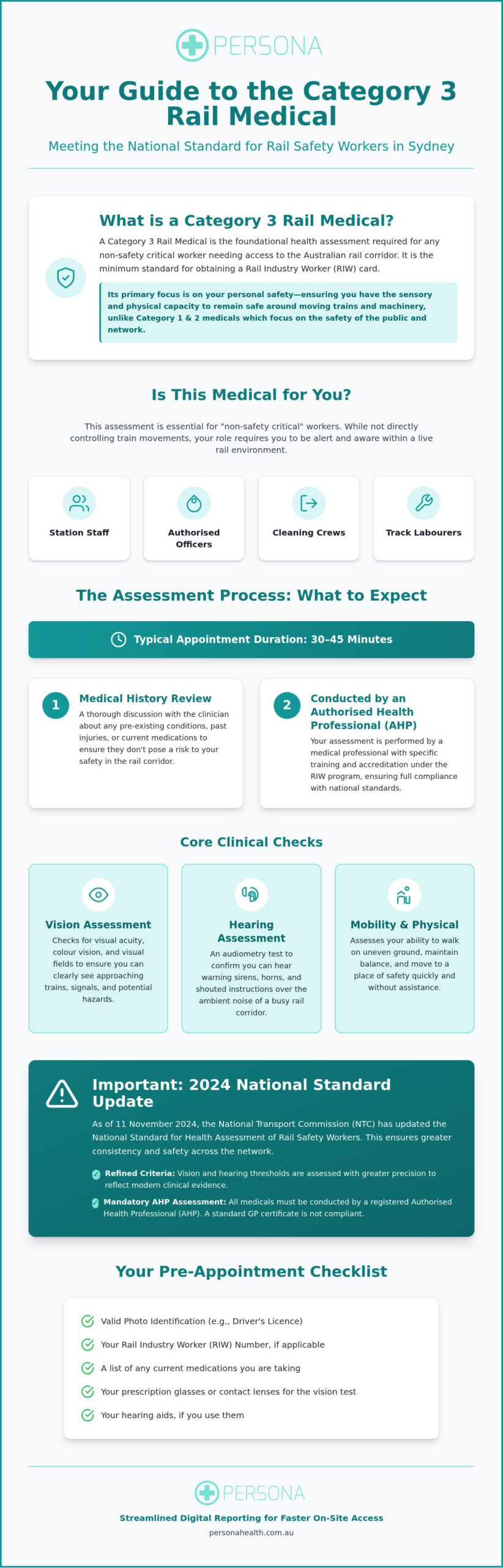
A cat 3 rail medical sydney is the foundational health requirement for anyone needing to enter the rail corridor for work. It’s the minimum standard required to obtain your Rail Industry Worker (RIW) card. Unlike Category 1 or 2 assessments, which focus on safety-critical tasks where a worker’s health could impact the public or the network, a Category 3 assessment focuses on your own safety. It ensures you have the physical and sensory capacity to stay safe while working near moving trains and heavy machinery.
Under Australian rail safety regulation, these assessments are mandatory to manage the inherent risks of working in a high-stakes environment. By identifying potential health issues early, we help you maintain your career longevity and personal wellbeing.
To get a clearer picture of why these specific sensory checks matter for your safety on-site, watch this short video:
Who is Classified as a Category 3 Rail Safety Worker?
Most workers classified under this category are considered “non-safety critical.” This includes station staff, authorised officers, cleaning crews, and track maintenance labourers who aren’t directly controlling train movements. While your role might not involve driving a locomotive or signalling, working “around the track” still carries significant risk. You need to be able to hear a warning siren over ambient noise or see an approaching train clearly enough to move to a place of safety immediately. This is the primary distinction; Category 1 and 2 workers hold the lives of others in their hands, whereas a Category 3 worker is responsible for their own personal safety in a live rail environment. This is why the cat 3 rail medical sydney assessment is so vital; it protects you from the environment you work in every day.
The 2024 National Standard Update
On 11 November 2024, the National Transport Commission (NTC) introduced an updated National Standard for Health Assessment of Rail Safety Workers. This update refined the medical criteria to reflect modern clinical evidence and improved safety outcomes. For Sydney workers, this means hearing and vision thresholds are now assessed with even greater precision to ensure consistency across the network. One of the most critical changes is the requirement for all assessments to be performed by an Authorised Health Professional (AHP). A regular GP can’t perform these checks unless they’ve completed the specific training and accreditation required by the national program. At Persona Health, our clinicians are fully accredited to provide these updated assessments, ensuring your results are compliant and your RIW card application proceeds without a hitch. By staying ahead of these regulatory shifts, we help you avoid the frustration of rejected medicals or expired certifications.
What to Expect During Your Cat 3 Assessment
When you arrive for your cat 3 rail medical sydney, the process is designed to be methodical and efficient, typically taking between 30 and 45 minutes. Our goal is to ensure you meet the physical requirements of the rail corridor while providing a calm, professional environment. Your assessment is performed by a clinician registered as an Authorised Health Professional (AHP) under the Rail Industry Worker (RIW) program. These specialists are trained to understand the specific risks of the NSW rail network and how your health profile fits into that environment.
The appointment begins with a thorough review of your medical history. You’ll discuss any pre-existing conditions or medications with the doctor to ensure they don’t pose a risk to your safety on-site. Following this, the clinical exam covers several key areas of health and sensory function. Once the physical checks are complete, results are processed through our modern digital reporting systems, allowing for fast turnaround times that help you get on-site without delay. If you’re looking for a streamlined experience, our team at Persona Health specialises in making these assessments as straightforward as possible.
Vision and Hearing Requirements
The sensory components of the exam are critical for your survival in the rail corridor. Audiometry testing is used to confirm you can hear warnings, such as train whistles or track-side alarms, even against a background of heavy machinery noise. We also conduct visual acuity tests to ensure you can see approaching hazards at a distance. Colour vision is equally important for identifying signals and safety markers correctly. If you wear glasses, contact lenses, or hearing aids, please bring them to your appointment; we’ll test your vision and hearing both with and without these aids to ensure you meet the National Standard.
Physical Mobility and Musculoskeletal Health
Working on or near tracks requires a certain level of agility and physical awareness. During the musculoskeletal portion of the exam, the AHP will assess your balance, coordination, and ability to traverse uneven ground safely. This ensures you can move quickly to a place of safety if a train approaches. We also include a brief psychiatric and behavioural evaluation, which is simply a conversation to ensure you have the required level of situational awareness for a high-risk workplace. Many employers also choose to include Drug and Alcohol Testing at this stage, as a clean screen is a standard prerequisite for entry into any Sydney rail project.
Navigating RIW Cards and NSW Compliance
Securing your cat 3 rail medical sydney is only half the battle; the next step is ensuring that data is officially recognised within the Rail Industry Worker (RIW) system. In New South Wales, Transport for NSW (TfNSW) mandates that all personnel on major projects, such as the Sydney Metro or Parramatta Light Rail, hold a valid RIW card. This card acts as a single, national competency and health management system. Without a current medical assessment uploaded by an Authorised Health Professional (AHP), your digital profile remains “non-compliant,” effectively barring you from site entry.
Persona Health takes the administrative burden off your shoulders by ensuring your medical data is uploaded directly and accurately to the RIW portal. This digital integration is vital for meeting employer obligations under the Work Health and Safety Act 2011 (NSW). Under this legislation, rail operators and contractors must ensure that every individual on-site is fit for duty. By maintaining a transparent, digital record of your health status, we help your employer stay compliant with SafeWork NSW requirements while you focus on the job at hand.
The RIW Card Application Process
Linking your medical results to your digital profile is a structured process that requires precision. First, you must have an active RIW profile, usually created by your employer. Once you attend your appointment, our AHP verifies your identity and conducts the assessment. The results are then uploaded to the system, where they are automatically matched to your profile using your unique RIW number. For Sydney contractors, maintaining this validity is non-negotiable; a lapsed medical can lead to immediate site suspension. To ensure your credentials remain current, you can Book your Cat 3 Rail Medical in Sydney through our streamlined booking system.
Regulatory Oversight: SafeWork NSW and Comcare
While the National Transport Commission sets the medical standards, SafeWork NSW provides the regulatory oversight for workplace safety on Sydney’s rail projects. They monitor how companies manage the health risks associated with rail work, ensuring “Fitness for Duty” isn’t just a checkbox but a lived safety culture. We also operate under the Privacy Act 1988, which means your sensitive medical information is handled with the highest level of security. Only the necessary “fit” or “unfit” status is shared with the RIW portal, protecting your personal clinical details while satisfying the legal requirements of rail operators and national bodies like Comcare.
Preparing for Your Appointment: A Practical Checklist
Preparation is the key to a stress-free experience. Most delays in securing a cat 3 rail medical sydney occur not because of health issues, but due to missing documentation or simple avoidable factors. To ensure your assessment proceeds smoothly, it’s vital to arrive well-rested and prepared. For those with chronic conditions, such as heart disease or diabetes, bringing a recent progress report from your treating specialist is incredibly helpful. This proactive step allows our clinicians to assess your fitness for duty immediately rather than pausing the process to request further information from your regular doctor, which can add days to your clearance time.
Your sensory health is also a major focus during the clinical exam. To give yourself the best chance during the audiometry test, try to avoid exposure to loud noises, such as heavy machinery or loud music, for at least 16 hours before your appointment. Similarly, ensuring you’ve had adequate sleep will help with the visual acuity and concentration components of the exam. Our team is here to support you through the process, providing a calm environment where your individual health needs are the priority and the focus remains on getting you safely back to work. To maintain the long-term physical resilience needed for such roles, many workers also invest in their fitness through programs like those at 6X Training.
What to Bring and Wear
- Current Photo Identification: A driver’s licence or passport is mandatory. We cannot legally conduct a rail medical without verifying your identity first.
- Comfortable Attire: You’ll be asked to perform basic mobility movements and traverse uneven ground. Wear loose, comfortable clothing and sturdy, flat footwear.
- Corrective Lenses and Hearing Aids: If you use these in your daily life or for work, you must bring them. We need to test your capacity both with and without these aids to meet the 2024 National Standard.
- Medication List: Bring a clear list of any current prescriptions, as these must be recorded as part of your clinical history and checked for potential side effects like drowsiness.
Managing Results and Validity
Under the National Standard, a Category 3 medical remains valid until you reach the age of 40. Once you pass this milestone, the risk profile changes, and you’ll need to renew your assessment every five years. This periodic check ensures that as your body changes, your capacity to stay safe in the rail corridor remains high. At Persona Health, we understand that you need to get on-site quickly. We utilise modern digital reporting systems to provide fast turnaround times, ensuring your results are processed and ready for employer review as soon as possible.
If the assessment identifies a potential concern, you might be found “Fit with Restrictions” or “Unfit.” This doesn’t necessarily mean your career is over. Often, it simply means you need a specific type of corrective lens or a follow-up with a specialist to manage a particular health factor. Our clinicians will guide you through these steps with empathy and professional authority, helping you understand exactly what is required to achieve compliance. To get started, you can book your appointment at a Persona Health clinic today to secure your future on the tracks.
The Persona Health Advantage: Sydney Rail Medicals
Choosing the right partner for your cat 3 rail medical sydney makes the difference between a fragmented administrative process and a seamless transition to the worksite. While a general GP might offer basic health checks, they often lack the specific AHP accreditation and deep understanding of the National Standard required for the rail industry. At Persona Health, our clinicians specialise in occupational health, ensuring every assessment is conducted with clinical precision and an appreciation for the unique demands of the NSW rail corridor. With clinics conveniently located in Parramatta, Rosebery, Gregory Hills, and Dee Why, we provide accessible care for contractors across the Greater Sydney region.
Our commitment to fast turnaround times is the benchmark for Sydney rail projects. We understand that every day you’re not on-site is a day of lost productivity; therefore, we’ve optimised our digital reporting systems to ensure results are delivered to employers without delay. Beyond the initial assessment, we provide ongoing support through comprehensive Workplace Injury Management, helping you navigate the complexities of recovery and return-to-work protocols with a focus on your long-term wellbeing and professional stability.
InjuryQR: Revolutionising Rail Site Safety
Safety in the rail industry doesn’t end when you leave the clinic. We’re proud to introduce InjuryQR, a free AI-powered triage service designed specifically for the modern workplace. If an incident occurs on-site, workers simply scan a QR code with their smartphone. There’s no app required; the worker describes the injury by voice, and the AI provides immediate, guided next steps, such as self-care advice, a telehealth referral, or emergency direction. This technology is a game-changer for rail sites, significantly reducing Lost Time Injuries (LTIs) and providing instant Certificates of Capacity where appropriate. We encourage Sydney businesses to enhance their safety culture by ordering free physical InjuryQR assets, such as posters and magnets, directly from the InjuryQR website.
Comprehensive Occupational Health Support
Our expertise extends across the entire lifecycle of a rail worker’s career. From initial Pre-Employment Medicals to ongoing health surveillance and drug and alcohol testing, Persona Health serves as a dedicated professional partner for Sydney’s rail teams. We don’t believe in a one-size-fits-all approach; instead, we tailor our services to the individual needs of each worker and the specific safety requirements of the rail operator. Our experienced medical team is here to ensure you remain compliant, safe, and ready to contribute to Australia’s vital rail infrastructure. Contact Persona Health today to request a quote or to speak with our team about your specific occupational health requirements.
Secure Your Future on the Sydney Rail Network
Securing your cat 3 rail medical sydney is a vital milestone that ensures you’re ready to work safely within the rail corridor. By understanding the sensory and physical standards set by the 2024 National Standard, you’re already one step ahead in maintaining your RIW card compliance. Remember that your health assessment is a baseline for your own safety while working near moving trains; being prepared with the right documentation and sensory rest ensures your appointment is efficient and successful.
At Persona Health, our Accredited Rail Health Professionals provide the expertise and empathy you need to feel confident in your results. With fast turnaround times and modern digital reporting, we help you avoid unnecessary delays in your career. Whether you visit our clinics in Parramatta, Rosebery, Gregory Hills, or Dee Why, you’ll receive professional care tailored to the unique demands of the Australian rail industry. Take the next step toward your career goals and Book your Cat 3 Rail Medical in Sydney with Persona Health today. We look forward to supporting your professional journey and keeping you safe on the tracks.
Frequently Asked Questions
How long does a Category 3 rail medical take?
A Category 3 rail medical typically takes between 30 and 45 minutes to complete. This timeframe allows our clinicians to conduct a thorough review of your health history, perform the required vision and hearing tests, and assess your physical mobility. If your employer has requested additional components, such as drug and alcohol testing, the appointment might take slightly longer. We focus on efficiency to ensure you can get back to your work schedule promptly.
How long is a Cat 3 rail medical valid for in NSW?
Your Category 3 rail medical is valid until you reach the age of 40. Once you pass this milestone, the National Standard requires a renewal every five years to ensure your health remains compatible with the risks of the rail environment. This periodic assessment helps in the early detection of changes in your hearing, vision, or physical health, keeping you safe on-site throughout your career in the NSW rail sector.
Do I need a Cat 3 medical for my RIW card?
Yes, a Category 3 assessment is the minimum requirement for obtaining or maintaining a Rail Industry Worker (RIW) card. This card is essential for anyone needing access to the rail corridor in Sydney. Your medical results must be uploaded to the RIW portal by an Authorised Health Professional to confirm your fitness for duty. Without this compliant medical record, your digital profile won’t allow you to enter major rail project sites.
What happens if I fail the hearing test for my rail medical?
Failing a hearing test doesn’t automatically mean you can’t work in the rail industry. If you don’t meet the initial threshold, our clinicians may refer you to an audiologist for a more detailed assessment or recommend a status of “Fit with Restrictions,” such as wearing a hearing aid while on duty. We work with you to find a path toward compliance that prioritises both your safety and your ability to perform your role effectively on-site.
Can I go to my regular GP for a Category 3 rail medical?
No, you cannot use your regular GP unless they are specifically registered as an Authorised Health Professional (AHP). The National Standard for Health Assessment of Rail Safety Workers requires clinicians to have specific training and accreditation to perform a cat 3 rail medical sydney. At Persona Health, our medical teams are fully accredited AHPs, ensuring your assessment meets all legal requirements for Transport for NSW and other national rail operators.
What is the difference between Category 1, 2, and 3 rail medicals?
The primary difference lies in how your health affects the safety of others. Category 1 and 2 workers perform safety-critical tasks, such as driving trains or signalling, where a sudden health event could endanger the public or the network. Category 3 is for non-safety critical workers, such as station staff or maintenance crews, where the assessment focuses primarily on ensuring the worker can keep themselves safe within the rail corridor environment.
Do I need to fast before my Cat 3 rail medical appointment?
You don’t need to fast before a standard Category 3 rail medical appointment. Unlike some higher-category medicals or specific health surveillance checks that require blood tests, a Cat 3 assessment focuses on vision, hearing, and physical mobility. However, it’s a good idea to stay hydrated and avoid excessive caffeine or loud noises before your exam to ensure your blood pressure and hearing results are as accurate as possible during the clinical tests.
How do I book a rail medical in Sydney with Persona Health?
Booking a cat 3 rail medical sydney with Persona Health is simple and can be done through our online booking portal or by calling our team directly. We have dedicated clinics in Parramatta, Rosebery, Gregory Hills, and Dee Why to serve the Sydney region. Our streamlined process ensures fast digital reporting to your employer, helping you meet your RIW requirements and start work on your next rail project without unnecessary delays.

Article by
Ian Nicholson
Ian is the Business Support Manager at Persona Health, where he plays a key role across IT, sales, marketing and business operations. With a broad skill set and a practical, solutions-focused approach, Ian helps drive the systems, communication and commercial strategy that support Persona Health’s continued growth across Australia.