
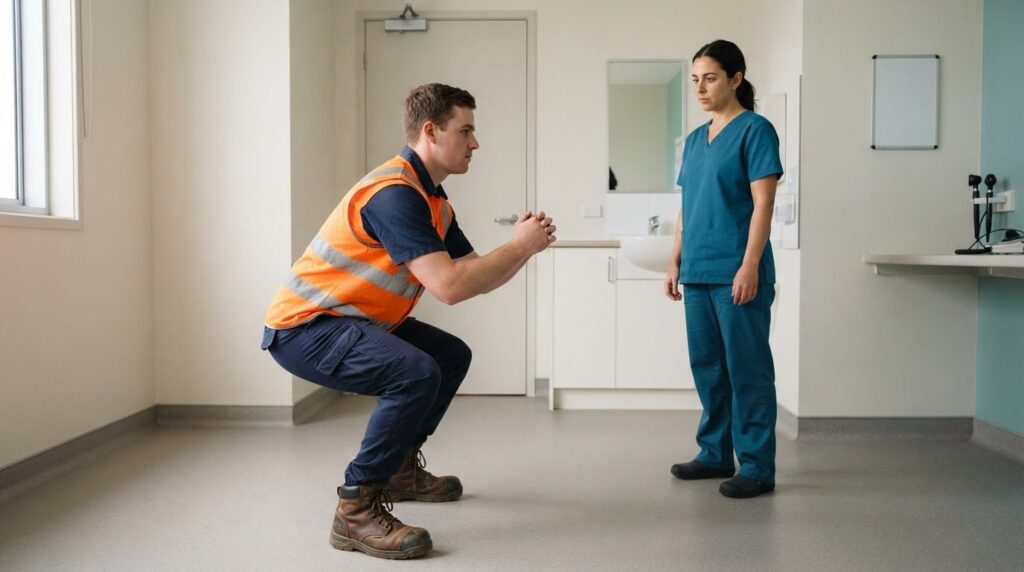
There’s no single medical assessment for every civil infrastructure role in Melbourne. Civil infrastructure medicals in Melbourne should be matched to the worker’s duties, the physical demands of the job and relevant workplace exposures. The assessment helps employers understand fitness for work and identify health considerations that may need to be managed on site.
On a road, rail or major construction project, workers face different demands, from operating plant to working around dust or performing physically strenuous tasks. A clear, role-based process supports worker wellbeing while helping your project meet its safety and compliance needs.
This guide explains how role-specific medical assessments fit into civil construction in Melbourne and across Victoria, what different checks may involve, and how to plan the process for your workforce. You’ll also learn where health surveillance, rail medicals and pre-employment assessments can be relevant, so you can make informed decisions without treating every worker as though their job carries the same risks.
Key Takeaways
- Match medical assessments to each worker’s actual duties, physical demands and workplace exposures rather than applying one checklist to every role.
- Allow for the assessment components required for the job when planning appointments and result reporting.
- Distinguish general construction checks from additional requirements that may apply to rail, utilities, roadwork or working at heights.
- Use functional capacity and fitness-for-work assessments to consider how a worker’s abilities relate to the tasks they need to perform.
- An Independent Medical Examiner can provide an objective opinion when a workplace health matter calls for independent assessment.
What medical assessments are required for civil infrastructure workers in Melbourne?
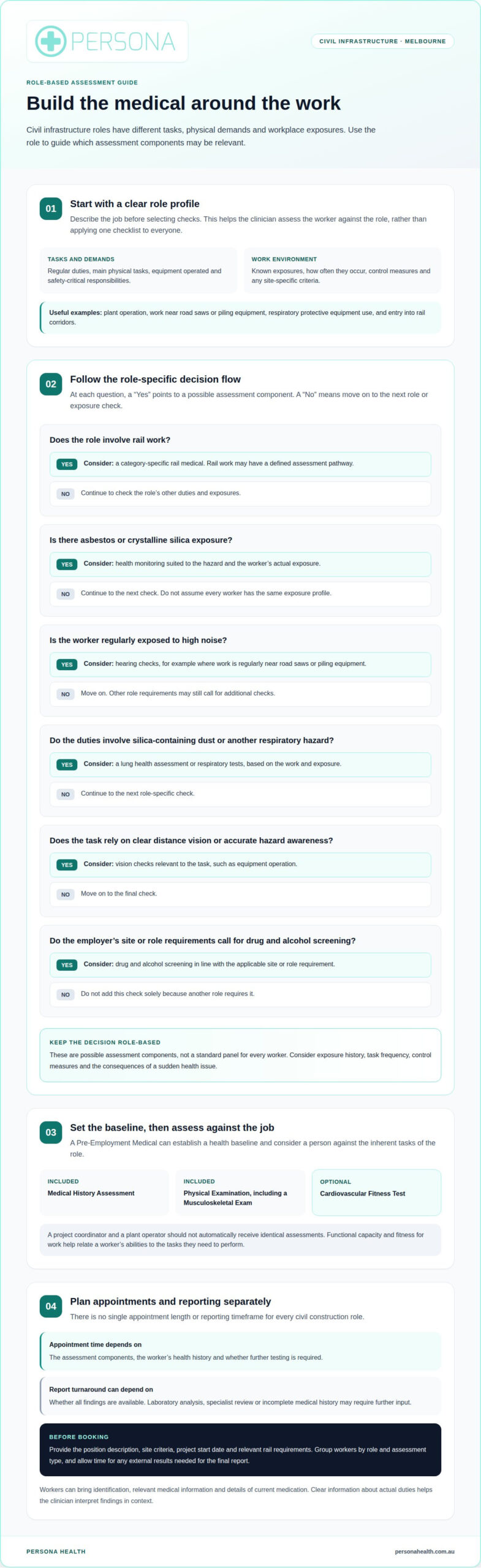
Assessment needs depend on the work, equipment and hazards on site. A light-vehicle driver has different demands from someone operating heavy plant, undertaking rail work or handling materials that create airborne dust. Start with a written role profile describing regular tasks, the work environment and safety-critical responsibilities.
A Pre-Employment Medical can establish a health baseline and assess a person against the inherent tasks of a role. The assessment includes a Medical History Assessment and Physical Examination, which includes a Musculoskeletal Exam. An optional Cardiovascular Fitness Test may also be included. The job description matters: an office-based project coordinator and a plant operator should not automatically receive identical assessments.
Additional checks may be appropriate when a role involves specific exposures or requirements. Depending on the work, an assessment plan could consider:
- Hearing checks for workers regularly exposed to high noise, such as near road saws or piling equipment.
- Lung health assessment where duties involve exposure to silica-containing dust or other respiratory hazards.
- Vision checks for tasks requiring clear distance vision, equipment operation or accurate hazard awareness.
- Drug and alcohol screening where the employer’s site or role requirements call for it.
These examples describe possible components, not a standard panel for every worker. Exposure history, task frequency, control measures and the consequences of a sudden health issue all influence what is relevant. For example, a concrete cutter’s dust exposure differs from that of a worker who occasionally enters the same area after controls are in place.
Some roles have a defined assessment pathway. Rail work may require a category-specific rail medical, while asbestos or crystalline silica exposure can call for health monitoring suited to the hazard. The assessment should reflect the actual exposure and role criteria, rather than assuming a general fitness check covers every requirement. A Melbourne-based assessment pathway can be organised around the job profile and relevant occupational health services in Melbourne.
Employers can make the process more useful by providing an accurate position description, the main physical tasks, known exposures and any applicable site criteria. The clinician can then assess the worker against those details and explain relevant findings in a work-focused report. Clear role information also helps avoid unrelated testing and supports consistent decisions across similar positions.
How long does a civil infrastructure medical take, and how soon are results available?
There isn’t one fixed appointment length or reporting timeframe for every civil construction role. The time needed depends on the assessment components, the worker’s health history and whether further testing is required. A basic review for a site-based labouring role differs from an assessment involving hearing, lung function, Drug and Alcohol Screening or rail requirements.
The appointment usually follows a clear sequence. First, the clinician confirms the role and reviews relevant health information. Next, they complete the examinations and tests specified for that job. A physical assessment may include tasks related to the position, while a worker with regular dust exposure may need Respiratory Tests. Each additional component takes time to conduct and document.
Before booking, provide the position description and any site-specific medical criteria. Include practical details such as whether the worker operates plant, wears respiratory protective equipment or enters rail corridors. This lets the assessment team plan the appointment around the requirements, rather than discovering missing information during the consultation.
Results can be ready after the clinical review when all required information is available. Additional steps can affect reporting time. For example, laboratory analysis, specialist review or incomplete medical history may mean the report needs further input. A test that requires external analysis follows that process before its result can be included in the final assessment.
Employers should distinguish appointment time from report turnaround. The appointment is the time spent completing the clinical assessment. Reporting time begins after the assessment and depends on whether the clinician has all relevant findings. A worker might finish the examination while a laboratory result is still being processed.
For coordinated workforce bookings, group workers by role and assessment type. A crew of plant operators may need different checks from workers undertaking silica-exposed tasks. Staggering appointments can help maintain project coverage while each worker completes the appropriate assessment. Keep the project start date, site access requirements and any mandatory rail criteria available during scheduling.
Workers can help avoid delays by bringing identification, relevant medical information and details of current medication. They should also be ready to discuss their actual duties, such as climbing into machinery or wearing a respirator. Accurate information helps the clinician interpret findings in context and reduces follow-up requests for missing details.
For civil infrastructure medicals in Melbourne, plan backwards from the worker’s required start date. Allow time for the appointment, any additional tests and report preparation. This creates a practical schedule without assuming every assessment or result will follow the same pathway.
What fitness, hearing, vision and drug and alcohol standards apply to Victorian civil construction workers?
Victorian civil construction roles don’t all call for the same health criteria. A labourer moving materials, a plant operator and a worker directing reversing vehicles have different tasks and consequences if a health issue affects performance. Assessment should relate each finding to the duties, site conditions and employer requirements, rather than treating one result as a universal pass mark.
Fitness for work considers whether a worker can perform the role’s physical and cognitive demands. Relevant tasks might include climbing into machinery, handling tools, walking over uneven ground or maintaining attention around moving plant. A clinician can interpret health information against those tasks and identify whether a restriction, adjustment or further assessment is relevant. A diagnosis alone doesn’t describe how someone performs a specific job.
Hearing and vision checks also need a task-based context. Hearing may matter when a worker must detect instructions, alarms or vehicle movements amid construction noise. Vision can be relevant to reading signals, identifying hazards or operating equipment. An assessment records functional findings, while the employer’s site criteria determine how those findings relate to the position. Corrective lenses or hearing protection may also form part of the work context.
Drug and Alcohol Screening requirements are commonly set through the employer’s policy, project rules or role-specific requirements. Those documents should explain which workers are covered, when testing occurs, how results are managed and what process applies to a non-negative result. The testing method and interpretation must follow the applicable procedure. A test result should be considered within that process, not treated as a complete assessment of every aspect of fitness for work.
Before arranging checks, match the criteria to the job. A practical sequence is:
- Describe the worker’s actual duties, including equipment operation and safety-critical tasks.
- Identify relevant exposures, such as sustained noise or airborne dust.
- Record any project-specific medical or testing requirements.
- Share those criteria with the assessing clinician for role-based interpretation.
For example, a traffic controller may need clear communication and visual awareness, while a worker operating machinery may need to demonstrate sustained attention and access to controls. These examples show why a single hearing, vision or physical result cannot determine suitability across every Victorian site. Rail work may also use its own category-based medical criteria, separate from general civil construction expectations.
Clear criteria support consistent decisions and protect worker privacy. Employers should receive information relevant to work capacity and stated requirements, rather than unrelated clinical details. A documented process also helps explain how hearing, vision, fitness and Drug and Alcohol Screening results were considered for a particular role.
Melbourne medicals for rail, road, utilities or heights
Yes. A rail worker, road crew member, utilities technician and worker at height can face different task demands. Their medical assessment should reflect the specific role and project criteria, not simply the broad label “civil construction”. For example, a rail corridor role may have a defined rail medical category, while a road crew role may focus on traffic exposure, equipment use and site duties.
Rail work can involve safety-critical tasks and site access conditions that differ from general road construction. The applicable rail operator or project requirements help determine the assessment pathway. A Category 3 rail medical is a distinct example of a role-specific assessment. Employers should provide the relevant category and duties, rather than assuming a general pre-employment check covers rail requirements.
Road and utilities work also vary. A worker directing traffic, operating a roller or locating underground services has different responsibilities and work environments. Medical assessment planning can consider the worker’s tasks, equipment and relevant exposures. For a utilities role, for example, the assessment may need to account for confined work areas, protective equipment or the physical demands of the assigned duties.
Working at heights calls for attention to the practical demands of the task. A worker accessing a platform, climbing ladders or using fall-arrest equipment may need assessment against the job’s physical and functional requirements. The assessment considers relevant health information alongside the specific work activities. It should not treat the phrase “working at heights” as a complete description of the role.
Project criteria can differ, so an employer’s role brief should identify:
- The worksite type, such as rail corridor, road reserve or utilities installation.
- The worker’s main tasks, including plant operation, climbing or traffic control.
- Relevant equipment and protective gear, such as a respirator or fall-arrest harness.
- Any rail category or project medical criteria that apply to the position.
These details allow the clinician to select and interpret assessments in context. A worker who occasionally enters a rail corridor may have different requirements from someone performing safety-critical rail duties. Likewise, a utilities technician’s occasional ladder use may differ from regular elevated work. Clear role information helps distinguish actual exposure from assumptions based on a job title.
For Melbourne infrastructure projects, keep assessment records aligned with each role and project requirement. If a worker transfers from road construction to rail work, reassess the new duties and applicable criteria before relying on an earlier assessment. This helps ensure the medical process reflects the work the person will actually perform.
Can employers require fitness assessments for civil work?
An employer can request a functional capacity or fitness-for-work assessment when it relates to a civil role’s actual duties. The assessment should address the work, not serve as a general medical examination without a clear purpose. For example, a plant operator’s tasks may involve climbing into machinery, using controls and maintaining attention around moving equipment.
Start with the position’s essential functions. A road crew role may involve walking on uneven surfaces, handling tools or working near traffic. A stores role on the same project may have different physical demands. A clinician can assess relevant abilities against the supplied duties, helping distinguish a task limitation from a medical diagnosis alone.
Employers should explain why an assessment is needed and what it will consider. The request can identify the role, the tasks in question and any functional concern that prompted the referral. If a worker is returning after an injury, for instance, the referral might ask whether they can safely manage specified lifting or climbing tasks. Avoid broad questions unrelated to the work.
A functional assessment may examine practical abilities relevant to the role. Depending on the referral, this could include movement, balance, lifting technique or tolerance for a particular task. The clinician’s findings can help clarify capacity and possible restrictions. They should be interpreted alongside the job demands, not as a pass-or-fail label detached from the worker’s duties.
Fitness for work is a broader question. It may consider whether a health issue, medication effect or temporary condition could affect a worker’s ability to perform specific tasks. For example, a temporary restriction on climbing would matter differently for a ground-based worker than for someone regularly accessing elevated equipment. The purpose is to understand work capacity and relevant adjustments.
A clear referral process helps keep decisions consistent. Employers can:
- Describe the role’s essential tasks and work setting.
- State the specific question the assessment needs to answer.
- Provide relevant task information, such as lifting or climbing demands.
- Use the resulting report to consider suitable duties or adjustments.
Health information should be handled confidentially and shared only as appropriate for the employment decision. A report focused on work capacity can give an employer relevant findings without turning every clinical detail into workplace information. If a report identifies a restriction, the next step is to consider its practical effect on the worker’s actual duties and available adjustments.
For a Melbourne civil project, document the assessment rationale and connect it to the position description. This creates a clear record of the question asked, the tasks assessed and how the findings informed the work decision.
Persona Health: Independent Medical Examiner
Persona Health provides Independent Medical Examiner assessments when an impartial medical opinion can help clarify a workplace capacity question. The examiner considers the referral questions, relevant records and the worker’s circumstances, then prepares an objective report for the parties involved.
For employers coordinating assessments across locations, Persona Health has 100 affiliate clinics nationwide and Australia-wide mobile workplace services. Its employer-focused approach, responsive customer service, fast turnaround times and modern digital reporting support a more organised process. Pre-Employment Medicals and Crystalline Silica Medicals address different workforce assessment needs.
Set a clear health plan for your next project
Planning civil infrastructure medicals in Melbourne starts with a practical question: what health information will help you make a sound decision for this role? Set that purpose before arranging an assessment, and keep the referral focused on the worker’s duties and relevant project requirements. This helps make the process clearer for workers and more useful for your team.
Persona Health offers Pre-Employment Medicals, Workplace Injury Management and Crystalline Silica Medicals for different workforce needs. For injury reporting and early triage, InjuryQR is a free AI-powered service available to all Australian businesses. Workers scan a QR code without downloading an app, describe an injury by voice, and answer AI follow-up questions. The triage can provide self-care advice, arrange telehealth, typically within 3-4 hours, direct someone to an Emergency Department or instruct them to call 000. Free posters, stickers, keyrings and fridge magnets support workplace access. Certificates of Capacity can be issued immediately where appropriate. Earlier guidance can support better reporting and help reduce Lost Time Injuries.
With a clear purpose and role-specific information, you can move forward confidently and support a considered approach to workforce health.
Frequently Asked Questions
Which Melbourne clinics provide pre-employment medicals for civil construction and infrastructure roles?
Persona Health provides pre-employment medicals in Melbourne at Cairnlea and Craigieburn. Its other named locations are Gregory Hills, Parramatta, Rosebery and Dee Why in Sydney. For infrastructure roles, the referral can identify relevant duties and project criteria, such as plant operation or rail requirements. Details of the Melbourne service are available on the Melbourne pre-employment medicals page.
What tests are included in a civil construction pre-employment medical in Australia?
A pre-employment medical can include a medical history assessment and physical examination, including a musculoskeletal examination. Persona Health provides pre-employment checks, Category 3 rail medicals and drug and alcohol testing. A cardiovascular fitness test is optional. The assessment components are selected to suit the role, so a worker’s referral and job requirements help shape the medical.
What documents should workers bring to a pre-employment medical in Melbourne?
Bring the employer’s referral or position description, especially if it describes site tasks or role-specific criteria. A current medication list and relevant medical records can help the clinician review your health history. If you have previous reports relating to a condition relevant to the work, bring those too. For rail roles, include any category or operator assessment information supplied for your appointment. These details help connect the assessment to your intended duties.
What happens if a worker fails or needs follow-up after a pre-employment medical?
The clinician relates findings to the role’s duties and may identify a restriction, adjustment or need for further assessment. A result is not a universal pass or fail; employer site criteria determine how it applies to the position.

Article by
Ian Nicholson
Ian is the Business Support Manager at Persona Health, where he plays a key role across IT, sales, marketing and business operations. With a broad skill set and a practical, solutions-focused approach, Ian helps drive the systems, communication and commercial strategy that support Persona Health’s continued growth across Australia.