
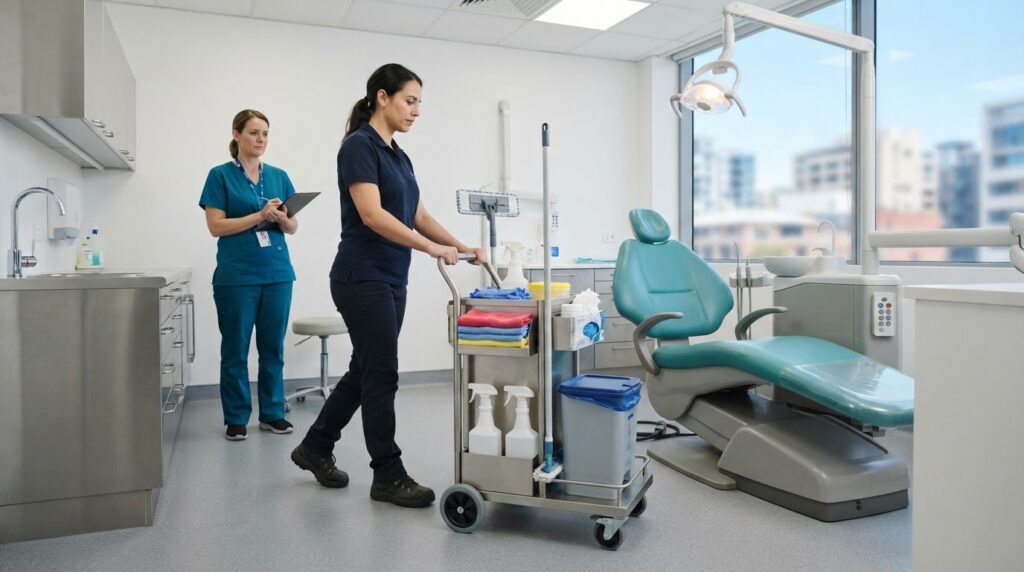
A spotless waiting room alone doesn’t show whether a commercial cleaner is prepared to work in a medical practice in Sydney. Dental, GP and allied health facilities have distinct cleaning needs, shaped by clinical areas, high-touch surfaces and each practice’s operations. Choosing the right cleaner takes more than judging appearances.
It makes sense to look closely at who will enter your practice and how the work will be managed. This guide explains what medical cleaning can involve and how to assess a provider’s staff screening, insurance and compliance processes. It also covers practical details for deciding whether a cleaning plan suits your rooms, services and daily routines.
Key Takeaways
- Assess a cleaning provider’s staff screening, insurance and documented procedures, not just the visible result.
- Match cleaning arrangements to the practice’s rooms, patient activity and areas requiring particular attention.
- Understand that medical requirements for cleaners depend on their role and exposure, rather than assuming every healthcare facility has identical requirements.
- Use relevant healthcare infection-control standards as a reference when reviewing cleaning processes and compliance.
- For a separate, impartial medical assessment, Persona Health’s Independent Medical Examiner service may be relevant to your needs.
Cleaner screening, insurance and compliance
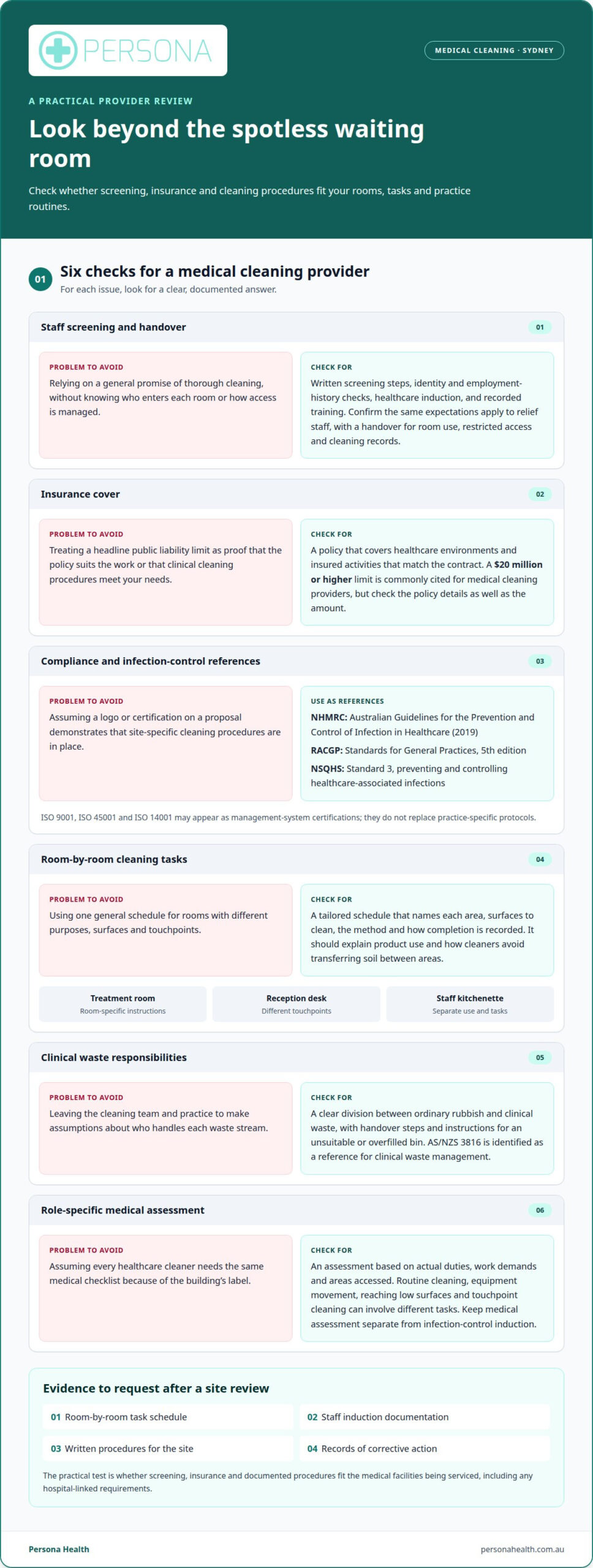
In a Sydney medical centre, reliable cleaning depends on people, procedures and records, not polished floors alone. When considering commercial cleaner medicals in Sydney, start by defining who enters each room, what they clean and how access is managed. Ask for written screening steps, staff induction details and a process for covering an absent cleaner. These records help show whether the same expectations apply to regular and relief staff. A clear handover tells the incoming cleaner which rooms are in use, which areas have restricted access and where cleaning records are kept.
Ask the provider to explain its screening process in practical terms: how it checks workers’ identities and employment history, what healthcare-specific induction covers, and how training is recorded. A certificate alone doesn’t demonstrate competence. For example, a cleaner entering a dental surgery needs to understand room-specific instructions and how to report a spill or damaged equipment. A cleaner assigned to waiting areas needs different access and task information. Ask how supervisors monitor work and respond to missed tasks, rather than relying on a general promise of thorough cleaning.
Insurance needs close attention too. A $20 million or higher public liability limit is commonly cited for medical cleaning providers, but the headline amount doesn’t answer every question. Check whether the policy covers work in healthcare environments and whether its insured activities match the contract. Clarify who is responsible for reporting incidents or damage, then keep the relevant policy details with the service agreement. This gives the practice a clearer view of the provider’s cover without confusing an insurance limit with evidence that clinical cleaning protocols meet site needs.
Compliance is a working system, not a logo on a proposal. The National Health and Medical Research Council’s Australian Guidelines for the Prevention and Control of Infection in Healthcare (2019) provide a reference for infection-control practices. The RACGP Standards for General Practices, 5th edition, are another reference for general practices. The Australian Commission on Safety and Quality in Health Care sets NSQHS Standards Standard 3 for preventing and controlling healthcare-associated infections. These references help frame questions about cleaning responsibilities, staff awareness and evidence that agreed procedures are followed.
Request protocols that turn relevant guidance into site-specific tasks. A tailored schedule should identify each area, the surfaces to clean, the method and how completion is recorded. A treatment room, reception desk and staff kitchenette have different uses and touchpoints. The schedule should explain how cleaners avoid transferring soil between areas, which products they use and how they follow product instructions. If a cleaner finds a sharps-container issue or clinical spill, the procedure should direct them to the practice’s nominated contact, not leave them to improvise.
Clinical waste deserves a separate conversation. AS/NZS 3816 is identified as a reference for clinical waste management, so clarify which party handles each waste stream and how handovers work. The provider’s scope should distinguish ordinary rubbish from clinical waste and explain how staff respond when a bin is unsuitable or overfilled. These details reduce assumptions between the practice and cleaning team. They also help clarify whether the agreed cleaning services address the actual needs of patients and staff.
Ask what evidence a supervisor can provide after a site review. Useful records include a room-by-room task schedule, induction documentation, incident-reporting steps and a record of corrective action. ISO 9001, ISO 45001 and ISO 14001 may appear as management-system certifications; they don’t replace practice-specific protocols. For commercial cleaner medicals in Sydney, the practical test is whether screening, insurance and documented procedures fit the medical facilities being serviced, including any hospital-linked requirements.
Are medical requirements different for healthcare or hospital cleaners in Sydney?
For commercial cleaner medicals in Sydney, the assessment should reflect the cleaner’s actual duties, not just the building’s label. A GP clinic, dental practice and hospital may involve different rooms, tasks and access arrangements. Someone working in reception has a different work pattern from a cleaner entering treatment rooms. Describe the position, tasks and areas the worker will access. This gives the employer a practical basis for deciding whether an assessment is relevant to the role.
There isn’t one medical checklist that automatically suits every healthcare cleaner. Employers can distinguish routine cleaning from tasks involving additional physical demands or specific site procedures. Moving equipment, reaching low surfaces or working around restricted rooms may be part of one position but not another. These details help shape a role-specific assessment and prevent a generic job title from replacing a clear account of the cleaner’s duties during a shift.
Medical assessment and infection-control induction serve different purposes. The National Health and Medical Research Council’s Australian Guidelines for the Prevention and Control of Infection in Healthcare (2019) provide a reference for infection-control practices. The RACGP Standards for General Practices, 5th edition, offer a reference for general practices. The Australian Commission on Safety and Quality in Health Care sets NSQHS Standards Standard 3 for preventing and controlling healthcare-associated infections. These references inform facility practices, rather than setting one medical examination for every cleaner.
Map any assessment to the position. Record the main tasks, relevant work demands and areas accessed, then identify which capabilities need consideration. A role involving regular floor cleaning may have different movement demands from one focused on touchpoints and waste handling. A hospital contractor may also need to follow site access and induction arrangements. Keep these operational requirements separate from medical questions so the assessment stays connected to the work, not assumptions about a person’s health.
Healthcare protocols also shape how cleaners prepare for their duties. Cleaning plans can account for differences between surfaces and items, with procedures suited to the areas being cleaned. A dental operatory, for example, isn’t interchangeable with an office corridor. Chemical disinfection contact times are typically 3-10 minutes, so cleaning plans need to allow products to be used as directed. These are procedure considerations, not automatic reasons to require a particular medical test. Employers should explain the task and relevant procedure clearly.
When arranging commercial cleaner medicals in Sydney, connect the cleaner’s duties with the facility’s induction. Explain which rooms are included, where the worker can enter and how to report an issue to the nominated contact. A cleaner assigned to waiting areas needs instructions for shared surfaces; someone entering clinical rooms needs the applicable room procedure. The NHMRC guidelines and NSQHS Standard 3 can inform infection-control arrangements, while the role description informs assessment decisions. Keeping these distinct helps requirements remain proportionate and understandable.
If your Sydney practice is defining a cleaner’s role, prepare its task description before arranging an assessment. Include work areas, routine tasks, physical demands and relevant site procedures. This helps clarify what the assessment should address and keeps it tailored to the position. For example, note whether the role includes moving cleaning equipment or entering treatment rooms. For help discussing role-specific assessment needs, contact Persona Health.
Cleaners may need to follow site-specific access and induction arrangements, along with infection-control practices suited to their tasks and the areas they enter.
Chemical disinfection is part of the facility’s cleaning process, not a substitute for defining the cleaner’s duties. Environmental surfaces are linked to 85% of healthcare-associated infections. The company recommended regular cleaning, followed by deep cleaning, and then applying or spraying disinfectant in healthcare facilities. The company said healthcare cleaners should use disinfectant products to remove pathogens, viruses, bacteria and other germs. The company advised local cleaners to wear PPE before entering healthcare facilities. These operational steps can be recorded separately from any assessment of the physical demands or capabilities required by the position.
Healthcare-specialised cleaning costs 35-60% more than standard commercial cleaning. Popular specialised healthcare cleaning providers may be booked 2-4 weeks in advance for new clients. These estimates can help employers distinguish the cost and scheduling of a specialist cleaning service from the separate question of whether a worker needs a role-specific medical assessment.
Persona Health: Independent Medical Examiner
Persona Health can help when an employment decision needs a medical assessment matched to the role. For a cleaner starting a new position, Pre-Employment Medicals are relevant, with the job’s duties informing the assessment. An Independent Medical Examiner may be appropriate when an independent medical opinion is needed in a workplace matter.
Persona Health takes an employer-focused approach, with responsive customer service, modern digital reporting and a focus on fast turnaround times. The right assessment pathway depends on its purpose and the role requirements. Contact Persona Health to discuss your needs.
Make your next assessment role-specific
Use the cleaner’s actual duties to guide your next employment decision. For commercial cleaner medicals in Sydney, a role description can clarify which work demands the assessment should address, rather than relying on the job title alone.
Persona Health offers Pre-Employment Medicals and Crystalline Silica Medicals for relevant workplace needs, as well as Workplace Injury Management. InjuryQR is a FREE AI-powered workplace injury triage service available to all Australian businesses. Workers scan a QR code without downloading an app, describe an injury by voice, and respond to AI follow-up questions. Outcomes can include self-care advice, a telehealth appointment typically within 3-4 hours, direction to an Emergency Department or instructions to call 000. Certificates of Capacity can be issued immediately where appropriate. Free posters, stickers, keyrings and fridge magnets help workplaces make the service accessible, supporting injury reporting and helping reduce Lost Time Injuries (LTIs).
Share the assessment purpose and role requirements to help identify a suitable next step.
A clear, role-focused approach can help you move forward with greater confidence.
Frequently Asked Questions
What medical checks are required for commercial cleaners in Sydney?
The assessment should relate to the cleaner’s duties and the employer’s role requirements. There isn’t one checklist for every cleaning position. A role focused on office areas may differ from one involving physical tasks or specific site procedures. Employers can provide the position description and relevant duties so the assessment can be matched to the work. Cleaning protocols and site induction remain separate from the medical assessment.
Do commercial cleaners in Sydney need a pre-employment medical assessment?
A pre-employment assessment may be used when an employer wants to understand a candidate’s health in relation to a specific role. It isn’t automatically the same for every cleaner or workplace. For example, an employer may want the assessment to consider the physical demands described in a position, rather than relying on the job title alone. Persona Health’s Pre-Employment Medicals are tailored to the employer’s requirements.
What tests are included in a cleaner medical assessment in Australia?
Persona Health’s Pre-Employment Medicals can include a medical history assessment, physical examination, musculoskeletal examination, drug and alcohol screening, and vision, hearing and respiratory tests. An optional cardiovascular fitness test may also be included. Components depend on the employer’s requested assessment and the role requirements. For a cleaner, identify relevant duties and assessment needs so the process focuses on the position rather than adding unrelated tests.
How much does a pre-employment medical for a cleaner cost in Sydney?
The cost depends on the assessment scope, role requirements and components requested. For example, a position requiring a physical examination and additional screening may involve a different scope from one with fewer requested components. When requesting a quote from Persona Health, share the role details and required assessments so the proposed service reflects the employer’s needs. Persona Health provides Pre-Employment Medicals in Sydney, Melbourne, Gregory Hills and Parramatta.
Where can cleaners get a pre-employment medical in Sydney?
Cleaners can arrange a pre-employment medical through Persona Health. Sydney locations include Parramatta, Rosebery, Gregory Hills and Dee Why; Melbourne clinics are in Cairnlea and Craigieburn. The network includes 100 affiliate clinics nationwide, alongside Australia-wide mobile workplace services. The suitable appointment depends on the requested assessment and the candidate’s circumstances. Employers can provide role details and requested components when arranging an assessment, helping keep it relevant to the position.

Article by
Ian Nicholson
Ian is the Business Support Manager at Persona Health, where he plays a key role across IT, sales, marketing and business operations. With a broad skill set and a practical, solutions-focused approach, Ian helps drive the systems, communication and commercial strategy that support Persona Health’s continued growth across Australia.