
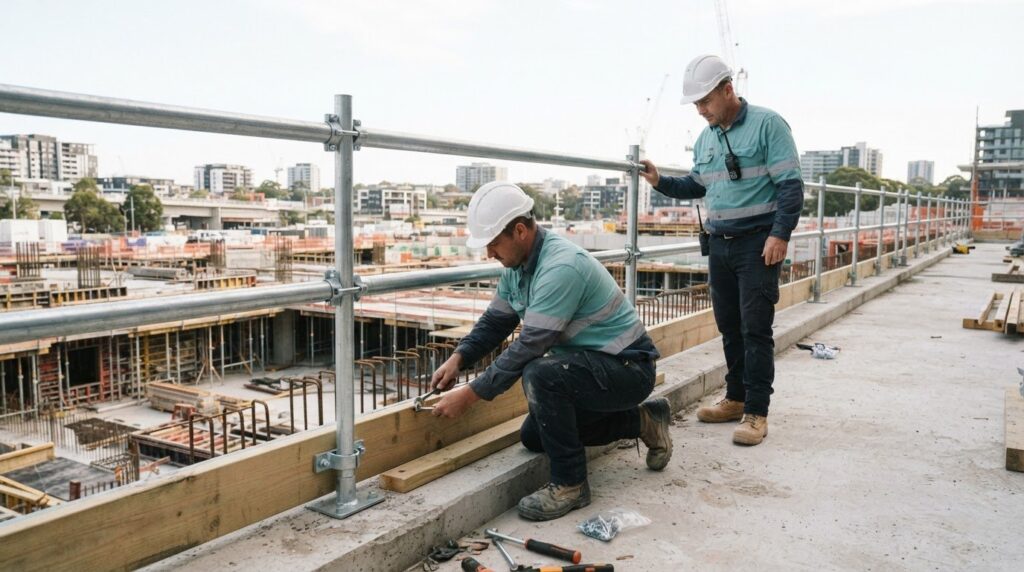
Reducing LTIFR starts with preventing injuries, not just counting them afterwards. Effective strategies to reduce LTIFR in NSW combine fall prevention, practical training, prompt hazard reporting and thorough incident follow-up. SafeWork NSW states that a PCBU must protect workers from the risk of falling from one level to another, regardless of height.
Injury frequency rates can reveal trends, but they cannot show on their own whether controls are working. A useful safety plan looks beyond the score to the hazards workers face and the actions taken when something goes wrong. This guide covers practical ways to strengthen fall prevention, tailor training to tasks, encourage hazard reporting and follow incidents through to corrective action. It also explains how to use NSW safety resources in regular reviews, so you can reduce risks as well as track outcomes.
Key Takeaways
- Prioritise fall risks around work at heights, vehicle operating areas and other changing site conditions, then match controls to the task.
- Make safety training practical: workers need to understand the hazards they may encounter, how to use controls and how to raise concerns.
- Use hazard reports and regular site reviews to spot risks early, including concerns workers may not raise through formal incident channels.
- Track incidents through to corrective action, and review whether the change addressed the underlying hazard rather than just recording the injury.
- InjuryQR is a free AI-powered triage service for Australian businesses: workers scan a QR code without downloading an app, describe an injury by voice and answer AI follow-up questions. It can provide self-care advice, telehealth appointments typically within 3-4 hours, direction to an Emergency Department or instructions to call 000; Certificates of Capacity can be issued immediately where appropriate, supporting timely reporting and helping reduce Lost Time Injuries.
1. Common fall hazards and industry hotspots
LTIFR means Lost Time Injury Frequency Rate. It compares lost time injuries with hours worked over a defined reporting period, using a consistent multiplier. Employers in NSW should document their injury criteria and multiplier, then apply them consistently across teams. A high LTIFR can indicate disruption, including replacement labour, delayed work and incident investigations. The impact depends on the injury and the work affected.
Falls remain a serious workplace hazard: they cause thousands of serious injuries every year in Australia. Risks can arise from roofs, ladders, platforms, unprotected edges, uneven ground and vehicle access points. SafeWork NSW states that PCBUs must protect workers from falling between levels, regardless of height. That makes low-level falls relevant too, including a slip from a loading dock or a ladder rung.
NSW incident notifications also point to wider site hazards. The NSW Resources Regulator received 551 notifications from October to December 2024. Its report identifies roads and vehicle operating areas, fires or explosions, and airborne contaminants as hazards that feature regularly. These examples matter because a fall risk can combine with moving vehicles, poor visibility, dust or a changing work area.
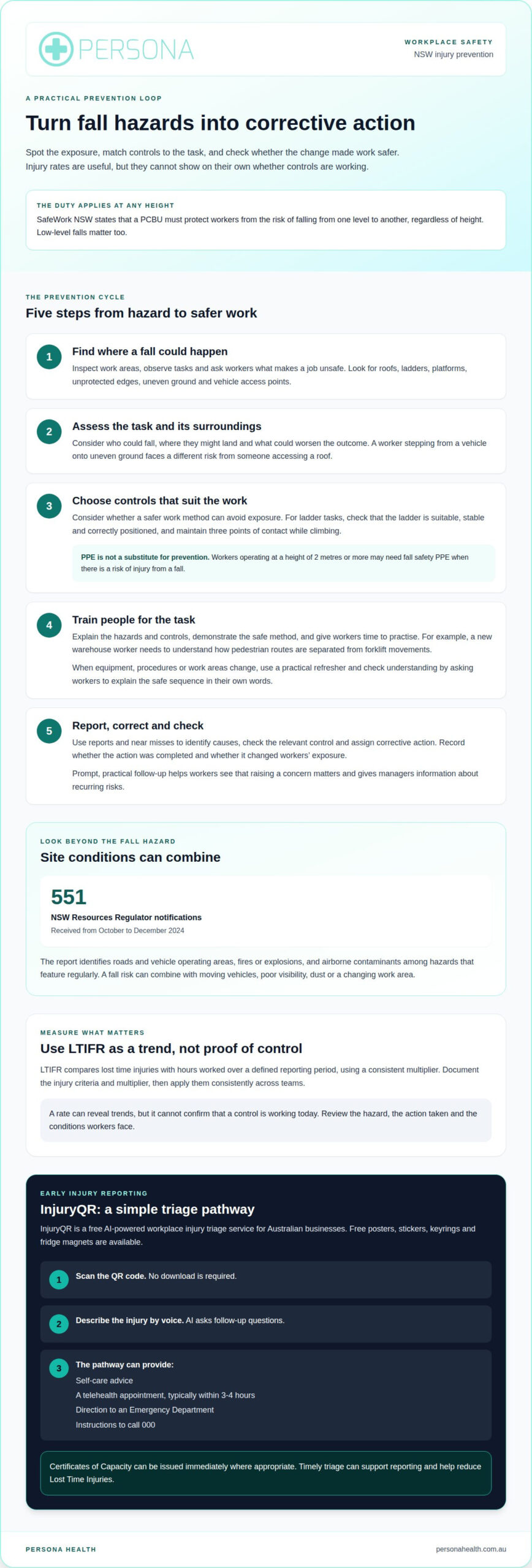
Identify high-risk hazards by inspecting work areas, observing tasks and asking workers what makes a job unsafe. Assess who could fall, where they might land and what could worsen the outcome. A worker stepping from a vehicle onto uneven ground, for instance, faces a different risk from someone accessing a roof. Choose controls that remove or reduce exposure, and review them when tasks or site conditions change.
For ladder tasks, maintain three points of contact while climbing. Check that the ladder is suitable, stable and positioned correctly for the job, rather than using it as a shortcut to a higher-risk task. At an edge or elevated platform, consider whether a safer work method can avoid exposure. Personal protective equipment can form part of the controls, but it should not replace practical prevention.
A common mistake is to focus on the score instead of the hazard. LTIFR can show trends, but it cannot confirm that a control is working today. A toolbox talk without task-specific instruction, a hazard form with no follow-up, or reliance on PPE alone can leave risks unchanged.
Use each reported fall or near miss to identify its cause, check the relevant control and assign corrective action. Record whether the action was completed and whether it changed workers’ exposure. This connects injury data with actual site conditions, rather than treating a lower rate as proof that fall hazards are controlled.
2. Employee training and safety culture
Training works best when workers practise the decisions their tasks require. A site induction can explain local rules, but workers also need task-specific guidance before using unfamiliar equipment. For example, a new warehouse worker should know how pedestrian routes are separated from forklift movements. A supervisor can observe the task and correct unsafe habits early.
Build instruction around the actual work, not a generic slide deck. Identify the hazards, explain the controls, demonstrate the safe method and give workers time to practise. A maintenance team working around moving plant needs different instruction from an office-based team. A short demonstration or walk-through of the work area can make each control clear.
Supervisors shape safety culture through their everyday responses. Prompt action on a report of a damaged guard shows workers that reporting matters. If production pressure repeatedly overrides safe procedures, workers may conclude that written rules are optional. Managers can reinforce expectations by discussing safe work during pre-starts and recognising workers who pause a task when conditions change.
Make it practical for workers to speak up. Explain who receives hazard reports, how to raise a concern and what happens next. A worker who notices a slippery access route, for example, should know how to warn nearby colleagues and report the condition. Clear follow-up builds trust and gives managers useful information about recurring risks.
InjuryQR supports early injury reporting and triage for Australian businesses. It’s a free, AI-powered service, with free posters, stickers, keyrings and fridge magnets. A worker scans a QR code without downloading an app, describes the injury by voice, then responds to AI follow-up questions. The pathway can provide self-care advice, arrange a telehealth appointment, direct the worker to an Emergency Department or advise calling 000. Telehealth appointments are typically within 3-4 hours. A Certificate of Capacity can be issued immediately where appropriate. Timely triage can help reduce Lost Time Injuries and improve reporting by guiding workers towards an appropriate next step.
Use brief refresher sessions when procedures, equipment or work areas change. A toolbox discussion about a new delivery route, for example, can clarify pedestrian access before vehicles arrive. Supervisors can check understanding by asking workers to explain the safe sequence in their own words, rather than relying on attendance records alone.
For practical support with workplace injury processes, discuss your workplace needs.
Include fall-risk controls in task briefings: workers operating at a height of 2 metres or more may need fall safety PPE when there is a risk of injury from a fall.
3. Hazard reporting and ongoing safety reviews
A hazard report is useful when it helps workers and supervisors act before someone is harmed. Keep reporting channels simple, such as a conversation with a supervisor, a site form or a digital system. A worker who spots a leaking pipe near a walkway should be able to report its location promptly and warn people nearby. Clear steps show workers who receives a report and what happens next.
Workers often notice changes that scheduled inspections miss. Ask what concerns they have raised, which tasks are difficult to complete safely and whether controls work during busy periods. A delivery driver may, for example, spot blocked sightlines near a loading area. Record the concern, assess the exposure and assign someone to decide on corrective action. Consider injury rates alongside current risks and possible blind spots.
Visual markers can highlight specific hazards where work happens. Signs can identify restricted areas, while floor markings can show pedestrian routes beside vehicle movements. Use clear, legible wording and place markers where workers make decisions, such as at an entry point or equipment control. A warning sign alone does not remove a hazard. If a temporary spill creates a slip risk, isolate the area and arrange clean-up as well as displaying a warning.
Review signs and markings when site conditions change. A new storage layout may hide a sign or direct workers towards a vehicle route. Include visual markers in routine walk-throughs, and ask workers whether each sign is visible from their approach. Replace faded floor markings and remove obsolete instructions to avoid conflicting messages.
Regular reviews should go beyond checking completed forms. Compare reported concerns with inspection findings, near misses and changes to work processes. If several reports describe congestion at the same doorway, examine the route, timing and storage arrangements. The pattern may reveal recurring exposure rather than isolated behaviour. Record the decision, the control selected and how its effectiveness will be reviewed.
Close the loop with the person who raised the concern. Explain whether the hazard was removed, controlled or referred for further assessment. If action takes time, share interim arrangements, such as using another access route. This shows that reporting leads to a decision and lets supervisors check whether the control works in practice.
For injuries or near misses, make reporting accessible and consistent. Workplace injury reporting processes can support timely triage and clearer records. Review the resulting information alongside workforce concerns, because a low injury count cannot show whether workers face unmanaged risks today.
4. Incident tracking and corrective actions
Measure LTIFR consistently by comparing lost time injuries with hours worked, using the same documented multiplier and reporting period. Set a realistic reduction target from your own baseline, then pair it with measures of whether controls are operating. A target alone cannot show what changed or whether workplace risks are better managed.
Maintain an incident register recording the event, work area, injury outcome, contributing conditions and follow-up actions. A hand injury during equipment maintenance, for example, should prompt a review of the task, equipment and work instructions. Record near misses and hazards too, so injury figures do not hide emerging problems. Consistent categories make patterns easier to identify across sites and teams.
NSW Resources Regulator figures illustrate why context matters. From October to December 2024, incident notifications decreased by six per cent for NSW coal mines and 16 per cent for NSW large mines compared with the previous quarter. Those changes describe notifications, not whether controls were effective at a particular worksite. Consider incident data alongside current risks, worker concerns and the condition of safety controls.
After an incident, establish what happened before deciding on corrective action. Speak with the worker and relevant witnesses, examine the work area, and review the task instructions and equipment. Distinguish immediate causes from contributing conditions. If a worker trips near stored materials, investigate access arrangements and storage practices, not only the worker’s actions.
Assign each corrective action to a responsible person and record its due date, completion evidence and review method. Relocating materials, for example, needs a follow-up inspection to confirm the route remains clear. If the same type of incident recurs, revisit the assessment and consider whether the action addressed the underlying exposure. Close actions only after the change has been implemented and reviewed.
Use trend reviews to set targets that reflect actual work and changing exposure. Compare consistent periods, account for hours worked and consider workforce or task changes before interpreting a rate. Avoid targets that encourage under-reporting or make workers feel blamed for raising concerns. Pair LTIFR with practical indicators, such as overdue corrective actions, repeat hazards and whether controls are checked.
InjuryQR can support prompt injury triage and reporting, alongside a structured incident review. Record relevant outcomes in the appropriate workplace process, protect sensitive information and use the findings to guide prevention. A lower LTIFR is meaningful when records are complete and corrective actions reduce exposure, not simply when fewer injuries appear in the register.
5. SafeWork NSW and industry safety resources
SafeWork NSW and the NSW Resources Regulator offer starting points for reviewing workplace risks. Use relevant guidance to frame a site discussion, then compare it with the work, equipment and conditions workers actually face. A resource is most useful when it prompts a practical check, such as confirming that a procedure reflects the current layout.
Industry LTIFR benchmarks vary with the work performed, injury definitions, reporting periods and hours worked. Compare like with like, using organisations with similar tasks and exposure, and treat benchmarks as context rather than proof of safe performance. If another business calculates its rate differently, the comparison may mislead rather than help set a realistic target.
The NSW Resources Regulator says its quarterly safety report is intended to help industry review safety management systems and conduct site risk assessments. Use it to prompt questions about site hazards, then check whether those issues apply locally. For example, a resources operator could review vehicle movements, emergency arrangements and dust controls against its own work areas.
The October to December 2024 report recorded 551 incident notifications. That figure describes notifications across the relevant reporting period, not the risk level at every NSW worksite. The report also identifies roads or other vehicle operating areas, fires or explosions, and air quality, dusts and other airborne contaminants as hazards that feature regularly in notifications. A transport depot, for example, may focus a review on vehicle routes and visibility, while another workplace assesses airborne exposures.
Turn a resource into a practical review process. First, select guidance relevant to the work activity. Then walk through the task with workers and supervisors. Record gaps between the written process and site practice, assign actions and review whether they changed exposure. A form that remains unchanged after equipment or work arrangements shift can quickly become unreliable.
SafeWork NSW materials can help structure discussions about controls and worker involvement. Use a toolbox meeting to examine one task, such as accessing a plant room, and invite workers to identify unclear instructions. Record the concern and response. During a later inspection, check whether the agreed change is visible in the work area.
Industry resources support, but do not replace, site-specific assessment. A quarterly report shows patterns across notifications; a workplace review examines conditions where people perform tasks. Track LTIFR alongside current hazard reports, completed actions and worker feedback. This broader view helps distinguish a change in recorded injuries from evidence that risk controls are improving.
Persona Health
Persona Health supports employers with occupational health services and workplace injury management in Sydney and Melbourne, including Gregory Hills and Parramatta. Its services include Pre-Employment Medicals, Workplace Injury Management and Crystalline Silica Medicals, supporting different workforce health needs.
Employers can access clinics in Parramatta, Rosebery, Gregory Hills and Dee Why in Sydney, and Cairnlea and Craigieburn in Melbourne. A network of 100 affiliate clinics nationwide and Australia-wide mobile workplace services supports local and multi-site workforces. Persona Health also focuses on fast turnaround times, responsive customer service, an employer-focused approach and modern digital reporting.
Contact Persona Health to discuss support for your workplace.
Turn safety findings into sustained action
Progress comes from making safety decisions part of everyday work, not reacting only to a changing rate. Choose one recurring risk, clarify who owns the next action, then build a regular review into how that work is planned. Keep listening to workers as tasks and conditions change. Their practical experience can reveal where a written process needs attention.
Effective strategies to reduce LTIFR in NSW connect injury information with prevention and appropriate support. Persona Health provides Workplace Injury Management, Pre-Employment Medicals and Crystalline Silica Medicals in Sydney and Melbourne, including Gregory Hills and Parramatta. These services support workplace health needs and complement, rather than replace, controls and reviews that address hazards at their source.
To discuss occupational health support for your workplace in Sydney, Melbourne, Gregory Hills or Parramatta, contact Persona Health and take the next step for your organisation.
Steady, thoughtful improvements can help your people work with greater confidence and help your organisation keep learning from experience.
Frequently Asked Questions
What are the current NSW WHS laws and SafeWork NSW requirements for reducing workplace injuries?
SafeWork NSW states that a PCBU must protect workers from the risk of falling from one level to another, regardless of height. Employers should identify hazards, assess risks and put suitable controls in place for the work being done. For example, review access arrangements before maintenance begins, then check whether workers can follow the planned safe method. Requirements depend on the hazard and work context.
Which strategies are most effective for reducing lost-time injuries in NSW workplaces?
Effective prevention starts with controls that reduce exposure at its source, supported by safe task planning and timely maintenance. Schedule equipment repairs before a fault forces workers to improvise during a busy shift. Review injury and near-miss patterns alongside changes in work, such as a new process or work area. These strategies to reduce LTIFR in NSW work best when supervisors check that controls remain practical during normal operations.
What steps should NSW businesses take after a workplace injury to prevent recurrence?
First, arrange appropriate care and make the area safe. Record what happened, speak with the injured worker when appropriate, and gather relevant details about the task, equipment and conditions. Then identify contributing factors, assign corrective actions and review whether they address the cause. InjuryQR can assist with workplace injury reporting and triage. Use the incident findings to update relevant procedures and brief affected workers before similar work resumes.
How can safety training, supervision and worker consultation reduce LTIFR?
Training helps workers understand how to perform their specific tasks safely, while supervision checks whether they apply that learning in practice. After introducing new equipment, for example, demonstrate its safe operation and ask workers to explain key steps. Consultation can reveal practical barriers, such as instructions that do not match the work sequence. Use feedback to refine procedures, then have supervisors observe the task and reinforce changes through regular conversations.

Article by
Ian Nicholson
Ian is the Business Support Manager at Persona Health, where he plays a key role across IT, sales, marketing and business operations. With a broad skill set and a practical, solutions-focused approach, Ian helps drive the systems, communication and commercial strategy that support Persona Health’s continued growth across Australia.