

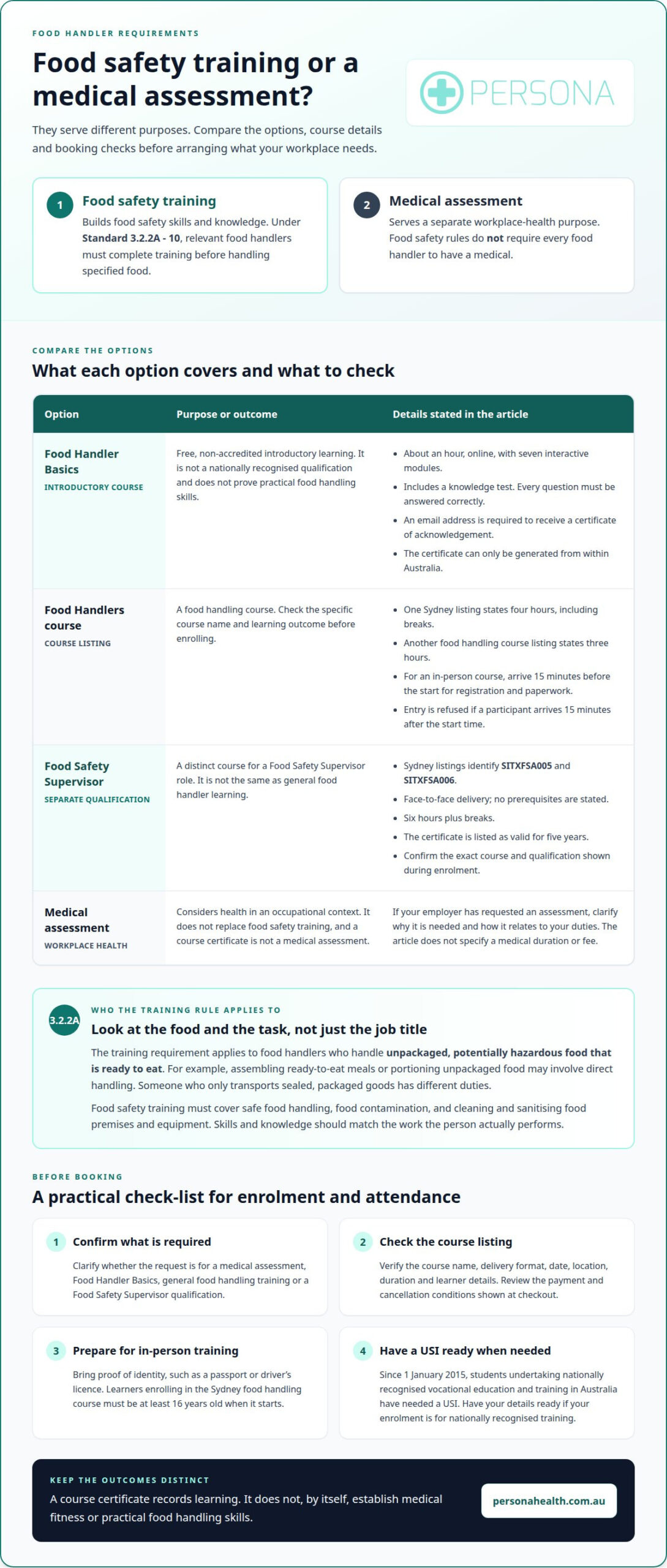
A food handler medical isn’t the same as food safety training. Under Standard 3.2.2A – 10, food handlers who handle unpackaged, potentially hazardous ready-to-eat food must complete food safety training before doing so. That requirement is about food safety skills and knowledge, while a medical assessment serves a different workplace-health purpose.
The distinction matters if you’ve been asked to arrange an assessment and aren’t sure whether you need a course or a medical. Food safety rules set a training requirement for food handlers; they don’t require every handler to have a medical. If your employer has requested one, start by clarifying why and how the assessment relates to your duties.
This guide explains how booking food handler medicals in Sydney works, what to understand about payment, and how to distinguish an occupational medical assessment from food safety training. You’ll have a clearer basis for taking the next step and arranging the option that fits your workplace’s needs.
Key Takeaways
- Understand what information helps clarify the purpose and arrangements for a workplace medical assessment before booking.
- Separate food safety training requirements from medical assessments: Standard 3.2.2A – 10 applies to handlers of unpackaged, potentially hazardous ready-to-eat food.
- Learn which symptoms or illnesses food handlers need to report and why timely communication supports safe food handling.
- See how food safety training and workplace health assessments address different needs, and when an Independent Medical Examiner may be relevant.
Booking and payment
First, establish whether you need a medical assessment or a food safety course. They serve different purposes: a medical appointment does not replace training, and a course certificate is not a medical assessment. The right next step depends on your employer’s request and the duties involved.
Sydney food safety course listings describe options with different durations and outcomes. A Food Handlers course is listed as four hours, including breaks, while another food handling course is listed as three hours. The NSW Food Authority’s Food Handler Basics course takes about an hour. Check the course name and learning outcome before enrolling, as these are distinct options.
Food Handler Basics is free and non-accredited. It offers introductory learning, not a nationally recognised qualification or proof of practical food handling skills. The course has seven interactive modules and a knowledge test. Learners must answer every test question correctly and provide an email address to receive a certificate of acknowledgement. The certificate can only be generated from within Australia.
A Food Safety Supervisor course is different again. Sydney listings identify SITXFSA005 and SITXFSA006, describe face-to-face delivery, and state that there are no prerequisites. The course takes six hours plus breaks. Its certificate is listed as valid for five years. Confirm the exact course and qualification shown during enrolment, particularly if your workplace requires a Food Safety Supervisor rather than general food handler learning.
For an in-person Food Handlers course, allow time for registration. Participants are advised to arrive 15 minutes before the scheduled start to complete paperwork. Entry is refused if a participant arrives 15 minutes after the starting time. Bring proof of identity, such as a passport or driver’s licence. Learners enrolling in the Sydney food handling course must be at least 16 years old when it starts.
Payment arrangements depend on the course and booking process. Before paying, check that the course name, delivery format, date, location and learner details suit your needs. Review the payment and cancellation conditions shown at checkout. This helps you distinguish a free introductory course from paid vocational training and avoid booking an online course when you need face-to-face attendance.
- Choose the right course: distinguish Food Handler Basics from a Food Safety Supervisor qualification.
- Check attendance details: note the listed duration, delivery format and venue in your booking.
- Prepare for class: bring accepted identity evidence and arrive before the start time.
- Keep the outcome clear: a course certificate records learning, but does not establish medical fitness or practical skills by itself.
Since 1 January 2015, students undertaking nationally recognised vocational education and training in Australia have needed a USI. If your enrolment is for nationally recognised training, have your USI details ready for the registration process. A statement of attainment or certificate is issued upon successful completion where the course leads to that outcome. The course information should explain the learning covered, including hygiene and hygienic practices, and any assessment required.
Food handlers working with unpackaged, potentially hazardous ready-to-eat food
Standard 3.2.2A – 10 applies to food handlers who handle unpackaged, potentially hazardous food that is ready to eat. These workers must complete a food safety training course before handling that food. The requirement focuses on safe food practices and relevant skills, not a routine medical examination.
The distinction matters when a workplace requests a medical. A course covers food safety knowledge, while a medical assessment considers health in an occupational context. Neither automatically replaces the other. Clarify whether the request relates to food handling skills, a health concern or another work requirement.
Work activities help determine who falls within the training requirement. For example, a hospitality worker assembling ready-to-eat meals or portioning unpackaged food may handle food directly. Someone who only transports sealed, packaged goods has different duties. Consider what food the worker handles, and whether it is unpackaged, potentially hazardous and ready to eat.
Food businesses must ensure handlers have completed compliant food safety training or have appropriate skills and knowledge. Consider each person’s duties, not just their job title. A kitchen hand, caterer or service worker may perform different tasks across shifts, so training and practical understanding should match the food safety demands of the work.
Skills and knowledge should match the work a person actually performs. Food safety training must cover safe food handling, food contamination, and cleaning and sanitising food premises and equipment. For example, someone preparing ready-to-eat food needs practices that limit contamination during preparation, handling and cleaning. General awareness alone may not cover every task-specific hazard.
The NSW Food Authority’s Food Handler Basics course is a free, non-accredited online course. It can support introductory learning, but it is not the same as Food Safety Supervisor training. Businesses should distinguish a basic course from checking whether workers have the required skills and knowledge. A certificate of acknowledgement does not prove practical competence.
A food safety supervisor has a separate role in a food business: supporting safe practices and helping workers understand relevant procedures. Their presence does not remove the requirement for individual handlers to meet applicable training or skills and knowledge requirements. For example, a supervisor may guide staff, but each worker still needs to apply hygienic practices in their own duties.
Businesses in hospitality, catering and food transport can match requirements to actual tasks. Identify who handles unpackaged ready-to-eat food, the hazards involved and how competence is demonstrated. This helps distinguish workers who need relevant food safety training from those whose duties do not involve that handling.
Medical assessments should be considered separately from food safety compliance. If an employer requests one, clarify the purpose and the work-related concern it addresses. For broader occupational assessment needs, discuss workplace assessment requirements with the appropriate team.
Which symptoms or illnesses must food handlers report to their employer?
Tell your employer promptly about an illness or symptoms that could affect safe food handling. Consider whether your health may create a contamination risk while you work. Since there is no specific symptom list here, don’t treat a short checklist as complete or as a replacement for workplace procedures.
Explain how you feel and which tasks you do. For example, say whether you prepare unpackaged ready-to-eat food, handle clean equipment or work in another area. This helps your employer assess whether your duties could affect food safety and decide on an appropriate response.
Use your workplace’s reporting process as soon as you notice a concern. Contact the supervisor or manager responsible for receiving health reports and describe the issue clearly. If symptoms develop during a shift, report the change promptly. Early communication gives the business a chance to respond before your duties continue unchanged.
Keep your report factual. Say when symptoms began, whether they are continuing and which food handling tasks you have done or are due to do. Avoid guessing at a diagnosis. If a health professional has given relevant advice, share what is needed to support a safe work decision while keeping personal medical details appropriately private.
Your employer can consider the work involved, possible food safety risks and workplace procedures. This may mean changing duties or taking another precaution while the concern is assessed. The response should reflect the circumstances, as symptoms do not all carry the same risk. Someone handling ready-to-eat food may need a different immediate response from someone working away from food.
Keep health reporting separate from training records. A food safety course supports knowledge and hygienic practices, but its certificate does not establish that someone is well enough for every task on every shift. Similarly, reporting symptoms does not replace relevant training. One process concerns safe work practices; the other addresses a current health concern.
If symptoms are severe or need urgent medical attention, prioritise appropriate care and notify your workplace as soon as practical. A workplace report is not a diagnosis. A clinician can assess personal health concerns, while the employer manages work arrangements and food handling risks.
For a physical workplace injury, rather than an illness affecting food handling, InjuryQR is a separate triage option available to all Australian businesses. It is a free AI-powered service, with free posters, stickers, keyrings and fridge magnets. Workers scan its QR code without downloading an app, describe an injury by voice, and answer AI follow-up questions. Outcomes may include self-care advice, a telehealth appointment typically within 3-4 hours, direction to an Emergency Department, or instructions to call 000. Certificates of Capacity can be issued immediately where appropriate. Clear injury reporting can help reduce Lost Time Injuries and improve workplace records.
If your health may create a contamination risk, don’t continue food handling duties unchanged. Your employer should assess the symptoms and tasks involved and may change your duties or take another precaution, depending on the circumstances.
Food safety
From 8 December 2023, Australian food businesses must meet Standard 3.2.2 of the Food Safety Standards Code. It requires food handlers and supervisors to have food safety and hygiene skills and knowledge relevant to their work. This requirement connects training to real duties, rather than relying on a job title or general induction alone.
Standard 3.2.2A adds requirements for food handlers handling unpackaged, potentially hazardous ready-to-eat food. Under Standard 3.2.2A – 10, they must complete a food safety training course before handling that food. A business must also ensure handlers have compliant training or appropriate skills and knowledge. The practical focus is safe handling throughout preparation and service.
Training must cover safe food handling, food contamination, and cleaning and sanitising food premises and equipment. These topics apply across ordinary tasks. For example, a worker assembling ready-to-eat sandwiches needs to understand how contamination can occur during preparation. A worker cleaning benches needs to know how to clean and sanitise food-contact surfaces correctly.
Food businesses can make training practical by matching it to each person’s work. Consider someone who portions unpackaged ready-to-eat food and then cleans their workstation. Relevant knowledge includes handling practices, contamination risks and cleaning procedures. Someone who handles only sealed goods has different tasks, so assess their actual duties before deciding what training or instruction is relevant.
The NSW Food Authority’s Food Handler Basics course is free, non-accredited online training. It offers introductory food safety learning, but it is not Food Safety Supervisor training delivered by approved registered training organisations in NSW. The options serve different purposes. Businesses should identify which learning supports workers’ duties and which qualifications or arrangements their food safety systems require.
Food safety training needs support from workplace procedures and supervision. A course can explain safe practices, but workers must apply them in daily tasks. For example, supervisors can observe whether staff follow cleaning procedures and handle food hygienically. If a process changes, such as when a new ready-to-eat menu item is introduced, consider whether workers need further guidance.
Refresher learning helps keep knowledge current. The NSW Food Authority recommends that food handlers complete refresher training every 5 years. Regular refresher learning can help reinforce safe food-handling practices. A business can use changes in duties, observed gaps or updated procedures to identify when further instruction is useful, while keeping records of relevant training and guidance.
Food Handler Basics does not prove a worker’s practical skills. Completing a course and demonstrating competence are different things. Someone may finish online learning but still need instruction on the equipment, cleaning products and procedures used at their workplace. Supervisors can provide task-specific guidance and address gaps as they arise.
Persona Health: Independent Medical Examiner
Persona Health provides Independent Medical Examiner services when an employer needs an independent medical opinion about a workplace health matter. Its practical, employer-focused approach helps keep the assessment relevant to the referral question, with responsive customer service and modern digital reporting.
An independent assessment may be relevant when a workplace issue requires an impartial medical opinion, rather than a food handling course or certificate. The assessment considers the referral question and relevant medical information. For employers seeking this type of opinion, Independent Medical Examinations explain the service in more detail.
Persona Health also offers Pre-Employment Medicals, Injury Management and Crystalline Silica Medicals. Fast turnaround is a focus, without a promised timeframe. Discuss the workplace matter with Persona Health to determine whether an Independent Medical Examiner is appropriate.
Make the next step clear
Before arranging a workplace assessment, define the decision it needs to inform. Is the employer seeking an independent opinion, an assessment connected with a job offer, or support following an injury? A clear referral purpose helps keep the appointment and resulting information focused on the work question.
If you’ve been asked to arrange food handler medicals in Sydney, first establish why and which duties the request relates to. Food safety training and an occupational medical assessment address different needs, so make the referral purpose clear. Relevant work details help focus the assessment on the question that matters to your workplace.
Persona Health offers Pre-Employment Medicals, Injury Management, Crystalline Silica Medicals and Independent Medical Examiner services. Each addresses a different workplace need, so the right next step depends on the issue requiring professional input.
A clear purpose is a practical starting point for a considered workplace decision.
Frequently Asked Questions
What are the requirements?
Requirements depend on the food handled and the worker’s duties. Under Standard 3.2.2A – 10, handlers of unpackaged, potentially hazardous ready-to-eat food must complete food safety training before handling it. Food businesses must also ensure handlers have compliant training or appropriate skills and knowledge. Separately, an employer may request a medical assessment for a work-related reason. Training and medical assessment address different needs, so identify which requirement applies.
Are food handlers in Sydney required to undergo medical examinations?
There is no general medical examination requirement for every food handler simply because they work in Sydney. Food safety requirements concern training or appropriate skills and knowledge, not routine medical checks. An employer may request an assessment for a separate workplace purpose. For example, a role-specific assessment may be considered during recruitment, but this does not make medical examinations a universal food handling requirement.
What health and hygiene requirements apply to food handlers in NSW?
Food handlers need food safety and hygiene skills and knowledge relevant to their work. Training must cover safe food handling, contamination, and cleaning and sanitising food premises and equipment. The NSW Food Authority’s Food Handler Basics course is a free, non-accredited learning option, distinct from Food Safety Supervisor training. Workers with a health concern that could affect safe handling should report it through their workplace process.
Are pre-employment medical checks required for food handling jobs in Sydney?
Pre-employment medical checks are not a universal requirement for food handling jobs. An employer may request one when it relates to the role and a workplace decision. For example, a position with duties beyond food preparation may have assessment needs linked to those tasks. The employer should explain the purpose so the assessment addresses the job and is not confused with food safety training or a course certificate.
What medical tests or health checks do Sydney food handling employers commonly request?
There is no single standard set of medical tests for every food handling job. An assessment should reflect the employer’s reason for requesting it and the duties involved. It may review relevant health information and work requirements, but that does not mean every worker needs the same tests. Food safety course assessments are different: they assess learning, not medical fitness for a role.
How much does a food handler medical assessment cost in Sydney?
The cost depends on the assessment, its scope and the information the employer needs. A food safety course is separate from a medical assessment, so course fees are not medical fees. The price of a workplace medical depends on the case and is provided after a quote request. Relevant factors include the referral purpose and required assessment components.
Where can I get a food handler medical in Sydney, and how do I book?
For a workplace medical, start with the employer’s referral or request so the appointment addresses the correct question. Persona Health has Sydney clinics in Parramatta, Rosebery, Gregory Hills and Dee Why, with particular focus on Gregory Hills and Rosebery. Its Melbourne clinics are in Cairnlea and Craigieburn. A nationwide network of 100 affiliate clinics and Australia-wide mobile workplace services also support workplace health needs beyond these locations.
What documents or identification should I bring to a food handler medical appointment?
Bring the employer’s referral or written request, appointment details and any relevant health information requested for the assessment. If relevant to the referral, a current medicines list or useful medical records can help explain your health context. Identification requirements depend on the appointment arrangements. Food safety course attendance has separate requirements, so don’t assume its identity instructions apply to a medical appointment.

Article by
Ian Nicholson
Ian is the Business Support Manager at Persona Health, where he plays a key role across IT, sales, marketing and business operations. With a broad skill set and a practical, solutions-focused approach, Ian helps drive the systems, communication and commercial strategy that support Persona Health’s continued growth across Australia.