
Did you know that by December 2026, the transition to the new Workplace Exposure Limit (WEL) will bring even stricter enforcement for Victorian businesses? It’s completely understandable if the evolving landscape of crystalline silica health monitoring melbourne feels overwhelming right now. Between the fear of heavy WorkSafe Victoria fines and the deep anxiety regarding long-term worker health outcomes like silicosis, the pressure to get compliance right is immense. You aren’t just looking for a tick-box exercise; you want a partner who treats your employees as individuals with unique health needs.
We understand that navigating which staff require testing can be confusing, especially with the recent engineered stone ban changing how we view silica risks across different industries. This guide will show you exactly how to meet Victorian safety regulations through professional health surveillance at our Cairnlea or Craigieburn clinics. You’ll also discover how our free InjuryQR service helps Australian businesses reduce Lost Time Injuries by allowing workers to report incidents instantly via a simple QR code scan. We will walk you through the 2026 standards and the exact steps needed to keep your team safe and your business fully protected.
Key Takeaways
- Understand the critical role of medical surveillance in detecting early signs of silicosis to protect your team from the hidden threats of respirable crystalline silica.
- Stay ahead of the 2026 transition to Workplace Exposure Limits and ensure your business meets the latest Occupational Health and Safety Regulations 2017 (Vic) for crystalline silica health monitoring melbourne.
- Discover the essential medical components required for compliance, including standardised spirometry tests and detailed occupational exposure assessments.
- Learn how to access professional silica medicals at our local Cairnlea and Craigieburn clinics to streamline your Victorian safety requirements.
- Explore how the free InjuryQR service can reduce Lost Time Injuries by providing immediate AI-driven triage and telehealth support for your workforce at no cost.
What is Crystalline Silica Health Monitoring?
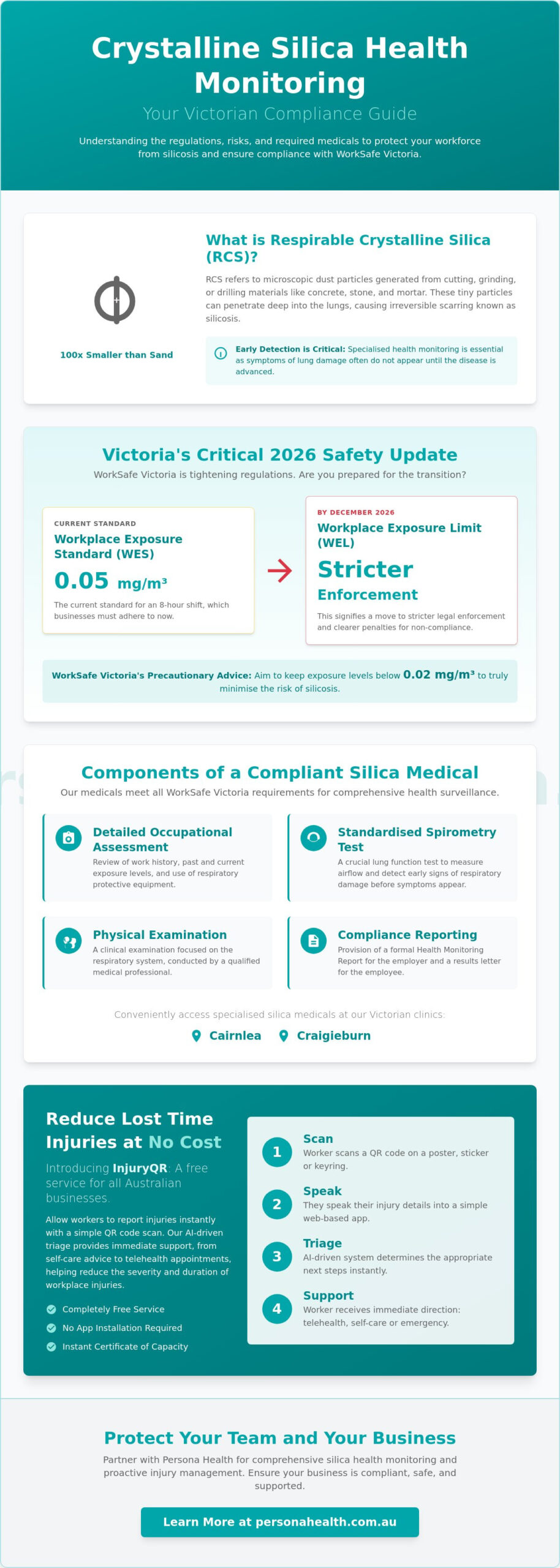
Providing a safe workplace involves more than just safety gear; it requires a proactive approach to understanding how the environment affects the human body. What is Crystalline Silica Health Monitoring? At its core, it is a specialised series of medical assessments designed to identify the earliest signs of lung damage before a worker even notices symptoms. Unlike a standard physical, this occupational health surveillance focuses specifically on the impact of Respirable Crystalline Silica (RCS). These microscopic dust particles are often 100 times smaller than a grain of sand, allowing them to settle deep within the lungs where they cause silent, permanent scarring.
The regulatory environment in Victoria is becoming significantly more stringent. By December 2026, the transition from a Workplace Exposure Standard to a Workplace Exposure Limit (WEL) means employers must implement even more precise crystalline silica health monitoring melbourne. This shift reflects a growing medical understanding that even low levels of exposure can be hazardous over time. It isn’t just about compliance; it’s about the long-term well-being of every individual in your workforce. Regular testing ensures that your safety controls are actually working as intended on the ground.
The Industries Most at Risk in Melbourne
While the 2024 ban on engineered stone was a major milestone, silica risks remain prevalent across Melbourne’s infrastructure sector. Major projects like the Metro Tunnel and various level crossing removals involve heavy work with concrete, bricks, and mortar, all of which contain silica. Tunnelling and excavation are particularly high-risk activities where dust can become trapped in confined spaces. Our clinics in Cairnlea and Craigieburn are strategically located to support these hubs, offering accessible testing for teams working on the city’s largest build sites. It’s vital to recognise that any worker cutting, grinding, or drilling materials containing silica requires regular on-site health surveillance to ensure their safety remains the priority.
Understanding Silicosis and Respiratory Health
Silicosis is a progressive disease where the lung tissue develops fibrotic nodules in response to the trapped dust. Because the damage is irreversible, early detection is the only way to prevent life-altering outcomes. Many standard GPs lack the specialised spirometry equipment or the specific training to identify occupational lung diseases in their infancy. This is why specialized crystalline silica medicals are essential. They provide the clinical depth needed to catch subtle changes in lung function that a general check-up would likely overlook, giving both the employer and the employee peace of mind.
Legal Requirements for Silica Monitoring in Victoria
Compliance is not optional. Under the Occupational Health and Safety Regulations 2017 (Vic), employers must provide health monitoring if exposure to silica is likely to adversely affect a worker’s health. While SafeWork Australia sets the national exposure standards, it is WorkSafe Victoria that enforces these rules within our state. Currently, the Workplace Exposure Standard (WES) for respirable crystalline silica is 0.05 mg/m³ over an eight-hour shift. However, a major shift is approaching. By December 2026, Victoria will transition to a more stringent Workplace Exposure Limit (WEL). This change signifies a move toward stricter legal enforcement and clearer penalties for businesses that fail to protect their teams.
The Legal Requirements for Silica Monitoring in Victoria dictate that you must act if there is a “reasonable risk” to health. WorkSafe Victoria actually recommends a precautionary approach, suggesting that employers aim to keep exposure levels below 0.02 mg/m³ to truly minimise the risk of silicosis. If your workplace involves high-risk crystalline silica work, you are also required to prepare a hazard control statement before any tasks begin. Failing to meet these standards can result in significant fines and legal action, but more importantly, it leaves your employees vulnerable to preventable disease.
The Role of WorkSafe Victoria
WorkSafe Victoria acts as the primary watchdog for crystalline silica health monitoring melbourne. They have the power to inspect sites and demand evidence of your health surveillance programmes. If a medical assessment returns an adverse result, such as signs of lung scarring or reduced capacity, you are legally mandated to report this to WorkSafe immediately. This reporting ensures that the regulator can track industry trends and intervene where safety controls are failing. Staying ahead of these requirements requires a methodical approach to testing and documentation.
Employer Duties and Record Keeping
Your responsibilities don’t end once the medical is finished. You must keep all health monitoring records for at least 30 years. This long timeframe is necessary because diseases like silicosis can take decades to manifest. During this time, you must ensure strict worker confidentiality; health data is sensitive and should only be shared with the individual and the relevant authorities when required. You are also obligated to provide the results of any health monitoring to your employees in a timely manner, ensuring they are fully informed about their own respiratory health. If you feel uncertain about how to structure these records, our team can help you navigate these crystalline silica medicals to ensure every box is ticked correctly.
The Components of a Crystalline Silica Medical
A crystalline silica medical is a methodical process designed to provide a clear picture of an individual’s lung health. It begins with a comprehensive respiratory medical history and an occupational exposure questionnaire. This allows our clinicians to understand the specific risks a worker has faced over their career. To meet WorkSafe Victoria’s health monitoring duties, the assessment must also include a physical examination that focuses on the respiratory system and general physical fitness. This isn’t just about looking for illness; it’s about establishing a baseline for every unique human body we care for.
One of the most critical elements is the ILO-standard chest X-ray. These are not standard radiology reports. They must be interpreted by qualified B-readers, who are radiologists with specialised training in identifying the subtle patterns of dust-related lung diseases. This level of precision is vital for effective crystalline silica health monitoring melbourne, as it ensures that even the smallest changes are documented accurately. By using B-readers, we provide a level of clinical certainty that standard imaging services often cannot match.
Advanced Respiratory Testing
Spirometry is a non-invasive test measuring the volume and speed of air inhaled or exhaled. While this is a standard tool, some cases may require high-resolution computed tomography (HRCT). HRCT provides much more detail than a standard X-ray and is often used if there is any uncertainty in the initial results. If our clinicians detect anything unusual, we facilitate a specialist occupational physician referral to ensure the worker receives the highest level of care. You can learn more about our specialised crystalline silica medicals to see how these tests fit into a broader health strategy.
Preparing Your Workers for the Appointment
Anxiety is a natural response to medical testing. We encourage employers to frame these appointments as a benefit, a way to ensure the worker’s long-term health is being actively protected. Employees should bring a list of their previous work history, any current medications, and their photo ID to the appointment. A typical session for health monitoring usually takes between 45 and 60 minutes. Providing this clear timeline helps staff feel more in control of the process. For businesses looking to integrate these medicals with broader safety tools, our InjuryQR service offers a way to manage workplace incidents with the same level of professional care and speed.
Implementing Monitoring in Melbourne: Cairnlea and Craigieburn
Choosing the right location for your team’s medical assessments is a vital part of maintaining a productive workforce. While government-funded options often focus heavily on the stonemasonry sector, many Melbourne businesses in construction, demolition, and tunnelling require more flexible, local solutions. Our clinics in Cairnlea and Craigieburn are positioned to provide exactly that. By opting for private crystalline silica health monitoring melbourne, you gain the advantage of faster booking times and a more personalised approach to your company’s specific risk profile. This local presence allows you to schedule multiple staff members in a single block, reducing the downtime associated with long travel across the city. Coordinating these sessions locally means your project leads can maintain tighter control over their schedules while still ensuring every worker receives a high-quality, clinical assessment.
A successful safety strategy doesn’t treat health monitoring as an isolated event. Instead, it integrates these medicals into a broader injury management framework. Our Victorian teams understand the local industrial landscape, from the unique dust risks on major rail projects to the specific reporting requirements of WorkSafe Victoria. This local expertise ensures that your compliance isn’t just a paperwork exercise; it’s a proactive health partnership that protects your most valuable assets. When you work with a partner who knows the Melbourne infrastructure scene, you receive advice that is relevant to your specific site conditions and workforce challenges.
On-Site vs. Clinic-Based Surveillance
For larger Melbourne workforces, bringing the medical team to your site can significantly streamline the process. Choosing on-site health surveillance is often the most efficient way to assess dozens of workers without disrupting project timelines. This approach minimises the logistical headache of sending individuals off-site one by one. However, clinic-based assessments in Cairnlea or Craigieburn remain the gold standard for more detailed respiratory testing. A clinical environment provides a controlled, quiet space for precise spirometry and immediate access to the specialised imaging required for silica compliance. We often recommend a hybrid approach depending on the size of your team and the intensity of their exposure.
Choosing a Qualified Occupational Health Partner
It is a common misconception that a general GP can handle complex silica medicals. Because silicosis is an occupational disease with subtle early markers, you need a partner with specialised training. An Occupational Physician possesses a deeper understanding of industrial toxicology and the long-term effects of hazardous substances than a standard family doctor. When selecting a provider, always check for their experience with Victorian safety standards and their ability to provide B-reader interpreted X-rays. If you are ready to secure your team’s health and ensure your 2026 compliance is already in place, you can book your crystalline silica medicals with our expert team today.
Persona Health: Your Partner in Silica Compliance
At Persona Health, we believe that effective crystalline silica health monitoring melbourne is built on a foundation of trust and clinical excellence. Our approach is never one-size-fits-all because every worker’s respiratory health is as unique as their fingerprint. By choosing our clinics in Cairnlea or Craigieburn, you aren’t just booking a test; you are entering a partnership dedicated to the long-term safety of your workforce. We understand the stress that compliance can cause for business owners, so we take the lead in ensuring every WorkSafe Victoria requirement is met with precision and care. Our clinicians combine professional authority with a deeply empathetic tone, ensuring your employees feel supported and valued throughout their assessment.
Serving the local industrial community in Melbourne’s north and west, our clinics provide a stable and reliable resource for businesses of all sizes. We recognize the specific challenges faced by Victorian employers as they prepare for the 2026 regulatory shifts. Our role is to act as your expert guide, simplifying the complex world of occupational health while maintaining a focus on individual well-being and recovery. When your team visits us, they aren’t just another number; they receive care that is tailored to their specific work history and health needs.
Our Specialised Medical Assessments
Our protocols for crystalline silica medicals are designed to exceed the national standards set by SafeWork Australia. We manage the entire lifecycle of the surveillance process, from the initial respiratory questionnaire to the coordination of B-reader interpreted X-rays. Our team handles all reporting and compliance documentation for your business, providing you with clear, actionable results while maintaining the highest levels of worker confidentiality. This methodical process ensures that any early markers of exposure are identified and managed before they become life-altering health issues.
Booking Your Melbourne Health Monitoring
Securing an appointment at our Melbourne or Sydney locations is a straightforward process designed to fit around your operational needs. Beyond the medical assessments, we offer a complete ecosystem for injury management in Melbourne and Sydney. A key part of this is our free InjuryQR service. This tool allows your workers to scan a QR code on a poster, sticker, or fridge magnet to report an injury instantly. There is no app to install; they simply speak their details into a web-based app for immediate AI-driven triage. This process determines the next steps, ranging from a telehealth appointment within 3 to 4 hours to an emergency 000 call. We can even issue a Certificate of Capacity immediately, helping you reduce Lost Time Injuries through rapid intervention. This entire service is provided free of charge to all Australian businesses, reflecting our commitment to a safer, healthier industrial community.
Securing Your Workforce for 2026 and Beyond
The transition to the 2026 Workplace Exposure Limits marks a significant change for Victorian industries. By prioritising crystalline silica health monitoring melbourne now, you ensure your business remains ahead of these stricter regulations while actively safeguarding the respiratory health of your team. Early detection through specialised spirometry and B-reader interpreted imaging is the only way to prevent the irreversible effects of silicosis. Our methodical approach combines clinical precision with a deep understanding of the local industrial landscape to give you and your employees peace of mind.
At Persona Health, we offer the specialised occupational health expertise you need to navigate these complex requirements with confidence. Our clinics in Cairnlea and Craigieburn provide professional, local support that is fully compliant with WorkSafe Victoria standards. We’re here to help you build a safer workplace where every individual’s well-being is the top priority. Book your crystalline silica health monitoring at our Melbourne clinics today and take a proactive step towards a healthier future for your entire workforce. You can trust that your compliance and your employees’ health are in expert hands.
Frequently Asked Questions
How often should employees undergo silica health monitoring in Victoria?
Employees should undergo a baseline assessment before they start work in a high-risk environment and then regular periodic assessments thereafter. While the exact frequency depends on the specific risk level of the role, many Victorian employers schedule medicals every one to two years. If your workplace has a consistent risk of silica exposure, WorkSafe Victoria also requires you to conduct ongoing air monitoring at least once every six months to ensure your safety controls remain effective.
Who is responsible for the cost of silica health monitoring?
The employer is legally required to provide and pay for all health monitoring for employees who are exposed to crystalline silica where there is a risk to their health. This is a mandatory obligation under the Occupational Health and Safety Regulations 2017 (Vic). You cannot ask employees to cover the cost of these medicals or use their personal leave for the appointments, as these assessments are an essential part of your workplace safety duties.
Can an employee refuse to participate in health monitoring?
While an employee can technically refuse a medical procedure, participating in health monitoring is generally considered a lawful and reasonable direction for maintaining workplace safety. If a worker refuses, you may need to move them to a different role where exposure is not a risk to fulfil your duty of care. It is helpful to have empathetic conversations with your staff to explain that the process is designed to protect their long-term health and ensure they remain safe at work.
What happens if a worker is diagnosed with a silica-related condition?
If a worker is diagnosed with a silica-related condition, you must notify WorkSafe Victoria immediately as part of your mandatory reporting obligations. The affected employee should be removed from further exposure and provided with the necessary medical support and care. For rapid intervention, our free InjuryQR service allows workers to report incidents instantly, providing immediate AI-driven triage and access to telehealth appointments within 3 to 4 hours to help manage the situation effectively.
Is an ILO chest X-ray mandatory for silica monitoring?
Yes, an ILO-standard chest X-ray is a core component of crystalline silica health monitoring melbourne. These X-rays must be interpreted by a qualified B-reader radiologist who has specialised training in identifying the subtle patterns of dust-related lung diseases. This level of precision is essential because standard radiology reports may not provide the clinical detail required to identify the early markers of silicosis, ensuring your team receives the most accurate health assessment possible.
Does health monitoring replace the need for respiratory protective equipment (RPE)?
Health monitoring does not replace the need for Respiratory Protective Equipment (RPE) or other safety controls like ventilation and wet cutting. Instead, it is a tool used to verify that your existing safety measures are actually working to protect your staff. Under the hierarchy of controls, you must first aim to eliminate or reduce dust at the source before relying on RPE as a final layer of protection for your team members.
What is the difference between silica monitoring and a standard pre-employment medical?
A standard pre-employment medical focuses on general fitness for a role, whereas silica health monitoring is a specialised clinical assessment for a specific hazard. It includes targeted respiratory testing such as spirometry and ILO-standard X-rays that are not part of a general check-up. These medicals are designed specifically to detect the microscopic lung damage caused by respirable crystalline silica, providing a much deeper level of occupational health surveillance for your workforce.
Are there specific requirements for silica monitoring in the Melbourne tunnelling sector?
The Melbourne tunnelling sector is subject to strict requirements due to the high-risk nature of working in confined spaces. Employers must prepare a crystalline silica hazard control statement before work commences if exposure is likely to exceed half the exposure standard. Given the unique challenges of tunnelling, regular air monitoring and frequent health surveillance are vital to ensure that dust extraction and ventilation systems are effectively protecting every individual working on the project.

Article by
Ian Nicholson
Ian is the Business Support Manager at Persona Health, where he plays a key role across IT, sales, marketing and business operations. With a broad skill set and a practical, solutions-focused approach, Ian helps drive the systems, communication and commercial strategy that support Persona Health’s continued growth across Australia.