

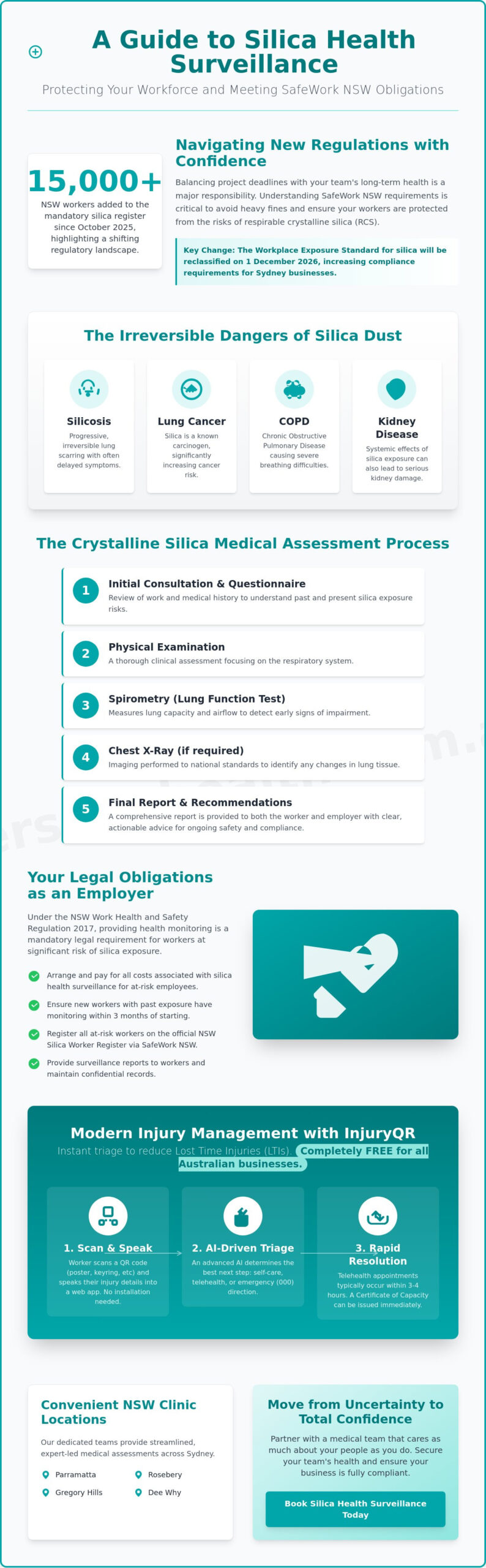
Almost 15,000 workers in New South Wales have been added to the mandatory silica register since October 2025, a figure that highlights just how quickly the regulatory landscape is shifting for local businesses. You likely feel the weight of these changes, balancing the need to keep your projects on schedule with the deep responsibility you have for your team’s long term health. It’s natural to feel concerned about the complexities of SafeWork NSW requirements or the potential for heavy fines if a detail is missed.
We’re here to help you move from uncertainty to total confidence. This guide explains exactly how to implement robust silica health surveillance sydney to protect your workforce and meet every legal obligation. You’ll learn about the transition to the 1 December 2026 Workplace Exposure Limits and how our dedicated teams in Parramatta, Rosebery, Gregory Hills, and Dee Why simplify the medical process. We also look at how digital tools like InjuryQR can transform your approach to safety. This free service allows workers to scan a QR code on a poster or keyring to access immediate AI driven triage and telehealth, often within hours. By the end of this article, you’ll have a clear, actionable plan to reduce risk and partner with a medical team that cares as much about your people as you do.
Key Takeaways
- Understand the latest SafeWork NSW regulations and how the 2026 reclassification of exposure limits impacts your business operations.
- Discover how professional silica health surveillance sydney identifies early signs of lung damage to protect your team and reduce long term liability.
- Clarify your legal obligations as an employer, including the requirement to fund health monitoring and register workers on the NSW Silica Worker Register.
- Learn how to integrate the free InjuryQR service into your safety plan to provide instant medical triage via a simple QR code scan, helping to significantly reduce Lost Time Injuries.
- Identify convenient clinic locations in Parramatta, Rosebery, Gregory Hills, and Dee Why for streamlined, expert led medical assessments.
What is Silica Health Surveillance and Why is it Essential in Sydney?
Health surveillance is much more than a routine check-up. It is a systematic process of medical monitoring designed to identify early changes in a worker’s health when they are exposed to specific hazardous substances. In the context of the Sydney construction and manufacturing sectors, this monitoring focuses heavily on Respirable Crystalline Silica (RCS). This fine, invisible dust is produced when materials like concrete, bricks, and stone are cut, crushed, or ground. Because these materials are the foundation of almost every local infrastructure project, the risk of exposure is a constant reality for many workforces.
The primary goal of this medical oversight is the early detection of respiratory conditions before they become life-altering. Under the Work Health and Safety Regulation 2017 in NSW, providing health monitoring is not optional; it is a mandatory legal requirement for employers whose workers are at significant risk. By implementing a consistent program for silica health surveillance sydney, you are doing more than just ticking a compliance box. You are building a culture of care that protects your most valuable asset: your people.
To gain a deeper understanding of how these medical assessments function within the industrial environment, watch this helpful video:
The Health Risks of Respirable Crystalline Silica
When workers inhale silica dust, the microscopic particles travel deep into the lungs. These particles are jagged and indestructible, causing the body to create permanent, fibrous scar tissue in an attempt to protect itself. This process can lead to several devastating conditions, including lung cancer, kidney disease, and chronic obstructive pulmonary disease (COPD). Perhaps the most significant concern for Sydney employers is What is Silicosis? It is a progressive lung disease that often shows no symptoms for many years. Because damage is irreversible once it begins, waiting for a worker to “feel sick” is a dangerous strategy. Regular crystalline silica medicals are the only way to catch these changes early enough to make a difference.
Who Requires Silica Monitoring in NSW?
Mandatory monitoring is triggered when there is a “significant risk” to a worker’s health due to exposure. In Sydney, this typically involves high-risk sectors like engineered stone fabrication, tunnelling projects, and large scale demolition. If your workplace air monitoring results indicate that dust levels are approaching or exceeding the Workplace Exposure Standard, you must arrange health surveillance. Our clinical teams across Parramatta, Rosebery, Gregory Hills, and Dee Why help businesses determine which staff members require monitoring based on their specific roles and exposure history. This ensures that your silica health surveillance sydney program is both legally compliant and tailored to the unique needs of your site.
The Process of a Crystalline Silica Medical Assessment
Every medical assessment is a vital data point in your company’s safety story. A professional assessment ensures workers are clinically fit for their specific duties and identifies health risks before they become permanent injuries. At Persona Health, we follow strict national guidelines to ensure every check is legally defensible and medically sound. We know your time is valuable. Our silica health surveillance sydney is structured to be thorough yet efficient, so your team can get back to work with minimal downtime. Results are provided to both the employer and the worker, accompanied by clear, actionable recommendations to ensure ongoing safety.
Our clinical approach is designed to build trust with your employees. We explain each step clearly, helping them understand that these tests are a proactive measure for their long term well-being. This transparency reduces anxiety and fosters a more safety-conscious culture on your site. Whether your team is based in Parramatta, Rosebery, Gregory Hills, or Dee Why, our clinics provide a consistent and supportive environment for these essential health checks.
Step-by-Step Breakdown of the Medical Exam
The process begins with a detailed respiratory and occupational exposure history questionnaire to identify past risks. This is followed by a physical examination focusing on the respiratory system and overall fitness for duty. A critical component is standardised lung function testing, or spirometry, which measures breathing capacity and flow. If the physician determines it is necessary based on the worker’s history or symptoms, we provide a referral for a high-quality chest X-ray. These images are interpreted using the International Labour Organisation (ILO) classification system, the global benchmark for detecting dust-related lung changes.
Understanding the Role of the Occupational Physician
The occupational physician acts as a specialist advisor for your business. They review all clinical results to determine if any health changes exist that could be related to silica exposure. Following the exam, they provide a formal report stating if the worker is fit for work or if specific restrictions are required. These physicians also advise on necessary changes to workplace controls or PPE requirements to better protect your staff. If you need to organise your next round of testing, you can book crystalline silica medicals at any of our Sydney locations to ensure your records remain up to date.
This specialist oversight is particularly important for meeting your obligations under the NSW Silica Worker Register. The physician’s report provides the evidence needed to confirm a worker’s health status, allowing you to manage your compliance with confidence. By choosing a partner that understands both the clinical and regulatory aspects of silica exposure, you create a safer, more resilient workplace for everyone involved.
Employer Obligations and SafeWork NSW Requirements
SafeWork NSW regulations are uncompromising when it comes to worker safety. As a person conducting a business or undertaking (PCBU), the legal responsibility for health monitoring sits directly with you. This means you must pay for all costs associated with silica health surveillance sydney, including medical fees, any required travel, and the worker’s wages during the assessment. It is also your duty to ensure the monitoring is conducted by a registered medical practitioner with specific experience in occupational health to ensure the results are accurate and compliant.
The administrative side of compliance is equally rigorous. In Australia, you are required to keep health surveillance records for at least 30 years. This long duration reflects the slow progression of silica-related diseases, which may not appear until decades after exposure has ceased. Failing to maintain these records or provide monitoring can lead to significant penalties. Beyond the risk of fines, non-compliance often results in increased workers’ compensation premiums and leaves your business vulnerable to long term liability claims. Managing these requirements can be complex, but our team at Persona Health provides the clinical expertise needed to keep your business on the right side of the law.
When to Start Health Surveillance
Timing is a critical factor in your compliance strategy. Baseline monitoring must occur before a worker begins any high-risk role. This provides a clear medical snapshot of their lung health before any potential exposure on your site. Once a worker is active in a silica-exposed role, periodic monitoring typically occurs every 12 months. You must also remember that the NSW Silica Worker Register, which became mandatory on 1 October 2025, requires you to register any worker in a high-risk role within 28 days of them starting. Finally, an exit medical is required when a worker leaves your company or the industry to document their health status at the end of their tenure.
Reporting Adverse Health Results
If a medical assessment reveals a diagnosis of silicosis or another silica-related condition, you have immediate reporting obligations. You must notify SafeWork NSW of the result. This is a serious matter. In the 2025-2026 fiscal year up to March, there were 45 reported cases of silicosis in NSW, and the regulator tracks these closely to identify high-risk workplaces. The medical practitioner also has a professional duty to report certain findings to the regulator. Following an adverse result, you are legally required to review and, if necessary, improve your workplace dust controls. If you need to bring your team up to date with their requirements, our on-site health surveillance services can streamline the process directly at your workplace.
Modern Injury Management: Integrating InjuryQR for Sydney Sites
While silica health surveillance sydney focuses on the long term monitoring of respiratory health, a truly comprehensive safety strategy must also address immediate physical injuries. At Persona Health, we believe that clinical oversight should be available the moment an accident occurs. We achieve this by integrating InjuryQR into our injury management framework. This digital solution allows your team to bridge the gap between an on-site incident and professional medical intervention. It ensures that minor issues don’t develop into serious complications or long term claims. By pairing periodic health checks with rapid response technology, you create a complete safety net for your workforce.
Our approach is designed to be supportive and accessible. We provide your site with physical assets like posters, keyrings, stickers, and fridge magnets. These items are the gateway to immediate care. When a worker is injured, they simply scan the QR code to begin the reporting process. This proactive system is particularly valuable in high pressure environments like construction sites in Parramatta or Rosebery, where every minute counts in managing a workplace incident effectively.
How InjuryQR Streamlines Workplace Safety
The beauty of this system lies in its simplicity. Workers use a scan-to-speak interface that requires no app installation, which removes the technical barriers often found with traditional reporting software. Once the details are spoken into the web-based app, an AI-driven triage process begins immediately. This system determines the most appropriate level of care based on the severity of the injury. Outcomes range from guided self-care and telehealth appointments to direct instructions for the nearest emergency room or a 000 call. For most non-emergency cases, a telehealth appointment is available within 3 to 4 hours, providing expert medical advice without the worker having to leave the site or wait in a clinic.
Benefits of Rapid Intervention for Employers
For a business owner, the primary benefit is a significant reduction in Lost Time Injuries (LTIs). By addressing injuries within the first few hours, you can often keep a worker in the system and on a suitable duties plan. The platform can issue a Certificate of Capacity immediately following a telehealth consultation, allowing you to manage the return to work process with clinical guidance from day one. Best of all, Persona Health provides this entire service free of charge to all Australian businesses. This allows you to enhance your safety culture without adding to your overheads. To strengthen your workplace safety strategy, you can learn more about our injury management in Sydney and how it complements your health monitoring programme.
Integrating this technology shows your team that their health is a priority. It provides peace of mind for workers in Gregory Hills or Dee Why, knowing that professional help is just a scan away. When combined with regular silica health surveillance sydney, InjuryQR forms a robust defence against both the hidden risks of dust exposure and the immediate physical hazards of the modern workplace.
Booking Silica Health Surveillance in Sydney and NSW
Arranging your team’s medical assessments shouldn’t be a source of stress or administrative burden. At Persona Health, we’ve designed our booking process to be as seamless as possible, allowing you to focus on your core business while we handle the clinical details. Our clinics are equipped with the latest diagnostic technology for silica health surveillance sydney, ensuring that every result is accurate, reliable, and fully compliant with SafeWork NSW standards. We understand that every project has its own unique timeline, so we offer flexible scheduling to help you maintain momentum on site.
For businesses with larger workforces or remote project sites, we provide on-site health surveillance. This service brings our expert clinical team directly to your workplace, significantly reducing travel time and operational downtime. Whether your team is based in a factory, a fabrication workshop, or a major infrastructure project, our mobile services ensure that every worker receives the same high standard of care without the need for off-site appointments. Our professional support team is always available to help you navigate the complexities of compliance, providing clear guidance on reporting and record-keeping.
Our Sydney and Melbourne Clinic Locations
We’ve strategically placed our facilities to ensure easy access for workers across the most active industrial hubs. In New South Wales, our modern clinics are located in Parramatta, Rosebery, Gregory Hills, and Dee Why. These locations serve the growing needs of the Greater Sydney area, providing a professional and welcoming environment for your staff. Each centre is staffed by dedicated experts in occupational medicine who understand the specific health risks associated with your industry. We take pride in creating a clinical experience that is both efficient and reassuring for every individual who walks through our doors.
Our commitment to Australian industry extends beyond NSW. We also offer comprehensive services in Victoria, with clinics conveniently located in Cairnlea and Craigieburn. This allows businesses with interstate operations to maintain a consistent health monitoring programme across their entire workforce. By partnering with a provider that has a broad geographic footprint, you simplify your safety management and ensure that your workers receive consistent, high-quality medical oversight regardless of their location.
Why Partner with Persona Health?
We believe that occupational health is most effective when it is delivered with a blend of clinical precision and deep empathy. Our team doesn’t just process appointments; we treat every worker as an individual with unique health needs and personal goals. We specialise in a range of high-risk assessments, including crystalline silica medicals and asbestos medicals. This specialist focus means we’re intimately familiar with the latest regulatory changes and clinical best practices, giving you the confidence that your silica health surveillance sydney is in expert hands.
To provide a truly complete health and safety solution, we integrate InjuryQR into our service model. This free digital tool ensures that if an injury does occur, your workers have instant access to AI-driven triage and telehealth support. We also encourage you to book your pre-employment medicals with us to ensure that every new hire starts their journey with a clean bill of health. By choosing Persona Health, you’re partnering with a modern, reliable leader in occupational medicine that is dedicated to the long term well-being of your workforce and the stability of your business.
Securing Your Workplace Future in 2026
Meeting the evolving standards for silica health surveillance sydney is an investment in the longevity of your business and the health of your people. By staying ahead of SafeWork NSW requirements and the 2026 exposure limit changes, you protect your company from significant liability and ensure your workers return home healthy every day. We’ve seen how professional medical assessments combined with rapid digital triage can transform site safety from a source of anxiety into a pillar of operational strength.
Our expert Occupational Physicians are ready to support your compliance journey with clinical precision and a genuine commitment to individual care. From our clinics in Parramatta, Rosebery, Gregory Hills, and Dee Why, we provide SafeWork NSW compliant assessments and offer the InjuryQR triage service free of charge to all our clients. This integrated approach ensures that whether you’re managing long term dust exposure or an immediate on-site injury, your team is always in expert hands. Book Your Silica Health Surveillance in Sydney Today and take a proactive step toward a safer, more resilient workplace. We look forward to partnering with you to build a healthier future for the Australian construction and manufacturing industries.
Frequently Asked Questions
How often is silica health surveillance required for Sydney workers?
Initial monitoring must occur at the baseline before a worker starts in a high risk role. Ongoing periodic checks are typically required every 12 months for those exposed to respirable crystalline silica. An exit medical is also mandatory when a worker leaves the company or industry to document their final health status and ensure your compliance records are complete.
Who pays for the crystalline silica medical assessments in NSW?
The employer, known as the Person Conducting a Business or Undertaking (PCBU), is legally responsible for all associated costs. This includes the medical assessment fees, any travel expenses incurred by the worker, and their regular wages for the time spent attending the appointment. SafeWork NSW enforces these requirements to ensure no financial barrier prevents workers from receiving essential health monitoring.
What happens if a worker is diagnosed with silicosis during monitoring?
If a diagnosis occurs, the employer must immediately notify SafeWork NSW of the result. The medical practitioner also has a professional duty to report the finding to the regulator. You’ll then need to conduct an urgent review of your workplace dust controls and implement stricter safety measures to prevent further exposure to other team members who may be at risk on your site.
Is a chest X-ray always required for a silica medical?
A chest X-ray is required at the baseline and then typically every five to ten years for the first 20 years of exposure. The frequency increases for workers with more than 20 years of experience or if clinical abnormalities are detected. Our occupational physicians determine the need for imaging based on the individual’s exposure history and findings during the physical respiratory exam.
How long must an employer keep silica health surveillance records?
You must keep these records for at least 30 years in Australia. This long term requirement is due to the latency period of silica related diseases, which can take decades to manifest after the initial exposure. Maintaining accurate records for this duration ensures your business remains compliant and provides a clear medical history if a worker’s health changes later in their life.
Can Persona Health conduct silica monitoring at our Sydney construction site?
Yes, we offer on-site health surveillance for larger teams across Sydney to help reduce workplace disruption. Our clinical teams can visit your project in Parramatta, Rosebery, Gregory Hills, or Dee Why to conduct assessments directly at your workplace. This service ensures your silica health surveillance sydney is completed efficiently while keeping your projects moving forward and your team on site.
What is the difference between air monitoring and health surveillance?
Air monitoring measures the concentration of dust in the workplace atmosphere to check if it exceeds the 0.05 mg/m³ exposure standard. In contrast, health surveillance monitors the worker’s physical response to that environment through clinical testing. Both are essential components of a complete safety plan, with air monitoring identifying environmental risks and health surveillance identifying early medical changes in the individual.
How does the InjuryQR service help with silica-related workplace safety?
InjuryQR provides a rapid response system for any immediate physical injuries that occur on site. While silica health surveillance sydney looks at long term lung health, InjuryQR uses AI driven triage to manage acute incidents. Workers simply scan a QR code on a poster or keyring to access telehealth appointments within three to four hours, and this service is provided free to all Australian businesses.

Article by
Ian Nicholson
Ian is the Business Support Manager at Persona Health, where he plays a key role across IT, sales, marketing and business operations. With a broad skill set and a practical, solutions-focused approach, Ian helps drive the systems, communication and commercial strategy that support Persona Health’s continued growth across Australia.