

You might assume that the 2024 ban on engineered stone removed the regulatory pressure from your business, but the reality for Victorian employers is actually becoming more complex. We understand the stress of navigating WorkSafe Victoria’s shifting standards, especially as the state transitions to stricter Workplace Exposure Limits by December 2026. Securing a compliant silica medical for stonemasons in Melbourne is no longer just a checkbox for avoiding fines; it is a vital step in protecting the unique health and wellbeing of every individual on your worksite.
This guide provides a clear roadmap to help you meet Victorian health monitoring requirements and safeguard your workforce against the irreversible effects of crystalline silica. You will learn exactly what a high-quality medical assessment entails and how our dedicated centres in Cairnlea and Craigieburn offer a supportive, expert-led experience for your employees. We also explore how integrating free tools like InjuryQR can reduce lost time injuries through immediate, AI-powered triage, ensuring your team remains healthy, productive, and fully protected under Australian industrial law.
Key Takeaways
- Understand the evolving Victorian regulatory landscape and how to ensure your business remains fully compliant with the 2026 Workplace Exposure Limits.
- Discover the essential components of a silica medical for stonemasons in Melbourne, including respiratory history and spirometry, to safeguard your workers’ long-term wellbeing.
- Find out how to access specialised health surveillance at our Cairnlea and Craigieburn clinics through a streamlined booking process tailored for the stonemasonry industry.
- Learn how to implement the free InjuryQR tool to provide your team with immediate, AI-powered injury triage and reduce Lost Time Injuries without any app installations.
Understanding Silica Medical Requirements for Melbourne Stonemasons
A silica medical is a highly specialised health surveillance assessment. It aims to detect the earliest clinical indicators of lung disease before permanent damage occurs. Under the Occupational Health and Safety Regulations 2017 (Vic), these assessments are mandatory for any individual performing high-risk crystalline silica work. For employers, arranging a silica medical for stonemasons melbourne ensures your business stays compliant while genuinely caring for the people who form the backbone of your operations. It is not just a standard check-up; it is a targeted respiratory evaluation designed to protect your team from invisible hazards.
To understand the regulatory shifts driving these requirements in the Victorian stone industry, watch this summary of the national changes:
Stonemasonry remains a high-focus industry because materials like granite and quartzite contain significant concentrations of silica. Even with the engineered stone ban in effect, natural stone processing still generates fine, hazardous dust. Baseline medicals are essential before any new worker enters a high-risk environment. This initial screening establishes a clear health profile. It allows our clinicians to monitor changes over time with precision, ensuring that the unique respiratory health of every worker is documented from day one.
The Risks of Respirable Crystalline Silica
When stone is cut, ground, or polished, it releases particles 100 times smaller than a grain of sand. These invisible fragments bypass your body’s natural defences, lodging deep within the lung tissue. Understanding Silicosis is the first step in prevention; this condition and chronic obstructive pulmonary disease (COPD) can develop silently over years. Because lung damage is irreversible, regular screening is the only effective way to manage long-term health outcomes. Early detection through a silica medical for stonemasons melbourne is the most reliable method to identify issues before they become life-altering.
Who Needs Health Surveillance?
WorkSafe Victoria defines high-risk work based on whether exposure is likely to exceed half the exposure standard. Employer obligations extend to both contractors and full-time staff. Specific roles requiring monitoring include:
- Fabricators and cutters: Anyone directly processing natural stone materials.
- Polishers and installers: Workers exposed to dust during finishing or on-site adjustments.
- Support staff: Individuals working in close proximity to dust-generating areas.
If you are unsure about your team’s specific needs, our experts at the Cairnlea or Craigieburn clinics can help clarify your obligations under current Victorian law. We focus on providing a supportive environment where workers feel heard and employers feel confident in their compliance status.
What a Crystalline Silica Medical Assessment Involves
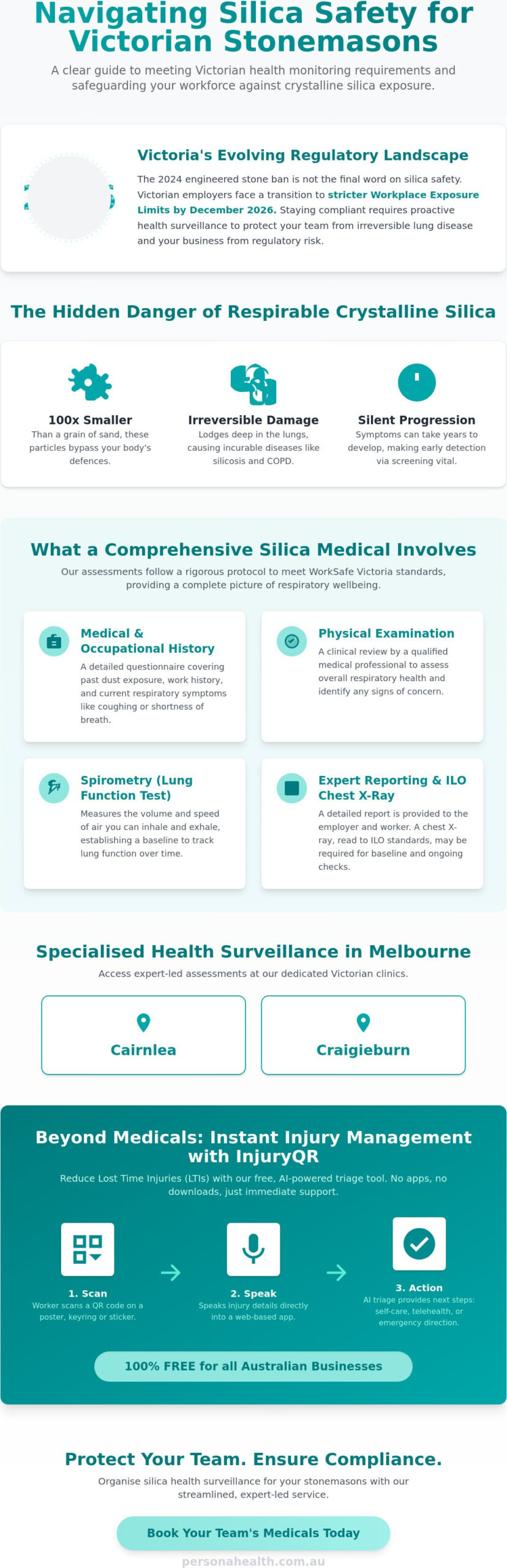
Booking a silica medical for stonemasons in Melbourne involves more than a simple lung check. It is a comprehensive health surveillance protocol designed to provide a complete picture of your respiratory wellbeing. Our clinicians at Cairnlea and Craigieburn follow a rigorous process to ensure every assessment meets the high standards set by Victorian regulators. This structured approach helps in identifying subtle changes in lung function long before they impact your daily life. We focus on creating a supportive environment where workers feel comfortable discussing their health history openly.
The assessment typically consists of four core elements:
- Occupational and medical history: A detailed questionnaire focusing on your history of dust exposure and any current respiratory symptoms like shortness of breath or a persistent cough.
- Spirometry: Standardised lung function testing to measure the volume and speed of air you can inhale and exhale.
- Physical examination: A clinical review conducted by a medical practitioner with specific expertise in occupational health.
- Chest X-ray: An imaging procedure interpreted using the International Labour Office (ILO) classification system, which is the global standard for identifying dust-related lung diseases.
Following WorkSafe Victoria’s guidance for stonemasons, these tests are interpreted with a focus on early intervention. Our goal is to provide peace of mind through clinical accuracy and a compassionate understanding of the challenges faced in the masonry trade. Ensuring your team receives the right level of care is essential for long-term safety. You can easily book a Crystalline Silica Medical through our streamlined process to keep your workforce protected.
The Spirometry Test Explained
Spirometry is a vital tool for measuring how much air you can breathe out and how fast you can do it. We specifically look at two metrics: Forced Expiratory Volume in one second (FEV1) and Forced Vital Capacity (FVC). To get the most accurate results, we ask workers to prepare by avoiding smoking for at least several hours and skipping heavy meals before their appointment. These results provide a baseline that allows us to track your lung health over your entire career with precision.
High-Resolution Computed Tomography (HRCT)
While a standard ILO chest X-ray is the traditional starting point, it has limitations. In certain cases, particularly if symptoms are present or X-ray results are inconclusive, a High-Resolution Computed Tomography (HRCT) scan may be required. HRCT is significantly more sensitive and can detect early-stage silicosis that a standard X-ray might miss. At Persona Health, we coordinate these advanced imaging services when necessary, ensuring you have access to the most precise diagnostic tools available today.
Victorian Regulations and Your Duty of Care in 2026
As we approach the full implementation of the new Workplace Exposure Limits by 1 December 2026, the regulatory environment for Melbourne stonemasons has never been more rigorous. While the July 2024 ban on engineered stone was a landmark shift, it did not remove the legal necessity for health surveillance in natural stone processing. In fact, WorkSafe Victoria has intensified its focus on ensuring that workers handling granite, sandstone, and concrete are adequately protected. Meeting the requirements for a silica medical for stonemasons in Melbourne is a continuous obligation that begins before a worker even picks up a tool.
The legal framework requires a systematic approach to monitoring. You must provide a baseline medical before a worker starts high-risk work, followed by annual reviews, and finally an exit medical when they leave the business or the industry. According to WorkSafe Victoria’s guidelines, these records must be kept for at least 30 years. This long-term record-keeping is vital because silica-related conditions can take decades to manifest. Managing this documentation is a core part of your duty of care, ensuring that every individual has a documented history of their health and exposure.
A critical component of this process is the “Appointed Medical Practitioner”. This must be a registered doctor with the appropriate expertise to oversee health surveillance. At Persona Health, our clinicians act as your professional partners, ensuring that every on-site health surveillance program or clinic-based assessment is legally robust and clinically sound. We help you navigate these rules so you can focus on your craft while we focus on the health of your team.
Compliance with WorkSafe Victoria Standards
Ensuring your business avoids the heavy penalties associated with non-compliance is essential for long-term stability. Beyond the threat of fines, a consistent history of health monitoring is vital for your WorkCover standing and insurance premiums. By aligning your reporting with the latest SafeWork Australia standards through Persona Health, you demonstrate a proactive commitment to safety. This evidence-based approach provides a clear paper trail that protects your business from future liability and ensures you are meeting the highest Victorian safety benchmarks.
Managing Worker Privacy and Reports
We understand that medical data is highly sensitive. Our process ensures that while we protect worker privacy, you receive the clear fitness-for-work information needed to manage your team effectively. If a report indicates a change in respiratory health, it does not always mean a worker must stop immediately; it often triggers a review of workplace controls or a temporary move to lower-risk duties. We guide you through these next steps, focusing on the individual’s health and the long-term resilience of your entire workforce.
Organising Health Surveillance at Persona Health Melbourne
Finding a provider who understands the specific needs of the Victorian stone industry shouldn’t be a source of stress. We’ve positioned our clinics in Cairnlea and Craigieburn specifically to support the northern and western suburbs of Melbourne. This strategic placement ensures your team doesn’t have to travel across the city for a high-quality silica medical for stonemasons in Melbourne. Whether you’re a sole trader or managing a large team, we provide a structured and supportive environment for every assessment. Our goal is to make compliance a seamless part of your business operations.
We also offer full integration with other essential services to save you time. Many employers find it highly efficient to bundle these assessments with pre-employment medicals for new hires. This ensures every worker is fit for duty from their very first day on the tools. For larger stonemasonry yards across Victoria, we can even arrange on-site health surveillance. This minimises downtime and allows your staff to undergo monitoring in a familiar environment, reducing the logistical burden on your management team.
Why Choose Persona Health for Silica Medicals?
Our physicians are experts in occupational medicine. They have a deep understanding of the construction and masonry sectors, which allows us to provide a unique blend of clinical excellence and empathetic care. We know that medical appointments can cause anxiety for workers. Our team is trained to ease these concerns through clear communication and a patient-centred approach. We also prioritise fast turnaround on reports. We know your projects have tight deadlines; we ensure you get the results you need without unnecessary delays to keep your workflow moving.
Booking Your Appointment in Cairnlea or Craigieburn
We’ve made the booking process as simple as possible to respect your time. You can use our online system for individual appointments or call our support team for complex group requirements. When workers arrive for their crystalline silica medicals, they should bring any previous respiratory test results and a list of current medications. This helps our doctors provide the most accurate assessment of their lung health. You can easily book your silica medical for stonemasons in Melbourne through our portal to ensure your workforce remains protected and your business remains compliant.
Beyond Medicals: Rapid Injury Management with InjuryQR
While a silica medical for stonemasons in Melbourne addresses long-term respiratory health, day-to-day physical injuries like muscle strains or lacerations also require immediate, professional attention. We’ve introduced InjuryQR to help Melbourne businesses bridge the critical gap between an incident occurring and a medical professional intervening. This free tool’s specifically designed to reduce Lost Time Injuries (LTIs) by ensuring no workplace injury goes unmanaged or ignored. It helps foster a proactive safety culture where every worker feels supported the moment something goes wrong on the site.
The beauty of this system lies in its total simplicity. There aren’t any apps to download and no complex logins to remember during a stressful or painful moment. Workers simply interact with physical assets like posters, keyrings, or stickers placed around the workshop or in company vehicles. By integrating InjuryQR into your daily operations, you’re not just meeting a basic regulatory requirement. You’re building a modern workplace that values rapid intervention and the long-term physical wellbeing of its staff.
How InjuryQR Works on the Job Site
Reporting an injury’s as simple as scanning a QR code on a poster or keyring. Once scanned, the worker speaks their injury details directly into a web-based app using voice recognition. The AI-driven triage process then immediately determines the safest and most appropriate next steps for that specific individual. This could range from guided self-care for minor issues to a telehealth appointment with a qualified doctor, which is typically available within 3 to 4 hours. In more serious cases, the app provides clear directions to the nearest emergency room or initiates an immediate 000 call for emergency services.
Benefits for the Stonemasonry Industry
For managers in the stonemasonry trade, the administrative relief is significant. InjuryQR can issue a Certificate of Capacity immediately, keeping the Workplace Injury Management process moving without the typical bureaucratic delays. This rapid response prevents minor strains from escalating into major WorkCover claims that could otherwise impact your insurance premiums for years. Most importantly, this entire service is provided free of charge to all Australian businesses through Persona Health. It perfectly complements your regular silica medical for stonemasons in Melbourne by providing a total health and safety solution for your entire team.
Securing a Healthier Future for Your Stonemasonry Team
Navigating the transition to Victoria’s 2026 Workplace Exposure Limits doesn’t have to be a source of anxiety for your business. By prioritising a regular silica medical for stonemasons melbourne, you’re doing more than just avoiding WorkSafe fines; you’re actively protecting the unique respiratory health of the people who make your success possible. We’ve seen how baseline medicals and annual monitoring provide the clinical evidence needed to manage long-term risks with confidence and clarity. It’s about building a workplace where safety’s a shared value rather than a regulatory burden.
Our team of specialised occupational physicians is here to guide you through every step of this process with WorkSafe Victoria compliant reporting and a deeply empathetic approach to care. As a partner of Persona Health, you also receive free access to InjuryQR, allowing you to manage acute workplace incidents with the same level of precision as your long-term health monitoring. It’s time to streamline your compliance and give your workforce the expert clinical support they deserve. You can book your stonemason silica medicals at our Melbourne clinics today to ensure your team remains safe and your business stays protected. We look forward to supporting your journey toward a safer, healthier worksite.
Frequently Asked Questions
How often do stonemasons need a silica medical in Victoria?
You must provide a baseline medical assessment before a worker starts high-risk work, followed by periodic monitoring at least every 12 months. An exit medical is also a legal requirement when a worker leaves your employment or the industry entirely. This schedule ensures a continuous, documented record of an individual’s respiratory health throughout their career in the stone trade.
Does the engineered stone ban mean I no longer need silica medicals?
No, the ban on engineered stone doesn’t remove your legal obligation to provide health surveillance for your team. Natural stone materials like granite, sandstone, and marble still contain significant levels of crystalline silica that can be hazardous when processed. If your work involves cutting, grinding, or polishing these materials, you must still arrange a silica medical for stonemasons in Melbourne to remain compliant with Victorian safety regulations.
What happens if a worker fails their silica lung function test?
An unsatisfactory result doesn’t automatically mean a worker must stop working; it triggers a clinical review and an evaluation of your workplace dust controls. The focus is on early intervention, which might involve a temporary move to lower-risk duties or an upgrade in respiratory protective equipment. We work closely with both the employer and the worker to manage these findings with empathy and professional expertise.
Can a general practitioner (GP) perform a silica medical?
While any doctor can perform a standard check-up, Victorian law requires health surveillance to be overseen by an “Appointed Medical Practitioner” with specific occupational health expertise. Most general practices don’t have the specialised spirometry equipment or the access to ILO-standard X-ray reporting required for WorkSafe compliance. Our clinicians at Cairnlea and Craigieburn are specifically trained to handle these complex assessments for the stonemasonry industry.
How much does a crystalline silica medical cost for a Melbourne business?
The cost of health monitoring is a mandatory expense that the employer must cover under the Occupational Health and Safety Regulations 2017. While fees vary based on the specific tests required, such as whether an ILO X-ray is needed that year, it’s an essential investment in your team’s wellbeing. We recommend contacting our Melbourne clinics directly for a tailored quote based on your specific workforce requirements.
Is a chest X-ray required for every silica medical assessment?
A chest X-ray is essential for a baseline medical and is then performed at periodic intervals, typically every two to five years, or sooner if symptoms develop. The Appointed Medical Practitioner determines the exact frequency based on the individual’s exposure history and lung function results. When required, we use the ILO classification system to ensure the highest level of diagnostic accuracy for dust-related lung conditions.
How long does a silica medical appointment usually take?
A standard silica medical appointment typically takes between 45 and 60 minutes to complete thoroughly. This time allows our clinicians to conduct a detailed medical history, a physical examination, and the necessary lung function testing without rushing the process. If an X-ray is required on the same day, you should allow extra time for the imaging at a nearby radiology provider.
What is the difference between health surveillance and a standard pre-employment medical?
A standard pre-employment medical assesses a person’s general fitness for a specific role, while health surveillance is a targeted program designed to monitor the effects of a specific hazard like respirable crystalline silica. While both are important for workplace safety, a silica medical for stonemasons in Melbourne focuses specifically on respiratory health and long-term exposure patterns. Health surveillance is an ongoing legal obligation that continues for the duration of the worker’s exposure.

Article by
Ian Nicholson
Ian is the Business Support Manager at Persona Health, where he plays a key role across IT, sales, marketing and business operations. With a broad skill set and a practical, solutions-focused approach, Ian helps drive the systems, communication and commercial strategy that support Persona Health’s continued growth across Australia.