

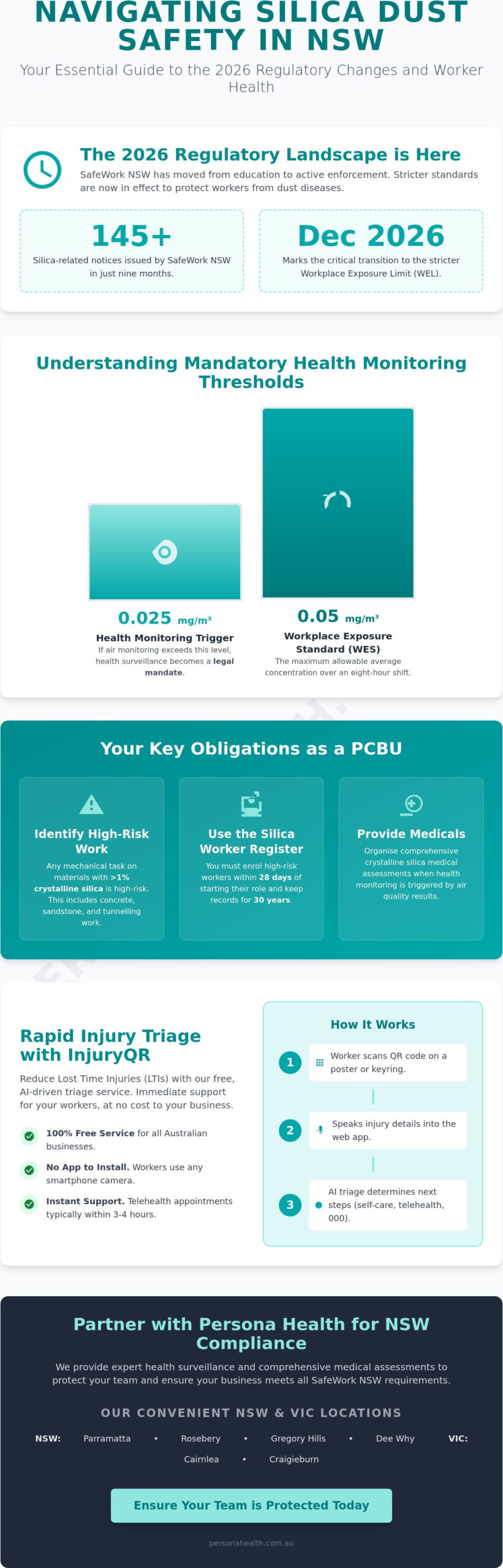
Did you know that SafeWork NSW issued 145 silica-related notices in the nine months following the launch of the mandatory Silica Worker Register? With nearly 15,000 workers already registered, the scrutiny on silica exposure testing requirements nsw has reached a critical point for every PCBU in the state. It is clear that the regulatory landscape is shifting quickly, leaving many businesses searching for certainty in a sea of new obligations.
It’s natural to feel uneasy about the transition to the strict Workplace Exposure Limit (WEL) arriving in December 2026. The fear of heavy penalties, paired with a sincere concern for your team’s long-term wellbeing, can make these evolving standards feel overwhelming. You deserve a professional partner who understands that compliance is about protecting the unique health of your people, not just ticking boxes or avoiding fines.
Our expert clinical guide for 2026 provides the clarity you need to navigate health monitoring obligations with total confidence. We’ll explore the latest thresholds and explain how Persona Health supports your team across our clinics in Parramatta, Rosebery, Gregory Hills, and Dee Why. You’ll also learn how we reduce lost time injuries through InjuryQR. This free service allows workers to scan a QR code on a poster or keyring and immediately speak their details into a web app for instant AI-driven triage and telehealth support.
Key Takeaways
- Understand the updated silica exposure testing requirements nsw, including the mandatory Silica Worker Register and the shift to the Workplace Exposure Limit (WEL) by late 2026.
- Identify the specific airborne concentration limits that trigger legal health monitoring obligations for your workforce to ensure full SafeWork NSW compliance.
- Learn what a comprehensive crystalline silica medical assessment entails and how standardised testing protects both your business and your employees’ long-term health.
- Discover how to implement InjuryQR to provide immediate AI-driven triage and telehealth support for your workers at no cost to your business.
- Access professional health surveillance and medical assessments across our convenient NSW locations in Parramatta, Rosebery, Gregory Hills, and Dee Why.
The 2026 Regulatory Landscape for Silica Testing in NSW
The regulatory framework in New South Wales has undergone a profound transformation. Since the “Managing risks of respirable crystalline silica in the workplace” Code of Practice took effect in February 2026, the expectations for employers have become more rigorous. SafeWork NSW has shifted from a period of education to one of active enforcement. This change ensures that every worker is protected from the devastating effects of dust diseases. At the heart of these updates is a clearer definition of silica exposure testing requirements nsw, designed to catch potential health issues before they become life-altering. Understanding What is Silicosis? helps us appreciate why these strict measures are essential for any business handling stone, concrete, or soil.
To better understand how air monitoring fits into your safety strategy, watch this helpful video from the regulator:
Staying ahead of the silica exposure testing requirements nsw is about more than just avoiding fines; it’s about building a culture of care. SafeWork NSW is now conducting thousands of workplace visits to ensure businesses are meeting their obligations. They focus on whether you’ve implemented high-level engineering controls rather than just relying on masks. As a PCBU, you’re the first line of defence for your team’s respiratory health. We’re here to guide you through these changes with professional expertise and a focus on your workers’ wellbeing.
Defining High-Risk Crystalline Silica Processing
The 2026 standards pivot on a specific threshold: the 1 percent silica content rule. If your team performs mechanical tasks on materials containing more than 1 percent crystalline silica, the law classifies this as high-risk processing. This isn’t limited to the now-prohibited engineered stone. It impacts tunnelling, demolition, and civil works where sandstone or concrete are common. For NSW businesses, this threshold is the legal trigger for air monitoring and health surveillance. If you aren’t sure of the silica content in your materials, obtaining a safety data sheet is your first step toward compliance.
The Mandatory Silica Worker Register
The Silica Worker Register is now a central pillar of NSW workplace safety. Employers must enrol any worker engaged in high-risk processing within 28 days of them starting that role. It’s a proactive way to track exposure across an individual’s career. You are responsible for keeping these health monitoring records for 30 years, as silica-related diseases can take decades to manifest. SafeWork NSW has already issued 145 silica-related notices between July 2025 and March 2026, showing they’re serious about enforcement. Failing to maintain this register or provide crystalline silica medicals can lead to substantial penalties under current WHS laws.
Understanding Mandatory Health Monitoring Thresholds
The figure 0.025 mg/m³ is perhaps the most important measurement for any NSW business managing dust risks. While the current Workplace Exposure Standard (WES) for respirable crystalline silica is 0.05 mg/m³ as an eight-hour time-weighted average, the legal trigger for health monitoring is actually half that amount. Meeting the silica exposure testing requirements nsw involves understanding that once air monitoring shows levels exceeding this 0.025 mg/m³ threshold, health surveillance is no longer a recommendation. It becomes a non-negotiable legal mandate.
It’s vital to distinguish between air monitoring and health surveillance. Air monitoring evaluates the effectiveness of your engineering controls by measuring what’s in the atmosphere. Biological health surveillance, or medical testing, looks at the individual worker to ensure those controls are actually protecting their lungs. Even if your site uses the latest water suppression or vacuum systems, these mechanical solutions can fail. Regular medical assessments act as the ultimate safety net for your team’s wellbeing.
Frequency is another critical factor. SafeWork NSW guidelines generally require a baseline health assessment before a worker starts in a high-risk role. This is followed by periodic monitoring, typically every 12 months, though a medical practitioner may recommend more frequent checks if exposure levels are high or if early signs of lung changes are detected. An exit medical is also required when a worker leaves your business or the industry to provide a final record of their respiratory health.
The 0.025 mg/m³ Threshold Explained
NSW uses half the national exposure standard as a trigger level to provide a necessary safety buffer. Because silica-related lung damage is often irreversible, waiting until a worker is exposed to the full 0.05 mg/m³ limit is considered too risky. If your air monitoring results show concentrations at or above 0.025 mg/m³, you must initiate a health monitoring program. This proactive approach ensures that any physiological changes are caught long before they develop into a chronic condition. It’s a standard that prioritises human life over mere baseline compliance.
Employer Obligations for Health Surveillance
As a PCBU, you carry the full financial and administrative responsibility for health monitoring. You must provide these assessments at no cost to your workers, which includes paying for the medical appointments, any diagnostic tests like X-rays, and the worker’s wages while they attend the clinic. You are also required to choose a registered medical practitioner with experience in occupational health. If a report indicates that a worker has reached a threshold of concern, you have a legal duty to notify SafeWork NSW. To ensure your project remains fully compliant without disrupting your schedule, you might consider on-site health surveillance to streamline the process for your entire crew.
Components of a Crystalline Silica Medical Assessment
A medical assessment for silica exposure is far more than a routine check-up. It is a precise diagnostic protocol designed to detect the earliest physiological signs of dust-related lung changes. To meet the silica exposure testing requirements nsw, these assessments must be conducted by a registered medical practitioner with specific expertise in occupational health. At our clinics in Parramatta, Rosebery, Gregory Hills, and Dee Why, we provide crystalline silica medicals that follow rigorous clinical standards to ensure every worker receives a personalised and accurate health profile.
The process begins with a detailed occupational and medical history. Our physicians take the time to understand each worker’s specific exposure patterns, including the types of materials handled and the effectiveness of their personal protective equipment. This individualised approach allows us to interpret clinical data with a deep understanding of the person behind the results. Once the history is established, the assessment moves into objective diagnostic testing to measure respiratory health against established benchmarks.
Spirometry and Respiratory Function Testing
Spirometry is the cornerstone of respiratory surveillance. This test measures the volume of air a worker can inhale and exhale, as well as the speed at which they can clear their lungs. We focus on key metrics such as the Forced Expiratory Volume in one second (FEV1) and the Forced Vital Capacity (FVC). By comparing current results with a worker’s baseline, we can identify even minor declines in lung function. If a significant change is detected, it triggers an immediate clinical review to determine if further diagnostic imaging or a change in work duties is necessary to protect the individual’s health.
Chest X-Rays and the ILO Classification
Standard clinical X-rays are often insufficient for detecting the fine scarring associated with early-stage silicosis. For this reason, the silica exposure testing requirements nsw mandate high-quality chest X-rays interpreted using the International Labour Organisation (ILO) International Classification of Radiographs of Pneumoconioses. This standardised scale allows radiologists to categorise the size, shape, and profusion of any small opacities in the lungs. We ensure these films are reviewed by specialised B-Reader radiologists, who possess the advanced training required to provide the highest level of diagnostic accuracy for dust diseases.
The final step involves the occupational physician synthesising all this data to determine a worker’s fitness for duty. They provide a clear report to the employer, detailing whether the worker is fit to continue their current role or if workplace restrictions are required. This expert interpretation bridges the gap between complex clinical data and practical workplace safety management.
Managing Workplace Risks and Injuries with InjuryQR
While the long-term silica exposure testing requirements nsw ensure chronic health risks are monitored through annual medicals, your site still needs a solution for immediate incidents. Respiratory distress or sudden injuries require a response that is both clinical and instantaneous. InjuryQR provides this safety net; it allows workers to access professional medical advice the moment an incident occurs. By digitising the reporting process, we help NSW firms significantly reduce Lost Time Injuries (LTIs) and provide better care for their people.
The beauty of this system lies in its simplicity. There is no software to install and no complex forms to fill out. A worker simply scans a QR code located on a poster or keyring and speaks their details directly into a web-based app. This immediate voice-to-text reporting ensures that no detail is lost in the heat of the moment. For workers concerned about silica dust inhalation or other workplace hazards, this instant connection to a clinical pathway provides immense peace of mind. It bridges the gap between the worksite and the clinic, ensuring that every individual’s health is prioritised.
The AI-Driven Triage Process
Once the details are recorded, the AI-driven triage engine determines the safest next step for the worker. This path ranges from simple self-care instructions to immediate emergency room directions or a 000 call. If the injury is non-critical, a telehealth appointment is typically organised within three to four hours. This speed of intervention is a hallmark of our commitment to excellence across our NSW centres in Parramatta, Rosebery, Gregory Hills, and Dee Why. It ensures that medical expertise is always within reach, regardless of where your project is located.
Implementation for NSW Businesses
We believe that high-quality injury management should be accessible to every Australian business. That’s why we provide InjuryQR and all its physical assets, such as stickers, magnets, and keyrings, entirely free of charge. If a worker requires time away or modified duties, a Certificate of Capacity can be issued immediately through the platform. This ensures that your business remains compliant with SafeWork Australia standards while supporting the worker’s recovery journey from day one. It’s a modern, empathetic approach to managing the risks inherent in high-risk crystalline silica processing.
Discover how our Workplace Injury Management service can protect your team and your bottom line.
Partnering with Persona Health for NSW Compliance
Meeting the silica exposure testing requirements nsw doesn’t have to be a source of stress or uncertainty for your business. At Persona Health, we believe that clinical excellence and empathy go hand in hand. We don’t just provide a medical service; we act as a modern professional partner to help you protect your most valuable asset: your people. By choosing a provider that understands both the clinical nuances and the regulatory pressures of SafeWork NSW, you can focus on your core operations with absolute peace of mind. We pride ourselves on being a reliable guide through the complexities of the 2026 standards.
Our approach is fundamentally human-centric. We recognise that behind every health monitoring report is an individual with a family and a career. This is why our communication is designed to be supportive and reassuring, helping to alleviate any anxiety workers may feel about their respiratory assessments. We provide clear, actionable insights that allow you to manage your team’s health proactively. Whether you are a small local firm or a major civil contractor, our goal is to build a long-term health surveillance strategy that evolves with your workforce and the changing legal landscape.
Our Sydney and NSW Health Centres
Our network of clinics is strategically placed to support the booming infrastructure and construction sectors across the state. Whether your team is based in the heart of Western Sydney or along the Northern Beaches, you can access our specialised services in Parramatta, Rosebery, Gregory Hills, and Dee Why. We also maintain a strong presence in Victoria with centres in Cairnlea and Craigieburn, ensuring consistent health surveillance for firms operating across state lines. Booking a consultation at our specialised clinical centres is a straightforward process. Our friendly team is always ready to help you organise a recurring assessment schedule that fits your project timeline.
Comprehensive Occupational Health Solutions
We understand that your compliance needs are often multi-faceted. Many of our clients find it efficient to integrate silica medicals with other essential assessments, such as Cat 3 Rail Medicals or Pre-Employment Medicals. This holistic approach ensures that every worker’s health profile is complete and that you are meeting all your legislative duties in one visit. It reduces the administrative burden on your staff and provides a more seamless experience for your employees.
For larger infrastructure projects where sending an entire crew to a clinic isn’t practical, our on-site health surveillance team brings the clinic directly to your site. This specialised service is designed to minimise downtime while ensuring the highest standards of clinical accuracy. We assist you in navigating the reporting requirements for SafeWork NSW, ensuring that all records are maintained for the mandatory 30-year period. By partnering with us, you aren’t just meeting the silica exposure testing requirements nsw; you are investing in a culture of safety and wellbeing that will sustain your business for years to come.
Securing Your Workforce for 2026 and Beyond
Transitioning to these rigorous standards is an essential step toward a safer and more sustainable workplace. You’ve seen how the Silica Worker Register and the upcoming shift to Workplace Exposure Limits (WEL) demand a proactive stance from every PCBU. By staying ahead of the silica exposure testing requirements nsw, you aren’t just meeting a legal obligation; you’re actively protecting the long-term health of your team. This commitment to safety builds trust and ensures that your operations remain resilient in an evolving regulatory environment.
Our specialised occupational physicians provide the clinical authority and empathetic support needed to manage these complex requirements with ease. With SafeWork NSW compliant reporting and the seamless integration of our free InjuryQR service for all clients, we ensure your business is equipped for both chronic surveillance and immediate incident management. Whether you visit us in Parramatta, Gregory Hills, or our Victorian centres in Cairnlea and Craigieburn, you’ll find a professional partner dedicated to your success.
Book your Crystalline Silica Medicals in Sydney or Melbourne today to secure your compliance and your people’s wellbeing. We’re ready to help you navigate these changes and build a healthier future for your entire workforce.
Frequently Asked Questions
What are the silica exposure testing requirements in NSW for 2026?
The requirements mandate that any worker at significant risk of exposure to respirable crystalline silica must undergo a structured health monitoring program. This includes a baseline assessment before starting work, periodic medicals every 12 months, and a final exit medical. From December 2026, the transition to the hard Workplace Exposure Limit (WEL) reinforces these obligations for every PCBU across the state.
Which workers in NSW are required to have silica health monitoring?
Health monitoring is a legal necessity for any worker involved in high-risk crystalline silica processing. This includes mechanical tasks like crushing, cutting, or grinding materials with a silica content of more than 1 percent. If air monitoring on your site shows respirable dust levels at or above 0.025 mg/m³, you must provide biological health surveillance for those employees immediately.
How often do I need to organise silica medicals for my employees?
You must organise a baseline medical assessment before a worker begins high-risk duties, followed by periodic reviews every 12 months. In some cases, an occupational physician may recommend more frequent testing if a worker shows early signs of lung changes or if exposure levels are particularly high. A final exit medical is also required when the worker leaves your employment or the industry.
What happens if a worker is diagnosed with silicosis in NSW?
You must notify SafeWork NSW immediately and provide the affected worker with a copy of their health monitoring report. The worker’s current role and exposure levels must be reviewed, which typically involves moving them to a role where no further silica exposure can occur. We provide empathetic and professional support through this process at our centres in Parramatta, Rosebery, Gregory Hills, and Dee Why.
Is the Silica Worker Register mandatory for all construction businesses?
The register is mandatory for any business where workers perform high-risk crystalline silica substance processing. You are required to enrol eligible workers on the register within 28 days of them starting their high-risk role. This system ensures that a worker’s exposure history follows them throughout their career, providing a vital long-term record for their future health and safety.
Can I use my local GP for crystalline silica medical assessments?
While any registered medical practitioner can perform assessments, SafeWork NSW strongly recommends using doctors with specialised training in occupational health. Most local GPs do not have the equipment or expertise to conduct ILO-standard X-ray interpretations or complex spirometry. Our specialised physicians ensure that your silica exposure testing requirements nsw are met with the clinical accuracy required for full compliance.
How does InjuryQR help manage silica-related health risks?
InjuryQR provides a rapid intervention tool for acute respiratory concerns or workplace injuries on site. Workers scan a QR code on a keyring or poster to speak their symptoms into a web app for instant AI-driven triage. This free service connects your team to telehealth appointments within three to four hours, ensuring that potential health issues are addressed the moment they arise.
What is the cost of implementing silica health monitoring in Sydney?
The cost depends on the number of workers and the specific tests required, such as ILO-classified X-rays and respiratory function testing. As the employer, you are legally responsible for all medical fees, travel costs, and the worker’s wages during the assessment. We offer transparent, tailored quotes for our NSW clinics to help you manage these essential safety costs while protecting your workforce.

Article by
Ian Nicholson
Ian is the Business Support Manager at Persona Health, where he plays a key role across IT, sales, marketing and business operations. With a broad skill set and a practical, solutions-focused approach, Ian helps drive the systems, communication and commercial strategy that support Persona Health’s continued growth across Australia.