

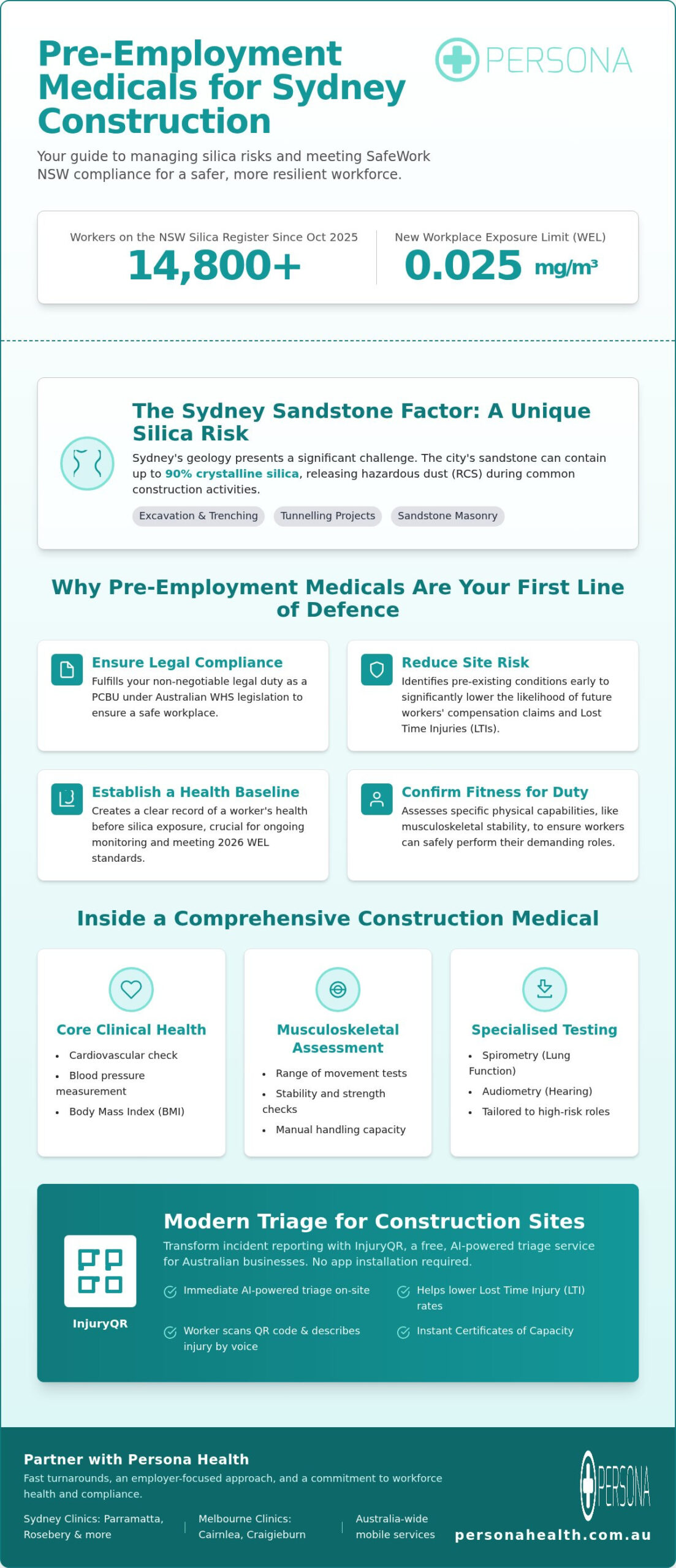
Since October 2025, more than 14,800 workers have been added to the NSW Silica Worker Register, a figure that underscores the massive regulatory shift currently reshaping our industry. For site managers and business owners, the challenge is no longer just about finding skilled labour. It’s about navigating the 2026 Workplace Exposure Limits (WEL) and ensuring that every pre-employment medical for construction workers sydney provides a clear, defensible record of fitness for duty. You likely feel the weight of these new SafeWork NSW requirements, especially when managing the high risks associated with Sydney sandstone and crystalline silica exposure.
We’ve designed this guide to simplify your compliance journey and help you build a more resilient, reliable workforce. You’ll learn how to secure faster turnarounds for fitness-for-work certificates while meeting the strict health monitoring triggers set at 0.025 mg/m³. We also preview how modern digital triage tools like InjuryQR can transform your incident reporting and significantly reduce lost time injuries. By the end of this guide, you’ll have a practical roadmap for maintaining a healthy site that stays well ahead of the latest Australian safety standards.
Key Takeaways
- Understand the critical role of baseline health monitoring in managing silica risks, especially with the 2026 Workplace Exposure Limits now in effect across NSW.
- Learn how a comprehensive pre-employment medical for construction workers sydney identifies underlying cardiovascular and musculoskeletal issues before they become costly site injuries.
- Discover the specific tests required for SafeWork NSW compliance, including spirometry and audiometry tailored to high-risk tunnelling and sandstone projects.
- Explore how digital tools like InjuryQR provide immediate AI-powered triage on-site, helping to lower your Lost Time Injury rates and improve reporting accuracy.
- Find out how Persona Health’s Sydney-wide clinic network, including Parramatta and Rosebery, delivers the fast turnaround times needed to get your workforce on-site without delay.
Why Pre-Employment Medicals are Critical for Sydney Construction
A pre-employment medical acts as a vital baseline health assessment, particularly for high-risk roles where physical demands are extreme. Under Australian WHS legislation, a Person Conducting a Business or Undertaking (PCBU) has a non-negotiable legal obligation to ensure that every worker is physically capable of performing their specific duties without risking themselves or others. This process is grounded in Occupational safety and health principles, which prioritise the prevention of injury over reactive treatment. By identifying pre-existing conditions or vulnerabilities early, you can significantly reduce the likelihood of future workers compensation claims and Lost Time Injuries (LTIs) on your site.
To better understand how these assessments protect both the business and the individual, watch this helpful overview of the medical process:
The Sydney Sandstone Factor
Sydney’s unique geology presents a specific challenge that isn’t as prevalent in other Australian capitals. Much of the city sits on Sydney Basin sandstone, which can contain up to 90% crystalline silica. When you’re involved in CBD excavations, major tunnelling projects, or high-density builds, the mechanical processing of this rock releases respirable crystalline silica (RCS) into the air. This dust is invisible but incredibly hazardous. Because Sydney’s sandstone composition is so silica-rich, a standard health check isn’t enough. A targeted pre-employment medical for construction workers sydney must establish a clear respiratory baseline before any exposure occurs, especially with the 2026 Workplace Exposure Limits (WEL) now strictly enforced by SafeWork NSW.
Common local activities with high exposure risks include:
- Excavation and trenching within the Sydney CBD and surrounding suburbs.
- Sandstone masonry and restoration of heritage buildings.
- Large-scale tunnelling for infrastructure projects like the Sydney Metro.
Understanding Fitness for Work
There’s a distinct difference between being generally healthy and being “fit for duty”. A worker might have a clean bill of health from their GP but still lack the musculoskeletal stability required for heavy manual handling or the cardiovascular endurance needed for underground work. At Persona Health, we focus on the individual’s unique physical profile to ensure they can meet the specific rigours of their role. Our clinicians identify potential risks, such as undiagnosed hypertension or limited range of movement, before the worker even steps on site. For a deeper look at how we tailor these screenings, you can view our Fitness for Work Assessments guide, which details the professional standards required for 2026.
What is Included in a Construction Medical Assessment?
A comprehensive pre-employment medical for construction workers sydney involves more than just a quick physical check. It’s a multi-layered assessment designed to ensure each individual can safely handle the specific environmental stressors of a Sydney site. We start with clinical fundamentals, such as cardiovascular health, blood pressure, and BMI tracking. These metrics aren’t just numbers; they help us understand a worker’s ability to cope with the physical strain of high-density builds or the heat often trapped in deep excavations.
Just as Sydney construction firms must ensure their workers are fit for duty, other specialised trades globally, such as kitchen cabinet painters denver co, recognise the importance of health and safety standards in delivering high-quality refinishing services.
Specialised Silica and Respiratory Testing
For those working in Sydney’s sandstone-heavy environments, a standard assessment must be upgraded to include a crystalline silica medical. This specialised screening focuses on lung health through Spirometry (lung function testing). Spirometry is essential for detecting early-stage damage from respirable crystalline silica before symptoms even appear. In specific high-exposure roles, such as tunnelling or dry-cutting stone, we may also require ILO-standard chest X-rays. These provide a globally recognised baseline for monitoring lung tissue health over a worker’s career.
Drug and Alcohol Screening
Maintaining a safe workplace culture starts with ensuring every individual on site is alert and unimpaired. Drug and alcohol screening is a non-negotiable standard for most Sydney construction projects. Whether using instant-result kits or laboratory-based testing, our protocols are designed to be respectful yet rigorous. These tests help mitigate the high risks associated with operating heavy machinery and working in complex site layouts. Implementing a clear, consistent testing policy doesn’t just meet compliance; it fosters a culture of mutual care and reliability among the crew. If you need to ensure your team is fully prepared for their next project, you can easily organise your next pre-employment medical for construction workers sydney with our experienced team.
SafeWork NSW Compliance and the 2026 Exposure Standards
Compliance in the Sydney construction sector is undergoing its most significant transformation in a generation. From 1 December 2026, the new Workplace Exposure Limit (WEL) for respirable crystalline silica will officially replace the previous standards, establishing a strict ceiling that must not be exceeded. For any PCBU (Person Conducting a Business or Undertaking), this means the margin for error has disappeared. SafeWork NSW has become increasingly proactive, issuing 145 silica-related notices between July 2025 and March 2026 alone. If your air monitoring detects silica concentrations at or above 0.025 mg/m³, the requirement for a pre-employment medical for construction workers sydney and ongoing health surveillance becomes mandatory.
It is your legal responsibility as an employer to fund and organise these assessments. You cannot pass these costs on to the worker or leave the scheduling to chance. For high-risk work, such as mechanical processing of materials containing more than 1% crystalline silica, a Safe Work Method Statement (SWMS) is essential. This document must clearly outline how you will manage dust and how the health of your team will be monitored through regular clinical reviews. SafeWork NSW inspectors now frequently audit these programs to ensure that theoretical safety plans match the actual health data being collected on the ground.
NSW WHS Legislation Overview
The Work Health and Safety Act 2011 (NSW) and its 2026 amendments provide the framework for these obligations. Non-compliance is no longer just a matter of paperwork; the penalties for failing to provide adequate silica health monitoring are substantial and can include heavy fines or legal action. Since 1 October 2025, the NSW Silica Worker Register has tracked individuals in high-risk roles, with nearly 15,000 workers already registered as of early 2026. Under the Privacy Act 1988, you’re also required to maintain these health records for 30 years, ensuring that a worker’s health history is preserved even decades after they leave your site.
Air Monitoring vs Individual Health Surveillance
A common misconception is that air monitoring on site replaces the need for medicals. While air monitoring is vital for validating that your engineering controls, like on-tool suction or wet-cutting, are working, it only measures the environment. It doesn’t account for individual mask fit, personal hygiene, or pre-existing vulnerabilities. Individual on-site health surveillance is the only way to confirm that your safety measures are actually protecting the person. Health surveillance is defined as the monitoring of a person to identify changes in health status due to occupational exposure. By integrating a pre-employment medical for construction workers sydney with regular check-ups, you create a robust safety net that air sensors alone cannot provide.
Booking Your Medicals at Persona Health Sydney Clinics
Booking a pre-employment medical for construction workers sydney shouldn’t be a bottleneck in your project timeline. We understand that when you’re coordinating a new intake for a major build, you need a partner who combines clinical precision with operational speed. Persona Health provides a streamlined experience through our dedicated Sydney hubs in Parramatta, Rosebery, Gregory Hills, and Dee Why. These locations are strategically placed to serve the city’s busiest growth corridors, ensuring your team spends less time travelling and more time on the tools. Our employer-focused approach prioritises fast turnaround times for certificates, often delivering results within 24 to 48 hours.
If your workforce is scattered across the state, our 100-clinic affiliate network provides consistent, high-quality assessments regardless of where your workers are based. For large-scale infrastructure projects, such as the Sydney Metro or major motorway extensions, we also offer mobile on-site health surveillance. This service allows us to bring our medical expertise directly to your site office, minimising downtime and ensuring that every pre-employment medical for construction workers sydney is conducted in the context of the actual working environment.
The Persona Health Advantage
Our experienced medical team understands the unique pressures of the Sydney construction sector, from the physical demands of high-density residential work to the respiratory risks of sandstone tunnelling. We’ve invested in modern digital reporting systems that provide employers with secure, seamless access to fitness-for-work certificates. This transparency helps you maintain an up-to-date compliance register without the burden of manual paperwork. We encourage proactive site managers to book their pre-employment medicals today to ensure their crew is fully compliant before the next project phase begins.
Preparing Your Workers for the Assessment
A smooth assessment begins with a well-prepared worker. To ensure the process is as efficient as possible, please provide your team with the following checklist of what to bring to their appointment:
- Current Australian photo identification (Driver’s License or Passport).
- Any corrective lenses (glasses or contacts) used for work or driving.
- A list of current medications and relevant medical history.
- Comfortable clothing suitable for a musculoskeletal range-of-motion test.
We strive to create a clinical yet friendly environment where workers feel supported rather than scrutinised. If an assessment identifies a potential issue, we don’t simply issue a “fail”. Our team is skilled at handling “fitness with restrictions”, providing practical recommendations that allow workers to stay employed safely while managing specific health needs. This balanced approach protects the individual’s wellbeing while helping you maintain a stable, reliable workforce.
Modern Triage: Using InjuryQR for Construction Sites
Managing health and safety on a dynamic Sydney build goes beyond the initial screening process. While a pre-employment medical for construction workers sydney provides the necessary baseline, the reality of high-risk work means that incidents can still occur. When they do, the speed and accuracy of your response determine the long-term impact on both the worker’s recovery and your site’s productivity. Traditional reporting methods are often slow or incomplete, leading to delayed treatment and increased Lost Time Injuries (LTIs). Digital triage tools represent the next evolution in site safety, bridging the gap between an on-site incident and professional medical care.
At Persona Health, we view the medical assessment as the start of a partnership. Our role is to support your business in maintaining a healthy, reliable workforce through every phase of a project. Effective workplace injury management requires immediate action, ensuring that minor strains don’t escalate into long-term claims. By integrating modern triage technology, you can ensure that your workers receive the right care at the right time, reinforcing the safety culture established during their initial induction.
InjuryQR: AI-Powered Workplace Triage
To address the challenges of immediate incident response, we provide InjuryQR as a free service for our clients. This AI-powered triage tool is designed specifically for the fast-paced environment of a construction site. The process is straightforward and requires no app downloads. A worker or supervisor simply scans a QR code located on-site, describes the injury using their voice, and receives instant, AI-guided next steps. These steps may range from simple self-care instructions to immediate telehealth consultations or emergency directions.
The benefits for Sydney PCBUs are significant. InjuryQR facilitates the immediate issuance of Certificates of Capacity where appropriate, allowing for a faster return to light duties. It also ensures that every incident is captured in real-time, providing a clear digital trail for your safety records. This level of responsiveness has been shown to reduce LTIs and improve the overall accuracy of incident reporting across complex projects.
Requesting Your Free InjuryQR Assets
We believe that safety tools should be accessible and easy to implement. To support your compliance with SafeWork NSW incident reporting requirements, businesses can order physical InjuryQR assets, including durable posters and magnets, to be placed around the site. These physical markers serve as a constant reminder that professional support is only a scan away. This technology doesn’t just manage injuries; it provides peace of mind for your crew, knowing that their wellbeing is prioritised even after their pre-employment medical for construction workers sydney is complete. Contact Persona Health today to integrate InjuryQR into your safety plan and ensure your site is equipped with the best in modern triage technology.
Securing a Healthier Future for Your Construction Team
The transition to the 2026 Workplace Exposure Limits marks a new era for site safety in New South Wales. By prioritising a comprehensive pre-employment medical for construction workers sydney, you aren’t just ticking a compliance box; you’re investing in the long-term vitality of your most valuable asset. We’ve seen how establishing clear baselines for silica exposure and musculoskeletal health can drastically reduce the risk of future claims and lost time. When you combine these clinical insights with modern triage tools like InjuryQR, you create a workplace where every individual feels protected and every incident is managed with expert precision.
Our experienced Occupational Physicians are ready to guide you through these legislative shifts at our clinics in Parramatta, Rosebery, and Gregory Hills. We provide the SafeWork NSW compliant assessments you need to keep your projects moving without delay. Book your Construction Medicals with Persona Health today and take the first step toward a safer, more reliable site. We look forward to supporting your team’s unique health journey and helping your business thrive throughout 2026 and beyond.
Frequently Asked Questions
Who is responsible for paying for silica health monitoring in Sydney?
The Person Conducting a Business or Undertaking (PCBU) is legally required to fund all costs associated with health monitoring. This includes the initial pre-employment medical for construction workers sydney and any subsequent periodic reviews. Employers cannot pass these expenses on to the worker or require them to use their own private health insurance for mandatory workplace surveillance.
How often do Sydney construction workers need a silica medical assessment?
Workers typically require a baseline assessment before starting work, followed by periodic reviews every one to three years. The exact frequency depends on the risk level and the specific advice provided by the occupational physician. If air monitoring on your site shows respirable crystalline silica concentrations at or above 0.025 mg/m³, more frequent monitoring is often necessary to ensure the worker’s lung health remains stable.
What happens if a worker is diagnosed with silica-related lung damage?
If a worker is diagnosed with silica-related damage, the PCBU must immediately remove them from any further exposure to crystalline silica dust. You are also legally required to notify SafeWork NSW of the diagnosis. At Persona Health, our medical team works closely with employers to manage the workers compensation process and develop safe, restricted-duty plans that support the individual’s wellbeing while maintaining site safety.
Is a standard GP check-up sufficient for construction health surveillance?
A standard GP check-up is not sufficient for meeting SafeWork NSW health surveillance requirements. Construction medicals require specialised tests, such as spirometry conducted to international standards and ILO-classified chest X-rays, which most general practices are not equipped to perform. Our clinics in Parramatta and Rosebery are specifically designed to handle these high-level assessments and provide the detailed reporting required by law.
Do I need air monitoring if my workers are wearing P2 respirators?
Yes, air monitoring is still required even if workers are using P2 respirators. Respiratory protective equipment is the last line of defence in the hierarchy of controls and does not replace the need to validate your environment. Air monitoring is essential to prove that your higher-level engineering controls, such as ventilation or wet-cutting, are successfully keeping dust levels below the 2026 Workplace Exposure Limit (WEL).
How long does it take to get results from a pre-employment medical?
Most businesses receive fitness-for-work certificates within 24 to 48 hours of the assessment. At Persona Health, we prioritise fast turnaround times to ensure your recruitment process isn’t delayed. Once the pre-employment medical for construction workers sydney is complete, the results are processed through our digital reporting system, allowing for immediate employer access and faster site inductions.
What is the difference between a Cat 3 Rail Medical and a construction medical?
A Cat 3 Rail Medical is a specific assessment for workers on the rail network who perform non-safety critical tasks, such as maintenance or cleaning within the rail corridor. While it shares some clinical basics with a standard construction medical, it must follow a strict national standard for rail safety. Construction medicals are more broadly focused on site-specific risks like manual handling and silica exposure in the general building sector.
How does InjuryQR help with silica-related safety compliance?
InjuryQR supports compliance by providing an immediate digital record of workplace incidents and acute exposure events. While silica damage is often a long-term concern, any site incident must be reported and triaged instantly to meet SafeWork NSW standards. Using the InjuryQR voice-activated system ensures that reporting is accurate and that workers receive immediate guidance, which is a key component of a modern health and safety management plan.

Article by
Ian Nicholson
Ian is the Business Support Manager at Persona Health, where he plays a key role across IT, sales, marketing and business operations. With a broad skill set and a practical, solutions-focused approach, Ian helps drive the systems, communication and commercial strategy that support Persona Health’s continued growth across Australia.