
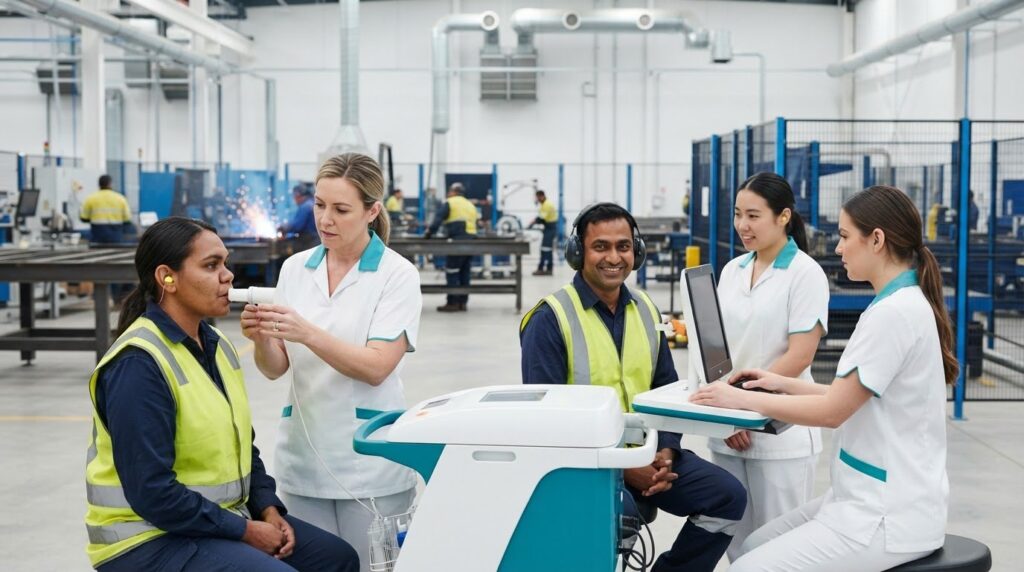
In 2025, Dandenong South accounted for 303 of the more than 3,000 manufacturing injuries recorded across Victoria, placing local industrial facilities under closer regulatory scrutiny than ever. If you manage a busy fabrication, chemical, or machining plant, you already know how challenging it is to balance high production targets with strict occupational safety duties. Between managing worker exposure to welding fumes, continuous noise, isocyanates, and crystalline silica, organising compliant health monitoring for manufacturing workers Dandenong South can quickly disrupt tight shift schedules, especially when off-site medical appointments stall the factory floor.
Protecting your team shouldn’t come at the expense of your daily output. You can establish compliant, cost-effective occupational health monitoring for your Dandenong South manufacturing workforce while keeping operational downtime to an absolute minimum. In this guide, we break down your statutory obligations under Victorian OHS regulations, clarify mandatory testing requirements for hazardous substances, and demonstrate how mobile on-site health surveillance provides rapid, dependable protection for both your people and your business.
Key Takeaways
- Understand your statutory employer duties under WorkSafe Victoria, including mandatory surveillance triggers for airborne contaminants and hazardous substances.
- Discover how tailored health monitoring for manufacturing workers Dandenong South addresses plant-specific risks like welding fumes, isocyanates, continuous noise, and respirable dust.
- Compare the productivity benefits of mobile on-site screening vans against off-site clinics to protect shift coverage and minimise machine downtime.
- Learn practical strategies for smooth factory floor rollouts, from worker consultation and anxiety reduction to strict health privacy compliance.
- Explore how pairing routine medical surveillance with rapid incident triage tools like InjuryQR protects workers and keeps WorkCover premiums under control.
Understanding Health Monitoring Duties for Dandenong South Manufacturers
Dandenong South forms the engine room of Victoria’s heavy industrial output. Across its expansive industrial precincts, thousands of workers handle structural steel fabrication, chemical blending, precision machining, and materials processing every day. Operating in such high-output environments brings serious regulatory responsibilities. Under the Occupational Health and Safety Act 2004, employers have a legal duty to eliminate or reduce operational risks so far as is reasonably practicable. Implementing structured health monitoring for manufacturing workers Dandenong South ensures that exposure to physical and chemical hazards is tracked before subtle physiological changes turn into permanent chronic illness.
Key Victorian Regulations and WorkSafe Victoria Requirements
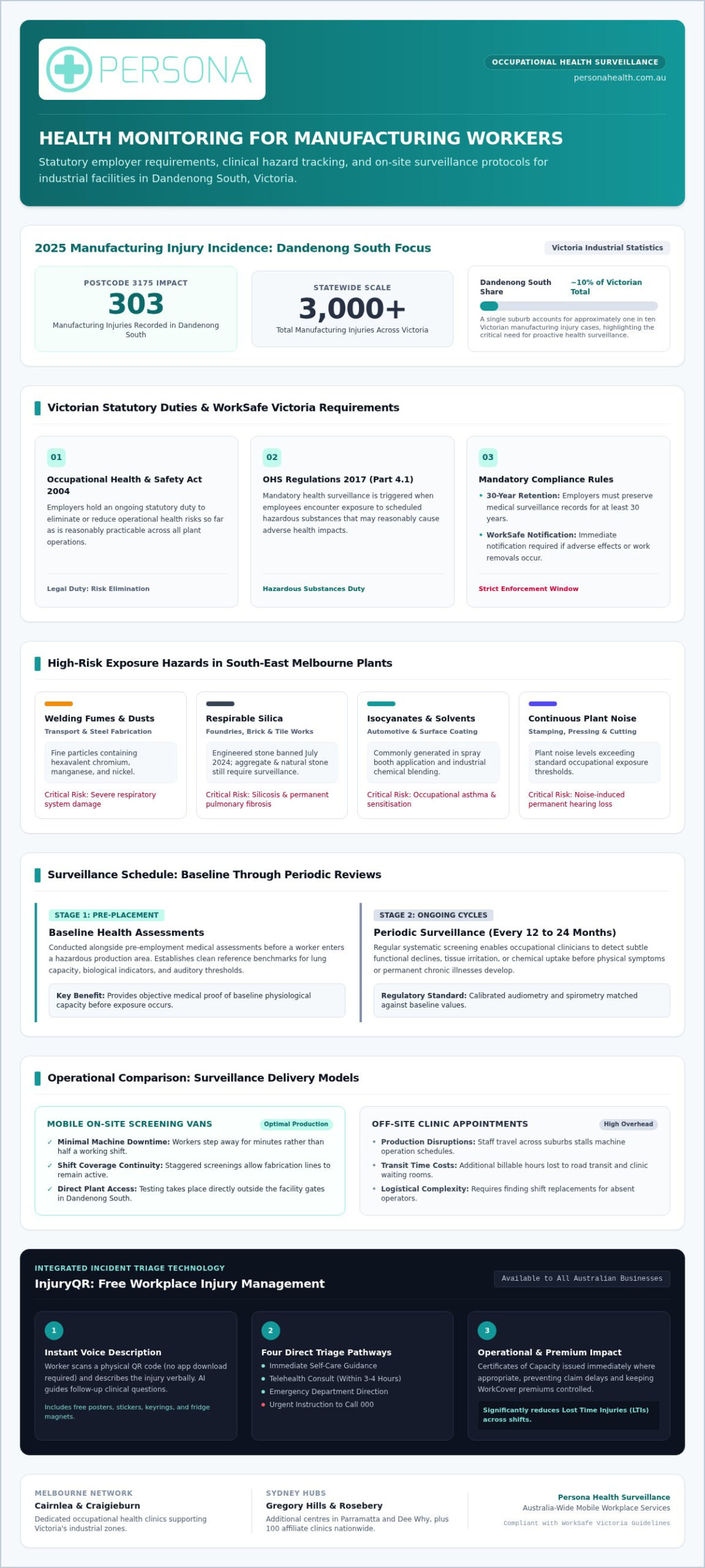
Victorian duties differ from national model laws. Under the Occupational Health and Safety Regulations 2017 Part 4.1 (Hazardous Substances), employers must supply health surveillance if employees face exposure to scheduled substances that could reasonably cause adverse health impacts. Core principles of occupational safety and health require systematic biological tracking rather than guesswork. Victoria mandates that employers keep complete health monitoring records for at least 30 years. If an appointed medical practitioner determines that a worker exhibits adverse effects or requires removal from work, the employer must notify WorkSafe Victoria immediately.
High-Risk Exposure Hazards in South-East Melbourne Factories
Production environments in postcode 3175 present varied airborne and physical threats across different trades:
- Welding fumes and metal dusts: Common across heavy transport and structural steel plants, releasing fine particles of hexavalent chromium, manganese, and nickel that damage respiratory systems.
- Respirable crystalline silica: Generated during brick, tile, and foundry operations. While Victoria strictly prohibited engineered stone manufacturing in July 2024, handling natural stone and aggregate materials still requires vigilant dust surveillance.
- Isocyanates and industrial solvents: Widely applied in automotive assembly, surface coating, and spray booths, carrying significant risks of occupational asthma and chemical sensitisation.
Baseline Versus Periodic Assessments: Why Timing Matters
Effective surveillance relies on clear comparison data. Baseline health checks establish a worker’s initial lung capacity, hearing thresholds, and biological baselines before they ever step into a hazardous production zone. Integrating these checks alongside pre-employment medical assessments gives safety managers an objective benchmark. Conducting periodic reviews every twelve to twenty-four months enables clinicians to spot early functional declines. To evaluate your statutory obligations or book on-site testing for your plant, you can contact Persona Health to consult our occupational medical team.
Core Medical Screenings Required in Manufacturing Health Surveillance
Setting up an effective surveillance program means targeting the exact physiological systems that industrial work stresses every day. General wellness check-ups are not enough. Structured health monitoring guidance sets out specific clinical protocols to identify early tissue irritation, biological uptake of chemicals, or nerve damage before workers notice physical symptoms. For local manufacturing operators, establishing robust health monitoring for manufacturing workers Dandenong South requires combining calibrated hearing checks, respiratory function assessments, and targeted biological testing into a cohesive schedule.
Audiometric Testing and Noise-Induced Hearing Loss Prevention
Industrial machinery, stamping presses, and metal cutting tools regularly exceed safe acoustic thresholds. Under Victorian OHS regulations, employers must provide audiometric testing whenever workers are required to wear hearing protection, specifically when continuous noise exceeds 85 dB(A) over an 8-hour shift or impacts peak at 140 dB(C). Mandated testing timelines require an initial test within three months of someone starting work, followed by ongoing reviews at least every two years. If two tests within two years reveal a hearing reduction of 15 dB or more at 3000 Hz, 4000 Hz, or 6000 Hz, the employer must promptly arrange a comprehensive audiological examination.
Spirometry, Chest X-Rays, and Respiratory Surveillance
Inhaling dust, metal particulates, and welding fumes degrades lung elasticity over time. Surveillance relies on standardised spirometry testing to track Forced Vital Capacity (FVC) and Forced Expiratory Volume in one second (FEV1). These spirometric values indicate whether airway obstruction or lung restriction is quietly developing. For workers exposed to crystalline silica or toxic mineral dusts, baseline and periodic ILO chest X-rays or high-resolution computed tomography (HRCT) detect early tissue scarring. To ensure physical controls work together, pair these clinical evaluations directly with quantitative respirator fit testing, guaranteeing that respiratory protective equipment forms an airtight seal against the worker’s unique facial anatomy.
Biological Monitoring for Chemicals, Solvents, and Heavy Metals
Skin absorption and vaporous inhalation represent invisible transmission routes in spray painting, parts washing, and polymer manufacturing. Biological surveillance evaluates chemical metabolites in urine or blood, capturing the total internal dose absorbed across all pathways:
- Isocyanates: Urine testing immediately post-shift captures metabolite excretion, confirming whether spray booth engineering controls effectively protect painters.
- Lead and heavy metals: Blood screening quantifies systemic absorption during foundry operations, soldering, and heavy fabrication.
- Solvent metabolites: Biological tracking assesses liver and kidney filtration efficiency after prolonged organic solvent contact.
- Visual skin assessments: Routine physical inspections identify contact dermatitis, cracking, or chemical sensitisation caused by synthetic cutting fluids and coolants.
If you need advice on structuring clinical protocols for your plant floor, reach out to our clinical team to design a customised screening program tailored to your plant’s specific chemical registers.
Evaluating Providers: On-Site Mobile Vans vs. Melbourne Clinics
Operations managers face a direct logistical dilemma when coordinating health monitoring for manufacturing workers Dandenong South: should you transport staff off-site or bring clinical services straight to the factory gate? Sending workers across town to external clinics creates severe operational friction, including vehicle travel costs, lost production hours, and expensive overtime to backfill automated machinery stations. Choosing between mobile medical vans and fixed clinical facilities depends on workforce volume, shift arrangements, and testing urgency.
Operational Pros and Cons of Mobile On-Site Health Surveillance
Mobile testing units remove transit friction entirely by parking directly outside your manufacturing facility. Occupational health clinicians conduct spirometry, vision, and audiometric screenings in sound-attenuated, climate-controlled mobile suites, cycling staff through brief appointments during regular shift breaks. This structure accommodates early morning and night shift teams without disrupting continuous fabrication or chemical processing lines. Aligning testing schedules with WorkSafe Victoria’s manufacturing safety basics ensures seamless compliance while keeping output steady. Exploring dedicated on-site health surveillance programs allows local facilities to evaluate entire shifts smoothly over a single day.
When Fixed Occupational Health Clinics Make Better Sense
While mobile vans deliver unmatched efficiency for bulk annual cohorts, fixed medical clinics remain the practical choice for staggered hiring cycles. Brick-and-mortar centres suit single new-starter assessments, follow-up specialist referrals, and cases requiring advanced chest imaging. Persona Health supports Victorian employers through Melbourne clinics in Cairnlea and Craigieburn, bolstered by a network of 100 affiliate clinics nationwide. This physical clinic network guarantees reliable, standardised clinical evaluations whenever you onboard new plant personnel or manage phased return-to-work duties outside scheduled mobile visits.
Key Provider Evaluation Criteria for Dandenong South Employers
Selecting the right occupational partner requires reviewing specific operational capabilities:
- Regulatory familiarity: Appointed medical practitioners must understand Victorian OHS legislation, crystalline silica standards, and WorkSafe reporting obligations.
- Rapid digital reporting: Providers should deliver secure electronic health reports and employer summaries promptly, preventing onboarding delays.
- Shift flexibility: Clinicians must adapt to plant operations, accommodating split shifts, early starts, and overtime rosters.
Need advice on coordinating assessments for your factory floor? Contact Persona Health today to plan a tailored surveillance schedule that safeguards your team without interrupting production.
Implementing a Seamless Health Monitoring Program on the Factory Floor
Rolling out health monitoring across an operational manufacturing plant requires precision coordination. When executed properly, regular clinical screenings integrate smoothly into daily production schedules rather than creating unexpected machine downtime. Achieving high participation rates starts with demystifying the process for your workforce. Engaging early with elected health and safety representatives (HSRs) helps reassure plant employees that occupational surveillance is a protective measure designed to verify engineering controls, not an adversarial screening tool to disqualify people from work.
Step 1: Identifying At-Risk Roles and Tailoring Assessment Panels
Begin by mapping operational hazards directly against your plant’s staffing structure. Cross-reference chemical Safety Data Sheets (SDS) and recent industrial hygiene air monitoring data to establish risk baselines. Distinct operational zones require differentiated screening panels:
- Boilermakers and welders: Prioritise spirometry and baseline chest imaging alongside regular hearing assessments.
- Industrial spray painters: Target biological urine testing for isocyanates paired with visual skin checks for chemical contact dermatitis.
- CNC machinists and press operators: Focus primarily on calibrated audiometry and dermal evaluations for synthetic fluid sensitivity.
Step 2: Preparing Rosters, Testing Spaces, and Workforce Briefings
Logistical success hinges on creating efficient operational intervals. Book workers into staggered 15 to 20 minute time slots so cell leaders can cycle staff through testing without halting production lines. If you are hosting a mobile medical van, reserve a level, accessible parking space close to staff amenities. When indoor testing rooms are used, ensure the designated area is quiet, climate-controlled, and equipped with stable mains power for diagnostic audiometers and spirometry sensors. Clear toolbox talks before testing day reduce anxiety, reiterating that medical data remains confidential under the Privacy Act 1988 and Australian Privacy Principles.
Step 3: Interpreting Results, Adverse Trends, and Action Plans
Employers receive an actionable outcome summary confirming each employee’s fitness to continue work and noting any recommended adjustments. Confidential clinical notes remain strictly between the worker and the examining physician. If health monitoring for manufacturing workers Dandenong South flags an adverse health effect or biological uptake exceeding safe thresholds, you must review your hierarchy of controls immediately:
- Inspect local exhaust ventilation systems and capture hoods for reduced airflow.
- Audit respiratory protection fit, filter replacement schedules, and seal compliance.
- Submit statutory notifications to WorkSafe Victoria if a doctor confirms a work-related illness.
Partnering with Persona Health and Integrating Modern Incident Triage
Delivering high-standard industrial safety requires uniting preventive occupational checks with rapid clinical response. Persona Health works alongside Victorian industrial operations to make statutory medical surveillance straightforward, practical, and non-disruptive. By pairing mobile screening services with swift digital reporting, factory managers receive actionable medical clearance letters and aggregate summaries promptly, eliminating paperwork backlogs and maintaining complete regulatory alignment with WorkSafe Victoria.
Dedicated Occupational Health Services for Melbourne Manufacturing
Our experienced clinicians understand the technical hazards present in heavy fabrication, automotive assembly, and chemical processing. Rather than treating safety surveillance as an administrative chore, we build tailored testing panels that reflect your specific risk environment. Manufacturers across south-east Melbourne access comprehensive testing through our modern mobile screening vans travelling directly to your gate, our Melbourne facilities in Cairnlea and Craigieburn, and a broader network of 100 affiliate clinics nationwide. For companies managing complex sites, our occupational health and surveillance guide details how coordinated on-site visits streamline testing for entire shifts without interrupting factory run times.
Instant Injury Triage with InjuryQR on the Factory Floor
Even in well-managed facilities, physical strains, cuts, or crush hazards occur. While health monitoring for manufacturing workers Dandenong South detects chronic occupational illness, immediate triage resolves acute factory incidents. That is why Persona Health integrates InjuryQR, a completely free AI-powered workplace injury triage service available to all Australian businesses.
The triage process is instant and accessible for every worker on site:
- No app required: Workers scan a QR code placed on physical posters, stickers, keyrings, or fridge magnets located around the factory.
- Voice-guided assessment: The worker describes the injury by voice, and the AI asks clinical follow-up questions to gauge severity.
- Immediate medical pathways: The system directs the worker to tailored self-care, urgent emergency services, or an occupational telehealth appointment, typically within 3 to 4 hours.
- Fast documentation: Treating doctors can issue valid Certificates of Capacity immediately where clinically appropriate, facilitating prompt suitable duties and slashing Lost Time Injuries (LTIs).
Getting Started with Your Dandenong South Monitoring Plan
Protecting your team and keeping your WorkCover claims profile low begins with clear planning. Our medical coordinators review your plant hazards, align clinical panels with Victorian exposure limits, and establish an annual testing schedule built around your production calendar. We also supply free InjuryQR workplace kits to ensure your incident response matches your high preventive standards.
Safeguard Your Plant Workforce and Simplify Victorian Compliance
Establishing structured health monitoring for manufacturing workers Dandenong South protects your team against hazardous industrial exposures while maintaining strict alignment with WorkSafe Victoria mandates. Moving away from disjointed off-site clinic appointments to fully equipped mobile testing units eliminates shift bottlenecks and protects valuable production hours. With the guidance of experienced occupational health doctors specialising in Victorian manufacturing hazards, your facility gains accurate baseline tracking and rapid digital reporting. Supported by a national network of 100 affiliate clinics and free InjuryQR digital incident triage connecting injured staff to telehealth within 3 to 4 hours, your business has the comprehensive support needed to close the loop between clinical prevention and acute care.
Taking proactive control of your workplace health surveillance today builds a resilient factory floor, protects your WorkCover claims history, and keeps your daily production running smoothly.
Frequently Asked Questions
Is health monitoring legally mandatory for manufacturing employers in Victoria?
Yes, health monitoring is mandatory under the Victorian Occupational Health and Safety Regulations 2017 whenever workers face potential exposure to scheduled hazardous substances or noise levels likely to affect their health. It isn’t an optional wellness perk. If engineering controls cannot completely eliminate hazardous exposure, WorkSafe Victoria requires employers to track worker health systematically to prevent occupational illness.
What specific manufacturing chemicals trigger mandatory health monitoring under WorkSafe Victoria?
Mandatory monitoring is triggered by substances listed in Victorian hazardous substance schedules where significant exposure risk remains. Common factory triggers include isocyanates found in spray paints and polyurethane coatings, respirable crystalline silica in abrasive operations, inorganic lead during casting, and chemical solvents. Health monitoring for manufacturing workers Dandenong South ensures biological absorption of these scheduled agents remains well below regulatory thresholds.
Can occupational health monitoring be performed on-site at our Dandenong South factory?
Yes, mobile medical surveillance units travel directly to manufacturing premises across Dandenong South. Purpose-built vans feature calibrated audiometric booths and spirometry equipment, allowing clinicians to screen entire shift rosters on-site. Conducting testing at your facility prevents lost transit time, simplifies roster cover, and eliminates travel disruptions while fulfilling your statutory OHS obligations under Victorian law.
How long must manufacturing businesses keep employee health monitoring records in Victoria?
Victorian OHS regulations mandate that employers retain employee health monitoring records for at least 30 years from the date of creation. Because occupational diseases like silicosis or occupational asthma can take decades to show full clinical symptoms, maintaining longitudinal health records is essential. Employers must store these confidential medical summaries securely to comply with the Privacy Act 1988 and Australian Privacy Principles.
What happens if a worker shows adverse results, such as hearing loss or reduced lung capacity?
If assessments reveal abnormal findings, such as a significant hearing threshold shift or reduced spirometry volumes, the examining doctor provides clinical recommendations for immediate workplace review. The employer must investigate the root cause, inspect ventilation systems, verify PPE fit, and adjust duties if medically advised. If an occupational disease or exposure exceedance is confirmed, the employer must formally notify WorkSafe Victoria.
Do manufacturing employees have the right to refuse mandatory workplace health monitoring?
Employees generally cannot refuse statutory health surveillance where exposure to scheduled hazards makes monitoring a legal condition of work under Victorian OHS laws. Because employers hold an overarching duty of care to ensure safe working environments, routine screening is considered a reasonable safety requirement. Clear, transparent communication usually resolves worker hesitation by demonstrating that health monitoring for manufacturing workers Dandenong South protects long-term bodily health.
How does InjuryQR assist manufacturing managers with workplace incidents and injury management?
InjuryQR is a free AI-powered triage platform that streamlines factory incident reporting without requiring app downloads. When an incident occurs, workers scan a QR code from provided posters or keyrings and describe the issue using voice prompts. The system provides immediate first-aid guidance, directs emergency cases, or books occupational telehealth typically within 3 to 4 hours. Treating clinicians issue instant Certificates of Capacity, cutting Lost Time Injuries significantly.

Article by
Ian Nicholson
Ian is the Business Support Manager at Persona Health, where he plays a key role across IT, sales, marketing and business operations. With a broad skill set and a practical, solutions-focused approach, Ian helps drive the systems, communication and commercial strategy that support Persona Health’s continued growth across Australia.