
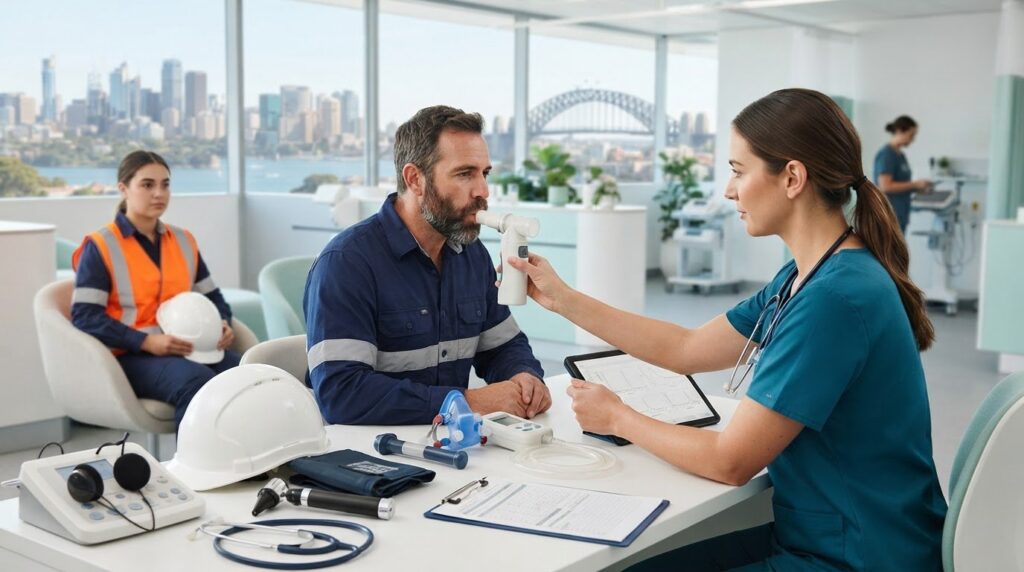
With Australia’s construction sector recording a serious injury claim rate of 16.9 claims per 1,000 workers, a generic tick-and-flick health check cannot properly protect your people or your program. You already know the compounding cost of waiting days for induction sign-offs while subbies stand idle at the perimeter gate. Securing compliant construction worker medicals North Sydney site managers and contractors rely on shouldn’t mean wrestling with fragmented appointment desks, slow administrative turnarounds, or ambiguous clearance reports that overlook high-risk trade exposures.
Discover how to select, schedule, and manage compliant construction worker medicals across North Sydney to protect your workforce and avoid project downtime. In this comprehensive guide, we show you how to satisfy SafeWork NSW health surveillance mandates for crystalline silica, noise, and manual handling with total confidence. You will explore practical steps to secure decisive fit-for-work certificates within 24 to 48 hours, while coordinating effortless screening through trusted Sydney clinics and fully equipped mobile testing units.
Key Takeaways
- Understand the critical health surveillance components mandated by SafeWork NSW, including targeted screening for respirable crystalline silica and workplace noise exposure.
- Learn how streamlining construction worker medicals North Sydney contractors schedule helps deliver definitive fit-for-work certificates within 24 to 48 hours to protect site commencement dates.
- Discover the essential criteria for selecting an occupational health partner, prioritising trade-specific physical assessments over generic tick-and-flick examinations.
- See how baseline clinical records protect employers from contentious compensation claims and link directly to fast workplace injury triage platforms such as InjuryQR.
- Identify practical scheduling models that combine centralised Sydney clinic access with mobile on-site testing to slash contractor downtime and administrative overhead.
Key Components of Construction Worker Medicals in North Sydney
Commercial builds across North Sydney present complex site hazards, from tight high-rise structural envelopes around Victoria Cross to dense infrastructure interfaces. Thorough clinical evaluations confirm whether a worker can safely execute rigorous site tasks while dramatically mitigating commercial disruption, reducing insurance premiums, and preventing lost-time injuries. A steel fixer encounters vastly different biomechanical loads than an electrician, machine operator, or finishing plasterer. Rigorous construction worker medicals North Sydney contractors rely on must account for these individual trade profiles rather than applying blanket checklists.
Grounding workforce screening in modern principles of occupational safety and health ensures that workers match the daily physical realities of their packages. Exploring tailored screening through specialised pre-employment medicals establishes early medical safeguards, ensuring new starters enter active projects without creating avoidable safety risks for themselves or their crew.
Musculoskeletal and Functional Capacity Evaluations
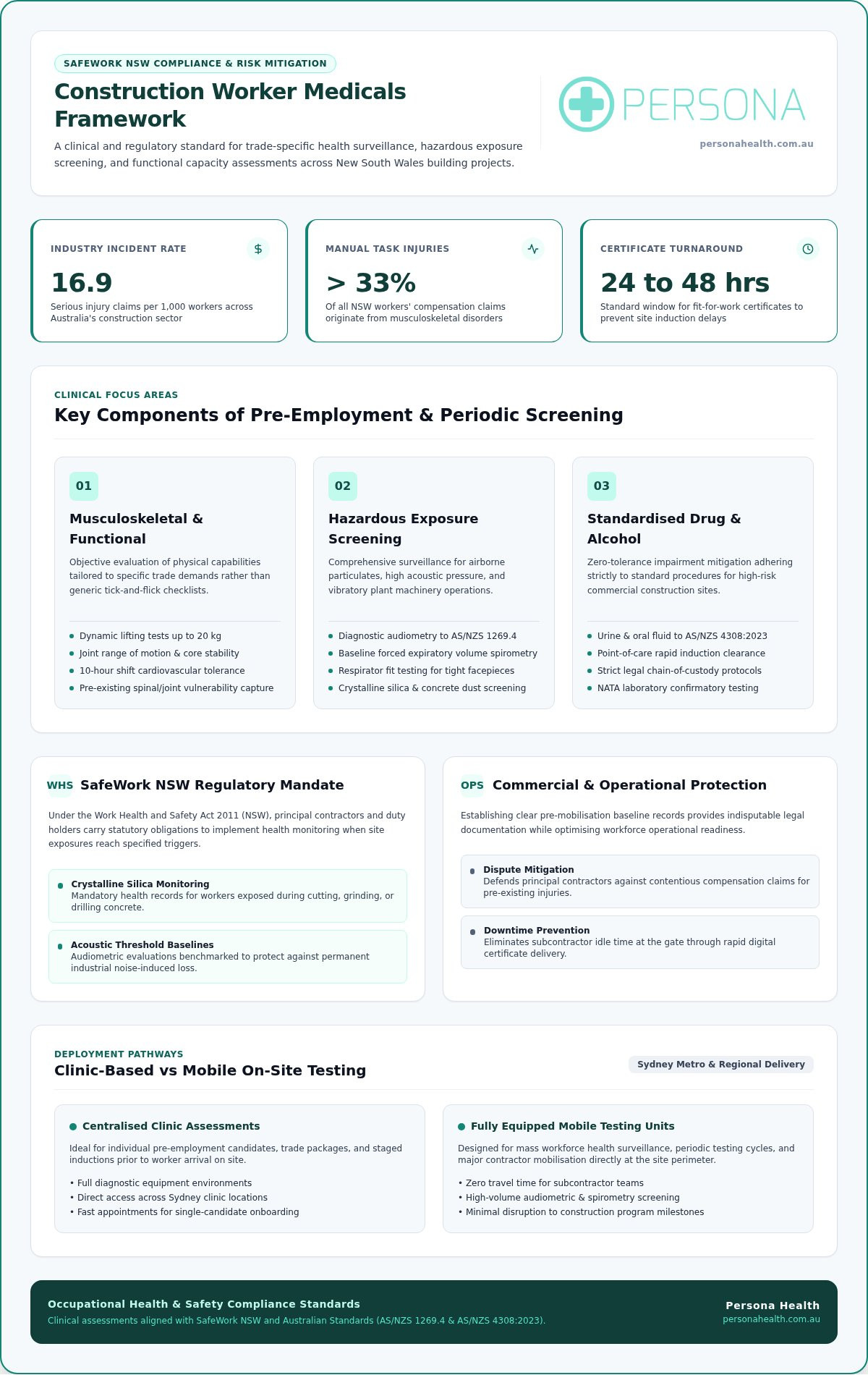
Musculoskeletal disorders from hazardous manual tasks account for more than a third of all workers’ compensation claims across New South Wales. Functional assessments rigorously evaluate joint range of motion, core stability, and dynamic lifting capacities up to 20 kilograms. Dynamic cardiovascular tests examine whether a candidate can sustain physically intense tasks across ten-hour shifts. Clinical observation of old spinal, knee, or shoulder injuries captures pre-existing vulnerabilities before mobilization, creating an objective physiological benchmark.
Hazardous Exposure Screening: Dust, Noise, and Vibration
Urban building projects concentrate airborne dusts and continuous acoustic loads. Baseline spirometry measures forced expiratory volume to flag early respiratory restriction prior to concrete grinding, cutting, or drilling. Pairing clinical spirometry with professional respirator fit testing ensures tight-fitting facepieces actually seal against toxic particulates. Concurrently, diagnostic audiometry benchmarked strictly against AS/NZS 1269.4 identifies pre-existing hearing loss before plant machinery and percussion tools cause permanent damage.
Standardised Workplace Drug and Alcohol Screening
Zero tolerance for impairment on high-risk sites protects the entire workforce. Urine and oral fluid testing conducted under AS/NZS 4308:2023 standards detects illicit substances and prescription medications that compromise safety. Point-of-care rapid screening gives supervisors immediate clearance for urgent site inductions. Whenever a non-negative result arises, disciplined chain-of-custody protocols transfer the specimen to NATA-accredited laboratories for definitive confirmatory analysis, ensuring legally defensible outcomes.
SafeWork NSW Compliance and Health Surveillance Mandates
Under the Work Health and Safety Act 2011 (NSW), principal contractors and duty holders carry a legal obligation to ensure site activities don’t compromise worker well-being. When active work packages introduce physiological risks that engineering controls or personal protective equipment cannot fully resolve, health monitoring ceases to be optional. The National health monitoring guide outlines how surveillance must be established when exposure to toxic dusts, noise, or hazardous chemicals reaches specified triggers. Maintaining accurate statutory health documentation protects directors from severe SafeWork NSW penalties and sudden site shutdowns.
Health surveillance documentation constitutes sensitive medical data under the Privacy Act 1988 and the Australian Privacy Principles. These files must remain strictly confidential, preserved securely for up to 30 years depending on the airborne agent, and isolated from standard employment records. Embedding targeted construction worker medicals North Sydney principal contractors can trust guarantees robust regulatory alignment while safeguarding sensitive worker information.
Crystalline Silica and Airborne Dust Regulations
SafeWork NSW focuses intense regulatory scrutiny on civil demolition, cutting, and grinding activities. With the national exposure standard for respirable crystalline silica (RCS) set at 0.05 mg/m³, health monitoring is legally required whenever air monitoring reaches 0.025 mg/m³ or where workers face significant ongoing exposure. Employers must also register qualifying individuals on the NSW Silica Worker Register within 28 days of commencing high-risk processing. Compliant monitoring demands formal respiratory questionnaires, standardized spirometry, and chest X-rays read to International Labour Organization (ILO) standards. Booking clinical crystalline silica medicals ensures complete alignment with these rigorous statutory expectations.
Audiometric Testing Mandates Under Clause 58
Clause 58 of the NSW WHS Regulation mandates that workers required to wear personal hearing protection must receive baseline audiometric testing within three months of commencing work. Employers must carry out follow-up hearing assessments at least every two years thereafter. Daily workplace noise levels surpassing 85 dB(A) or peak acoustic impacts over 140 dB(C) cause irreversible sensorineural damage over time. Routine testing benchmarked against AS/NZS 1269.4 catches early threshold shifts, giving your safety leaders the objective data needed to upgrade acoustic dampening before permanent hearing loss occurs. For tailored guidance on implementing compliant health surveillance for your trade packages, speak with our occupational health team.
How to Choose a Medical Provider for North Sydney Projects
North Sydney developments face severe urban logistical constraints. Between complex traffic corridors, congested site loading docks, and rapid metro line expansion, project schedules cannot absorb unexpected delays. Choosing the wrong occupational health clinic directly disrupts your critical path. Subcontractors wait on paperwork, high-risk trades remain grounded, and administrative teams burn hours chasing clinical notes. Sourcing efficient construction worker medicals North Sydney teams can execute seamlessly requires partnering with a provider geared specifically around commercial construction deadlines.
Your occupational health provider should act as a commercial enabler rather than an administrative bottleneck. Look for clinics that combine deep trade understanding with responsive booking systems and clear operational processes.
Assessing Report Turnaround Times and Candidate Access
Induction programs grind to a halt when medical results lag behind recruitment schedules. High-performing providers deliver definitive fit-for-work certificates within 24 to 48 hours of assessment completion. Location convenience matters just as much. Because trade personnel commute from varied regions across Greater Sydney, your provider must offer accessible clinic hubs near arterial transit routes, making appointments straightforward for candidates before their first morning on site.
Clinical Expertise and Standardised Reporting Systems
General practitioners unfamiliar with building sites often issue non-committal or overly cautious health assessments that confuse site managers. Demand occupational medical examiners who understand construction realities and provide unambiguous outcomes: fit, fit with specific restrictions, or temporarily unfit. Modern digital platforms streamline this workflow, giving project safety officers immediate access to legally defensible fitness certificates while keeping personal diagnostic health files strictly confidential under the Privacy Act.
Balancing On-Site Mobile Testing with Dedicated Clinics
Major project milestones demand distinct assessment models depending on workforce volume and mobilization speed:
- On-site mobile units: Mobile screening vans prove invaluable during mass site inductions or large-scale health surveillance sweeps, testing entire shifts on location without workers leaving the compound.
- Dedicated permanent clinics: Established facilities handle regular individual recruitment intakes, comprehensive musculoskeletal evaluations, and candidate baseline testing before trades arrive at the project gate.
- Affiliate network reach: A wide provider network ensures specialist subbies travelling from regional centres or interstate can complete their medicals prior to setting foot in Sydney.
Balancing both models gives site administrators the flexibility to manage sudden staffing surges during intensive structural, tunnelling, or fit-out packages.
Connecting Baseline Medicals with Incident Triage and Injury Management
A comprehensive onboarding assessment does far more than clear a worker for site entry. When properly documented, baseline physiological data creates a definitive clinical benchmark before someone lifts a tool on site. In heavy construction, disputes frequently flare up over whether a spinal strain or rotator cuff impingement occurred during work hours or stemmed from an unrecorded degenerative issue. Rigorous construction worker medicals North Sydney employers conduct provide objective legal clarity, protecting builders against contentious claims while ensuring genuine injuries receive immediate, targeted care.
Connecting baseline findings from construction worker medicals North Sydney teams undertake with active incident management ensures every injury pathway is medically grounded from day one.
Using Medical Records to Guide Return-to-Work Programs
When an incident occurs, baseline pre-placement records dramatically accelerate rehabilitation. Occupational doctors review initial spinal mobility, grip strength, and lifting tolerances to draft practical suitable duties registers. Rather than relying on speculative restrictions, treating clinicians tailor transitional tasks directly to verified physical capacities. This structured approach prevents premature strain, avoids reinjury, and promotes constructive collaboration between the injured worker, site supervisors, and insurers.
Immediate Worksite Triage with Free AI-Powered InjuryQR
Rapid clinical intervention within the first few hours of an incident significantly reduces Lost Time Injuries (LTIs). To bridge the gap between an incident occurring on site and prompt medical assessment, Australian principal contractors can deploy InjuryQR across their projects. InjuryQR is a free AI-powered workplace injury triage service available to all Australian businesses, providing free printed posters, stickers, keyrings, and fridge magnets for site amenities and first aid sheds.
The reporting workflow requires no app download. Workers simply scan the on-site QR code using their smartphone, describe the incident by voice, and answer intuitive AI follow-up questions. Depending on clinical severity, the platform instantly directs the worker to appropriate care pathways: evidence-based self-care advice, urgent directions to the nearest hospital Emergency Department, or instructions to call 000 for critical events. For non-emergency sprains, cuts, and soft tissue trauma, workers access telehealth appointments typically within 3 to 4 hours. Doctors issue digital Certificates of Capacity immediately where appropriate, eliminating needless lost days, cutting claim costs, and giving North Sydney safety managers real-time visibility over workforce incidents.
Streamline Your North Sydney Construction Medicals with Persona Health
Commercial building, civil excavation, and dense transport infrastructure demand an occupational health partner that moves at the speed of your project program. Since 2016, Persona Health has partnered with principal contractors and trade businesses across New South Wales to deliver reliable, medically robust assessments. Fast-tracked digital reporting keeps recruitment pipelines flowing smoothly, eliminating costly downtime while keeping your project entirely compliant. Coordinating the construction worker medicals North Sydney supervisors rely on has never been more straightforward.
Customised Screening Packages for Construction Trades
Different scopes of work carry vastly different biomechanical loads and hazard profiles. Persona Health configures modular assessment packages directly aligned with your site job dictionaries, whether you are placing plant operators, riggers, scaffolders, or formworkers. Site managers can combine comprehensive musculoskeletal testing with AS/NZS 1269.4 audiometric checks, SafeWork NSW silica surveillance, and AS/NZS 4308:2023 drug and alcohol screening. These role-specific packages satisfy tier-one head contractor pre-qualification standards without adding redundant testing.
Accessible Sydney Clinic Locations and Mobile Deployment
Minimising travel time for subbies ensures rapid induction sign-offs. Our centrally situated clinics in Rosebery and Parramatta offer convenient transit access for trade contractors travelling across Greater Sydney to North Sydney jobs. We also operate strategic facilities in Gregory Hills and Dee Why, Melbourne facilities in Cairnlea and Craigieburn, and a nationwide network of 100 affiliate clinics. When major package mobilisations require high-volume screening without pulling trades off the tools, our fully equipped mobile workplace testing units deploy directly to your North Sydney compound.
Straightforward Booking and Account Coordination
Administrative friction shouldn’t stand between a qualified trade contractor and an active worksite. Persona Health provides a modern, employer-focused booking process that cuts through repetitive phone calls and endless email trails. Responsive customer support guarantees candidates are evaluated promptly, with clear fit-for-work determinations returned within 24 to 48 hours to lock in your commencement dates.
To design a compliant screening matrix for your upcoming trade packages or reserve clinic bookings, speak with the Persona Health contact team.
Protect Your Workforce and Keep North Sydney Sites Moving
Delivering major commercial and infrastructure builds across North Sydney requires proactive risk management from the very first site induction. Establishing role-specific clinical baselines shields your operations against SafeWork NSW compliance breaches, hazardous dust exposure penalties, and costly compensation disputes. Investing in accurate construction worker medicals North Sydney site managers trust ensures your workforce remains resilient and fully capable of handling demanding trade packages.
Established in 2016, Persona Health brings deep occupational medicine experience and responsive customer service directly to your contracting pipeline. With dedicated Sydney clinics in Rosebery, Parramatta, Dee Why, and Gregory Hills, complemented by over 100 nationwide affiliate clinics, scheduling trade assessments has never been simpler. Fast digital workflows deliver clear, definitive fit-for-work certificates within 24 to 48 hours so your construction milestones stay firmly on track.
Take control of your site safety today and give your teams the expert clinical backing they deserve to thrive on site.
Frequently Asked Questions
What does a standard construction worker medical include in North Sydney?
A standard assessment evaluates a worker’s physical capacity and physiological baseline against daily site hazards. Assessments typically include a comprehensive musculoskeletal screening of the spine and joints, dynamic lifting checks, cardiovascular fitness, vision testing, and AS/NZS 4308:2023 drug and alcohol screening. Spirometry and audiometry are included to benchmark respiratory and hearing health before candidates commence active trade work.
How quickly can employers expect to receive the medical assessment results?
Employers typically receive clear, digital fit-for-work certificates within 24 to 48 hours following assessment completion. When booking the construction worker medicals North Sydney builders rely on, prompt reporting prevents costly induction bottlenecks. If a candidate requires specialized pathology or confirmatory laboratory testing for a non-negative drug screen, those specific components may require an extra 24 to 48 hours.
Is health surveillance for silica and dust exposure legally required in NSW?
Yes, health surveillance is a statutory legal requirement under the NSW Work Health and Safety Regulation when workers face significant risk of exposure to respirable crystalline silica. Screening is triggered whenever air monitoring reaches 0.025 mg/m³ or where workers regularly perform high-risk cutting, crushing, or grinding. Employers must coordinate doctor-supervised spirometry, respiratory examinations, and register eligible personnel on the SafeWork NSW Silica Worker Register within 28 days.
Can medical assessments be conducted directly on our North Sydney job site?
Yes, fully equipped mobile occupational health units can deploy directly to your North Sydney site office or compound. Mobile testing is ideal for mass onboarding programs, major civil mobilisations, or scheduled health surveillance sweeps. This mobile service eliminates transit downtime across the harbour while conducting audiometry, lung function testing, and physical checks on location. Individual candidate assessments can also be completed at central Sydney clinics.
What happens if a prospective trade contractor fails their pre-employment medical?
Occupational doctors rarely issue an outright fail; instead, the clinician typically classifies the worker as “fit with restrictions” or “temporarily unfit”. The report identifies specific limitations, such as modified overhead lifting or avoiding prolonged kneeling, allowing safety managers to assign suitable duties safely. If an acute medical issue is detected, the candidate is directed to their GP for treatment before undergoing re-evaluation.
How often should existing construction workers undergo periodic health assessments?
Assessment frequency depends on specific site hazard exposures and regulatory mandates. Under NSW regulations, audiometric screening is required within three months of starting and at least every two years for high-noise tasks. Hazardous substance monitoring for silica or lead generally occurs annually. Arranging periodic construction worker medicals North Sydney employers schedule ensures ongoing fitness as workers take on different, physically demanding project packages.

Article by
Ian Nicholson
Ian is the Business Support Manager at Persona Health, where he plays a key role across IT, sales, marketing and business operations. With a broad skill set and a practical, solutions-focused approach, Ian helps drive the systems, communication and commercial strategy that support Persona Health’s continued growth across Australia.