

A fast medical result is useful only if it helps you make a fair, role-related decision. For defensible hiring decisions with objective medicals in Melbourne, assess each candidate against the requirements of the job and record the evidence behind the outcome. Turnaround depends on the assessment components required and when the candidate completes them.
Pre-employment checks can help determine whether a candidate can meet a role’s requirements. The challenge is to use findings consistently, without allowing assumptions about someone’s health or background to replace evidence. A medical result should inform the decision, not become a shortcut for judging a candidate.
This article explains how role-based medicals work, what can affect reporting time, and how to document decisions clearly. It also connects hiring with injury risk management, helping you take a practical, fair approach from assessment through to the start of work.
Key Takeaways
- Match each medical assessment to the role’s actual tasks and workplace risks, rather than relying on a generic checklist.
- Use clinical findings as evidence to inform hiring decisions, alongside the candidate’s ability to meet the role’s requirements.
- Apply consistent criteria to candidates and keep clear records of the job requirements, assessment results and decision process.
- Plan assessment components around the role and employer requirements, as these influence what the screening involves and how results are returned.
- Consider suitable adjustments or alternative duties when an assessment identifies a concern, rather than treating the result as an automatic rejection.
What Is a Pre-Employment Medical?
A pre-employment medical assesses whether a candidate can safely meet the physical and medical demands of a particular role. Its scope should reflect the job tasks and workplace risks, rather than rely on the same checklist for every position.
For a practical overview of Australian screening and functional assessments, watch this video:
Role-specific medical assessments
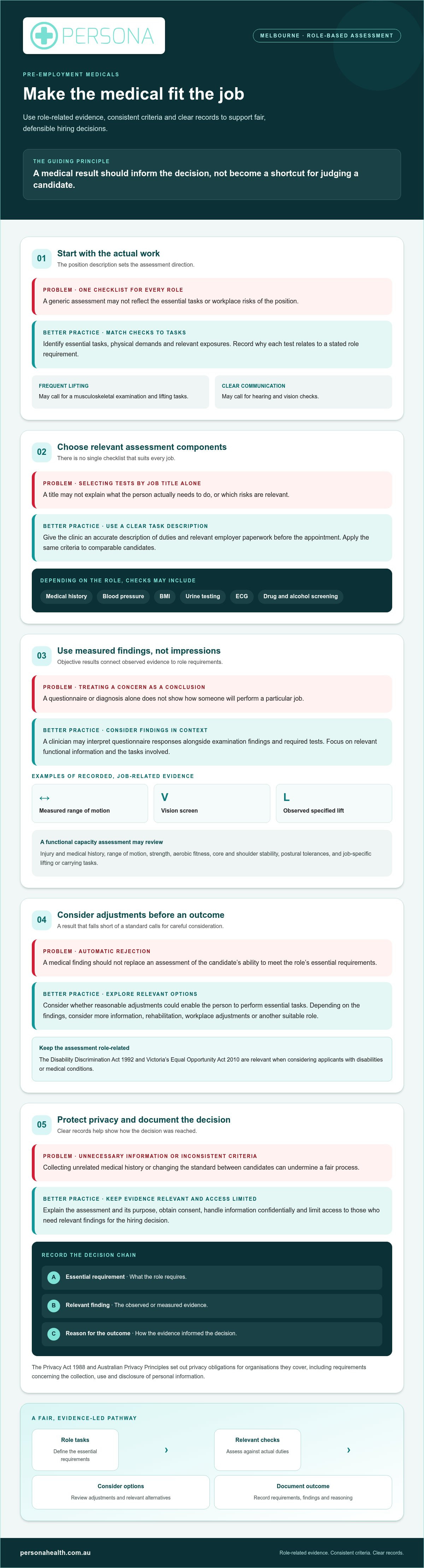
Start with the position description: identify essential tasks, physical demands and relevant exposures. A role involving frequent lifting may call for musculoskeletal examination and lifting tasks, while a position requiring clear communication may need hearing and vision checks. Depending on the job, assessments may also cover medical history, blood pressure, BMI, urine testing, ECG or drug and alcohol screening. Each component should connect to a stated role requirement.
For example, a warehouse role involving repeated carrying may need a different assessment pathway from a desk-based position. Record the task and reason for each test, then apply the same criteria to candidates seeking the same role.
Screening standards and assessment types
There is no single checklist that suits every job. Employers can set a consistent standard for each role, then select medical assessments that address its requirements. A functional capacity assessment may review injury and medical history, range of motion, strength, aerobic fitness, core and shoulder stability, postural tolerances, and job-specific lifting or carrying tasks.
For job-specific pre-employment testing, provide the clinic with an accurate task description and any company paperwork before the appointment. This helps align the assessment with actual duties, rather than assumptions based on a job title. Apply the same criteria to comparable candidates.
Assessment scope, consent and privacy
In Victoria, focus on matters relevant to the role’s inherent requirements and identified risks. Explain the proposed assessment and its purpose to the candidate, and obtain consent before proceeding. Handle medical information confidentially and use it only for an appropriate hiring purpose.
The Privacy Act 1988 and Australian Privacy Principles set out privacy obligations for organisations they cover, including requirements concerning the collection, use and disclosure of personal information. Limit access to those who need relevant information for the hiring decision. Decision-makers generally need job-related findings, not unrelated medical history.
Objective assessments and Melbourne providers
Objective pre-employment medicals in Melbourne use defined tests and recorded findings linked to job requirements. Examples include a measured range of motion, a vision screen or observed performance of a specified lift. These findings help separate evidence from intuition, while allowing the employer to consider adjustments and the candidate’s circumstances.
Melbourne occupational health clinics provide different combinations of medical checks and functional assessments. Compare the proposed assessment scope with the role description, ask how results will be reported, and provide relevant employer forms before the appointment. A Melbourne occupational health clinic can be part of that local assessment pathway.
Occupational Health Doctor review and defensible hiring outcomes
An occupational health doctor can interpret assessment findings against the candidate’s stated role requirements. The employer remains responsible for applying consistent criteria and recording the hiring decision.
Health questionnaires and medical history
A health questionnaire gathers information relevant to the planned assessment, while a medical history helps the clinician interpret findings in context. Questions should connect to job demands, such as lifting, prolonged standing or workplace hazards. Avoid collecting information that has no clear purpose in the assessment.
At the appointment, the clinician may review the candidate’s responses alongside examination findings and required tests. For example, a reported shoulder injury may prompt closer consideration of a role’s overhead tasks. A questionnaire is a starting point, not a hiring verdict.
Disability and medical-condition hiring rules
The federal Disability Discrimination Act 1992 and Victoria’s Equal Opportunity Act 2010 are relevant when considering applicants with disabilities or medical conditions. Keep selection criteria tied to the role, assess each candidate consistently, and consider whether reasonable adjustments could enable the person to perform its essential tasks.
A diagnosis alone does not show how someone will perform a particular job. Focus on relevant functional information, such as whether a candidate can complete a specified task, and consider adjustments before reaching an outcome. For complex decisions, seek appropriate employment or legal advice.
Objective results and defensible decisions
Objective results describe observed or measured findings, rather than impressions about a candidate’s health. An Occupational Health Doctor may compare those findings with the demands supplied for the role and identify where more information, rehabilitation, workplace adjustments or another suitable role could be considered.
To support defensible hiring decisions with objective medicals in Melbourne, document the essential requirement, relevant finding and reason for the final decision. Use the same assessment criteria for candidates applying for the same role. A result that falls short of an expected standard calls for careful consideration, not automatic rejection.
Psychological screening also needs a clear, role-related purpose. If included, explain its scope and use, and interpret findings in the assessment context. Do not use a mental health label as a substitute for evidence about a candidate’s ability to perform the work.
Assessment-to-decision steps
Use a documented process from booking to outcome:
- Define the role’s essential tasks, hazards and required capabilities before booking.
- Send the clinic the position description, relevant employer paperwork and assessment requirements.
- Tell the candidate what the health assessment involves and how relevant findings will inform the hiring process.
- Arrange the appointment and any role-related checks, such as hearing, vision, musculoskeletal or drug and alcohol screening.
- Review the report against the predetermined criteria, then document the evidence and decision.
Industries such as rail, mining, transport and infrastructure may have distinct role demands and screening needs. Consistent records help explain how the assessment informed the decision, while protecting confidential health information. Keep the job description, interview rubric and formal assessment outcome together in the recruitment record.
Risk-based pre-employment medicals in Melbourne
A risk-based pathway connects screening to the work, not assumptions about a candidate. In Melbourne, role demands, workplace hazards and employer requirements help determine which assessments are relevant.
Industry-specific screening
Pre-employment medicals are commonly used in public passenger driving, commercial truck driving, aviation, rail, mining and other high-risk sectors. Screening should reflect each job’s demands: a driver may need an assessment relevant to safe vehicle operation, while a rail role may follow its applicable rail health assessment requirements.
For hazardous work, identify relevant exposures and any applicable health surveillance requirements separately. Don’t treat an industry label as a complete assessment plan. Consider the actual tasks, workplace conditions and required fitness standards before selecting tests.
Duty of care and workforce safety
A considered assessment can help employers determine whether a candidate’s abilities align with a role’s essential demands. For example, repeated lifting may make musculoskeletal capacity relevant, while hazardous exposure may call for separate health monitoring. Record the work-related reason for each assessment and apply the same criteria to comparable candidates.
Workplace safety also depends on responding well when an injury occurs. InjuryQR is a FREE AI-powered workplace injury triage service for all Australian businesses, with free posters, stickers, keyrings and fridge magnets. Workers scan a QR code without downloading an app, describe an injury by voice, then answer AI follow-up questions. The service can provide self-care advice, telehealth appointments typically within 3-4 hours, Emergency Department direction or instructions to call 000. Certificates of Capacity can be issued immediately where appropriate. Early triage, timely certificates and easier reporting can help reduce Lost Time Injuries (LTIs) and improve incident reporting.
Employer screening considerations
Before booking, record the role’s physical demands, relevant hazards and required capabilities. Then select assessments that address them, such as a musculoskeletal review or role-specific functional tasks. Include a measurement such as weight only when it is relevant to the job and its risks.
Set drug and alcohol screening requirements according to employer policy, workplace risk and relevant regulations. Apply the process consistently to candidates for the same role, and explain the assessment’s purpose and steps. A qualified occupational health professional can assess findings against the job information provided, while the employer records how the evidence informed its decision. Revisit the pathway if duties or workplace risks change.
What is a pre-employment health screening?
A role-specific employment medical uses the job’s tasks and risks to select relevant checks. The assessment pathway should show how each test relates to the work, rather than apply an identical panel to every position.
Role-specific medical screening
Start with a task-based description of the role. Repetitive handling may call for a musculoskeletal review, while a safety-sensitive position may require checks linked to its specific demands. Persona Health’s Pre-Employment Medicals include a medical history assessment, physical examination, drug and alcohol screening, vision, hearing and respiratory tests, and industry-specific components where relevant.
Functional capacity testing can examine movement, strength, aerobic fitness, stability and specific work tasks. For example, a candidate for a materials-handling role may complete lifting or carrying tasks that reflect the stated duties. The test should measure the ability the job requires, not performance of an unrelated task.
Provide the clinic with accurate job information and any company assessment forms before the appointment. Include equipment, work postures and essential tasks, such as climbing access steps or working overhead. Clear paperwork helps the clinician select appropriate checks and report findings against the role’s defined requirements.
Job analysis and role suitability
Job analysis turns broad expectations into observable requirements. List the essential tasks, how often they occur, the work environment and relevant hazards. “Fit for physical work” gives little direction, while “repeatedly lift and carry specified workplace items” identifies a capability that can be assessed.
Under Australian employment and anti-discrimination principles, medical assessments should relate to a role’s inherent requirements. They help establish whether a candidate can perform those requirements, with reasonable adjustments considered where relevant. A diagnosis alone does not show whether a person can do the job.
Separate essential tasks from preferences. If a role requires safe equipment operation, assess the relevant ability rather than use a general health measure as a proxy. If a task can be changed without removing an essential function, consider whether an adjustment could support the candidate.
Before booking, employers can document:
- The role’s essential tasks and physical demands.
- The workplace exposures or safety-critical duties that shape testing.
- The assessment results needed to evaluate each stated requirement.
- How relevant adjustments will be considered in the hiring decision.
This record links job analysis, screening and role suitability. It also helps ensure candidates for the same position are assessed against consistent criteria. Review the assessment pathway when duties, equipment or workplace conditions change, so the checks remain relevant to the actual job.
Hiring decisions and injury risk management
Employment medical assessments can inform hiring and workplace planning, but results need careful interpretation. Connect each finding to the role’s physical demands and the work a candidate must perform safely.
Risks of rejecting candidates on medical results
Rejecting a candidate solely because a report notes a diagnosis or past injury can confuse medical history with ability to do the job. If a result has no clear link to an essential task, the decision may be difficult to explain and could raise fairness concerns.
A past back injury, for example, does not by itself show whether someone can perform a defined lifting task. A general vision result also needs interpretation against the position’s actual visual demands. The key question is whether the evidence addresses a genuine job requirement.
Medical findings can be incomplete or misunderstood when separated from their assessment context. Before deciding, clarify what the report means for the role, consider whether adjustments could address a limitation, and record the reasoning. Don’t treat a screening result as an automatic pass-or-fail rule.
Reducing medical-result decision risks
Use the same predetermined criteria for candidates applying for the same role. Compare relevant findings with documented duties, such as operating equipment, carrying workplace items or maintaining a required posture. Keep the interview scoring, job description and assessment outcome together so the decision trail is clear.
If a result raises a concern, consider the specific task, how often it occurs and the conditions involved. Ask whether a reasonable change to equipment, task allocation or work practices could support safe performance. If the report does not answer a job-related question, clarify it through the assessment process before making a final decision.
Hiring is only one part of injury risk management. Clear induction, suitable task allocation and responsive reporting help employers manage risks after workers start. If an injury occurs, InjuryQR can support triage and reporting alongside the workplace’s existing response arrangements.
A practical record can follow this sequence:
- Identify the essential requirement and its physical demands.
- Note the assessment finding that relates to that requirement.
- Record any clarification or adjustment considered.
- Explain how the evidence informed the hiring outcome.
This approach separates role-related evidence from assumptions about health. It gives managers a consistent basis for decisions across the workforce, while limiting confidential medical information to what the process needs.
Persona Health: Pre-Employment Medicals
Persona Health provides Pre-Employment Medicals to help employers assess candidates against specific role requirements. Share the position description, essential tasks and relevant workplace risks so the assessment focuses on job-related evidence. This supports a consistent comparison between findings and role demands, while the hiring decision remains with the employer.
For transport and infrastructure roles, Cat 3 Rail Medicals may address applicable rail assessment needs. Crystalline Silica Medicals are relevant where workplace exposure calls for this specific assessment. If an employee is injured, Workplace Injury Management can support a structured response beyond recruitment.
To discuss a role-based assessment for your Melbourne workforce, contact Persona Health or visit personahealth.com.au.
Make your next hiring process more defensible
Building defensible hiring decisions with objective medicals in Melbourne starts before recruitment. Review the role profile to identify essential duties, demands that may be adjusted and the evidence needed to inform a decision. This gives your organisation a practical reference point when similar vacancies arise.
Keep the profile current. If equipment, work methods or responsibilities change, revisit the assessment requirements before the next appointment. A role-focused process helps managers consider candidates consistently while recognising each person’s individual circumstances and capabilities.
In your next recruitment round, check that interview criteria, assessment requests and decision records reflect the actual work. If they do not, update the process before inviting candidates. Small, deliberate improvements can make decisions clearer for hiring teams and more respectful for applicants.
With a clear process in place, you can approach your next hiring decision with greater structure and confidence.
Frequently Asked Questions
How quickly are results returned?
Results are often returned on the same day, depending on the checks completed and information available. A straightforward assessment with all required paperwork can move through reporting more smoothly than one needing additional investigation or outstanding test results. Persona Health’s stated approach prioritises clear, timely reporting. Employers can help by providing accurate role details and ensuring candidates understand which assessment components are required before attending.
What Is Fitness for Work?
Fitness for work describes a person’s capacity to perform relevant tasks safely at a particular time. It relates to the duties and conditions involved, not simply whether someone has a medical diagnosis. Operating a vehicle, for example, has different demands from frequent manual handling. The assessment context matters, and work requirements should guide how relevant information is interpreted.
What exactly makes a hiring decision ‘defensible’?
A defensible decision has a clear, job-related rationale supported by records created during recruitment. A practical file could show the version of the position description used, the candidate’s assessment outcome, the selection criteria applied and the decision-maker’s reasoning. If candidates were treated differently, record the relevant reason. These records help explain how evidence informed the outcome, rather than relying on memory or informal impressions.
What is the most important document to keep for a defensible hire?
Keep the final position description identifying the role’s essential requirements. It provides a reference point for interpreting the medical assessment and explaining why particular findings mattered. Date the version used and retain it with the recruitment record. If a role changes from occasional to regular equipment operation, for instance, an updated description shows which duties informed the assessment and hiring decision.
What does a pre-employment medical include for different job types in Melbourne?
Components depend on the job and employer requirements. Persona Health’s Pre-Employment Medicals include a medical history assessment and physical examination, including a musculoskeletal examination. Drug and alcohol screening, vision, hearing and respiratory tests, and industry-specific components can also form part of the assessment. An optional cardiovascular fitness test is listed. Rail-related assessments can include Rail Medicals across Categories 1-3. The requested checks should match the role.

Article by
Ian Nicholson
Ian is the Business Support Manager at Persona Health, where he plays a key role across IT, sales, marketing and business operations. With a broad skill set and a practical, solutions-focused approach, Ian helps drive the systems, communication and commercial strategy that support Persona Health’s continued growth across Australia.