
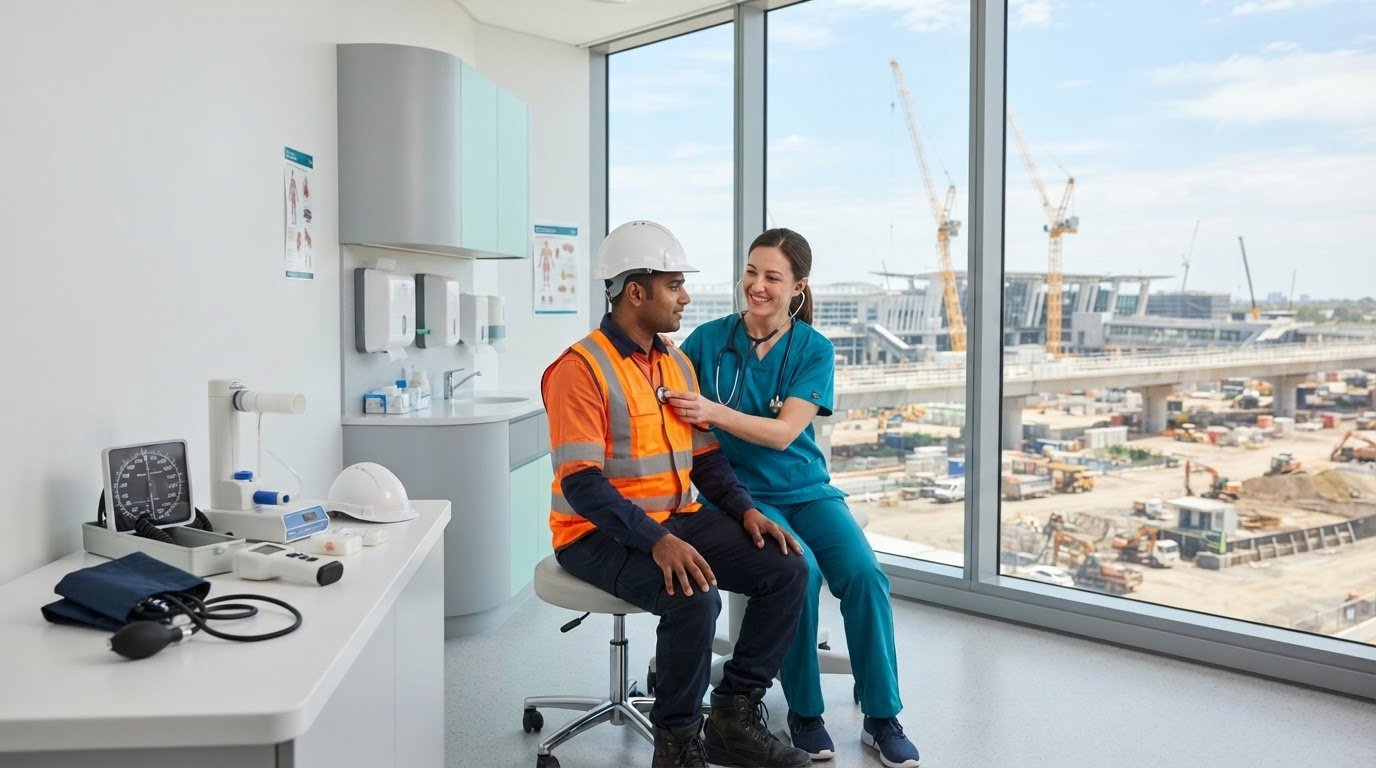
The right medical assessment depends on the work, not simply the airport project. For medical assessments for Western Sydney Airport construction jobs, checks may be tailored to rail-interface work, road and civil construction, or building tasks, based on the role’s physical demands and relevant workplace exposures. There is no single assessment for every construction worker.
It’s reasonable to want a clear idea of what an employer may ask you to complete before starting. The work, equipment and site conditions can influence the checks, so understanding how the assessment relates to the job can make the process easier to navigate.
This article covers examples for workers coordinating with rail, road and terminal projects, as well as those delivering landside civil and building works. It explains how pre-employment checks, rail medicals and exposure-related assessments may fit different tasks, and what information helps make an assessment relevant to the work you’ll do.
Key Takeaways
- Match the medical assessment to the role’s physical demands, equipment and work environment rather than assuming every construction job needs the same checks.
- Understand how working at heights, operating machinery and other safety-critical tasks can shape the areas assessed.
- Consider how rail, road, terminal and landside civil works create different health assessment needs across Sydney projects.
- Learn which assessment examples may be relevant to pre-employment, rail-interface and exposure-related construction work.
- Use the role description and task details to understand why a particular assessment has been requested.
What medical standards apply to working at heights, operating machinery, and safety-critical construction tasks?
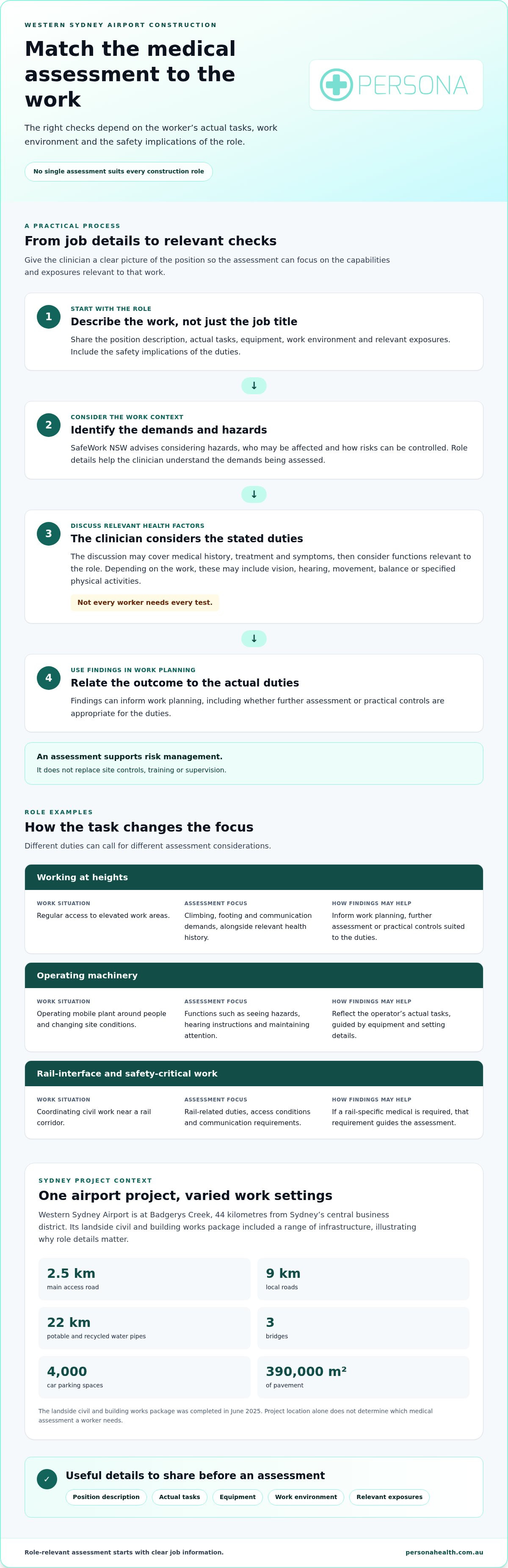
There isn’t one assessment that suits every construction role. Start with the worker’s actual tasks, work environment and the safety implications of health issues. Someone coordinating a rail interface may need different checks from an excavator operator or a worker installing terminal services. For medical assessments for Western Sydney Airport construction jobs, the employer’s role description helps focus the assessment on relevant duties and exposures.
SafeWork NSW advises managing workplace risks by considering the hazards, who may be affected and how risks can be controlled. For a medical assessment, details about the tasks help a clinician consider health history and functional capacity in relation to the role. An assessment supports risk management, but does not replace site controls, training or supervision.
To learn more about pre-employment assessments, watch this video:
Assessment components depend on the position. A clinician may discuss medical history, treatment and symptoms, then consider functions relevant to the stated duties. Depending on the work, these could include vision, hearing, movement, balance or specified physical activities. Not every worker needs every test.
Working at heights
Situation: A worker regularly accesses elevated work areas. Action: The assessment considers the role’s climbing, footing and communication demands alongside relevant health history. Result: Findings can inform work planning, including whether further assessment or practical controls are appropriate for the duties.
Operating machinery
Situation: An operator uses mobile plant around people and changing site conditions. Action: Role information guides consideration of functions such as seeing hazards, hearing instructions and maintaining attention. The employer describes the equipment and setting, rather than relying on the job title alone. Result: The assessment better reflects the operator’s actual tasks.
Rail-interface and safety-critical work
Situation: A worker coordinates civil work near a rail corridor. Action: The employer identifies rail-related duties, access conditions and communication requirements. If the position requires a rail-specific medical, that requirement guides the assessment. Result: Checks can match the relevant rail duties instead of assuming a general construction assessment covers every requirement.
Workplace injury response matters too. InjuryQR is a FREE AI-powered workplace injury triage service available to all Australian businesses, with free posters, stickers, keyrings and fridge magnets. A worker scans a QR code without downloading an app, describes the injury by voice, and answers AI follow-up questions. The service can provide self-care advice, arrange a telehealth appointment, direct the worker to an Emergency Department or instruct them to call 000. Telehealth appointments typically occur within 3-4 hours.
Situation: A worker reports an injury during a shift. Action: The QR triage guides them towards an appropriate next step, and a Certificate of Capacity can be issued immediately where appropriate. Result: Prompt direction to care and a straightforward reporting route can help prevent avoidable delays, support early treatment and reduce Lost Time Injuries (LTIs).
Before the assessment, provide the position description, tasks, equipment and relevant exposures. This helps keep the discussion specific, whether the work involves heights, plant operation or a safety-critical activity.
Examples of airport roles can help keep an assessment connected to the work advertised. These roles and employment terms do not, by themselves, specify a medical standard. The key question is what duties the worker will perform and what health-related functions those duties may require. Job information gives the employer and clinician a clearer starting point for discussing those demands.
Operating patterns matter as role context, too. A Labour Connect forklift operator role at Sydney International Airport is advertised for 38 hours per week. Western Sydney International Airport is planned to operate 24/7, without a curfew. That planned operating pattern is relevant background when considering the work environment, but it does not establish that every role has the same schedule or requires the same checks. Employers can provide the actual duties, equipment, access arrangements and work pattern for the position, so the assessment can focus on relevant capabilities and any need for further consideration. Findings can then inform work planning alongside the site controls, training and supervision described above. Any concerns should be considered in relation to the particular role rather than inferred from a job title or an advertised rate.
Sydney region
Western Sydney Airport sits at Badgerys Creek, 44 kilometres from Sydney’s central business district. Its construction connects with a broader network of road, rail and terminal projects. For workers, the relevant medical assessment depends on the particular role and work setting, not simply the project’s location.
The airport’s landside civil and building works package was completed in June 2025. It included 2.5 kilometres of main access road, 9 kilometres of local roads, shared paths and cycleways, and 4,000 car parking spaces. It also included 22 kilometres of potable and recycled water pipes, three bridges and 390,000 square metres of pavement. Those different work areas illustrate why job tasks and exposure details matter when planning an assessment.
Example: civil works near roads and access routes
Situation: A civil worker is assigned to road and pavement work connected with airport access. Action: The employer describes the actual duties, including equipment, work location and physical tasks. The assessment can then focus on relevant health history and the capabilities needed for the work. Result: The assessment relates to the position, rather than treating every project worker as having identical duties.
Regional work also extends beyond the airport boundary. These road projects show how airport-linked construction roles may involve different sites, interfaces and task profiles. A project engineer listing, for example, requests 3-5 years of experience on roads, pavements and asphalt projects. Experience requirements describe a role, but don’t replace a task-based assessment.
Example: rail coordination
Situation: A worker supports construction coordination where airport works interface with rail projects. Action: The role description sets out rail-related tasks, the work environment and communication requirements. If the position requires a rail-specific medical, that requirement guides the assessment. Result: The assessment is better matched to the work than a generic construction screening alone.
Western Sydney International Airport is scheduled to open in the second half of 2026. It is planned for 24-hour operations, seven days a week, without a curfew. Construction, commissioning and operational roles can therefore involve differing work patterns and responsibilities. An assessment should reflect the position being offered, rather than assume that every airport worker performs the same tasks or works the same roster.
Example: terminal and building work
Situation: A building worker carries out fit-out or services work in a terminal area. Action: The employer identifies the specific physical tasks and relevant exposure information. This distinguishes indoor building duties from road, plant or rail-interface work. Result: The assessment can consider factors relevant to the role without adding unrelated tests by default.
For context, the airport is planned to initially accommodate 10 million passengers annually. Forecasts indicate 6,000-8,500 airport jobs when passenger numbers reach 10 million annually around 2033. These figures describe the airport’s planned scale and future employment context; they don’t set a medical standard for an individual worker. The job’s actual demands remain the practical starting point.
Before an appointment, prepare the position description and explain the main tasks, work locations, equipment and relevant exposures. Include any rail-specific requirement or safety-critical responsibility. For medical assessments for Western Sydney Airport construction jobs, these details connect the assessment to the worker’s intended duties and project environment.
Persona Health: Pre-Employment Medicals
Persona Health provides Pre-Employment Medicals for employers and workers preparing for construction roles. Share the role description and assessment requirements so the process can focus on the position’s duties and relevant exposures.
Appointments are available at Persona Health clinics in Parramatta, Rosebery, Gregory Hills and Dee Why in Sydney, and Cairnlea and Craigieburn in Melbourne. Gregory Hills and Rosebery are convenient options for workers in the region. A network of 100 affiliate clinics nationwide and Australia-wide mobile workplace services can support different workforce arrangements.
Persona Health takes an employer-focused approach, with responsive customer service, fast turnaround times and modern digital reporting. For rail-related duties or silica exposure, Cat 3 Rail Medicals and Crystalline Silica Medicals may also suit the role. Contact Persona Health to discuss an assessment for your duties.
Plan the next step with confidence
Use the assessment to establish a clear starting point for the role. Employers can align the request with the position’s actual requirements, while workers can raise relevant health questions during their appointment. This keeps decisions connected to the work and supports a considered start.
Planning medical assessments for Western Sydney Airport construction jobs means sharing role-specific information before the appointment and understanding how the outcome relates to the duties. Keep communication clear between the employer, worker and assessing clinician, especially if the work assignment changes.
To discuss a role-specific assessment, contact Persona Health and take the next step with a clear understanding of the process.
A clear plan gives everyone a practical way forward.
Frequently Asked Questions
Which pre-employment medical tests are common for airport construction workers in Australia?
Assessment components depend on the role, and there isn’t one fixed test set for every airport construction worker. Persona Health’s Pre-Employment Medicals can include a medical history assessment, physical examination with musculoskeletal examination, drug and alcohol screening, and vision, hearing or respiratory tests. An optional cardiovascular fitness test and industry-specific components may also be relevant. For example, a worker assigned to rail-related duties may need an assessment aligned with the applicable rail category.
What are the fitness-for-work and physical capacity requirements for airport construction roles?
Requirements depend on the essential duties and the employer’s assessment criteria, not on a single physical capacity threshold for all construction roles. A worker climbing access structures, for example, may need different capabilities from someone doing indoor installation work. The role description should identify tasks such as lifting, climbing, equipment operation and sustained movement. The assessment can then consider relevant health information and physical function against those duties, without assuming every applicant needs the same tests.
How much do construction pre-employment medical assessments cost in Western Sydney?
The cost depends on the assessment required and is provided after a quote request. Factors include the role’s assessment components, any industry-specific medical, and whether additional tests are requested. For example, a position requiring only a general pre-employment assessment may differ from one needing rail-related or exposure-specific components. Share the job requirements and requested checks when seeking a quote, so the scope reflects the role rather than an assumed standard package.
What documents and preparation are needed for a construction pre-employment medical assessment?
Bring the employer’s referral or assessment instructions and, if available, a clear description of the job duties. Take identification and details of relevant medical history, current medicines and reports related to the assessment. If you use glasses or hearing aids, bring them so relevant checks can account for them. Follow any appointment preparation instructions, and ask the employer to clarify incomplete assessment paperwork.

Article by
Ian Nicholson
Ian is the Business Support Manager at Persona Health, where he plays a key role across IT, sales, marketing and business operations. With a broad skill set and a practical, solutions-focused approach, Ian helps drive the systems, communication and commercial strategy that support Persona Health’s continued growth across Australia.