
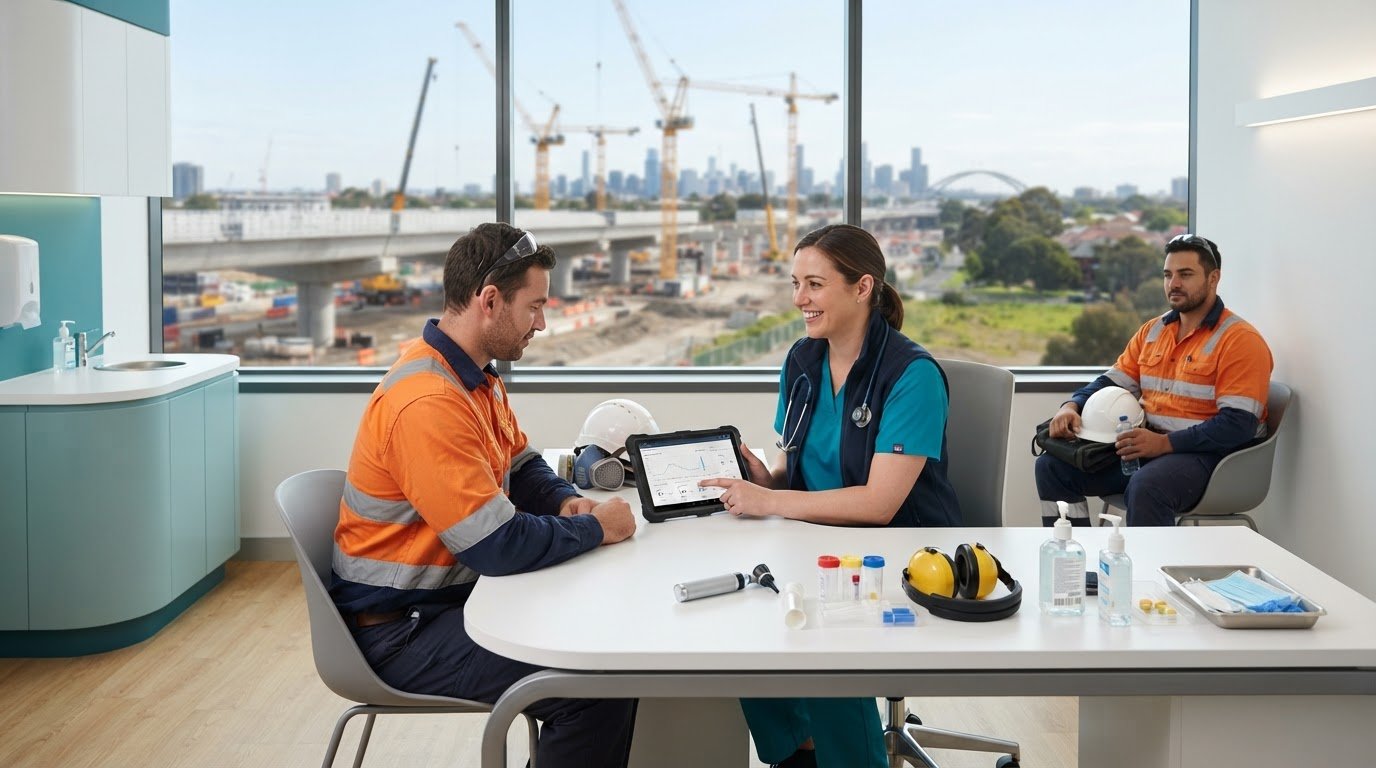
Health monitoring for Melbourne Airport Rail project workers should be planned around the work and its exposures. The appropriate assessments and timing depend on the hazards, duties and relevant medical advice, rather than a single project-wide schedule. This guide explains practical ways to assess those needs and organise follow-up.
On a major infrastructure project, clear and consistent processes help workers know how to raise concerns and understand what happens next. For health monitoring for Melbourne Airport Rail project workers, input from workers can help identify issues and improve how health concerns are reported and communicated.
A structured approach can help teams assess exposure, choose appropriate monitoring and explain the process to workers. The examples below offer practical planning guidance, not a description of the project’s specific arrangements.
Key Takeaways
- Project-specific worker health monitoring details have not been provided, so avoid assuming a single schedule applies to every role.
- Use worker engagement to identify relevant work activities, potential exposures and the questions a monitoring framework needs to address.
- Understand how monitoring considerations can differ for silica, asbestos, noise and hazardous chemicals.
- If you develop a work-related illness or injury, follow the site’s reporting and response process and seek appropriate care.
- Explore how pre-employment medicals and other relevant health services can support workers and employers in rail and infrastructure settings.
How often must health monitoring be conducted under Victorian workplace safety rules?
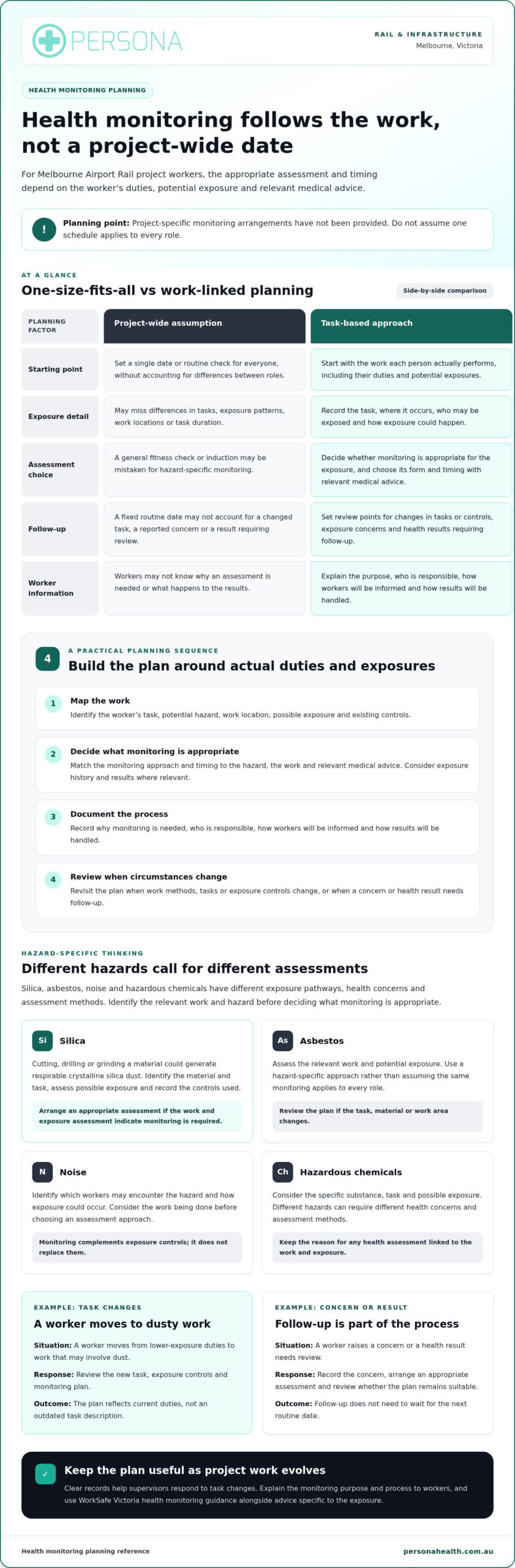
There is no single monitoring interval that suits every worker or exposure. For Melbourne Airport Rail roles, the appropriate schedule depends on the hazard, the work and the health monitoring required. A site-wide date alone may not account for differences in tasks, exposure patterns and individual health needs. WorkSafe Victoria’s health monitoring guidance can help employers assess requirements for a particular hazard. Start by considering the work each person actually performs.
Begin with each worker’s duties. Someone working near airborne contaminants may need a different monitoring approach from someone doing office-based project work. Record the task, potential exposure and existing controls, then use that information to plan monitoring. The process should be clear to workers and consistent for supervisors. WorkSafe Victoria guidance can inform planning, alongside advice specific to the exposure.
For an overview of workplace rights and responsibilities in Victoria, watch this WorkSafe Victoria video:
Set the interval from the work and exposure
Start with a task-based exposure assessment. Identify the substance or hazard, where it occurs, who may be exposed and how exposure could happen. Record relevant details such as work location and task duration, rather than assuming every contractor faces the same conditions. This helps distinguish roles with different risks and monitoring needs.
Next, determine whether health monitoring is appropriate for the exposure and what form it should take. The method and timing should reflect the hazard and relevant medical advice. A worker’s role, exposure history and results may affect the plan. A routine induction or general fitness check is not a substitute for hazard-specific monitoring.
For each monitoring activity, record its purpose, who is responsible, how workers will be informed and how results will be handled. Set review points for changes to tasks, reported exposure concerns or health results requiring follow-up. This creates a clear process without assuming one interval works for everyone. Review arrangements when work methods or exposure controls change.
Apply the framework to changing project work
Melbourne Airport Rail includes complex construction and station works. According to the Victorian Government, the new Keilor East Station will service 5,200 passengers daily and will include a pedestrian overpass with lifts and stairs to the station platforms, commuter car park and a bus interchange. This describes the planned station, not a health-monitoring schedule for workers. Different activities across a project can involve different hazards, so plans need to follow the work.
Situation: a worker moves from a lower-exposure task to work that may involve dust. Action: review the new task, exposure controls and monitoring plan before assuming the existing schedule still fits. Result: the approach reflects the worker’s current duties, not an outdated task description.
Situation: a worker raises a concern or a health result needs review. Action: record the concern, arrange an appropriate assessment and review whether the monitoring plan remains suitable. Result: follow-up becomes part of the process instead of waiting for the next routine date.
For project teams, a practical schedule sets out why monitoring is needed, when it will be reviewed and what would prompt an earlier review. Explain its purpose and process to workers. Clear records help supervisors respond when tasks change, while a tailored approach avoids assuming one interval meets everyone’s needs. Health monitoring for Melbourne Airport Rail project workers should be documented and linked to actual duties and exposures.
Melbourne project teams can consider occupational health support in Melbourne as part of planning. Documenting task changes and review triggers helps keep the framework useful as project work evolves.
What health monitoring rules apply to workers exposed to silica, asbestos, noise, or hazardous chemicals on the project?
Start with the specific hazard and task, not a generic project-wide medical check. Silica, asbestos, noise and hazardous chemicals have different exposure pathways, health concerns and assessment methods. A monitoring framework should identify which workers may encounter each hazard, how exposure could occur and what response is appropriate. Consider Victorian requirements in relation to the work being done, rather than applying one checklist to every role.
Monitoring complements exposure controls. A medical assessment does not remove dust, isolate noise or replace safe handling procedures. Record the work activity, controls in place and reason for any health assessment. Review these details when a task, material or work area changes, so the process reflects actual conditions.
Silica and asbestos
Situation: cutting, drilling or grinding a material could generate respirable crystalline silica dust. Action: identify the material and task, assess possible exposure and record the controls used. If health monitoring is required for the exposure, arrange an appropriate assessment and explain its purpose to affected workers. Result: monitoring is linked to the actual silica risk, rather than simply to a job title.
For example, if a worker moves between general site duties and dusty cutting work, review the changed task. Keep exposure and monitoring records together, and explain how to report symptoms or concerns. A crystalline silica medical assessment is relevant when the work and exposure assessment indicate it is appropriate.
Asbestos needs its own process. Situation: planned work could disturb material suspected of containing asbestos. Action: stop treating the activity as routine, identify the material and work controls, and follow the site’s asbestos procedure before work proceeds. Consider health monitoring in relation to the worker’s exposure and applicable requirements. Result: the response focuses on preventing exposure and addressing any worker health follow-up.
Noise and hazardous chemicals
Noise exposure calls for a different assessment from dust. Situation: a worker regularly uses loud equipment or works near noisy plant. Action: identify the source, tasks, hearing protection and other controls. Consider whether a hearing assessment is appropriate, and record the reason and follow-up process. Result: monitoring reflects the worker’s noise exposure, rather than assuming every site role carries the same risk.
For chemicals, use the product label and safety data sheet to identify the substance and relevant exposure route. Situation: a worker handles a chemical during cleaning, maintenance or construction work. Action: record the product, task, possible contact route and controls, then determine whether health monitoring applies to that substance and exposure. Result: the assessment is selected for the chemical and work, not from a generic panel.
- Record the task, hazard and workers who may be exposed.
- Document controls, monitoring decisions and follow-up responsibilities.
- Review the assessment when materials, tasks or controls change.
- Explain how workers can raise concerns and receive results appropriately.
Keep medical information separate from general site records, and limit access to people who need it for their role. A clear process helps workers understand why an assessment is arranged and what happens afterwards. For project teams planning exposure-related assessments, discussing workplace health monitoring can help clarify the relevant service pathway.
Close-out should be as hazard-specific as the initial decision. For hazardous chemicals, identify the substance and task that could create contact, note the possible route of exposure, and document the controls before deciding what health follow-up is suitable. Explain to the worker what is being monitored, how concerns can be raised, and who will review the outcome. If the substance, method or work area changes, reassess exposure rather than carrying an earlier decision forward automatically. Keep a clear connection between exposure information, the reason for assessment and any next step, and limit follow-up to workers and tasks for which the assessment supports it. The Melbourne Airport Community Health Study will monitor health outcomes associated with aircraft noise annually for 20 years.
For workplace noise, keep records focused on the worker’s exposure to equipment or plant, the controls used and the reason for any hearing assessment. An aircraft-noise monitoring program does not replace reviewing occupational exposure. Across all hazards, workers should understand the purpose of monitoring and how to raise concerns. Supervisors should be able to see what has changed and what follow-up is appropriate.
What should workers do if they develop a work-related illness or injury on the project?
Act promptly if you’re injured at a Melbourne Airport Rail worksite or notice symptoms that may relate to work. Sudden pain, breathing difficulty, ringing ears or a skin reaction all deserve attention. For a life-threatening emergency, call 000 and follow the site emergency response process. Don’t wait for a routine health assessment to address urgent symptoms.
For a non-emergency, tell your supervisor or designated site contact as soon as practical. Use the project’s incident reporting process, even if an injury seems minor or symptoms developed gradually. Describe the task, location, hazard, when symptoms began and whether anyone witnessed the event.
Report the concern and seek appropriate care
Situation: a worker develops a cough after a dusty task or experiences pain while handling equipment. Action: if safe, stop or modify the task, move away from the suspected exposure and notify the site contact. Describe the symptom and task accurately, then seek suitable medical advice. Result: the worker can receive attention, and the employer can assess whether work practices need review.
For an acute injury, give the person coordinating the response practical information. Explain what happened, which body area is affected and whether anything has changed. Follow the site’s first-aid arrangements and instructions from the treating health professional. Avoid self-diagnosing or returning to a task that worsens symptoms without discussing your capacity and safe duties.
A gradual condition also needs to be recorded. Situation: discomfort builds over repeated shifts rather than following one incident. Action: note when it began, which tasks aggravate it and whether symptoms change away from work. Report the pattern through the site process and arrange a clinical assessment. Result: these details can help guide care and identify possible workplace contributors.
Use a clear triage and reporting pathway
InjuryQR is a FREE AI-powered workplace injury triage service available to all Australian businesses. It offers free posters, stickers, keyrings and fridge magnets. A worker scans a QR code, with no download required, describes the injury by voice, and answers AI follow-up questions. Depending on the responses, it can provide self-care advice, arrange a telehealth appointment, direct the worker to an Emergency Department or instruct them to call 000.
Telehealth appointments are typically within 3-4 hours. Where appropriate, Certificates of Capacity can be issued immediately. InjuryQR can make it easier to report concerns early and direct workers towards suitable care. Earlier reporting and appropriate triage can help reduce Lost Time Injuries (LTIs), while giving employers a clearer record to support follow-up.
Situation: a worker feels back pain but is unsure whether it needs urgent attention. Action: they use InjuryQR’s QR-based triage, then follow the outcome and notify the site contact. Result: the worker has a defined next step, and the event is less likely to go unreported.
Keep copies of relevant incident details, medical advice and work-related communication. Share health information through appropriate workplace channels. If symptoms change, tell the treating professional and site contact. For a return to work, discuss current capacity, useful adjustments and safe duties. Base any staged plan on clinical guidance and the role’s demands.
Employers can support follow-up with structured workplace injury management, including communication and coordination around suitable duties. Workers should know who receives reports, how urgent concerns are escalated and who explains the next steps. A consistent process supports early care, accurate records and practical recovery planning.
Discuss workplace injury management support
Site investigations, procurement and development works for Melbourne Airport Rail Stage 2 are scheduled to begin in the coming weeks. Workers can use the project’s reporting route to raise concerns and clarify who receives reports as work changes. Keep the account factual, and update the site contact if symptoms change or medical advice affects the worker’s capacity. This can help keep the concern connected to the work activity and any follow-up discussion about duties.
RPS’s Melbourne Airport Rail project work includes sustainability management. Workers can ask how a reported concern will be considered alongside the work activity, and whether the task or exposure needs review before they resume it. Follow the site’s established process and seek advice from a suitable health professional. Online triage does not replace emergency response when symptoms are urgent.
Persona Health: Pre-Employment Medicals
Persona Health provides Pre-Employment Medicals to help employers assess a worker’s health against role requirements. Its relevant services also include Cat 3 Rail Medicals, Crystalline Silica Medicals and Workplace Injury Management. For employers planning health support across sites, Persona Health offers Australia-wide mobile workplace services and a network of 100 affiliate clinics nationwide.
In Sydney, clinics are located in Parramatta, Rosebery, Gregory Hills and Dee Why. Melbourne locations include Cairnlea and Craigieburn. An employer-focused approach, responsive customer service, fast turnaround times and modern digital reporting support clear coordination across recruitment and workforce health needs.
For role-based recruitment assessments in Melbourne, Melbourne Pre-Employment Medicals are one practical option.
Contact Persona Health to discuss your workplace health needs.
Build a worker health plan that can adapt
As Melbourne Airport Rail work progresses, health planning needs to keep pace with changing tasks, materials and worker needs. Map each role’s demands, identify potential exposure points and explain how workers can raise concerns. This gives project teams a practical basis for reviewing arrangements as work changes, rather than relying on assumptions about one project-wide process.
For health monitoring for Melbourne Airport Rail project workers, the right assessment depends on duties and exposure. Persona Health provides Pre-Employment Medicals, Workplace Injury Management and Crystalline Silica Medicals to support recruitment, injury follow-up and silica-related health needs. Its occupational health services are available in Melbourne and Sydney, including Parramatta and Gregory Hills.
Clear communication and considered planning help workers take the next step with confidence.
Frequently Asked Questions
What medical assessments and health surveillance are provided to project workers?
No project-specific assessment list or health surveillance schedule has been provided for Melbourne Airport Rail workers. Assessment needs should be matched to each role’s duties and relevant exposures. Separately, Persona Health’s Pre-Employment Medicals include a medical history assessment, physical examination, drug and alcohol screening, vision, hearing and respiratory tests, plus industry-specific components where relevant. These services are available in Melbourne and Sydney, but do not establish what the project itself provides.

Article by
Ian Nicholson
Ian is the Business Support Manager at Persona Health, where he plays a key role across IT, sales, marketing and business operations. With a broad skill set and a practical, solutions-focused approach, Ian helps drive the systems, communication and commercial strategy that support Persona Health’s continued growth across Australia.