
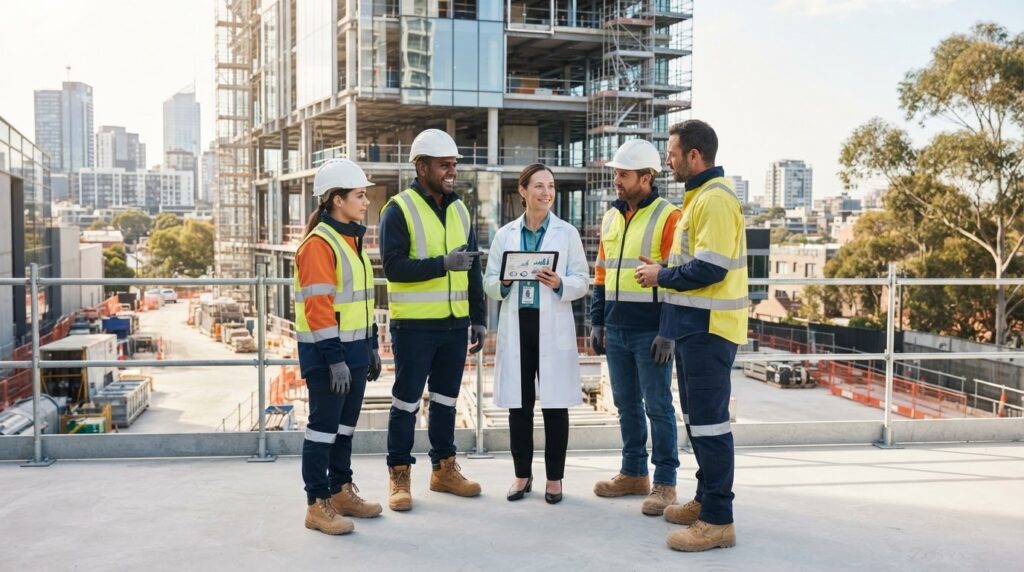
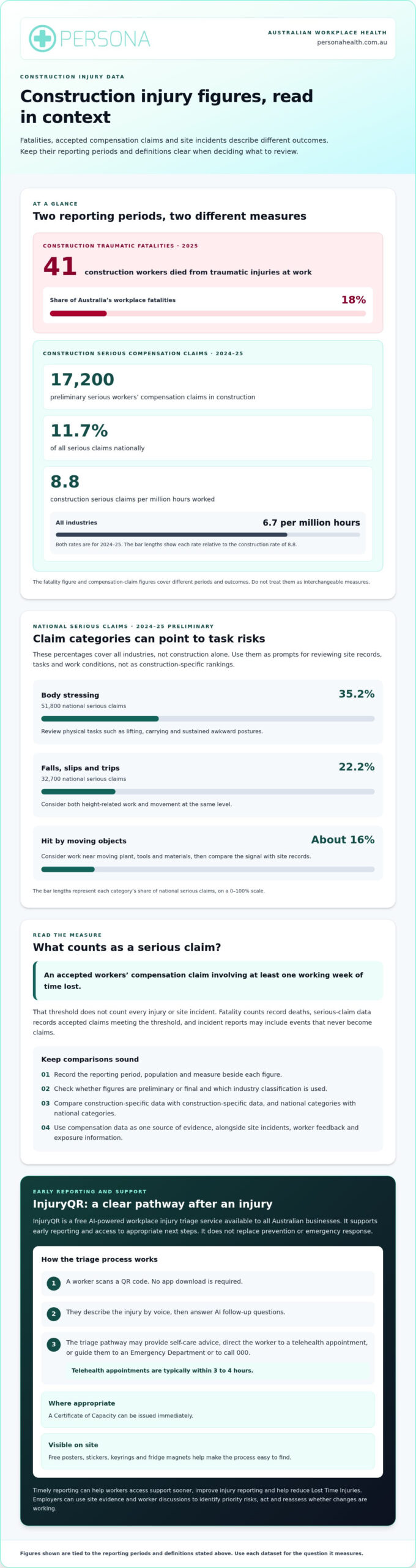
In 2025, 41 construction workers died from traumatic injuries at work, accounting for 18% of Australia’s workplace fatalities. Safe Work Australia’s latest figures bring construction industry injury trends Australia into sharp focus, but fatal incidents are only part of the picture.
Employers know that a serious injury can affect a worker, their crew and a project. The challenge is separating current evidence from isolated events, then deciding which tasks and reporting gaps deserve attention. This article explains what the figures show, including their reporting periods and definitions, and how employers can turn them into practical prevention and early-support priorities.
Early reporting can help workers access appropriate support sooner. InjuryQR is a free AI-powered workplace injury triage service for Australian businesses: workers scan a QR code, with no app download required, describe their injury by voice and answer AI follow-up questions. It can provide self-care advice, direct a worker to a telehealth appointment, typically within 3 to 4 hours, or guide them to an Emergency Department or to call 000. A Certificate of Capacity may be issued immediately where appropriate. Free posters, stickers, keyrings and fridge magnets help make the process visible on site.
We’ll also look at how occupational health and injury management can support workers and employers, alongside prevention.
Key Takeaways
- Read construction industry injury trends Australia alongside each dataset’s reporting period, claim definition and worker population before drawing conclusions.
- Compare injury patterns by task and work environment, and distinguish construction-specific findings from national claim categories.
- Use compensation data as one source of evidence, not a complete record of every injury or workplace exposure.
- Turn site evidence into action: review incident records, discuss patterns with workers, act on priority risks and reassess what changes.
- Match occupational health support to the need, using injury management for recovery planning and health surveillance where workplace exposures warrant monitoring.
What do AU construction injury trends show?
Construction injury figures can be difficult to compare because reports cover different periods, populations and types of harm. Fatality data and workers’ compensation claims describe distinct outcomes, while site incident records may capture events that never become claims. Reading the measures separately helps employers use the evidence without treating a single number as a complete picture of safety.
Safe Work Australia’s Key Work Health and Safety Statistics Australia 2026 reports 17,200 preliminary serious workers’ compensation claims in construction for 2024-25, representing 11.7% of all serious claims nationally. The report also gives a construction serious-claim frequency rate of 8.8 per million hours worked, compared with 6.7 across all industries. These claim figures are separate from the 2025 fatality data noted earlier.
WorkSafe Victoria’s falling-object animation provides a practical example of a construction hazard:
Which construction injury figures are current and comparable?
Check the latest Safe Work Australia statistics and record the reporting period, population and measure beside each figure. Safe Work Australia defines a serious claim as an accepted workers’ compensation claim involving at least one working week of time lost. In plain terms, the statistic counts accepted claims that meet this threshold, not every injury or site incident.
The ACTU’s 2025 summary reports construction’s share of serious claims as 12%, a rounded figure for that measure and reporting period. It is not a share of fatalities or all reported injuries. Lawyers’ figures of 36 construction fatalities and 16,647 compensation claims refer to 2022-23, so treat them as historical unless newer comparable data is verified.
Why do reporting periods and injury definitions matter?
A fatality count records deaths, serious-claim data records accepted claims meeting a time-lost threshold, and incident reports may include events that do not become claims. Each measure offers a different view. Check whether data is preliminary or final, which industry classification it uses and what population it covers before drawing comparisons. Safe Work Australia’s Construction Work Code of Practice provides Australian guidance on construction hazards and work practices.
InjuryQR is a free AI-powered triage service available to all Australian businesses. Early reporting through an appropriate triage pathway can help workers access support sooner and may help reduce Lost Time Injuries, without replacing prevention or emergency response.
How do injury mechanisms and serious claims differ across construction work?
A claim category points to a type of harm, while a task helps explain how exposure may arise. Carrying materials, working at height, handling mobile plant and working around electrical systems create different risk contexts. Construction industry injury trends Australia are most useful when employers keep those distinctions visible rather than treating every claim or incident as evidence of the same site-wide problem.
Safe Work Australia’s national serious-claim data provides a useful comparison, but its category percentages cover all industries, not construction alone. Its construction industry dashboard presents sector-specific data and lets readers examine the measures separately. The table distinguishes those datasets and shows what each can reasonably tell an employer.
| Mechanism or measure | Dataset and source | Practical interpretation |
|---|---|---|
| Body stressing | National serious claims, 2024-25 preliminary: 35.2% of claims, or 51,800 claims. Safe Work Australia. | A national signal to review physical tasks such as lifting, carrying and sustained awkward postures. It is not a construction-specific percentage. |
| Falls, slips and trips | National serious claims, 2024-25 preliminary: 22.2%, or 32,700 claims. Safe Work Australia. | Review both height-related work and same-level movement. This national category does not rank construction’s fall risks. |
| Being hit by moving objects | About 16% of national serious claims, 2024-25 preliminary. Safe Work Australia. | Consider work near moving plant, tools and materials, then compare the signal with site records. |
| Construction serious claims | Construction-specific serious claims, 2024-25 preliminary. Safe Work Australia’s Safe Work Australia construction industry data. | Use this sector dataset for construction comparisons, checking its measure and period before drawing conclusions. |
Traumatic fatalities count workers killed by traumatic injury; serious compensation claims count accepted claims involving at least one working week of time lost. The measures describe different outcomes and should not be used interchangeably.
What do falls and electrical incidents indicate?
NSW examples involving falls from height and electricity illustrate serious hazards, but an incident example cannot show how often that event occurs across the state or country. Treat it as a prompt to examine relevant tasks, site conditions and controls, not as a ranking of construction risks. For applicable state-specific guidance, consult SafeWork NSW material relevant to the work being undertaken.
How should employers read musculoskeletal and mental stress claims?
Safe Work Australia describes body stressing as a musculoskeletal-disorder mechanism. Its national data also places mental stress at about 11.5% to 12% of serious claims. These are national categories, not construction-specific rates or diagnoses. Use them to frame questions: are work demands, task design or support arrangements reflected in your own reports and worker feedback?
For further context, compare the dashboard’s construction measures with your own incident records, without assuming they cover the same population or period. A pattern is a reason to investigate, not proof of a cause. If a reported injury needs early triage, InjuryQR can support the reporting pathway described earlier in this article.
What can Australian construction injury data tell employers, and what can it miss?
Workers’ compensation data can show patterns in accepted claims, but it can’t count every injury, near miss or exposure at a worksite. A worker may report an injury internally without lodging a claim, while a developing condition linked to repeated exposure may not appear in the same dataset or reporting period as a sudden event. The data is valuable, but it is not a complete site register.
There is also a difference between observing a trend and explaining it. If claims associated with a particular mechanism rise, that alone doesn’t establish what caused the increase. Workforce size, hours worked, claim processing time, reporting practices and changes in work activity can all affect what the figures show. National findings can guide questions, but they don’t prove that the same pattern exists on an individual construction site.
Why might claims data under-represent workplace harm?
A reported injury may not become a workers’ compensation claim, so it won’t be included in claims statistics. An Australian Bureau of Statistics and ACTU work health and safety analysis published in October 2025 reported that around 3 in 10 Australian workers who experienced a work-related injury lodged or received workers’ compensation. This was an all-industry finding, not a construction-specific estimate. The same analysis reported that 40% of non-claimants still required time off work.
Those figures don’t tell employers why an individual didn’t claim, or how serious an unclaimed injury was. Avoid filling those gaps with assumptions. Compare claim records with internal reports, first-aid records, near misses and worker feedback, while respecting privacy and following relevant record-handling requirements.
How should employers use national and state information?
Use national data to identify issues worth exploring, then test them against your own site evidence. Safe Work Australia provides national statistics; SafeWork NSW and WorkSafe Victoria provide regulator information relevant to their respective jurisdictions. Comcare is relevant only where an employer falls within its jurisdiction. Check the appropriate regulator’s current guidance for applicable requirements rather than treating one jurisdiction’s information as universal.
A practical comparison can include:
- Whether internal injury reports show patterns by task, location, shift or type of work.
- Whether workers describe hazards or early symptoms that have not resulted in a claim.
- Whether reporting and claim records cover the same period and workforce.
- Whether a change in work, exposure or workforce size could help explain a change in the numbers.
For example, a rise in reported strains during a project phase may warrant reviewing the tasks and worker feedback from that phase. It doesn’t, by itself, identify a cause. InjuryQR, introduced earlier, can support consistent early reporting, while workplace injury management can help coordinate appropriate support after an injury. Use the evidence to guide review, not to diagnose a worker or draw conclusions that the data can’t support.
How can construction employers turn injury trends into practical action?
Use industry evidence to decide what to examine, then ground each decision in your own worksite. A simple cycle of review, discussion, action and reassessment helps turn construction injury trends Australia into practical questions for workers and supervisors. Keep prevention and injury response distinct: one focuses on reducing exposure to hazards, while the other sets out what happens when someone is hurt.
Document both processes so people know how to raise concerns, who will follow up and how decisions are recorded. A trend is a prompt to investigate, not proof of a cause or a reason to apply the same response to every task.
How should a site review its injury patterns?
Start with the records available and note their limits. Group incidents by injury type, task, location and reporting period where those details are recorded. Discuss any recurring pattern with workers and supervisors, inviting them to describe what they observe without assuming a cause. Record the next review date and any agreed follow-up, so actions are not lost when work changes or teams move between tasks.
- Review: Compare incident and near-miss records with the relevant work activities. Note gaps or changes in reporting that may affect the picture.
- Discuss: Ask the people doing and supervising the work what conditions or task changes they have observed.
- Act: Select a practical follow-up, such as reviewing how a task is organised or making reporting steps clearer. Record the responsible person and planned action.
- Reassess: Return to the issue on the review date. Check whether actions were completed and whether new reports or feedback change your understanding.
For instance, if workers raise a recurring concern about access to a work area, record the concern, discuss the task with the relevant crew and decide whether a control review is needed. Avoid labelling the concern as the cause of an injury before the evidence supports that conclusion.
How can early triage support injury reporting and response?
InjuryQR can give workers a clear, accessible route to report an injury and receive appropriate early guidance. A straightforward reporting option may help capture concerns sooner, including those that might otherwise be delayed or missed. Earlier triage can support timely care and follow-up, which may help prevent a manageable injury from becoming a more complex Lost Time Injury. It doesn’t guarantee that an injury or time away from work will be avoided.
Use InjuryQR as one part of your response process, alongside site reporting arrangements and emergency procedures. It is not a substitute for prevention or emergency response. Review incoming reports for relevant follow-up, while protecting workers’ privacy and avoiding unsupported conclusions about causes. Where a report identifies a recurring task or condition, feed that information into the next site review and discuss it with the workforce.
How can occupational health support construction injury management in Australia?
Workplace injury management can help coordinate appropriate treatment, communication and work-related recovery planning after an injury. Support should reflect the worker’s individual circumstances and relevant clinical advice. It complements prevention, rather than replacing the need to review and manage workplace risks.
Health surveillance serves a different purpose. It may be appropriate where a worker’s role involves an exposure that warrants monitoring, rather than as a response to every injury. Employers can consider the work and exposure involved when planning suitable surveillance.
What support can help after a workplace injury?
Persona Health provides workplace injury management and telehealth injury management, alongside InjuryQR for early injury triage and reporting. The free InjuryQR service also provides workplace posters, stickers, keyrings and fridge magnets to help keep reporting information accessible. These options can support a workplace process, but they don’t replace emergency response or hazard prevention.
Clear communication between the worker, employer and relevant health professionals can help keep treatment and work-related recovery planning coordinated. Persona Health’s employer-focused approach includes responsive customer service and modern digital reporting, helping employers access information to support follow-up.
How can employers access occupational health support?
Persona Health’s clinics are in Parramatta, Rosebery, Gregory Hills and Dee Why in Sydney, and Cairnlea and Craigieburn in Melbourne. Australia-wide mobile workplace services and a national network of over 100 affiliate clinics can support employers with workforces across multiple locations. On-site health surveillance is available for workforces of 20-2000 employees where monitoring is relevant to workplace exposures.
Fast turnaround times and responsive communication can help employers coordinate occupational health processes with less uncertainty. Persona Health is accredited to ISO 9001, ISO 14001 and ISO 45001. Its practical, employer-focused approach recognises that workers and workplaces have different needs. Your Success Matters.
Make your next step a practical one
Use the evidence as a starting point for steady improvement, not a verdict on your site. Choose one priority to explore, invite workers and supervisors to share what they see, and decide how you’ll check whether the response is helping. That approach keeps construction industry injury trends Australia connected to the people, tasks and conditions that shape work on the ground.
Good support should fit the worker and the workplace. Persona Health’s occupational health team can help employers consider injury management and reporting support alongside prevention planning, with ISO accreditation to ISO 9001, ISO 14001 and ISO 45001. InjuryQR 3.0 is a free, voice-activated, AI-assisted workplace injury triage service that can help workers access an appropriate next step. These supports complement, rather than replace, a site’s own prevention and emergency processes.
A considered conversation can help you identify a useful next move for your workforce, without assuming every site has the same needs.
With clear reporting, practical follow-up and the right support, employers can keep learning and help workers feel heard and supported.
Frequently Asked Questions
Is construction the industry with the most serious injury claims in Australia?
Not based on construction’s reported 12% share alone. The ACTU’s 2025 summary of serious workers’ compensation claims places construction among the leading industries, but that share doesn’t show it has the highest number or proportion. For a fair comparison, check the same Safe Work Australia reporting period, claim definition and measure for every industry. The construction industry injury trends Australia data should be read as a sector comparison, not a league table based on a single figure.
Are construction fatalities and serious injury claims the same measure?
No. Fatality figures count deaths from traumatic injury, while serious-claim figures cover accepted compensation claims that meet the relevant time-lost definition. For an employer reviewing performance, keep each measure in its own column and include its reporting period. A fatality count can’t show how often non-fatal injuries occur, while a claims total can’t describe every site incident or exposure. Neither measure alone captures the full safety picture.
What does body stressing mean in Australian injury statistics?
Body stressing is a statistical mechanism category for claims involving physical stress on the body, rather than a diagnosis of a particular condition. It may include claims associated with physical demands such as manual tasks, but the source report’s definition determines what is counted. If a site is reviewing a pattern, compare the category with task-level reports and worker feedback. Don’t use the classification alone to decide what caused an individual’s symptoms.
Are mental stress claims increasing in construction?
The supplied Safe Work Australia 2026 summary reports that serious claims for psychological injury have increased by more than 160% over the last decade nationally. That finding is not a construction-specific trend and doesn’t establish what is happening on every site. Employers should check current industry-level reporting where available, then consider their own workforce feedback and records. Claim statistics describe recorded claims, not an individual worker’s experience or clinical assessment.
Do workers’ compensation statistics include every workplace injury?
No. The figures reflect claims captured under the dataset’s eligibility, acceptance and reporting rules, so incidents, symptoms or exposures may not appear. For example, a worker may report discomfort internally without a compensation claim being recorded in the same dataset. Employers can use incident records, first-aid information and workforce feedback to add context. Keep these sources distinct, and don’t assume why a worker did or didn’t make a claim.
Where can Australian employers find official construction injury information?
Start with Safe Work Australia’s national statistics and construction data, then consult the regulator relevant to the workplace. SafeWork NSW provides NSW-specific information, while WorkSafe Victoria covers Victoria. Comcare is relevant to employers and workers within its jurisdiction. Check each publication’s date, definition and scope before using it to guide a site decision. For example, a national claims category may not answer a question about a particular task or workplace.

Article by
Ian Nicholson
Ian is the Business Support Manager at Persona Health, where he plays a key role across IT, sales, marketing and business operations. With a broad skill set and a practical, solutions-focused approach, Ian helps drive the systems, communication and commercial strategy that support Persona Health’s continued growth across Australia.