
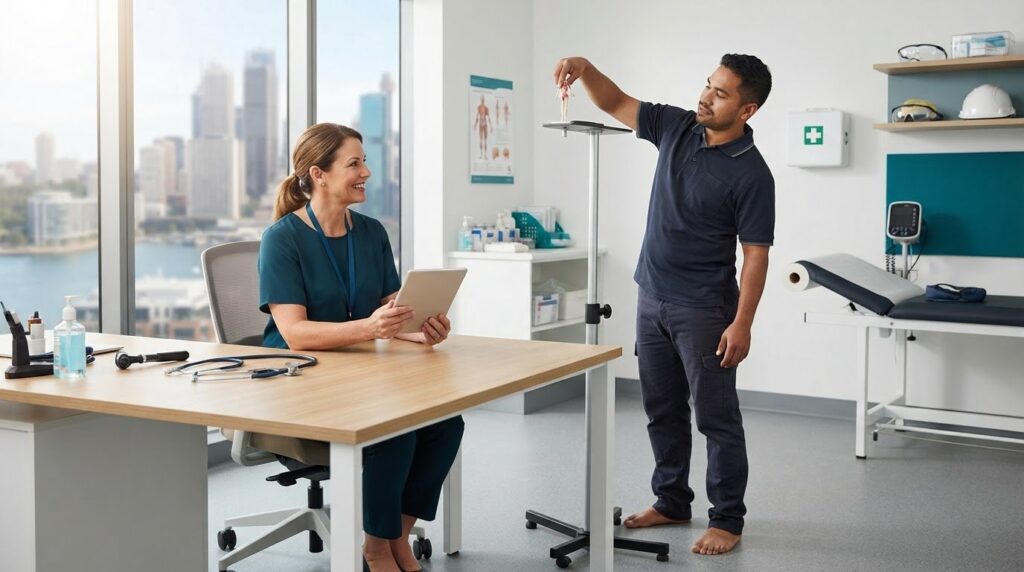
A fit for work medical assessment Sydney employers arrange is most useful when it answers a practical question about the job, not just records a general health check. If an assessment looks thorough but does not relate to the work a person actually performs, it may offer little help with a workplace decision. Start by identifying the role’s real tasks, work environment and relevant hazards.
A worker’s capacity for a role may depend on its physical demands and working conditions. The assessment scope should therefore be matched to the position’s inherent requirements and the question the employer needs answered. This helps keep the process relevant to the individual and provides useful information for a considered decision.
This article explains the purpose of a fitness for work assessment, the checks it may involve and how to define a suitable scope for a position. Persona Health supports employers with role-based assessments and clear reporting across Sydney, including access points in Rosebery and Gregory Hills. Your Success Matters, and a considered assessment can help bring greater clarity to the next step.
Key Takeaways
- A fit for work medical assessment Sydney employers arrange should inform a specific work-related decision, not define a person by a diagnosis.
- Start with the question to be answered and the relevant duties, then select assessment components that help address it.
- Clear role details and referral information help clinicians provide a report that responds to the employer’s question.
- Prepare by explaining the assessment purpose and role requirements, and give the worker clear appointment instructions.
- Persona Health offers employer-focused assessments in Sydney, with reports often returned the same day. Timing can vary.
What is a fit for work medical assessment in Sydney?
A fit for work medical assessment considers a person’s health in relation to the requirements of a particular role. It helps inform a work-related decision. It is not a general health check or a label based on a diagnosis.
The scope depends on the employer’s question and the work involved. A warehouse role with regular manual tasks raises different questions from operating machinery at a manufacturing site or driving for a local council. Rather than applying one standard test to every worker, focus on the duties and conditions that matter in the specific role.
A brief overview of the wider Occupational Safety and Health field can help put these assessments in context. For a practical introduction to pre-employment assessments, watch this video:
For a useful assessment, the clinician needs a clear referral question and accurate information about the work. An employer might need to understand whether a worker can carry out specified duties, or whether their current health could affect a particular task. The assessment informs that decision, but does not automatically determine an employment outcome. A fit for work medical assessment Sydney employers arrange is most relevant when it considers both the person and the actual demands of the job.
When might an employer arrange a fitness for work assessment?
An employer may arrange an assessment when the role’s demands or circumstances raise a specific question about capacity. A construction employer, for instance, may need information about how a worker’s health relates to regular site tasks. A logistics or manufacturing business could have questions about duties involving equipment, movement around a worksite or sustained physical activity. Transport and local government roles may involve particular driving or operational responsibilities. Keep the question tied to the work, rather than making assumptions about a diagnosis.
When a workplace injury needs to be reported or triaged, InjuryQR is a FREE AI-powered triage service available to all Australian businesses. Workers scan a QR code without downloading an app, describe the injury by voice, and respond to AI follow-up questions. Depending on the situation, InjuryQR can provide self-care advice, connect the worker to a telehealth appointment, typically within 3-4 hours, direct them to an Emergency Department or instruct them to call 000. Certificates of Capacity can be issued immediately where appropriate. Free posters, stickers, keyrings and fridge magnets help make InjuryQR accessible at work, supporting clearer injury reporting and efforts to reduce Lost Time Injuries.
How is it different from a pre-employment medical?
Both assessments may consider health in relation to work requirements. A pre-employment medical is generally arranged during recruitment to inform a decision about a prospective worker and a particular position. A fitness for work assessment addresses a defined work-related question, which may arise at another point in employment. The scope can overlap, and Persona Health pre-employment medicals include role-specific components. Learn more about pre-employment medical assessments in Sydney.
How does a role-based medical assessment work?
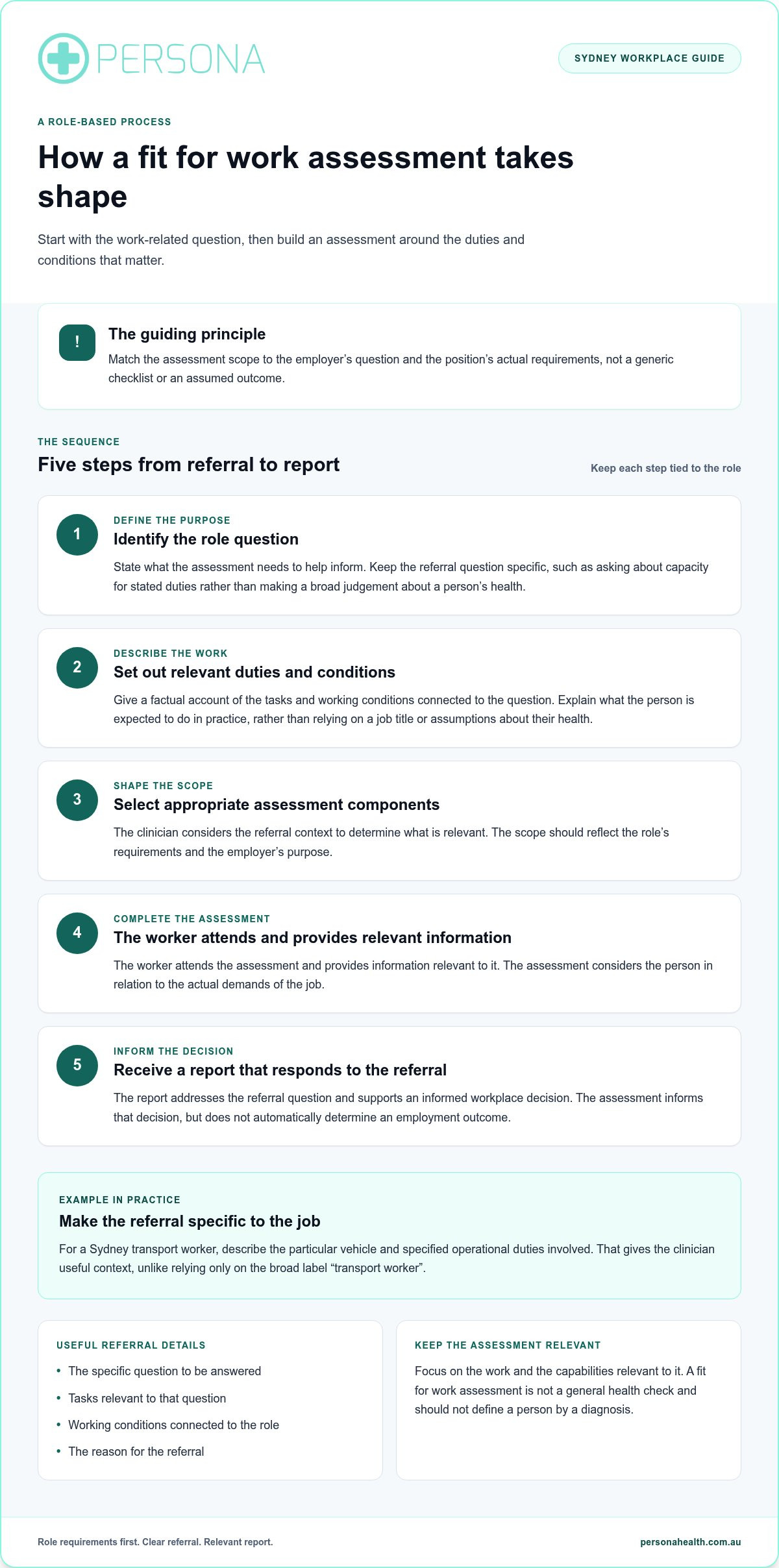
A clear process keeps an assessment focused on the decision the employer needs to make. For a fit for work medical assessment Sydney employers can use this sequence: define the question, describe the duties, identify relevant assessment components, complete the assessment and receive a report that addresses the referral.
The assessment scope should reflect the role’s requirements and the employer’s purpose, not a generic checklist or an assumed outcome.
- Identify the role question. State what the assessment needs to help inform.
- Describe relevant duties. Explain the tasks and working conditions connected to that question.
- Select appropriate components. The clinician considers the referral context when determining what is relevant.
- Conduct the assessment. The worker attends and provides information relevant to the assessment.
- Report the findings. The report responds to the referral question and supports an informed workplace decision.
For example, a Sydney transport employer may refer a worker whose role involves driving a particular vehicle and completing specified operational duties. Describe those duties in the referral instead of relying on the broad label “transport worker”. That gives the clinician useful context to consider relevant capabilities without presuming the result or treating every transport position as identical.
What information helps define the assessment?
Give the clinician a factual description of the position, the tasks relevant to the question and the reason for the referral. Explain what the person is expected to do in practice, rather than relying on assumptions about their health or conclusions based on a job title. This context helps the clinician understand what is being assessed and focus on relevant capabilities.
Keep the question specific. For instance, explain that you need information about a worker’s capacity for stated duties, rather than asking for a broad judgement about their health. Relevant, accurate role information makes the assessment more targeted and the resulting report more useful to the employer.
What can a Persona Health pre-employment medical include?
Persona Health pre-employment medicals are tailored to the role and assessment purpose. They can include a medical history assessment and physical examination, including a musculoskeletal examination, as well as drug and alcohol screening and vision, hearing and respiratory tests. A cardiovascular fitness test is also available as an optional component. These components do not all apply to every person or position.
Industry-specific requirements can call for a different pathway. For rail roles, Persona Health provides Rail Medicals CAT 1-3. The referral and job context help establish what is relevant, rather than assuming every pre-employment medical requires rail or other specialist components. For a plain-language overview of what happens in a pre-employment medical, see the related service information.
When preparing a referral, speak with the Persona Health team about clearly setting out the role question and relevant duties.
How can employers assess whether a provider suits a Sydney workplace?
A useful comparison looks beyond appointment location. For a fit for work medical assessment Sydney employers need a provider who can understand the role, arrange relevant clinical input and communicate findings clearly. Consider whether the process answers your referral question, and whether local access and support for a workforce across multiple sites suit your organisation.
| What to assess | What it means for your workplace |
|---|---|
| Role relevance | The assessment is shaped around the duties and question in the referral, rather than an identical checklist for every position. |
| Clinical credentials | Clinical care is provided by appropriately registered practitioners with relevant professional credentials. |
| Reporting clarity | The report is understandable and addresses the question the employer referred, helping inform a work-related decision. |
| Local access | Clinic locations give workers practical access to an in-person assessment. |
| Multi-site capability | A wider clinic network and mobile workplace services can help organisations coordinate assessment needs across different locations. |
Clear communication matters at every stage. Employers need to explain the role and the question they need answered; clinicians need enough context to assess what is relevant. A report that responds directly to the referral is more useful than a generic summary that leaves the employer unsure how the findings relate to the job. An assessment can inform a decision, but it does not guarantee a particular employment outcome or prevent every workplace risk.
Why does role relevance matter more than a generic checklist?
Two employees with the same job title may have different duties, and different roles can place different demands on a worker. An assessment based on the actual work question keeps the process practical and focused. A checklist applied unchanged across unrelated positions may include irrelevant items or miss information needed about a particular role.
Persona Health’s clinical team includes AHPRA-registered doctors, nurses and physiotherapists. The organisation is ISO accredited to ISO 9001, ISO 14001 and ISO 45001. These credentials and systems support a structured service, while accurate information about the role remains central to defining what the assessment needs to address.
Where can Sydney employers access Persona Health?
Persona Health has Sydney locations in Parramatta, Rosebery, Gregory Hills and Dee Why. Employers in south-west Sydney can access occupational health services in Gregory Hills, while the Rosebery clinic offers another local option. Melbourne clinics are located in Cairnlea and Craigieburn.
For organisations managing workers across multiple sites, Persona Health’s network of more than 100 affiliate clinics provides national access, and Australia-wide mobile workplace services can support workforce needs across locations. Local clinics and mobile services give employers practical options for coordinating assessments for workers in different settings.
How should employers and workers prepare for an assessment?
Good preparation helps keep the appointment focused and gives the worker a clearer idea of what to expect. For a fit for work medical assessment Sydney employers arrange, the referral should explain the work-related question and provide enough factual detail about the role. Give the worker straightforward instructions and explain who to contact with questions about attending.
Employer checklist:
- Describe the role and the duties relevant to the assessment in clear, factual language.
- State why the assessment is being requested and what work-related question it is intended to address.
- Give the worker the appointment details and any instructions provided for the assessment.
- Explain how the worker can raise questions before the appointment.
Handle medical information deliberately. Share only the information needed for the referral and limit access within the organisation to people who need it for the relevant work process. Privacy obligations can depend on the organisation and circumstances, so employers should check current guidance on the Privacy Act 1988 and Australian Privacy Principles before relying on a specific legal interpretation.
What should an employer communicate before the appointment?
Tell the worker, in plain language, why the assessment is taking place and outline the role requirements relevant to it. For example, explain that the referral concerns particular duties, rather than implying that a diagnosis has already been reached or an outcome decided. Provide practical appointment information from the booking instructions, and explain how the worker can ask questions about the process.
A clear explanation supports a respectful process. Avoid circulating medical details that are not needed to arrange or manage the referral. The employer’s role is to communicate the work context and purpose accurately, not to make assumptions about a person’s health.
What can a worker expect on the day?
The appointment follows the referral and the components selected for the role and assessment purpose, so there is no single format, duration or result. Depending on the referral, pre-employment components may include a medical history assessment, physical examination including a musculoskeletal examination, drug and alcohol screening, vision and hearing tests, respiratory tests, and industry-specific components.
Workers should follow the appointment instructions and provide accurate information relevant to the assessment. If any part of the referral or process is unclear, raise the question with the assessing clinician. This gives the clinician a chance to explain what is being considered and helps the worker participate with a clearer understanding of the appointment.
Employers can also help by ensuring the referral information matches the duties described to the worker. If the role or assessment purpose changes, update the relevant information rather than relying on an outdated description. Clear communication on both sides supports a more useful assessment and report without predetermining the outcome.
Arrange a fit for work medical assessment in Sydney with Persona Health
Arranging an assessment is easier when the referral starts with a clear question. Persona Health works with employers to align the assessment with the role and its relevant requirements, supported by responsive customer service and modern digital reporting. Persona Health provides fitness for work assessments to help inform workplace decisions through a role-based approach.
Reports are often returned the same day, although timing can vary. In one example, an employer needed a new starter on site within 48 hours, and the report was returned the same day. This illustrates how clear referral information and responsive communication can support time-sensitive planning, without guaranteeing the same timing for every assessment.
What can employers expect from Persona Health?
Expect practical coordination around the assessment purpose, with clear communication about the referral and reporting process. Digital reports help employers access the information in a modern format, with the report focused on the work-related question. Persona Health’s employer-focused approach recognises the individual circumstances behind each referral.
The service ethos is captured in Your Success Matters. Share the role requirements and reason for the assessment so the referral has a clear starting point. This supports a considered process without presuming what the assessment will find or what decision an employer should make.
What is the next step for a Sydney employer?
To arrange an assessment, prepare the worker’s role, workplace location and the purpose of the referral. Include the duties relevant to the question and the information you need the report to address. Persona Health’s team can help you understand the next steps and communicate the process clearly to the worker.
A focused referral gives the assessment a practical foundation. Contact Persona Health to discuss your workplace requirements and the appropriate pathway for your team.
Make your next workplace decision with greater clarity
A well-framed referral can turn uncertainty into a focused conversation about the work and the information needed to support a decision. Before arranging a fit for work medical assessment Sydney employers can write down the specific question they need answered and the duties that make it relevant. This helps keep the process grounded in the role and gives the worker a clearer understanding of why the assessment is being arranged.
Use the findings as one part of a considered workplace decision, alongside the role’s requirements and the information available to you. The aim is not to reduce a person to a medical result, but to support a fair, practical response to the question at hand. If the circumstances or duties change, revisit the referral question so the next step remains relevant.
A clear starting point makes the process more manageable for everyone involved. Contact Persona Health to discuss a fit for work assessment shaped around the real requirements of your role.
Frequently Asked Questions
Can an employer request a fit for work medical assessment in Sydney?
An employer can arrange an assessment to help answer a relevant question about a worker’s capacity for particular duties. For a fit for work medical assessment Sydney employers should be able to explain the role requirements and why the information is needed. For example, a change in a worker’s assigned tasks may prompt a question about those duties. The assessment should support a work-related decision, not serve as a general investigation into someone’s health.
Is a fit for work medical assessment the same as a pre-employment medical?
No. A pre-employment medical is generally arranged during recruitment, while a fitness for work assessment addresses a specific work-related question that may arise at another point in employment. They can share relevant components, depending on the role and referral. A prospective employee and an existing worker may both be assessed in relation to particular duties, but the employer’s reason for seeking information may differ.
What happens if an assessment identifies a concern relevant to the role?
A relevant finding should be considered in context, alongside the actual duties and the assessment’s purpose. It does not automatically determine whether someone can work or what an employer should decide. The report may help clarify the issue raised in the referral, and the employer can consider appropriate next steps through its workplace processes. If the worker has questions about a clinical finding, they can raise them with the assessing clinician.
How long does a fit for work medical assessment take?
There is no standard appointment length. Timing can depend on the referral question and which assessment components are relevant, so employers and workers should not assume every appointment will take the same time. Follow the instructions provided for the specific booking and allow for any practical guidance included there. If you are planning staff coverage or transport to an appointment, use the booking information rather than relying on a general estimate.
Can a worker’s medical information be shared with their employer?
Information sharing should be handled carefully and transparently. Before the assessment, clarify what information the employer is seeking and how the report will be used. Privacy requirements can depend on the circumstances, including the type of information and the employment context, so avoid assuming one rule applies in every case. Employers should check current guidance on the Privacy Act 1988 and Australian Privacy Principles, and manage health information confidentially.
Where can I access a fit for work medical assessment in Sydney?
Persona Health has Sydney clinic locations in Parramatta, Rosebery, Gregory Hills and Dee Why. The most practical location may depend on where the worker is based and the assessment arrangements for the referral. Persona Health also has a national network of more than 100 affiliate clinics, supporting employers with workforces in multiple locations. Contact Persona Health to discuss your role, workplace location and assessment purpose.

Article by
Ian Nicholson
Ian is the Business Support Manager at Persona Health, where he plays a key role across IT, sales, marketing and business operations. With a broad skill set and a practical, solutions-focused approach, Ian helps drive the systems, communication and commercial strategy that support Persona Health’s continued growth across Australia.