
A health check can provide useful information, but it won’t address the exposure putting workers at risk. For Sydney manufacturers, that distinction matters. Effective occupational health for chemical manufacturing workers Sydney workplaces depends on connecting role-based health surveillance with practical controls for the chemicals workers handle.
It can be difficult to know which roles need monitoring or how to organise appointments across shifts and sites. Health surveillance should be guided by a workplace risk assessment that considers the hazards, tasks and possible exposure routes. It can help identify signs that controls may need review, but it never replaces eliminating or minimising exposure.
This article explains how the Work Health and Safety Act 2011 (NSW), the Work Health and Safety Regulation 2025 (NSW) and SafeWork NSW guidance inform chemical risk management and health monitoring. It also covers the Workplace Exposure Limits change scheduled for 1 December 2026 and how Sydney-based support, including on-site services, can help you plan around worker roles and operational schedules. You’ll find a practical framework for linking risk assessment, exposure controls and appropriate health surveillance.
Key Takeaways
- Map chemical tasks, exposure routes and work conditions to identify which roles may need health surveillance.
- Give exposure controls, workplace exposure monitoring and worker health surveillance distinct purposes. One does not replace another.
- Use a practical planning sequence to coordinate health services around shifts, workforce size, site access and multiple locations.
- Occupational health for chemical manufacturing workers Sydney workplaces can include on-site audiometry, spirometry, heavy-metal screenings, skin checks and mobile ILO chest X-rays.
- Match health services to identified workplace risks without treating medical checks as a substitute for controlling exposure.
Why occupational health matters for chemical manufacturing workers in Sydney
Protecting workers while keeping production moving takes careful planning. In a chemical manufacturing workplace, health risks depend on the substances present, how work is done and the conditions workers encounter. A sealed process may involve different exposure potential from opening a container, cleaning equipment or responding to a spill. Assess each task on its own merits rather than assuming everyone in the same work area has the same exposure.
Occupational health in chemical manufacturing brings workplace risk information and appropriate health measures together to help protect workers from work-related harm. It connects health expertise with the way work is designed and carried out, consistent with the practical approach to workplace health and safety set out in Safe Work Australia guidance.
A chemical’s potential to affect health does not, on its own, show that a worker has been exposed or harmed. The possible health effects depend on the substance and the circumstances. For example, contact with skin or breathing in a substance may be relevant, but the assessment should also consider the actual process, exposure route and duration. Avoid drawing conclusions from a chemical name alone.
For Sydney workplaces, use current guidance from SafeWork NSW and Safe Work Australia when reviewing hazardous chemical risks. A chemical register and current safety data sheets (SDS) are useful starting points for understanding substances and their hazards. They inform the assessment, but do not replace observing the real tasks, conditions and controls on site.
This practical context matters whether you’re reviewing a process or arranging occupational health for chemical manufacturing workers Sydney-wide. Persona Health provides occupational health support for employers in Sydney, including on-site health surveillance. You can discuss your workforce and workplace needs through Sydney occupational health support.
Which chemical manufacturing tasks can create health concerns?
Consider handling, mixing, transferring, cleaning and maintaining equipment. A worker may come into direct contact with a substance during one task, while another task may involve a different exposure route or less contact. The substance, process, task duration and working conditions all affect the assessment. Review the SDS alongside routine and non-routine work, including maintenance and cleaning, to identify tasks that need closer attention.
Why role and exposure context matter
Operators, maintenance staff and cleaners may have different tasks, even in the same production area. An operator might manage a mixing process, while a maintenance worker opens equipment for servicing and a cleaner handles residues. Job titles alone do not show which substances a person encounters, how often a task occurs or under what conditions. Map the work each person actually performs before deciding what health monitoring may be appropriate.
How role-based health surveillance supports chemical manufacturing workers
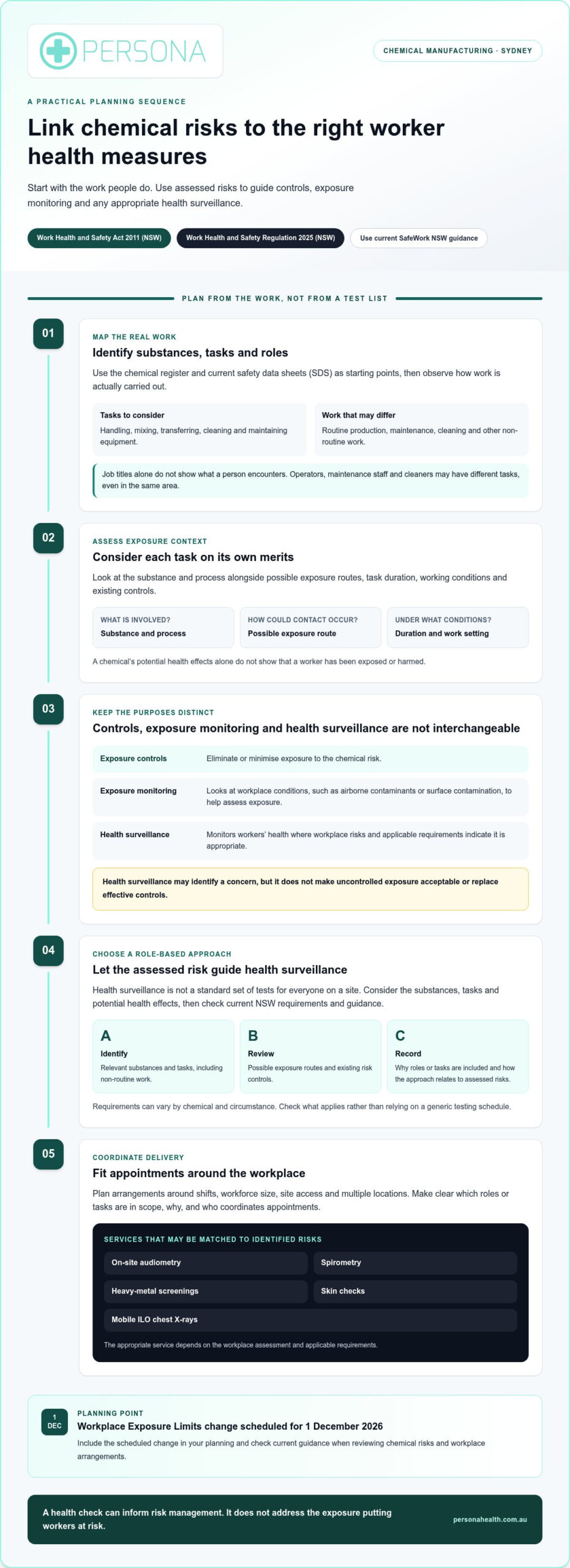
Health surveillance is health monitoring linked to an identified workplace risk. It is not a standard set of tests for everyone on a site. The purpose and approach should reflect the substance, the work being done and the potential health effects identified through assessment. In NSW, the Work Health and Safety Regulation 2025 sets requirements for health monitoring in specified circumstances. Check current SafeWork NSW guidance when deciding what applies to your workplace.
Start with the risk assessment, not a preferred test. Review the substances used, their safety data sheets, work tasks, possible exposure routes and existing controls. Consider how work operates in practice, including maintenance and cleaning tasks that may differ from routine production. Record why particular roles or tasks are included, and why others may need a different approach.
Keep two kinds of monitoring distinct. Exposure monitoring looks at workplace conditions, such as airborne contaminants or surface contamination, to help assess exposure. Health surveillance monitors workers’ health where the workplace risks and applicable requirements indicate it is appropriate. Neither takes the place of the other. Health surveillance may identify a concern, but it does not make an uncontrolled exposure acceptable or replace effective controls.
How employers decide whether surveillance is appropriate
Review the evidence for each hazard and affected task. SDS information helps identify a chemical’s hazards, while observing the work clarifies how contact could occur and how existing controls perform. Requirements can vary by chemical and circumstance, so check current NSW requirements rather than applying a generic testing schedule. Document the reasoning, including the roles considered and how the chosen approach relates to the assessed risks.
- Identify relevant substances and tasks, including non-routine work.
- Review possible exposure routes and existing risk controls.
- Check current SafeWork NSW guidance and document the decision for affected roles.
What a role-based programme should make clear
Workers and managers should know which roles or tasks are in scope and why. Set out who coordinates appointments, communicates arrangements, maintains programme records and follows up on recommendations. Plan around shift patterns and operational demands so the programme is workable without assuming every worker has the same health needs.
Keep individual health information appropriately separate from general workplace risk records, and manage access in line with applicable privacy obligations. Workplace records can capture the programme rationale, roles covered and completion status without treating personal clinical details as general operational information. Clear boundaries help protect workers’ privacy while allowing the employer to manage workplace risks.
For role-based occupational health for chemical manufacturing workers Sydney planning, discuss health surveillance support with Persona Health.
Does medical surveillance replace chemical exposure controls?
No. A medical check does not remove a hazardous chemical, prevent contact or correct a problem with a work process. Employers arranging occupational health for chemical manufacturing workers Sydney need to keep the focus on reducing exposure at work. Health surveillance may inform appropriate health follow-up, but it is not permission to leave a risk uncontrolled.
These measures have different purposes and work best as part of a considered risk-management approach:
| Measure | What it does |
|---|---|
| Exposure controls | Workplace measures selected through risk assessment to eliminate or minimise risk from hazardous chemicals. |
| Exposure monitoring | Measures workplace conditions, such as airborne contaminants or surface contamination, where appropriate. |
| Health surveillance | Monitors a worker’s health in relation to identified workplace risks where appropriate and required. |
For example, if a process review identifies a possible chemical exposure concern, arranging medical checks alone is not an adequate response. Review how the work is done and whether existing controls are suitable. Exposure monitoring may help assess workplace conditions, while health surveillance can support health follow-up where the assessment and current requirements indicate it is appropriate. Each measure addresses a different part of the picture.
Choose controls for the specific hazard and work setting rather than copying measures from another process or treating them as a universal checklist. SafeWork NSW’s Managing risks of hazardous chemicals in the workplace Code of Practice and current Safe Work Australia guidance can help employers understand their risk-management approach. Requirements can differ by chemical, so check the current guidance that applies to the substance and circumstances.
How exposure controls and health monitoring differ
Controls change the conditions or work practices that contribute to risk. Exposure monitoring gathers information about workplace conditions. Health surveillance looks at worker health in relation to identified risks. These measures may inform one another, but none should be used as a substitute for another where it is needed. Persona Health provides on-site health surveillance as part of workplace health planning.
What to do when findings or concerns arise
If monitoring results, a clinical finding or a worker’s concern suggests a possible issue, review the risk assessment and relevant controls with competent WHS support. Clinical findings need interpretation and follow-up by an appropriate health professional. Avoid drawing conclusions from a result without considering the worker’s circumstances and relevant clinical advice.
For an injury or incident requiring triage, InjuryQR is a free AI-powered workplace injury triage service available to Australian businesses. Workers scan a QR code without downloading an app, describe the injury by voice and respond to AI follow-up questions. Depending on the situation, the service can provide self-care advice, offer a telehealth appointment, direct someone to an Emergency Department or advise calling 000. Telehealth appointments are typically within 3-4 hours. Certificates of Capacity can be issued immediately where appropriate. Earlier, clearer triage can support injury reporting and help reduce Lost Time Injuries.
How to plan a chemical-worker health programme in Sydney
A well-organised programme starts with the work, not a standard package of tests. Employers seeking occupational health for chemical manufacturing workers Sydney-wide can use a clear planning sequence to connect workplace risks with suitable health services and realistic scheduling. Before implementation, check current NSW legal requirements and chemical-specific guidance from SafeWork NSW. Requirements can depend on the hazard and circumstances.
- Map tasks and roles. Record the processes workers perform, including routine production, cleaning, maintenance and other relevant tasks. Note which roles carry out each task, where the work occurs and whether activities differ between shifts or sites.
- Identify chemical hazards. Review the chemical register and current safety data sheets alongside the actual work process. Consider how workers could come into contact with a substance and which tasks need closer assessment.
- Review existing controls. Consider how current measures address the identified risks. Record questions that need further workplace assessment or competent WHS input before deciding on health services.
- Scope health needs. Use the assessment and applicable current requirements to define which roles or tasks are in scope, why they’re included and what health surveillance is appropriate. Avoid assuming all workers need the same approach.
- Arrange delivery and follow-up. Set out responsibilities, appointment logistics, communication and follow-up arrangements. Plan for workforce size, site access, shift patterns and any multi-site coordination so the programme fits the operation.
Build the programme around tasks and site operations
Create a role-and-task map that reflects actual chemical processes rather than relying on job titles alone. For each planned surveillance activity, document its purpose, scope and responsible workplace contacts. Then schedule private, orderly appointments around shift handovers and production needs, allowing workers to attend with minimal disruption. A clear schedule also helps managers coordinate attendance across teams and locations.
Coordinate Sydney sites and protect health information
For local access, Persona Health has Sydney clinics in Gregory Hills and Rosebery. These locations can support planning for local workforce health services. For multiple sites, use a consistent programme plan while adapting practical arrangements to each workplace’s operations and access requirements.
Health information needs careful handling. The Privacy Act 1988 and Australian Privacy Principles apply to some organisations and circumstances, so employers should understand which privacy obligations apply to them. In practice, limit access to clinical details to people who need them for an appropriate purpose, and keep individual health records separate from general risk and scheduling records. Follow current SafeWork NSW guidance for chemical health monitoring and record keeping, checking the requirements that apply to your circumstances.
For practical help coordinating workplace health support around your roles, shifts and Sydney sites:
How Persona Health supports chemical manufacturing workplaces in Sydney
Putting a health programme into practice takes services that fit identified workplace risks, worker roles and operating arrangements. Persona Health provides employer-focused occupational health support, including on-site health surveillance to help coordinate suitable services around manufacturing operations and workforce schedules.
On-site services and local Sydney access
On-site health surveillance is available for workplaces with 20-2000 employees. Depending on the programme’s needs, services can include:
- Audiometry, spirometry, heavy-metal screenings and skin checks
- Mobile ILO chest X-rays
- Drug and alcohol testing, vaccinations and serologies where relevant to the workplace programme
On-site workplace services can support coordination across shifts and multiple sites, with mobile workplace services available Australia-wide. Persona Health has clinics in Gregory Hills, Rosebery, Parramatta and Dee Why in Sydney, and Cairnlea and Craigieburn in Melbourne. A national network of more than 100 clinics can also support workforce coordination beyond these local sites. Learn more about on-site health surveillance services.
A practical, employer-focused occupational health partner
Services are delivered by AHPRA-registered doctors, nurses and physiotherapists. Responsive customer service, clear communication and modern digital reporting help employers coordinate arrangements and understand relevant workplace information, while keeping programme records separate from individual clinical details.
One client testimonial describes a new starter who needed to be on site within 48 hours, with the report returned the same day. This is an account of that individual experience, not a promised timeframe. Persona Health is accredited to ISO 9001, ISO 14001 and ISO 45001. Its approach is guided by the commitment, Your Success Matters.
InjuryQR also provides free workplace materials, including posters, stickers, keyrings and fridge magnets, to support access to its injury triage service.
For occupational health for chemical manufacturing workers Sydney employers can discuss a programme shaped around their workforce, sites and identified needs.
Make your next programme review a practical step forward
Choose a process, team or upcoming operational change to review with your WHS and occupational health contacts. Changes to materials, equipment, work methods or site arrangements can affect what support is appropriate, so build regular review into the way your programme is managed.
For occupational health for chemical manufacturing workers Sydney workplaces, the goal is a plan that reflects real tasks and supports workers without losing sight of day-to-day production. Start with the workplace information available, identify what needs further attention, then agree on a clear next action and who will take it.
A considered, collaborative approach can help you make confident decisions for your team and keep worker wellbeing part of the way your operation moves forward.
Frequently Asked Questions
Is health surveillance required for every chemical manufacturing worker?
No. There isn’t a blanket requirement for every worker to have the same checks. Identify the chemicals and tasks involved, then verify applicable health monitoring duties against current SafeWork NSW guidance and the Work Health and Safety Regulation 2025 (NSW). For each role considered, record the reason for including or excluding it. This makes the decision easier to review if a process, substance or worker’s duties change.
Can health surveillance prevent exposure to hazardous chemicals?
No. A health surveillance result cannot change conditions in a production area or stop a chemical reaching a worker. If a result or worker concern raises questions about a process, review the workplace risk assessment and control measures with appropriate WHS support. Keep clinical follow-up and workplace actions connected, while recognising that they address different needs.
How often should chemical manufacturing workers have health surveillance?
There’s no single interval that applies to every chemical manufacturing role. Follow relevant current requirements and the advice of the health professional overseeing the monitoring. Reconsider the programme when work changes, such as when a new chemical is introduced or a worker takes on different tasks. Record the basis for the chosen timing so it can be reviewed against current conditions rather than carried forward automatically.
What happens if a health surveillance result raises a concern?
An appropriate health professional should interpret the result and advise on clinical follow-up and any further steps. Employers shouldn’t diagnose a condition from a report. If a finding points to a possible workplace issue, review relevant processes and controls with suitable WHS support. Follow applicable NSW requirements for reporting, sharing the health monitoring report with the worker and responding to recommendations for remedial action.
Who can access a worker’s occupational health information?
Access should be limited to people with an appropriate need, and clinical details should be handled confidentially. The Privacy Act 1988 and Australian Privacy Principles apply to some organisations and circumstances, so exact obligations depend on the situation. Employers can separate appointment administration, such as attendance records, from clinical information. For a particular organisation’s responsibilities, seek suitable privacy or legal advice rather than relying on a general explanation.
Can on-site health surveillance be arranged for a large manufacturing workforce?
Yes. Persona Health provides on-site health surveillance for workplaces with 20-2000 employees. Appointments can be planned around site access, team structure and production schedules. Nominate a workplace contact, identify suitable areas for appointments and map attendance around shift patterns. For multiple facilities, a shared plan can keep communication consistent while allowing each site to manage its practical arrangements.
What services can be included in on-site health surveillance?
On-site health surveillance can include audiometry, spirometry, drug and alcohol testing, heavy-metal screenings, skin checks, mobile ILO chest X-rays, and vaccinations and serologies. The services selected should reflect the workplace programme’s purpose, worker groups and operational requirements. Setting these out in advance helps coordinate appointments and explain to workers why a service is being provided and what to expect on the day.

Article by
Ian Nicholson
Ian is the Business Support Manager at Persona Health, where he plays a key role across IT, sales, marketing and business operations. With a broad skill set and a practical, solutions-focused approach, Ian helps drive the systems, communication and commercial strategy that support Persona Health’s continued growth across Australia.