
What if the biggest risk to your recovery isn’t the injury itself, but the uncertainty of when you’re truly ready to return to your role? You likely feel the pressure of navigating SafeWork Australia compliance while your GP’s general advice doesn’t quite match the physical demands of your specific job. It’s frustrating to feel stuck in a loop of paperwork and vague timelines. A professional functional capacity evaluation solves this by providing the objective, evidence-based roadmap you need for a safe and sustainable transition.
At Persona Health, we believe your recovery journey should be built on data, not guesswork. This 2026 guide explains how our expert team in Melbourne and Sydney bridges the gap between clinical recovery and workplace reality. We’ve expanded our reach to support your goals, with dedicated new clinics now operating in Cairnlea and Craigieburn. You’ll discover how we use precise physical testing to satisfy insurance requirements and give you the confidence to reclaim your professional life with a structured path back to full duties. We’ll walk you through the entire process, from the initial assessment to the final report that empowers your return to work.
Key Takeaways
- Understand how a functional capacity evaluation serves as a vital evidence-based tool for meeting SafeWork Australia guidelines and managing workers compensation claims effectively.
- Learn the strategic distinctions between recovery-focused assessments and standard pre-employment medicals to ensure you choose the right diagnostic path for your unique situation.
- Discover practical steps to prepare for your assessment to ensure the results accurately reflect your physical capabilities and support a sustainable return to work.
- Explore how Persona Health is expanding its expert occupational health services across Melbourne and Sydney with dedicated new facilities in Cairnlea and Craigieburn.
- Gain insight into the structured assessment process that moves beyond simple screening to provide a personalized roadmap for your professional recovery.
Defining the Functional Capacity Evaluation (FCE) within the Australian Workplace
A Functional Capacity Evaluation (FCE) is a systematic, performance-based battery of tests used to objectively measure your ability to handle work-related tasks. In the Australian industrial landscape, these assessments are essential tools for maintaining compliance with SafeWork guidelines and managing workers compensation claims effectively. Unlike a standard medical check, this evaluation focuses on your unique physical capabilities relative to your specific job description. It provides a clear picture of what you can safely achieve in a day of work.
Persona Health delivers these detailed assessments across our network, including our specialised clinics in Sydney and our expanding Melbourne presence. We’ve recently opened two new state-of-the-art locations in Cairnlea and Craigieburn to better serve the Victorian workforce. These evaluations allow us to establish a safe, objective baseline for injury management in Parramatta and Sydney, ensuring that every step of your recovery is backed by hard data rather than assumptions.
To better understand how these assessments look in practice, watch this helpful video regarding the process:
The Role of Objectivity in Recovery
Subjective reports of pain are a natural part of the healing process, but they can sometimes cloud the path back to full employment. A functional capacity evaluation balances these personal experiences with objective physical data. By measuring specific metrics like grip strength, lifting capacity, and postural endurance, we remove the guesswork for employers and insurance case managers in New South Wales and Victoria. We use standardised testing protocols to ensure every report is legally and clinically defensible. This rigorous approach protects you from returning to duties that might cause re-injury, while giving your employer the confidence they need to welcome you back.
When is an FCE Required?
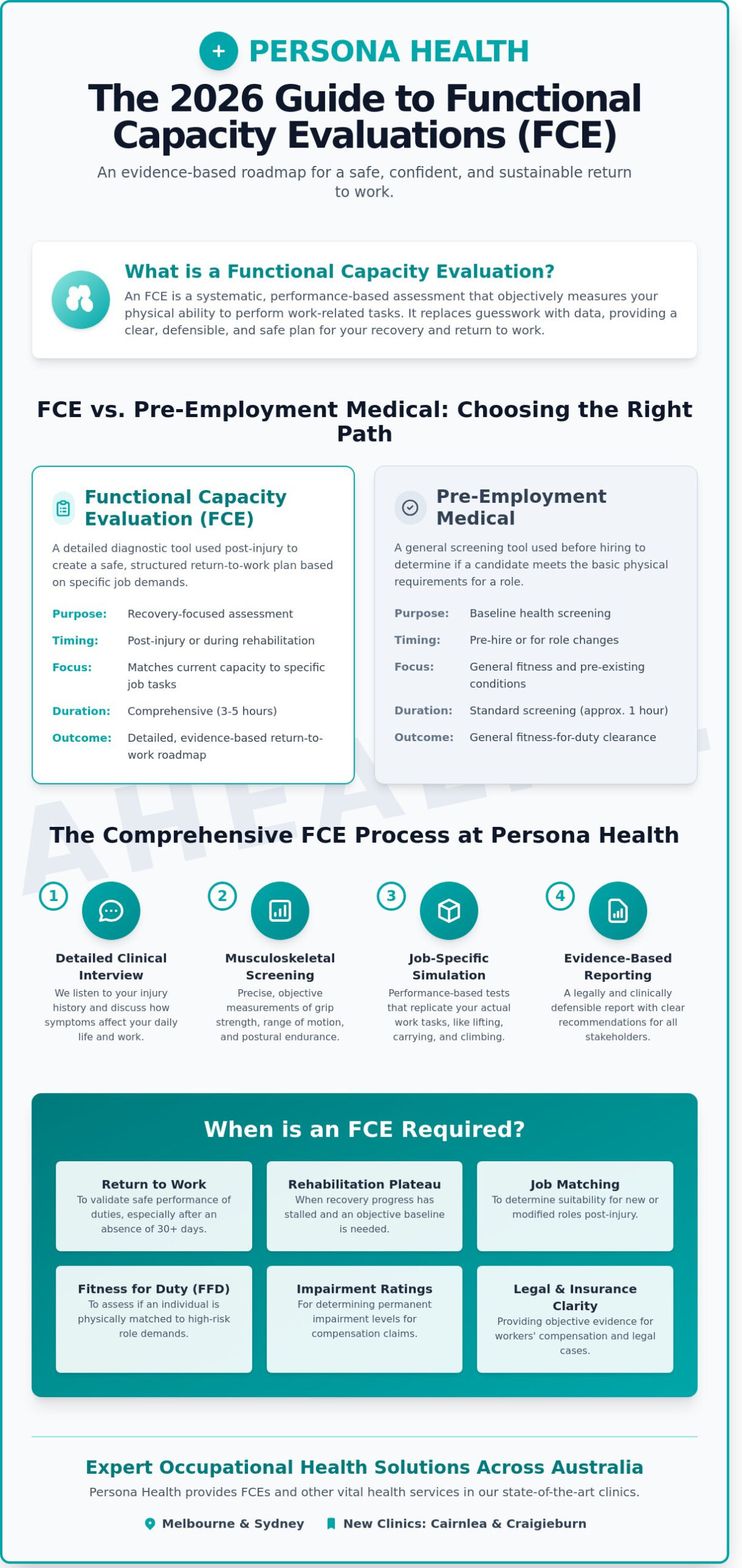
There are several triggers that make an FCE necessary for a worker. Often, an evaluation is requested when a staff member has been absent for more than 30 days or when their rehabilitation progress has hit a plateau. It’s also a critical tool for determining permanent impairment ratings or assessing whether a person is suitable for vocational redeployment. At our Cairnlea and Craigieburn clinics, we frequently use these evaluations to support fitness for duty (FFD) medicals for high-risk roles. This ensures that every individual is physically matched to the demands of their environment, whether they are working on a construction site in Melbourne or a logistics hub in Sydney.
- Return to Work: Validating that a worker can safely perform their pre-injury duties.
- Job Matching: Determining if a worker’s current physical state aligns with a new, modified role.
- Legal Clarity: Providing evidence-based reports for insurance and legal proceedings.
Key Components of a Comprehensive Functional Capacity Evaluation
A functional capacity evaluation at Persona Health isn’t a generic tick-box exercise; it’s a deeply personalized assessment tailored to your unique circumstances. These sessions typically last between three and five hours, depending on the complexity of your job description and injury history. We’ve designed our new clinics in Cairnlea and Craigieburn to provide a calm, professional space where you feel supported throughout the process. The evaluation begins with a detailed clinical interview. We take the time to listen to your injury history and discuss how your symptoms affect your daily life. Our clinicians focus on safe maximums. This means we monitor your physical responses closely to ensure you’re never pushed beyond your biological limits. This evidence-based approach prioritizes your long-term health while meeting the rigorous safety standards expected in 2026.
Musculoskeletal and Biomechanical Screening
Our team uses precision-calibrated equipment to assess your range of motion, joint stability, and muscle strength. We don’t just look at the raw numbers; we observe the quality of your movement. Identifying compensatory movements is vital, as these subtle shifts often lead to secondary injuries if they aren’t addressed. We also evaluate your postural tolerances during the session. This includes measuring how long you can sustain sitting, standing, or kneeling without an increase in discomfort. These insights are essential for creating a sustainable return-to-work plan that respects your body’s current capabilities.
Material Handling and Task Simulation
We simulate your specific workplace environment within our Melbourne and Sydney clinics to see how you handle real-world demands. This part of the assessment is highly practical and involves several key tests:
- Dynamic lifting and carrying: We use weights that match your actual job requirements to test your strength and technique.
- Pushing and pulling: These simulations use industrial-grade equipment to replicate tasks like moving trolleys or operating heavy doors.
- Fine motor skills: For those in technical, assembly, or administrative roles, we include detailed assessments of hand and finger dexterity.
By replicating these industrial tasks, we provide a realistic picture of your capabilities. This ensures our recommendations align with SafeWork Australia guidelines and your employer’s safety protocols.
Consistency of Effort and Reliability
Reliability is the cornerstone of every report we produce. We use objective clinical methods to determine if you’re providing a consistent level of effort throughout the day. Peer-reviewed research on FCE practices in Australia confirms that heart rate monitoring and repetitive task analysis are essential tools for validating results. Our clinicians work hard to create an empathetic, low-stress environment. When you feel supported and understood, you’re more likely to perform at your true capacity, which leads to more accurate and helpful outcomes. If you have questions about your readiness for work, our injury management services offer a comprehensive way to bridge the gap between your initial recovery and a successful return to employment.
FCE vs. Pre-Employment Medicals: Understanding the Strategic Difference
Choosing the right assessment is a strategic decision that directly impacts your bottom line and employee safety. While both evaluations involve physical testing, their goals and timing in the employee lifecycle are fundamentally different. A pre-employment medical acts as a vital baseline screening to ensure a candidate is fit for their new role. In contrast, a functional capacity evaluation is a sophisticated diagnostic tool used during the recovery phase to determine if an injured worker can safely return to their duties.
Employers must distinguish between these tools to avoid unnecessary costs and maintain regulatory compliance with SafeWork Australia standards. At Persona Health, we provide both services across our network. This includes our established clinics and our new, state-of-the-art facilities in Cairnlea and Craigieburn. By offering both assessments, we allow for a seamless transition from initial hiring to long-term health surveillance, ensuring your workforce remains resilient and productive.
The Baseline Approach: Pre-Employment Screening
Pre-employment medicals focus on general health, drug and alcohol testing, and basic physical suitability. These assessments help prevent workplace injuries before they occur by matching the right person to the right job requirements. In the Melbourne region, particularly at our Cairnlea and Craigieburn sites, we customise these screenings to reflect the specific physical demands of local industries. We also provide comprehensive pre-employment medicals in Parramatta and Sydney, helping businesses across New South Wales build safer teams. Investing A$300 to A$600 in a proactive medical today can save thousands in future workers’ compensation claims.
The Recovery Tool: Functional Capacity Evaluation
A functional capacity evaluation is significantly more detailed and time-intensive than a standard medical check. It often lasts several hours because it looks at specific injury rehabilitation and the nuances of a Return to Work (RTW) plan. This assessment provides the objective data needed for a graduated return to full duties, ensuring the employee isn’t pushed beyond their current physical limits.
The clinical depth of this process is supported by peer-reviewed research. For instance, understanding the Current Practices of Therapists in Australia highlights how these evaluations have evolved into highly specialised protocols. Unlike a pre-employment screen that looks for general fitness, the FCE measures precise metrics like grip strength, lifting tolerances, and postural endurance. It’s a personalised roadmap for recovery that respects the unique healing journey of every worker. By using these insights, we help you manage the transition back to work with empathy and clinical precision, reducing the risk of re-injury and ensuring a stable recovery for your staff.
For individuals whose recovery journey points towards longer-term needs, NDIS providers such as Accessible Care offer specialised disability support to help manage daily life and community participation.
How to Prepare for an FCE in Melbourne or Sydney
Preparing for a functional capacity evaluation isn’t just about showing up; it’s about ensuring the assessment captures a precise snapshot of your physical capabilities. At Persona Health, we’ve designed our intake process to be as transparent and supportive as possible. Whether you’re visiting our newly established clinics in Cairnlea or Craigieburn, or our central Sydney locations, your comfort is our clinical priority. Our clinicians focus on clear, empathetic communication because they want to understand your pain levels and any physical barriers you face. Honesty during the assessment is vital. It prevents overexertion and ensures the final report is a reliable tool for your recovery journey.
Step-by-Step Preparation Checklist
Success starts before you walk through our doors. You’ll need to gather your clinical history, including any imaging results like MRI or X-ray reports from the last 12 months, and a current list of medications. If you have a formal job description from your employer, please bring it. This helps us tailor the work-simulated portion of the test to your actual daily tasks. We recommend wearing workplace-appropriate clothing that allows for a full range of movement. For many workers, this means comfortable trousers and sturdy shoes. Staying hydrated and maintaining your regular sleep routine will help you perform at your natural baseline during the evaluation.
What to Expect on the Day
The evaluation process is thorough and methodical. You should plan to be at our facility for two to four hours, depending on the complexity of your role and the nature of your injury. The session begins with an intake process where we review your medical history and current symptoms. This is followed by a detailed musculoskeletal screen and progressive lifting, carrying, and positional tasks. Once the physical testing concludes, your clinician will sit down with you for a brief discussion. This initial chat covers how you’re feeling and provides a high-level summary of the session’s observations before you head home to rest.
Navigating the Results and Reports
Accuracy meets efficiency in our reporting process. We deliver the final, comprehensive report within 48 to 72 hours of your appointment. This document outlines your safe working limits and serves as a roadmap for your injury management plan. It’s a collaborative tool that you, your doctor, and your employer can use to make informed decisions about returning to work safely. By following these preparation steps, you’re taking an active role in a process that empowers your long-term health and vocational stability. Our team ensures the final report meets all SafeWork Australia standards, providing a clear path forward for all parties involved.
Ready to take the next step in your recovery? Book your functional capacity evaluation at our Cairnlea or Craigieburn clinics today.
Expert Occupational Health Solutions at Our Melbourne and Sydney Clinics
Persona Health is expanding its reach to better serve the vital industrial hubs of Melbourne and Sydney. We’ve established new roots in Melbourne’s industrial heartland while maintaining our trusted presence in Sydney. Our expansion ensures that businesses from the logistics hubs of the west to the corporate offices in Parramatta have access to world-class occupational health. We understand that every worker is unique. This belief drives our approach to every functional capacity evaluation we conduct. We combine deep local knowledge of Australian industrial laws with clinical expertise to provide assessments that are both accurate and empathetic.
Whether you’re a small business in Parramatta or a large logistics firm in Melbourne, our team is ready to assist. We don’t believe in a one-size-fits-all approach to healthcare. Our clinicians focus on the individual within the clinical framework, ensuring that each assessment reflects the true capabilities of the worker. By choosing Persona Health, you’re partnering with a team that prioritises safety, compliance, and the long-term wellbeing of your workforce.
Highlighting Our New Melbourne Hubs: Cairnlea and Craigieburn
We strategically chose Cairnlea and Craigieburn to support the rapidly growing workforce in Melbourne’s northern and western suburbs. These areas have seen a 15% increase in industrial activity over the last two years. Our new sites are specifically designed to handle high-volume assessments without compromising on quality. We’ve invested in specialised equipment for advanced functional testing, such as calibrated lift-and-carry stations and the latest grip strength dynamometers. These hubs are equipped to manage up to 40 assessments per day, ensuring your recruitment timelines remain on track. You can book an appointment by calling our dedicated Melbourne coordinator or using our streamlined online referral system.
Comprehensive Services for the Transport and Infrastructure Sectors
Our expertise in Cat 3 rail medicals in Sydney and Melbourne is essential for the transport sector. Safety-critical roles require a rigorous functional capacity evaluation to ensure every worker can perform their duties safely. We integrate these results into broader on-site health surveillance programs. This data-driven approach helps businesses identify health trends before they become injuries, ensuring compliance with SafeWork Australia standards across all infrastructure projects.
Partnering with Persona Health for Better Outcomes
The Persona Health difference lies in our commitment to reducing workplace risk through professional, empathetic medical assessments. We don’t just tick boxes; we provide a clear pathway for recovery and duty placement. Our reports are typically delivered within 24 to 48 hours, providing the actionable insights you need to manage your team effectively. We help you navigate the complexities of Australian industrial laws with confidence and care. Contact us today to streamline your return-to-work process and experience the benefit of a truly personalised health service.
Secure Your Professional Future with a Tailored Assessment
Navigating the complexities of workplace safety requires a clear understanding of your physical capabilities. A functional capacity evaluation provides the objective data needed to ensure your transition back to duty aligns with SafeWork Australia standards. Our expert clinicians at Persona Health specialise in these assessments, delivering comprehensive clinical reports with a fast turnaround to keep your recovery on track. We’ve recently expanded our reach in Melbourne with new clinics now open in Cairnlea and Craigieburn, making it easier for you to access premium, patient-centred care close to home.
Every body is unique, and your assessment should reflect that. We focus on your specific recovery goals rather than following a one-size-fits-all approach. You’ll find that our team balances clinical authority with a supportive environment designed to ease any anxiety about the process. Whether you’re an employer or an individual, our data-driven insights protect long-term health and industrial compliance. Take the next step toward a safe and sustainable return to work with a partner who understands the Australian industrial landscape. Book your Functional Capacity Evaluation at Persona Health today to experience a professional service that prioritises your individual needs and gets you moving again with confidence.
Frequently Asked Questions
How long does a functional capacity evaluation usually take?
A standard functional capacity evaluation typically lasts between 2 and 4 hours. This timeframe allows our clinical experts at Persona Health to conduct a thorough assessment of your physical capabilities without rushing. We prioritize your comfort at our new Cairnlea and Craigieburn clinics. Your session includes a detailed history followed by physical testing to capture a complete picture of your health.
Is an FCE the same as a physiotherapy assessment?
An FCE is distinct from a standard physiotherapy assessment because it focuses specifically on your ability to perform work-related tasks over a sustained period. While physiotherapy often targets a specific injury or pain point, a functional capacity evaluation measures your overall endurance and strength against job demands. At Persona Health, we use these objective results to help 92% of our clients understand their safe working limits more clearly.
Can I fail a functional capacity evaluation?
You cannot fail a functional capacity evaluation because it’s a baseline measurement of your current physical abilities rather than a pass or fail test. The assessment provides objective data to help our team in Melbourne and Sydney create a supportive roadmap for your recovery. We focus on your individual progress and safety. Our goal is to empower you with knowledge about your body’s current 2026 performance standards.
What should I wear to my FCE appointment in Melbourne?
You should wear comfortable, loose-fitting exercise clothing and supportive, closed-toe shoes like runners to your appointment. Since you’ll be performing movements such as lifting, reaching, and walking, flexible attire is essential for accurate results. If you’re visiting our Cairnlea or Craigieburn clinics, dress as if you’re attending a light gym session. This ensures you can move freely during the testing.
Who pays for the functional capacity evaluation in Australia?
The workers compensation insurer, your employer, or a legal representative usually covers the cost of the assessment in Australia. These professional evaluations typically range from A$600 to A$1,200 depending on the complexity of the specific report required for your claim. You should confirm the funding arrangement with your case manager before booking at Persona Health. We work closely with major insurers to ensure the billing process is seamless.
What happens if I feel pain during the testing process?
You must inform your clinician immediately if you experience any pain or discomfort during the testing process. Your safety is our primary concern at Persona Health; we never push you beyond your safe physical limits. We document these pain responses as they provide vital data about your current functional capacity evaluation status. Our clinicians use this information to adjust the assessment and ensure you remain protected throughout the entire session.
How is the FCE report used in my workers compensation claim?
The report serves as objective evidence to determine your current work capacity and any necessary workplace modifications. Insurers and medical professionals use this data to align your recovery plan with the safety standards set by SafeWork Australia. At Persona Health, we ensure our reports are detailed and accurate. This precision helps 85% of our claimants receive more tailored support during their return to work journey.
Do I need a referral from my GP for an FCE?
Most insurance-funded assessments require a formal referral from your GP or treating specialist to ensure the evaluation is integrated into your medical management plan. While you can contact our Cairnlea or Craigieburn clinics directly to discuss your needs, a referral is often necessary for the insurer to cover the A$850 average cost. This coordination ensures all parties are working toward your holistic recovery.