

A food-processing medical should reflect the work, not just the job title. Health screening for food processing workers in Victoria is shaped by the role’s tasks, workplace conditions and relevant health and social history. That means an assessment for a production-floor role may focus on different work demands from one for a kitchen or packing role.
It’s understandable to want a clear picture of what an assessment involves, especially when personal health information is part of the process. This article explains how job requirements and workplace exposures can guide a pre-employment medical, and what health and social history may be relevant to discuss. You’ll also learn how food-handling responsibilities differ from a medical assessment, so you can approach each requirement with more confidence.
Key Takeaways
- Match assessment content to the role’s actual tasks, equipment and workplace exposures rather than relying on the job title alone.
- Use the pre-employment assessment to consider the worker’s capacity for the role’s physical and practical demands.
- Discuss relevant medical and social history in the context of the work, while treating personal health information with care.
- Separate employer-directed medical screening from food-safety responsibilities, including how workers report illness or possible contamination.
- Use a role-specific assessment to support informed employment decisions and identify any workplace adjustments that may be appropriate.
Customising screening to workplace and job requirements
Food-worker health screening should reflect each role’s tasks, equipment and exposures. Food safety guidance is available from Food Standards Australia New Zealand and the Victorian Department of Health. For workplace health, consult guidance from WorkSafe Victoria and Safe Work Australia.
Workplace and job screening needs
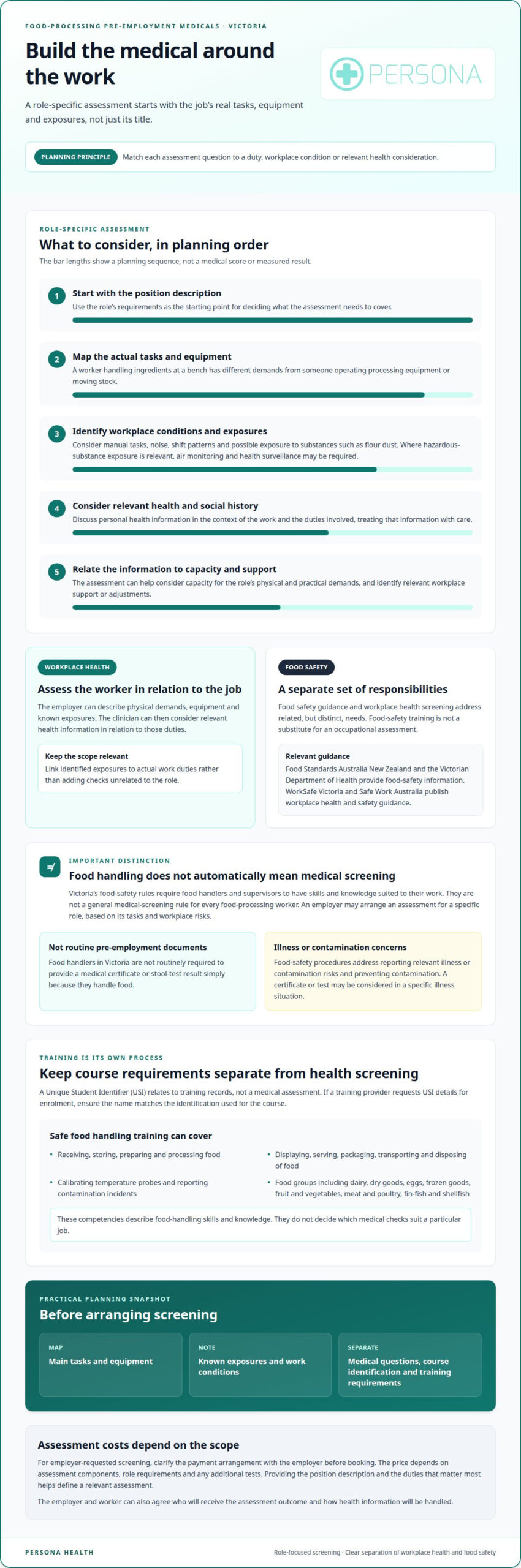
Start with the position description, then consider its tasks and workplace conditions. A worker handling ingredients at a bench faces different demands from someone operating processing equipment or moving stock. Consider manual tasks, noise, shift patterns and possible exposure to substances such as flour dust. Where hazardous-substance exposure is relevant, air monitoring and health surveillance may be required. The assessment plan should link each identified exposure to the role’s actual duties.
Government agency guidance
Food Standards Australia New Zealand establishes the Australia New Zealand Food Standards Code, while the Victorian Department of Health provides state food-safety information. For workplace risks, WorkSafe Victoria and Safe Work Australia publish occupational health and safety guidance. These address related but distinct needs: safe food handling and risks to workers. Use the guidance relevant to the issue, rather than treating food-safety training as a substitute for an occupational assessment.
Keep employment screening separate from course enrolment. If a position requires a food-safety course, prepare the identification details requested by the training provider. A Unique Student Identifier (USI) relates to training records, not a medical assessment. Have your USI details ready for enrolment if requested, and ensure your name matches the identification used for the course. This helps keep course administration separate from personal health information collected during screening.
Course requirements depend on the qualification and unit. Victoria University lists Certificate III in Commercial Cookery, Certificate III in Patisserie and Certificate IV in Kitchen Management as courses that include a safe food handling unit. The unit applies to food handlers who directly handle food during their daily work. Its practices are based on the organisation’s food safety program, which would normally use the HACCP method.
The unit assesses controls for receiving, storing, preparing, processing, displaying, serving, packaging, transporting and disposing of food. It also covers calibrating temperature probes and reporting contamination incidents. Victoria University’s safe food handling unit includes dairy, dry goods, eggs, frozen goods, fruit and vegetables, meat and poultry, and fin-fish and shellfish. These competencies describe food-handling skills and knowledge; they do not determine which medical checks suit a particular job.
For a practical planning step, write down the role’s main tasks, equipment and known exposures before arranging screening. Then separate workplace medical questions from course identification and training requirements. If you need to discuss how the workplace context informs the assessment, use the workplace assessment enquiry page.
Food-processing pre-employment medical assessments
A pre-employment assessment considers the demands of the role and the worker’s relevant health information. It is separate from food-safety training, which addresses safe food-handling practices.
Screening requirements in Victoria
Victoria’s food-safety rules require food handlers and supervisors to have skills and knowledge suited to their work. This is not a general medical-screening rule for every food-processing worker. An employer may arrange an assessment for a specific role, taking its tasks and workplace risks into account. The scope should relate to the job, not simply to handling food.
Before an assessment, the employer can describe the position’s physical demands, equipment and known exposures. The clinician can then consider relevant health information in relation to those duties. For example, a role involving repetitive manual tasks calls for a different discussion from one focused on monitoring a processing line. The outcome should help assess work capacity and identify relevant support or adjustments.
Medical certificates and stool test results
Food handlers in Victoria aren’t routinely required to provide a medical certificate or stool-test result simply because they handle food. Food-safety duties focus on reporting relevant illness or contamination risks and preventing contamination. A certificate or test may be considered in a specific illness situation, rather than treated as a standard pre-employment document.
Keep the two processes distinct. An employment medical assesses suitability for a role’s demands; food-safety procedures address illness and safe handling at work. If a worker reports a suspected food-borne illness, the employer should follow applicable food-safety requirements, rather than assume a pre-employment test answers the question.
Payment and screening costs
For employer-requested screening, clarify the payment arrangement with the employer before booking. The price depends on the assessment components, the role’s requirements and any additional tests. Requesting a quote establishes the cost for the assessment; there is no single fee for every food-processing job.
To make the request useful, provide the position description and identify the duties that matter most. This helps define a relevant assessment without adding unrelated checks. The employer and worker can also agree who will receive the assessment outcome and how health information will be handled.
There is no single vaccination list for every food-processing worker simply because they handle food. Recommendations depend on individual health history and the role’s specific exposure risks. Workers can discuss their vaccination history and workplace exposures with a treating health professional, then consider role-related advice separately from food-safety training.
For a practical next step, gather the job description, known workplace exposures and any specific assessment requirements before arranging an appointment. A pre-employment assessment enquiry can help clarify the information needed to plan the screening.
Medical and social history
A pre-employment assessment may consider health information relevant to a person’s capacity for the role. The questions depend on actual duties, such as repetitive handling, operating machinery or working shifts. A worker can explain how a health condition, medication or previous injury affects those tasks. This keeps the discussion focused on work requirements rather than unrelated personal details.
Social history can help explain factors affecting work, such as shift patterns, sleep routines or support needs. It should not be treated as a measure of character or food-handling competence. For example, work in an aged-care kitchen may involve different tasks from a production line, even though both roles handle food. Any assessment should connect the information gathered to the job’s demands and the worker’s relevant skills.
Food handlers must tell their supervisor if they know or suspect they have a food-borne disease, a potentially contaminating skin sore or discharge, or that they contaminated food while handling it. Vomiting, diarrhoea, fever, or a sore throat with fever may lead a food business to suspect food-borne illness. Report symptoms promptly, before continuing food-handling duties, so the business can respond to the contamination risk.
Under clause 14 of Standard 3.2.2, food handlers have health responsibilities. A Victorian food business must take practical steps to prevent people on its premises contaminating food. If it knows or suspects a worker has a food-borne illness, it should ensure the worker does not handle food or food-contact surfaces. A worker excluded because of a known or carried illness can resume food handling only after medical advice confirms they are no longer affected.
An infected skin sore or discharge calls for reasonable measures to prevent food contamination. The business should respond to the reported condition and protect food and food-contact surfaces. Health information should be handled carefully and used in ways relevant to food safety. A medical certificate does not replace reporting a relevant illness or following workplace food-safety procedures.
For a separate workplace injury, InjuryQR is a free AI-powered triage service available to Australian businesses. A worker scans a QR code without downloading an app, describes the injury by voice, then answers AI follow-up questions. Outcomes include self-care advice, telehealth appointments typically within 3-4 hours, Emergency Department direction or instructions to call 000. Where appropriate, a Certificate of Capacity can be issued immediately. Free posters, stickers, keyrings and fridge magnets support reporting, which can help reduce Lost Time Injuries. InjuryQR triage does not replace the food-contamination response required for illness or an infected wound.
Are food processing workers in Victoria required to undergo health screening?
Victoria’s food-safety requirements and workplace health screening address different concerns. Food handlers and supervisors need food-safety and hygiene skills and knowledge suited to their work. That requirement is not, by itself, a general medical examination for every worker.
The Food Act 1984 and the Australia New Zealand Food Standards Code provide the food-safety framework for Victorian businesses. Standard 3.2.2 covers food-safety practices and general requirements, while Standard 3.2.2A addresses food-handler training. These requirements focus on safe food handling, illness reporting and contamination prevention. They should not be confused with an employer-arranged assessment of a worker’s capacity for specific duties.
Whether a medical assessment is appropriate depends on the job and its exposures. A production worker lifting containers, someone monitoring a packing line and a person cleaning processing equipment may face different demands. Employers can describe the role’s tasks, equipment and known exposures, then consider relevant assessment components. Health screening for food processing workers in Victoria should reflect genuine job demands, not apply an identical checklist to every position.
Some exposures may call for monitoring or health surveillance. Where workers face hazardous-substance exposure, employers should arrange air monitoring and undertake health surveillance where required. Flour dust is an example of a substance that may trigger occupational illness even when it is not classified as hazardous. Identifying the substance and how workers encounter it helps determine appropriate controls and follow-up.
Noise is another workplace factor. Victorian food and beverage employers should provide audiometric testing for workers exposed to noise. If workers need to raise their voices to communicate over one metre and it is uncertain whether noise exposure may have exceeded the exposure standard, arrange a noise assessment. This helps establish whether further action is needed.
Employers can make the process practical by documenting the role before arranging screening:
- Describe regular duties, including handling, cleaning and equipment operation.
- Record known exposures, such as noise, flour dust or hazardous substances.
- Separate food-safety training from medical assessment and exposure surveillance.
- Link each proposed screening measure to a specific task or workplace exposure.
Food-safety training addresses safe handling practices, while audiometric testing relates to noise exposure. Another work process may involve hazardous substances and require air monitoring or health surveillance. Employers considering health screening for food processing workers in Victoria can use this role-based approach to keep screening proportionate and relevant to the actual workplace.
Standard 3.2.3 of the Australia New Zealand Food Standards Code sets requirements for food premises and equipment. Victoria University’s assessment requires students to follow procedures for calibrating temperature probes and reporting food contamination incidents. These operational procedures concern food handling and contamination, rather than establishing a medical-screening requirement.
The Certificate III in Food Processing is recognised nationally under the Australian Qualifications Framework. Food processing work must follow workplace procedures and the food-safety and work health and safety requirements that apply in the relevant Australian state or territory.
What are the Victorian food safety rules for workers who are ill or have infectious diseases?
Victoria’s food businesses must manage illness and hygiene risks that could contaminate food. Standard 3.2.2 of the Australia New Zealand Food Standards Code sets relevant responsibilities for food handlers and their supervisors.
Clause 14 of Standard 3.2.2 covers food-handler health responsibilities. Clauses 13 and 15 address hygiene responsibilities. Together, these provisions require food businesses to take all practical steps to prevent people on their premises contaminating food. A food business must also use a worker’s reported health information only to protect food from contamination.
Workers must tell their supervisor if they know or suspect they have a food-borne disease. They must also report a potentially contaminating skin sore or discharge, or suspect they contaminated food while handling it. Vomiting, diarrhoea, fever, or a sore throat with fever may lead a food business to suspect food-borne illness. Reporting symptoms helps the business respond before contaminated food reaches customers.
If a business knows or suspects that a food handler has a food-borne illness, it should ensure the person does not handle food or food-contact surfaces. The response should match the possible contamination risk. For example, a worker reporting diarrhoea should stop preparing food while the business addresses the report and protects food-contact areas.
A worker excluded from food handling because they are known to have or carry a food-borne illness cannot resume those duties until medical advice confirms they are no longer affected. This requirement concerns resuming food handling, not simply returning to the workplace in another capacity. The business should use reported information only for decisions needed to protect food from contamination.
An infected skin sore or discharge requires reasonable measures to prevent food contamination. Depending on the situation, this may involve keeping the affected area from contact with food and food-contact surfaces. The worker should tell their supervisor, and the business should take practical steps to manage the risk. A medical certificate does not replace these reporting and hygiene responsibilities.
For a clear response, workers can promptly report the symptom or wound, identify any food or surfaces potentially affected, and follow the supervisor’s instructions. Managers can document practical food-protection steps without using health information for unrelated purposes. InjuryQR, discussed earlier, is separate workplace injury triage support, not a substitute for food-illness procedures.
Australian food businesses must ensure that a person with an infected skin sore or discharge takes reasonable measures to prevent food contamination. The focus is on the risk the sore or discharge could create and whether the measures taken are directed at preventing contamination. The response should be considered in terms of protecting food, not as a matter of unrelated health information.
Workers can clarify the issue by telling their supervisor about the sore or discharge and discussing how to prevent food contamination. The business can then consider which reasonable measures are needed and ensure they are followed. Keeping the focus on this practical purpose helps workers and supervisors address the concern without assuming the same response suits every situation.
Persona Health: Pre-Employment Medicals
Persona Health provides Pre-Employment Medicals, with assessments shaped by the role and its workplace requirements. Its employer-focused approach, responsive customer service, fast turnaround times and digital reporting support informed recruitment decisions. Persona Health is accredited to ISO 9001, ISO 14001 and ISO 45001.
For food-processing positions, share the job duties and known exposures so the assessment has relevant context. Appointments are available in Sydney at Parramatta, Rosebery, Gregory Hills and Dee Why, and in Melbourne at Cairnlea and Craigieburn. A network of 100 affiliate clinics nationwide and Australia-wide mobile workplace services support access for different workforce needs.
If you’re planning an assessment, explore Pre-Employment Medicals and contact Persona Health to discuss the next step.
Plan the next step with confidence
Use the role’s duties to make your next screening decision clear and practical. Health screening for food processing workers in Victoria is most useful when it reflects the specific position and its workplace requirements.
Before proceeding, bring together the job description and the purpose of the assessment. This gives you a focused starting point for discussing what information is relevant to the role and deciding on the next step.
A thoughtful plan can help you move forward with clarity and confidence.
Frequently Asked Questions
What health checks or medical examinations are recommended for food processing workers in Victoria?
Recommended checks depend on the role, and a pre-employment medical can combine several components. These may include a medical history assessment, physical examination with a musculoskeletal exam, drug and alcohol screening, and vision, hearing or respiratory tests. A cardiovascular fitness test is optional, and industry-specific components can be included where relevant. For example, the position’s duties can help identify appropriate assessment elements.
Do health screening requirements differ for meat, dairy, seafood, and other food processing workplaces in Victoria?
Checks can differ according to job tasks and workplace exposures, not just the food category. A seafood packing role and a dairy processing role may involve different equipment, duties and working conditions, even within the same facility. Employers can compare each position’s duties and exposure profile, then select relevant assessment components. This avoids assuming that everyone handling meat, dairy, seafood or other products needs identical medical checks.

Article by
Ian Nicholson
Ian is the Business Support Manager at Persona Health, where he plays a key role across IT, sales, marketing and business operations. With a broad skill set and a practical, solutions-focused approach, Ian helps drive the systems, communication and commercial strategy that support Persona Health’s continued growth across Australia.