
With Australia’s national return to work rate slipping to 88.9 per cent in 2025, many businesses are finding that traditional recovery pathways are no longer enough to manage the complexities of modern workplace injuries. You’ve likely felt the frustration of a stalled recovery process where communication between treating doctors and the workplace feels like a game of broken telephone. It’s stressful to watch workers compensation premiums climb while your injured team members remain stuck in clinical limbo. We understand that behind every claim is a person who wants to recover and a business that needs to maintain productivity.
In this guide, you’ll discover how an injury management consultant acts as the vital bridge between medical capacity and operational reality, ensuring your organisation remains compliant with the latest SafeWork Australia standards and SIRA requirements. At Persona Health, we see firsthand how independent clinical expertise can resolve conflicts and clarify pathways for everyone involved. We will explore the specific mediation strategies used to reduce Lost Time Injury (LTI) rates, how to align medical certificates with actual job demands, and how modern AI tools like InjuryQR are now providing immediate triage to prevent claims from escalating in the first place.
Key Takeaways
- Understand the specific clinical authority of an injury management consultant and how their SIRA accreditation ensures compliance with Australian workers compensation frameworks.
- Learn to identify the hidden clinical and psychosocial barriers that often stall recovery progress and lead to rising insurance premiums.
- Clarify the distinct roles of IMCs compared to rehabilitation providers and GPs to ensure every stakeholder has the right information at the right time.
- Gain a step-by-step framework for referring complex cases, including the specific documentation required for a successful clinical review.
- See how modern digital tools like InjuryQR and fast reporting turnarounds from Persona Health can significantly reduce your organisation’s Lost Time Injury (LTI) rates.
What is an Injury Management Consultant and Why are They Vital for Australian Workplaces?
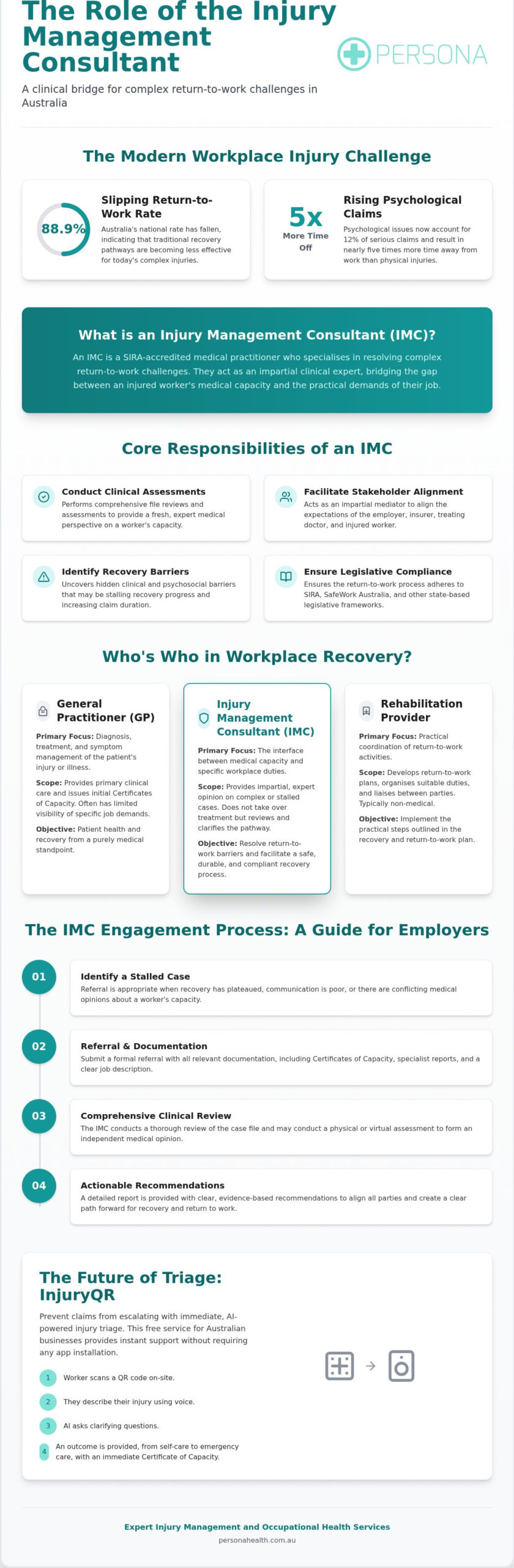
An injury management consultant (IMC) is a registered medical practitioner who has undergone specialised training to resolve complex return-to-work issues. Unlike a standard treating GP, who focuses primarily on clinical diagnosis and symptom management, an IMC specialise in the intricate interface between a person’s health and their specific job requirements. In New South Wales, these professionals must be formally accredited by the State Insurance Regulatory Authority (SIRA), ensuring they have the expertise to navigate the legislative requirements of the workers compensation system while maintaining strict clinical independence.
The primary role of the consultant is to act as an impartial mediator when recovery progress has plateaued or when there is a disagreement regarding a worker’s capacity. They don’t take over the clinical care of the patient. Instead, they provide a fresh, expert perspective to align the expectations of the employer, the insurer, and the treating doctor. This holistic approach often draws on the principles of Occupational therapy, focusing on how a worker can safely participate in workplace activities despite their current physical or psychological limitations.
To better understand this concept, watch this helpful video:
The Regulatory Framework in Australia
The remit of an IMC is strictly governed by the Workplace Injury Management and Workers Compensation Act 1998. Whether operating under the guidelines of WorkSafe Victoria or SafeWork NSW, the consultant is legally required to remain impartial. Their assessments and file reviews aren’t designed to “deny” claims. They’re designed to identify clinical barriers that might be preventing a worker from returning to their pre-injury life. This statutory independence is what builds trust between all stakeholders in a dispute.
The Business Case for Professional Consultancy
The financial stakes for Australian businesses are high. Data from 2026 shows that Australia’s national return to work rate has decreased to 88.9 per cent. When a claim lingers, workers compensation premiums inevitably rise. Professional intervention is particularly crucial for psychological concerns, which now account for 12 per cent of all serious claims and result in nearly five times the time away from work compared to physical injuries. By engaging an expert through injury management services, employers can reduce the risk of secondary psychological issues and improve overall workforce morale. It sends a clear message that the organisation is committed to a safe, sustainable, and evidence-based recovery process for its people.
Core Responsibilities: How an IMC Facilitates Recovery and Return to Work
The role of an injury management consultant is far more dynamic than simply reviewing medical certificates or chasing paperwork. They provide a clinical lens to the Rehabilitation & return to work process, ensuring that every decision is backed by medical evidence rather than assumption. This focus on evidence-based, patient-centred care is a philosophy shared by collaborative wellness clinics like Russell Health Collective, which provide specialised health services to support long-term wellbeing. By conducting comprehensive clinical assessments, they bridge the gap between what a worker believes they can do and what they are physiologically capable of performing safely. This objective oversight is often the catalyst needed to restart a recovery process that has lost momentum.
Clinical Assessment and Capacity Determination
A consultant evaluates both physical and psychological readiness for duty. This is vital when you consider that psychological concerns now account for approximately 12 per cent of all serious workers compensation claims in Australia. These cases often involve complex psychosocial barriers that a standard GP might overlook. The consultant matches clinical findings to specific job descriptions and workplace environments, ensuring that the proposed recovery timeframe is realistic. They use evidence-based medicine to determine if a worker’s current capacity allows for a gradual increase in duties or if specific workplace modifications are required to prevent a recurrence of the injury.
Mediation and Stakeholder Alignment
Communication breakdown is a leading cause of prolonged claims. Misunderstandings often arise because a treating doctor lacks the context of the modern workplace; they might inadvertently certify a worker for total incapacity simply because they aren’t aware of the diverse range of “suitable duties” available. This is where an injury management consultant steps in to facilitate a three-way dialogue between the employer, the worker, and the GP. They educate treating doctors on the Health Benefits of Good Work (HBGW) principles, demonstrating how early, safe intervention actually supports long-term clinical recovery.
They also act as a neutral party to resolve disagreements regarding the suitability of offered tasks. If a worker feels the duties are too strenuous, or if an employer feels the recovery is taking longer than expected, the consultant provides an objective clinical review. This alignment ensures that every stakeholder is working toward the same goal: a safe, durable, and sustainable return to work. If your organisation is currently navigating a particularly difficult case, seeking a professional injury management review can provide the clinical clarity needed to move forward.
Comparing Occupational Health Roles: IMC vs. Rehabilitation Provider vs. GP
Identifying the right professional for a specific stage of recovery is essential for any Australian business. While a workplace rehabilitation provider (often an allied health professional) focuses on the vocational execution of a return-to-work plan, an injury management consultant provides the clinical authority needed to drive that plan forward. This distinction is supported by WorkSafe Victoria’s guidance on OHS consultants, which emphasises the role of specialised expertise in helping employers meet their complex legislative obligations. Without this clinical oversight, even the best rehabilitation programmes can stall if the underlying medical barriers aren’t addressed.
It’s also vital to understand when to engage an Independent Medical Examiner (IME) versus an injury management consultant. An IME typically provides a “one-off” forensic assessment to determine permanent impairment or liability for insurance purposes. In contrast, an IMC is an active, collaborative participant in the recovery journey. They often work in tandem with an Occupational Physician to provide ongoing guidance, ensuring that the clinical pathway remains aligned with the worker’s evolving physical or psychological capacity.
Why an IMC is Different from a Treating Doctor
A treating GP is primarily an advocate for their patient’s general wellbeing. While this is crucial for clinical care, GPs often lack the time or specific training to assess a worker’s fitness for duty within a specific industrial context. They rarely visit worksites to understand the physical demands of a role. An IMC fills this gap by focusing specifically on the workplace environment. They assess requirements firsthand and provide an objective clinical review without taking over the patient’s treatment, maintaining a level of impartiality that a treating doctor cannot always provide.
The Synergy Between IMCs and Workplace Rehabilitation
Effective recovery requires a clinical roadmap that a rehabilitation provider can then execute with confidence. The consultant identifies what is medically safe, which allows the rehab provider to focus on ergonomic adjustments, workplace modifications, and graded duties. This collaboration becomes a powerful preventative tool when linked to on-site health surveillance. By monitoring the interaction between the worker and their environment, businesses can identify early warning signs and prevent the recurrence of injuries, ensuring that the return to work is both safe and durable for the long term.
The IMC Engagement Process: A Practical Step-by-Step Guide for Employers
Engaging an injury management consultant shouldn’t be seen as a sign of failure in your Return to Work (RTW) process. Instead, it’s a strategic clinical intervention designed to provide the clarity needed to move past complex roadblocks. Many Australian employers hesitate, waiting until a claim has spiralled or premiums have already spiked, but early engagement often leads to significantly better outcomes for both the worker’s health and the business’s bottom line. The process is methodical, transparent, and focused on finding a sustainable way forward.
When to Engage a Consultant
Recognising the “red flags” early can save months of lost productivity. You should consider a referral if you notice conflicting medical certificates, where the treating doctor’s restrictions don’t seem to align with the clinical diagnosis. Another trigger is a lack of recovery progress despite active treatment, or a breakdown in communication between the worker and their supervisor. In high-stakes environments, such as those requiring specialised rail medicals or other safety-critical roles, the clinical oversight of a consultant is essential to ensure that any return to duty doesn’t compromise workplace safety.
Preparing for a File Review or Clinical Assessment
The success of a review depends heavily on the quality of information provided to the medical professional. Before the assessment, you’ll need to gather all relevant incident reports, current Certificates of Capacity, and detailed job descriptions that outline the physical and psychological demands of the role. It’s equally important to manage the worker’s expectations. Reassure them that the injury management consultant is there to provide expert support for their recovery, not to act as a form of surveillance. Persona Health facilitates these assessments at our modern clinics in Parramatta and Rosebery in Sydney, or Cairnlea in Melbourne, ensuring a professional and neutral environment for all parties.
Once the assessment is complete, the focus shifts to implementation. A clinical report is only valuable if it leads to action. This involves updating the RTW plan to reflect the consultant’s findings on the worker’s actual physical capacity. If the report suggests specific ergonomic modifications or a different graded schedule, these should be integrated into the workplace immediately. This proactive approach keeps the recovery momentum high and demonstrates a genuine commitment to the worker’s wellbeing. If you are currently navigating a claim that has plateaued, you can request an injury management review from our experienced medical team to help get your recovery plan back on track.
Persona Health: Expert Injury Management and the Future of Triage with InjuryQR
At Persona Health, we recognise that effective recovery requires more than just clinical knowledge; it demands speed and seamless integration with your existing business systems. Our medical team provides the authority of a senior injury management consultant while ensuring that clinical reports are delivered with the fast turnaround times necessary for business continuity. We don’t believe in a one size fits all approach. Instead, we combine our extensive clinical expertise with modern digital reporting to ensure you have a clear, actionable roadmap for every injured worker. By linking our long term recovery strategies with pre-employment medicals, we help organisations identify risks before they become claims, creating a proactive culture of workplace safety.
Our reach extends across Australia, providing your business with the stability of a national network and the personalised care of a local partner. With flagship clinics in Parramatta, Rosebery, Gregory Hills, and Dee Why in Sydney, alongside Cairnlea and Craigieburn in Melbourne, we are positioned to support your team wherever they work. This physical presence is backed by a 100-clinic affiliate network and Australia-wide mobile services, ensuring that professional injury management is never out of reach for your workforce.
InjuryQR: Instant AI-Powered Triage for Modern Workplaces
The first few minutes following a workplace incident are critical for determining the trajectory of a claim. To support employers in this high pressure window, we provide InjuryQR, a free AI-powered triage service that simplifies the reporting process. There is no app to download; workers simply scan a QR code on a poster or magnet and describe their injury using voice recognition. The AI then provides immediate, evidence-based guidance, directing the worker toward self-care, a telehealth consultation, or emergency medical attention.
The benefits for your organisation are immediate and measurable. InjuryQR facilitates the issuance of Certificates of Capacity where appropriate, ensuring that the return to work process begins the moment an injury occurs. This immediate intervention has been shown to significantly reduce Lost Time Injury (LTI) rates and improve the accuracy of incident reporting. It removes the uncertainty that often leads to “doctor shopping” or unnecessary time away from work, keeping your recovery goals on track from the very first scan.
Local Support in Sydney and Melbourne
Navigating the nuances of state-specific legislation, such as the requirements set by SafeWork NSW or WorkSafe Victoria, requires a partner who understands the local landscape. Our consultants are experts in these frameworks, providing you with the peace of mind that your compliance obligations are always met. Beyond our clinical assessments, we empower your onsite teams by providing free physical InjuryQR assets, including durable posters and magnets for your staff rooms or vehicles. This ensures that every member of your team has a direct, clinical pathway to recovery in the palm of their hand. By choosing Persona Health, you aren’t just hiring an injury management consultant; you are engaging a modern professional partner dedicated to the health and productivity of your most valuable resource: your people.
Optimising Your Workplace Recovery Strategy for 2026
Effective recovery is more than just a clinical process; it’s a strategic alignment between a worker’s health and their professional capacity. We’ve explored how an injury management consultant acts as the essential mediator to resolve complex disputes and provide the clinical roadmap required for a durable return to work. By addressing psychosocial barriers early and ensuring that medical certificates match the actual demands of the job, your organisation can significantly reduce Lost Time Injury (LTI) rates and maintain a more resilient workforce.
Persona Health is committed to providing this high level of clinical oversight with the speed your business demands. Our experienced medical team across Sydney and Melbourne offers fast turnaround times on all clinical assessments, ensuring you never lose momentum during a claim. We also provide free InjuryQR triage for all our Australian clients, giving you the tools to manage incidents with AI-powered precision from the very first minute.
Contact Persona Health today to discuss how our injury management consultants can support your team’s recovery and return to work. We look forward to helping you build a safer, more productive workplace where every individual’s recovery is handled with the professional care and clinical expertise they deserve.
Frequently Asked Questions
What is the primary role of an injury management consultant?
The primary role of an injury management consultant is to act as an impartial medical mediator when return to work progress has stalled. They provide expert clinical advice to align the worker’s physical or psychological capacity with their specific job requirements. By reviewing medical files and assessing the individual, they help resolve disagreements between treating doctors and employers, ensuring a clear and safe pathway forward.
How does an IMC differ from a rehabilitation provider in Australia?
An IMC is always a registered medical practitioner with specialised training, whereas a rehabilitation provider is typically an allied health professional. While the rehab provider handles the vocational execution of a claim, such as coordinating workplace modifications, the consultant provides the clinical authority and medical roadmap. This ensures that all recovery goals are grounded in evidence-based medical practice rather than just vocational milestones.
Is an injury management consultant’s report legally binding?
An IMC’s report is not legally binding in the same way as a court order, but it carries significant weight within the Australian workers compensation system. Insurers and employers use these professional opinions to make informed decisions about claim liability and suitable duties. Because the consultant is accredited and impartial, their recommendations are often the primary evidence used to resolve disputes regarding a worker’s clinical capacity.
Who pays for the services of an injury management consultant?
The cost of engaging an injury management consultant is usually covered by the workers compensation insurer as part of the claim management process. In some instances, an employer may choose to engage a consultant directly for a private fitness for duty assessment to manage workplace safety and productivity proactively. You should check with your insurer to confirm the specific funding arrangements for your current case.
Can an employee refuse to see an injury management consultant?
Employees generally have a legislative obligation to participate in the injury management process under the Workplace Injury Management and Workers Compensation Act 1998. While a worker might feel hesitant, refusing to attend a required assessment can sometimes impact their ongoing entitlement to benefits. It’s helpful to reassure the worker that the consultant’s role is to support their safe recovery and sustainable return to the workplace.
What is the difference between an IMC and an Independent Medical Examiner (IME)?
An IMC is a collaborative partner focused on the ongoing recovery process, while an Independent Medical Examiner (IME) provides a forensic, one-off assessment. IMEs are typically used to determine permanent impairment or liability for a claim. In contrast, the consultant works with all parties to resolve clinical barriers and facilitate a gradual increase in duties over time through active mediation.
How do I find a SIRA-approved injury management consultant in Sydney?
You can find accredited consultants through the official SIRA website or by partnering with a specialist occupational health provider like Persona Health. We have experienced medical professionals available at our clinics in Parramatta, Rosebery, Gregory Hills, and Dee Why. Our team understands the specific requirements for Sydney workplaces and provides fast turnaround times on all clinical reporting and assessments.
What should I do if an IMC’s recommendations conflict with the treating GP’s advice?
If a conflict arises, the consultant will usually attempt to contact the treating GP directly to discuss the clinical findings and the specific requirements of the workplace. The goal is to reach a consensus based on the Health Benefits of Good Work principles. If a disagreement persists, the insurer will typically rely on the specialist expertise of the consultant to determine the most appropriate and safe capacity for the worker.

Article by
Ian Nicholson
Ian is the Business Support Manager at Persona Health, where he plays a key role across IT, sales, marketing and business operations. With a broad skill set and a practical, solutions-focused approach, Ian helps drive the systems, communication and commercial strategy that support Persona Health’s continued growth across Australia.