

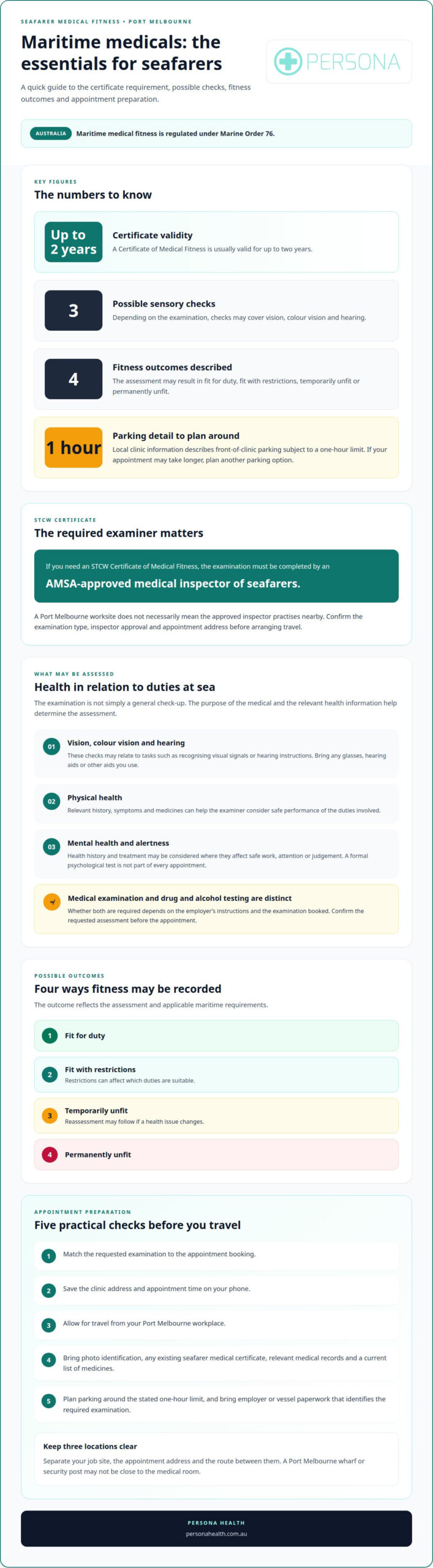
For seafarers seeking an STCW certificate, a medical examination must be completed by an AMSA-approved medical inspector of seafarers to obtain a Certificate of Medical Fitness. In Australia, maritime medical fitness is regulated under Marine Order 76, and certificates are usually valid for up to two years. If you’re arranging maritime security medicals in Port Melbourne, knowing which examination applies is an important first step.
It’s understandable to want clear answers before booking, especially when your work depends on meeting the right medical requirements. A maritime medical is more than a general health check: it assesses whether your health is compatible with safe work at sea and may include vision, colour vision and hearing checks.
This guide explains who needs a maritime medical, what the fitness assessment can involve and how outcomes are determined. It also covers the Australian requirements and what to consider when looking for an AMSA-approved inspector in or near Port Melbourne.
Key Takeaways
- If you need an STCW Certificate of Medical Fitness, your examination must be completed by an AMSA-approved medical inspector of seafarers.
- Understand how vision, colour vision and hearing assessments can contribute to a maritime fitness examination.
- Learn how Australian medical fitness rules apply and what different fitness outcomes can mean for your duties.
- Approved inspectors may not be available in every location, so appointment planning can include travel.
- Find out when Persona Health’s Independent Medical Examiner service may be relevant to your occupational health needs.
Clinic location and contact details
Port Melbourne is a work location, but that does not mean an approved medical inspector practises nearby. Maritime security roles may be based around port facilities, while the appointment takes place at a separate clinic. Confirm the appointment address and examination type before planning travel from your workplace. This distinction matters if your employer requires an examination by an AMSA-approved medical inspector.
When comparing Port Melbourne clinics for maritime medicals, check whether the inspector is AMSA-approved for the examination you need, whether an appointment suits your schedule and how easily you can reach the clinic from your job site. Confirm appointment times and the clinic’s exact address before arranging time away from work.
Available local information describes a clinic with front-of-clinic parking subject to a one-hour limit. Allow time to find the entrance, park and complete reception steps within that limit. If you expect the appointment to take longer, plan another parking option in advance. Port Melbourne traffic and your shift start time may also affect when you need to leave.
For the clinic location and access, separate three details: the job site, the appointment address and the route between them. A Port Melbourne wharf or security post may not be close to the medical room. Check the suburb and street address on your appointment confirmation, then plan public transport or driving. Melbourne clinic information is available on the Melbourne clinic page, which helps distinguish metropolitan services from a Port Melbourne workplace.
Bring photo identification, any existing seafarer medical certificate, relevant medical records and a current list of medicines to your Port Melbourne appointment. Include employer or vessel paperwork that identifies the required examination. These documents help the examiner understand your health history and the purpose of the assessment. Keep your appointment confirmation handy, especially if it includes forms or booking instructions.
Before travelling, take these practical steps:
- Match the requested examination to the appointment booking.
- Save the clinic address and appointment time on your phone.
- Allow for travel from your Port Melbourne workplace.
- Bring identification and relevant medical paperwork together.
- Plan parking around the stated one-hour limit.
For maritime security medicals in Port Melbourne, accurate location details help prevent unnecessary travel and scheduling confusion. The right appointment depends on the certificate or work requirement, the inspector’s approval and access to the clinic. Keep your job location separate from the examination address when coordinating with your employer or vessel operator.
Physical and mental fitness assessments
An Australian maritime medical assesses whether a seafarer’s health is compatible with their duties at sea. It is not simply a general check-up. The examiner considers the purpose of the examination and relevant health information, then assesses the areas required for that medical. The demands of one vessel or role may differ from those of another.
An Australian maritime medical may include vision, colour vision and hearing checks. These relate to practical tasks, such as recognising visual signals or hearing instructions in a working environment. The specific checks depend on the examination. Tell the examiner about any glasses, hearing aids or other aids you use, and bring them to the appointment.
Physical fitness is considered in relation to safe performance of duties, not as a single measure of general athletic ability. Your medical history, current symptoms and medicines can help the examiner understand your health. Explain any condition that affects movement, stamina or alertness, and describe your treatment. Accurate information supports an assessment based on your circumstances.
Mental health can also be relevant to fitness for duty. The examiner may consider your health history and whether a condition or treatment affects safe work, including attention or judgement. This does not mean every appointment involves a formal psychological test. Be ready to discuss relevant concerns clearly, including how they affect your usual duties or ability to respond to workplace demands.
Do Port Melbourne maritime medicals include drug and alcohol testing? A maritime medical and drug and alcohol testing are distinct assessment types. Whether both are required depends on the employer’s instructions and the examination booked, so the requested assessment should be clear before the appointment.
To make the examination relevant, describe your usual duties accurately. A seafarer with security duties may face different demands from someone assigned administrative tasks aboard a vessel. Explain any relevant shift pattern, safety responsibilities or physical requirements provided by your employer. This helps the examiner relate the assessment to the medical’s purpose rather than make assumptions about maritime work.
Bring a current medicine list and relevant medical records, particularly if you have an ongoing condition or a recent change in treatment. Include details about the condition, treatment and any effects you notice at work. Bring vision or hearing aids you use regularly as well. These steps help the examiner consider your health information alongside the required checks.
The outcome reflects the assessment and the applicable maritime requirements. It may be fit for duty, fit with restrictions, temporarily unfit or permanently unfit. Restrictions can affect which duties are suitable, while a temporary outcome may involve reassessment after a health issue changes. For maritime security roles in Port Melbourne, the key is to match the examination to the work and certificate requirements.
Australian seafarer medical fitness regulation
Australian seafarer medical fitness requirements depend on the work and certificate involved. According to the Australian Maritime Safety Authority (AMSA), seafarer medical fitness in Australia is regulated under Marine Order 76 (Health – medical fitness). This is the central regulatory reference for understanding which medical examination applies to a seafarer’s circumstances.
To obtain an STCW Certificate of Medical Fitness, you must have the examination completed by an AMSA-approved medical inspector of seafarers. The inspector’s approval matters: a general health examination alone does not meet this requirement. Before booking, establish whether your work or certificate application requires an STCW examination, then arrange an appointment with an inspector approved for seafarer medicals.
Medical certificates are usually valid for up to two years. “Up to” describes the usual maximum validity, not a promise that every certificate lasts for that period. The certificate and medical outcome relate to the examination completed. Keep the certificate details available for employment or certification processes, and note its validity period so you can plan ahead.
The assessment may result in one of four fitness outcomes: fit for duty, fit with restrictions, temporarily unfit or permanently unfit. A restriction can affect which duties a seafarer may perform. A temporary unfit outcome differs from a permanent one. These categories describe fitness in relation to maritime work, rather than acting as a simple pass-or-fail label.
For example, being fit with restrictions is a different outcome from being temporarily unfit. The wording matters because an employer or certification process may need to understand the relevant duties and any stated limitations. Read the outcome alongside the certificate rather than treating “fit” as the only possible result.
For seafarers working around Port Melbourne, the practical first step is to identify the certificate pathway. An STCW requirement means the examination must be completed by an AMSA-approved medical inspector of seafarers. Other maritime roles may require a different examination, so a job title alone does not determine which medical applies. The required certificate or employer instruction helps define the appointment.
Use this short sequence to prepare:
- Identify the certificate or medical requirement linked to your role.
- For an STCW Certificate of Medical Fitness, arrange examination with an AMSA-approved medical inspector of seafarers.
- Keep the certificate and its stated outcome available for relevant work processes.
- Make a note of the validity period, which is usually up to two years.
Marine Order 76 provides the Australian regulatory framework, while the certificate requirement determines the relevant examination pathway. Keeping those two points clear helps seafarers distinguish a general medical appointment from the examination needed for a specific maritime certificate.
Availability of approved medical inspectors
Start your search for an appropriate Port Melbourne appointment by identifying the examination required. For an STCW Certificate of Medical Fitness, the examination must be completed by an AMSA-approved medical inspector of seafarers. Some locations do not have an approved inspector, so seafarers may need to travel. A nearby general medical clinic is not necessarily suitable for this certificate pathway.
How soon can you book and receive results for a Port Melbourne seafarer medical? Booking depends on an approved inspector’s appointment availability. Results follow completion of the required examination, with timing influenced by the assessments needed and whether additional information is required.
Break the appointment search into practical steps. First, identify the certificate or work requirement provided by your employer or vessel. Next, establish whether it requires an STCW examination. Then arrange an appointment with an inspector approved for seafarer medicals. This helps prevent booking a general medical assessment when your certificate requires a specific examination.
Port Melbourne’s location does not guarantee that an inspector practises nearby. If the available appointment is elsewhere, travel may be necessary. Consider the clinic address, journey time and shift arrangements together. For example, a seafarer rostered near the port may need to allow for travel before or after a duty period.
Appointment availability and result timing are separate considerations. Availability determines when the examination can take place. Results depend on completing the examination and any required follow-up. If the examiner needs additional information, further steps may be needed before the outcome is finalised. Avoid planning a vessel assignment around an assumed result date.
Before arranging travel, have the relevant details ready:
- The certificate or medical requirement linked to your role.
- Your employer’s instructions about the examination.
- Your preferred appointment location and travel constraints.
- Relevant medical records and a current list of medicines.
- Contact details for receiving appointment and result information.
These details help clarify the appointment’s purpose and reduce avoidable booking changes. If no inspector is available in Port Melbourne, a wider search may identify an appointment location that suits your work arrangements. The right choice still depends on the certificate requirement, not just the shortest journey.
When arranging the appointment, ask about the examination type, address and required documents. Keep the confirmation with your employer’s instructions. This gives you a clear reference if work schedules change or the appointment requires travel.
For maritime security work around Port Melbourne, plan around the approved inspector and required examination rather than assuming both are available locally. Allow time for the result process after the assessment, especially if further information is needed. Clear scheduling helps you coordinate medical requirements with your employer’s timetable.
What maritime security medical examinations are available in Port Melbourne?
The examination required depends on the certificate or work requirement, not just the Port Melbourne job location. For an STCW Certificate of Medical Fitness, the examination must be completed by an AMSA-approved medical inspector of seafarers. A general workplace medical and a seafarer certificate examination serve different purposes, so book the assessment that matches the required outcome.
A seafarer fitness assessment may include vision, colour vision and hearing checks. These can relate to tasks such as recognising signals or hearing instructions. The examiner considers the examination’s purpose and relevant health information. The specific checks depend on the medical being completed.
Other maritime security medical requests may be part of an employer’s fitness-for-work process rather than an STCW certificate application. In that case, the employer’s instructions define the assessment. For example, a hiring process may request a pre-employment medical, while a seafarer seeking an STCW certificate needs the approved inspector pathway. These are not interchangeable bookings.
Drug and alcohol testing is a separate assessment, not a seafarer medical examination. If your employer requires both, the instructions should identify each requirement so the booking can account for both. A testing request alone does not mean an STCW medical has been completed.
Before arranging a maritime medical in Port Melbourne, clarify these details:
- The certificate, role or employer requirement the examination must address.
- Whether an STCW Certificate of Medical Fitness is required.
- Whether the appointment must be with an AMSA-approved medical inspector of seafarers.
- Whether separate drug and alcohol testing is requested.
- Which clinic location can complete the required examination.
This information helps distinguish a seafarer certificate examination from other occupational assessments. If the requirement names an STCW certificate, the inspector’s approval is essential. If it names a different workplace assessment, the employer’s stated purpose guides the appointment.
For maritime security medicals in Port Melbourne, match the examination to the written requirement before booking. An employer’s email, onboarding document or certificate instruction can clarify the purpose. Bring that information and relevant medical records to the appointment so the examiner understands both the request and your health history.
Port Melbourne is your work location, but it does not determine which examination applies or guarantee that an approved inspector practises nearby. Some locations do not have an AMSA-approved medical inspector, so travel may be needed. Confirming the examination type first helps you plan the right appointment and avoid confusing a general medical with a certificate-specific assessment.
Persona Health: Independent Medical Examiner
Persona Health provides Independent Medical Examiner assessments for occupational health matters. This is separate from an AMSA seafarer medical and doesn’t replace an STCW certificate examination. Persona Health also offers Pre-Employment Medicals, Workplace Injury Management and Crystalline Silica Medicals, with an employer-focused approach, responsive customer service, fast turnaround times and modern digital reporting.
For Melbourne-based occupational health support, Persona Health has locations in Cairnlea and Craigieburn, alongside Parramatta, Rosebery, Gregory Hills and Dee Why in Sydney. Its network includes 100 affiliate clinics nationwide, with Australia-wide mobile workplace services. InjuryQR is a free AI-powered triage service for Australian businesses: workers scan a QR code without downloading an app, describe an injury by voice, and answer AI follow-up questions. It can provide self-care advice, telehealth, Emergency Department direction or instructions to call 000. Certificates of Capacity can be issued immediately where appropriate. This process supports reporting and can help reduce Lost Time Injuries.
Contact Persona Health to discuss your occupational health needs.
Take the next step with a clear medical pathway
Before arranging maritime security medicals in Port Melbourne, turn the requirement into a clear plan for your next work or certification step. Keep the relevant instructions together and ensure the appointment matches the outcome you need. This helps you coordinate the medical with your work schedule and avoid treating different occupational assessments as interchangeable.
Your circumstances and work goals are individual. If you’re unsure which occupational health support suits your situation, explain the requirement and the decision you need to make. Persona Health provides occupational health services, including independent medical assessments. A clear conversation can help establish a practical next step while keeping occupational assessments distinct from maritime certification requirements.
With the right information, you can move forward with greater clarity and focus on your next role or assignment.
Frequently Asked Questions
Who needs a maritime medical?
Seafarers seeking an STCW certificate need a seafarer medical examination to obtain a Certificate of Medical Fitness. Maritime security workers may also need an occupational medical if their employer or role requires one, but a security job alone does not establish that an STCW examination applies. Before arranging an appointment, confirm whether your paperwork specifies a seafarer certificate or an employer fitness assessment.
Which clinics in Port Melbourne conduct maritime or seafarer medicals?
An STCW medical must be conducted by an AMSA-approved medical inspector of seafarers. A clinic’s location in Port Melbourne does not establish that it can complete this examination. Some locations do not have an approved inspector, so seafarers may need to travel. Use the certificate requirement to identify the appointment you need, then plan around the inspector’s clinic location and your work schedule.
What are the requirements for an Australian maritime security medical?
The requirement depends on whether you need an STCW Certificate of Medical Fitness or an employer-requested assessment. For the STCW certificate, the examination must be completed by an AMSA-approved medical inspector of seafarers. Employer paperwork can clarify whether a separate workplace medical or drug and alcohol test is required. Keep these requirements distinct: a drug and alcohol test does not replace the certificate examination.
What medical standards apply to Australian seafarers and maritime security workers?
Australian seafarer medical fitness is regulated under Marine Order 76 (Health – medical fitness). The examination may assess vision, colour vision and hearing, alongside relevant health information and duties. Possible outcomes include fit for duty, fit with restrictions, temporarily unfit or permanently unfit. Maritime security workers who aren’t seeking an STCW certificate may have employer-specific assessment requirements, so their role documentation helps define the applicable medical.

Article by
Ian Nicholson
Ian is the Business Support Manager at Persona Health, where he plays a key role across IT, sales, marketing and business operations. With a broad skill set and a practical, solutions-focused approach, Ian helps drive the systems, communication and commercial strategy that support Persona Health’s continued growth across Australia.