
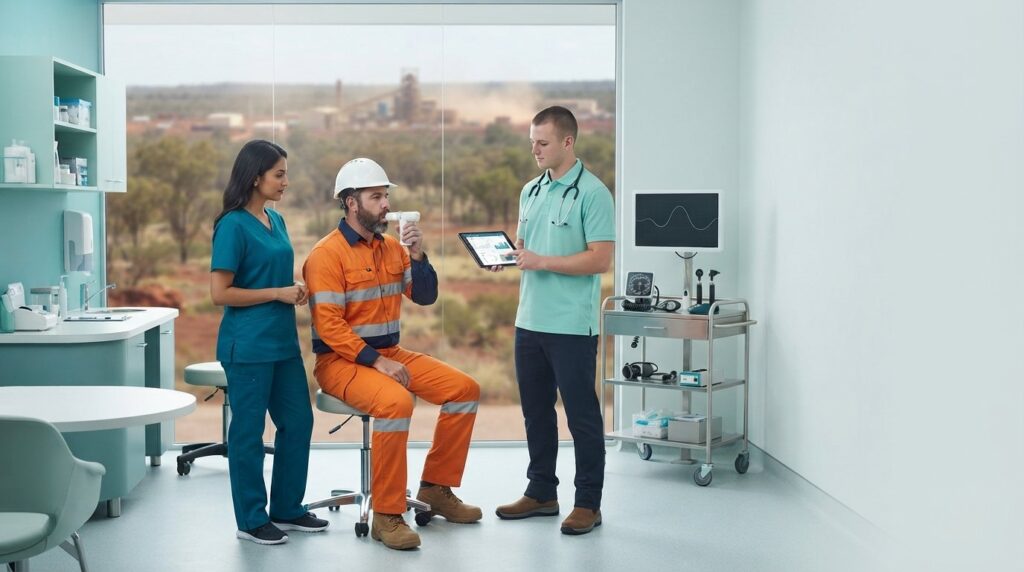
What if your screening process was a strategic asset rather than a logistical hurdle? In the high-stakes world of Australian resources, a pre employment medical mining assessment is often viewed as a final box to tick, yet it serves as your first line of defence against workplace injuries and operational downtime. We understand the frustration of seeing a prime candidate’s start date slip away because of slow medical turnarounds or the complex maze of state-specific legislative requirements. It’s a pressure that can compromise both your safety culture and your bottom line.
Managing a workforce in 2026 requires more than just a basic health check; it demands a deep understanding of evolving standards and a commitment to the unique well-being of every individual. This guide will help you master the complexities of Australian mining medicals to ensure a safe, compliant, and healthy workforce. We’ll explore how to navigate legislative compliance across different jurisdictions, reduce the high cost of Lost Time Injuries (LTIs), and implement fast, accurate medical reporting to keep your recruitment pipeline moving smoothly.
Key Takeaways
- Understand the complex legislative landscape across NSW, Victoria, and Queensland to ensure your operations meet the latest 2026 standards set by authorities like SafeWork NSW and WorkSafe Victoria.
- Learn how a tailored pre employment medical mining assessment serves as a vital fitness for work benchmark, helping to identify potential risks before a worker sets foot on site.
- Discover how to customise medical assessments based on specific job descriptions to ensure every team member is physically and mentally prepared for their unique role.
- Identify practical ways to streamline your recruitment process and reduce “time-to-hire” through centralised bookings and rapid digital reporting.
- Explore the benefits of partnering with a national occupational health provider to maintain high standards across multiple sites using a broad network of affiliate clinics.
Understanding Pre-Employment Medicals for the Australian Mining Industry
In the Australian mining industry, safety isn’t just a policy; it’s a fundamental requirement for survival and success. A pre employment medical mining assessment is a specialised fitness for work evaluation designed to ensure that every individual is physically and mentally capable of handling the rigours of the site. These assessments aren’t arbitrary. They’re carefully structured to align with SafeWork Australia standards and specific state Work Health and Safety (WHS) legislation, ensuring that your business stays compliant while protecting your most valuable asset: your people.
The primary objective is to identify any pre-existing conditions that might be exacerbated by the harsh mining environment. By establishing baseline health data, we create a vital reference point for long-term health surveillance. This proactive approach helps prevent chronic issues from developing and ensures that workers can enjoy a long, healthy career. You can learn more about our comprehensive approach to pre-employment medicals on our dedicated service page.
Legislative Framework: NSW Order 43 and QLD Coal Board Medicals
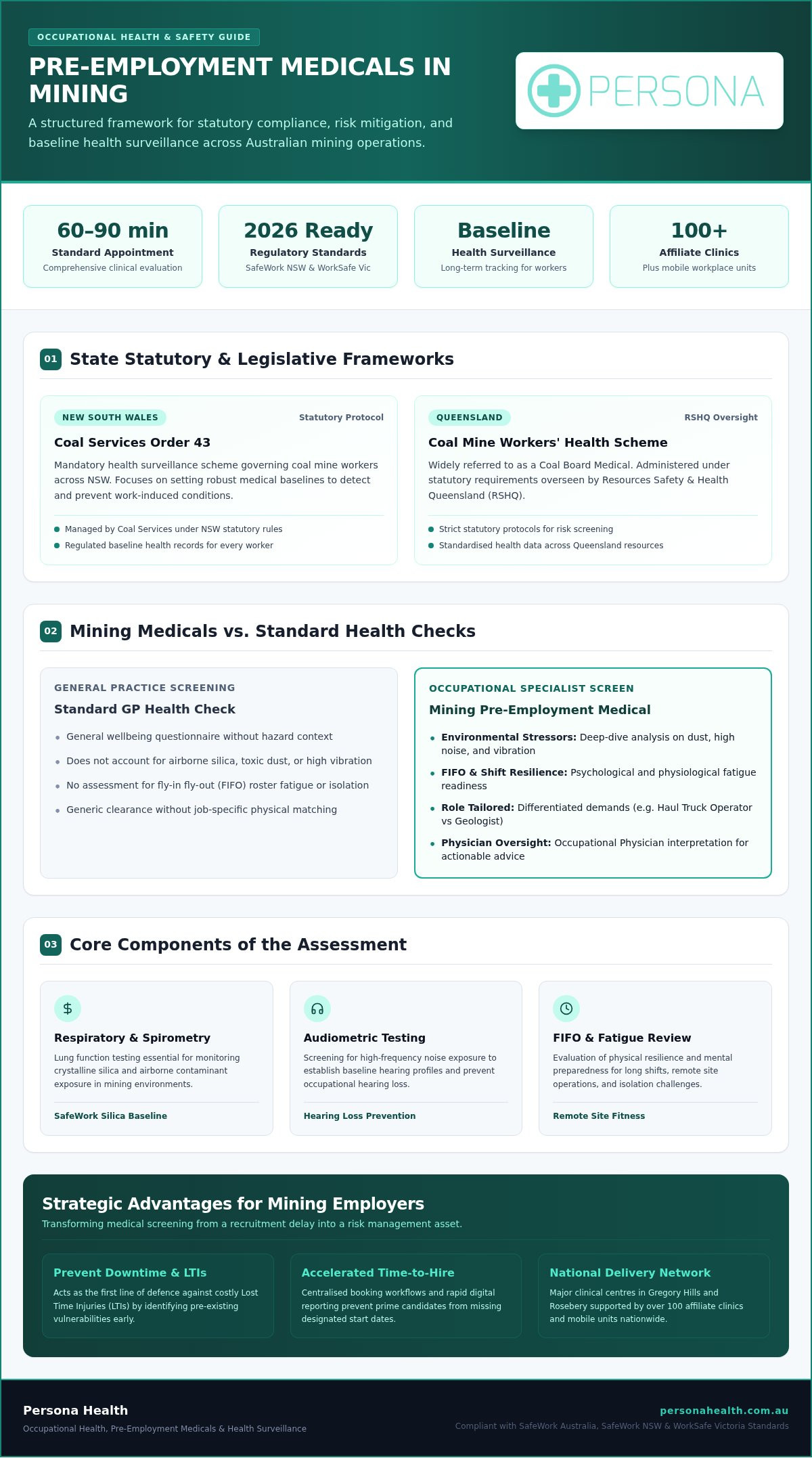
For operations in New South Wales, the process is governed by Order 43, a statutory requirement managed by Coal Services to monitor the health of coal mine workers. Across the border, the Queensland Coal Mine Workers Health Scheme, often referred to as a Coal Board Medical, follows strict statutory protocols now overseen by Resources Safety & Health Queensland (RSHQ). These frameworks ensure that health data is consistent and that workers are screened for specific risks inherent to coal mining. Navigating these requirements can be complex, but they’re essential for maintaining a legally compliant workforce.
Why Mining Medicals Differ from Standard Health Checks
Unlike a standard GP check-up, a mining medical focuses heavily on environmental stressors. We look closely at how a worker’s body might respond to prolonged exposure to dust, high-frequency noise, and constant vibration. This is why we include rigorous testing such as spirometry for lung function and audiometry for hearing. These aren’t just “extra” tests; they’re essential benchmarks for people working in high-risk zones.
Assessment for remote site work isn’t just about physical strength. It’s about resilience. A standard check-up doesn’t account for the psychological and physiological toll of fly-in fly-out (FIFO) rosters. We evaluate a candidate’s ability to thrive in isolation and manage the fatigue that comes with long shifts. Our clinics in Gregory Hills and Rosebery specialise in these deep-dive assessments, providing you with the clarity needed to make informed hiring decisions.
Core Components of a Mining Medical Assessment
A typical pre employment medical mining appointment usually lasts between 60 to 90 minutes. It’s a comprehensive session that moves beyond a simple questionnaire. We tailor each assessment to the specific job description and site requirements, ensuring that a haul truck operator and a site geologist are both evaluated against the unique physical demands of their roles. A thorough pre-employment medical check serves as the foundation of site safety, providing the baseline needed to manage health risks effectively.
Our Occupational Physicians play a central role in this process. They don’t just record data; they interpret complex results to determine fitness for duty. This expert oversight ensures that medical findings are translated into practical, actionable advice for employers, aligning with mining workplace health and safety standards. This level of clinical scrutiny is what distinguishes a professional assessment from a generic health screen.
Respiratory Health: Spirometry and Crystalline Silica Surveillance
Mining environments often involve exposure to airborne contaminants. Spirometry, or lung function testing, is critical for detecting early signs of impairment. This is especially vital when monitoring for crystalline silica exposure, which carries mandatory monitoring requirements under Australian law. We follow strict Australian Standards for respiratory fit testing to ensure that personal protective equipment actually provides the necessary defence against fine particulates.
Physical Capacity and Functional Assessments
A candidate’s ability to handle the physical rigours of the pit is measured through a physical abilities test. This involves lifting, reaching, and cardiovascular fitness assessments. Functional capacity evaluations (FCE) predict how well a worker will cope with repetitive tasks or heavy lifting. For machinery operators, we pay close attention to joint range of motion and spinal health, as prolonged sitting and vibration can exacerbate underlying musculoskeletal issues.
Managing physical safety also means having a plan for when things go wrong. We recommend implementing InjuryQR, a free AI-powered triage service for all Australian businesses. If a worker is injured, they simply scan a QR code, describe the incident by voice, and receive immediate guidance. This can include self-care advice or a telehealth appointment within 3 to 4 hours. By issuing Certificates of Capacity immediately where appropriate, InjuryQR helps reduce Lost Time Injuries (LTIs) and ensures your incident reporting is both fast and accurate.
Audiometry and Vision Standards in High-Risk Zones
Noise-induced hearing loss is a significant risk in the resources sector. We conduct baseline audiometry tests in accordance with AS/NZS 1269.4 to monitor hearing health over time. Similarly, vision standards are strictly enforced. Colour blindness testing is essential for safety-critical roles, such as electrical work or operating complex machinery where colour-coded signals are used. At our specialised clinics in Gregory Hills and Rosebery, we use modern digital reporting to ensure these vision and hearing benchmarks are met with precision. If you are ready to enhance your screening process, you can learn more about our tailored approach.
Compliance and Legislative Standards Across Australian States
Compliance in the resources sector isn’t a one-size-fits-all model. While Safe Work Australia mining safety guidelines provide a national foundation, each state operates under its own specific regulatory framework. In New South Wales, the focus is heavily on Order 43 requirements managed by Coal Services. Across the border, Queensland follows the Resources Safety & Health Queensland (RSHQ) statutory medicals. Meanwhile, in Victoria, WorkSafe Victoria oversees health standards with a sharp focus on the Occupational Health and Safety Act 2004, particularly regarding crystalline silica and quarry safety. Navigating these differences requires a partner who understands the local nuances of each jurisdiction.
Handling sensitive health data is a significant responsibility. Every pre employment medical mining assessment generates a wealth of private information that must be managed according to the Privacy Act 1988 and the Australian Privacy Principles. We take this duty seriously. Persona Health ensures that every clinic within our affiliated clinic network adheres to strict data security protocols. This ensures that your candidates’ medical history remains confidential while providing you with the clear, high-level fitness for work determinations you need to make hiring decisions.
Meeting the Health Standards for Mining and Quarrying
The health standards for underground mining are often more stringent than those for surface quarrying due to increased risks of atmospheric contaminants and isolation. A “Fitness for Work” determination isn’t just a “yes” or “no” answer. It’s a clinical opinion on whether a worker can perform their duties without risking their health or the safety of others. We use modern digital reporting to communicate these results to employers instantly. This speed is vital for maintaining compliance without slowing down your recruitment pipeline, ensuring that every worker on your site has a current, valid medical clearance.
Drug and Alcohol Screening: Zero Tolerance in the Pits
Safety in a high-risk environment like a mine pit is incompatible with substance use. That’s why drug and alcohol testing is a non-negotiable component of any mining medical. In the Australian workplace context, we typically use either urine or saliva testing. Urine testing is often preferred for its ability to detect historical use, while saliva testing is excellent for identifying recent use and potential impairment. We conduct all screenings in strict accordance with Australian Standards, including AS/NZS 4308:2008 for urine and AS/NZS 4760:2019 for saliva. This ensures that every test result is legally defensible and clinically accurate, supporting your site’s zero-tolerance policies.
Streamlining the Assessment Process to Reduce Recruitment Delays
Reducing “time-to-hire” is a critical priority for any mining recruiter. When you centralise your pre employment medical mining bookings, you eliminate the administrative burden of managing multiple providers and inconsistent reporting formats. Fast turnaround times for medical reports are essential in a competitive labour market; a delay of even 48 hours can mean losing a top-tier candidate to a rival site. We prioritise clear, responsive communication between our clinics, your recruitment team, and the candidate to ensure the process remains transparent and efficient. For a deeper look at the broader landscape, our pre-employment medical guide provides a comprehensive overview of current national standards.
Candidate Preparation: What to Tell Your New Hires
A significant number of recruitment delays stem from avoidable “failed” tests or inconclusive results caused by poor candidate preparation. To keep your timeline on track, provide your new hires with a clear checklist before they visit our Gregory Hills or Rosebery clinics. Preparation prevents failure. Ensure candidates know to bring a valid photo ID, such as a driver’s license or passport, and wear comfortable, loose-fitting clothing suitable for a physical functional assessment.
Physiological factors can easily skew results. We recommend that candidates avoid loud music or noisy environments for at least 16 hours before an audiometry test to ensure an accurate baseline. Staying well-hydrated with water is vital for urine samples, but candidates should avoid caffeine and energy drinks, as these can artificially spike blood pressure and heart rate. Honesty regarding medical history is equally important. Candidates should understand that disclosure isn’t about finding reasons to exclude them; it’s about ensuring they are placed in a role where they can work safely without risking their long-term health.
Managing Results and the Fit for Work Determination
Once the assessment is complete, we provide a clear fitness for work determination. Most candidates will be cleared as “Fit” for their intended role. However, you may also receive results categorised as “Fit with Restrictions” or “Temporarily Unfit.” A restriction doesn’t necessarily mean the candidate is unsuitable for your operations. It might simply mean they require specific ergonomic adjustments or should avoid certain heavy lifting tasks for a set period.
Our employer-focused approach at Persona Health means we provide practical, actionable advice on how to manage these restrictions safely within your operational needs. We don’t just deliver data; we deliver solutions that help you maintain a safe site. By utilising our network of 100 affiliate clinics, you can ensure this high standard of professional reporting is maintained across every site in Australia, regardless of how remote the location may be.
Why Choose Persona Health for Your Mining Workforce
Persona Health isn’t just a service provider; we’re a modern, responsive partner dedicated to the longevity of your workforce. In the fast-paced resources sector, you need more than just a medical certificate. You need a team that understands the strategic importance of a pre employment medical mining assessment in building a resilient, high-performing team. Our approach balances clinical authority with a deep empathy that reduces candidate anxiety, ensuring you get the most accurate results possible while your recruits feel supported and valued.
Managing national operations is simplified through our extensive network of over 100 affiliate clinics. Whether your recruits are in regional Western Australia or central Queensland, we maintain a consistent standard of care and digital reporting. This national reach, combined with our employer-focused approach, ensures that your recruitment drives stay on schedule, no matter where your candidates are based. We see the pre-employment stage as the beginning of a long-term safety partnership. By integrating these initial assessments with our injury management services, we create a continuous health profile for your workers. This holistic view allows for better risk mitigation and more effective return-to-work outcomes if an incident does occur.
Our Clinics in Gregory Hills, Rosebery, and Beyond
Our specialised facilities in Gregory Hills and Rosebery are purpose-built to handle the technical requirements of mining medicals. We also maintain significant hubs in Parramatta and across Melbourne in Cairnlea and Craigieburn. For Sydney and Melbourne based recruits, these local clinics provide a convenient, professional environment that reflects the high standards of your own organisation. This local presence is backed by our Australia-wide mobile workplace services, which can bring health surveillance and testing directly to your site or regional hub.
Beyond the Medical: Injury Management and InjuryQR
Site safety doesn’t end once the worker is cleared for duty. We provide all our mining clients with access to InjuryQR, a free AI-powered triage service. This tool is a game-changer for reducing Lost Time Injuries (LTIs). If a worker is injured on site, they simply scan a QR code on a poster or magnet and describe their injury by voice. The AI asks follow-up questions and provides immediate outcomes: self-care advice, a telehealth appointment (typically within 3 to 4 hours), or a direction to the Emergency Department.
This immediate response ensures that minor issues don’t escalate into long-term workers’ compensation claims. Because Certificates of Capacity can be issued immediately where appropriate, your site safety reporting is improved, and workers receive the right care at the right time. It’s a proactive way to manage risk that complements the baseline data gathered during their initial pre employment medical mining. By choosing Persona Health, you’re investing in a technology-led approach that keeps your site safe and your reporting accurate.
Securing Your Mining Workforce for 2026 and Beyond
Navigating the complex landscape of 2026 requires a proactive approach to occupational health that balances regulatory compliance with operational speed. A robust pre employment medical mining strategy ensures that your team meets the rigorous standards set by SafeWork NSW and WorkSafe Victoria without stalling your recruitment pipeline. By leveraging our specialist clinics in Gregory Hills and Rosebery, alongside our national network of 100 affiliate clinics, you gain access to fast digital reporting and expert clinical oversight. This partnership extends beyond the initial hire, as our free InjuryQR triage service provides your site with an immediate, AI-powered response to any workplace incident.
We’re here to help you manage the complexities of occupational health with a partner-led approach that puts your people first. Let’s work together to create a safer, healthier future for the Australian resources sector.
Frequently Asked Questions
How long does a mining pre-employment medical take?
A standard pre employment medical mining assessment generally takes between 60 and 90 minutes to complete. This timeframe allows our clinicians to conduct a thorough physical examination, functional capacity evaluation, and specific screenings like audiometry and spirometry. The duration might vary slightly depending on the specific site requirements or if additional tests, such as crystalline silica surveillance, are necessary for the candidate’s particular role in the pit or underground.
What happens if a candidate fails their mining medical?
Failing a medical is rarely a simple “yes” or “no” outcome. Instead, candidates are typically categorised as Fit, Fit with Restrictions, or Temporarily Unfit. If a candidate has a manageable condition, our Occupational Physicians provide actionable advice on how they can work safely with specific adjustments. This employer-focused approach helps you retain talent while maintaining strict adherence to mining workplace health and safety standards across your operations.
Are NSW Order 43 medicals different from standard pre-employment checks?
Yes, NSW Order 43 medicals are distinct from standard checks because they are a statutory requirement under the Coal Industry Act 2001. These assessments are specifically designed to monitor the long-term respiratory health of coal mine workers. They include more rigorous lung function testing and chest X-rays compared to a general fitness for work assessment, ensuring compliance with the unique health risks found in the NSW coal industry.
How often do mining employees need to have their health monitored?
Health monitoring frequency depends on the specific legislation and the hazards present on your site. For coal miners in NSW, Order 43 medicals are required every three years. However, if your workers are exposed to hazardous substances like crystalline silica or asbestos, more frequent annual monitoring is often mandatory. We help you stay compliant by tracking these intervals and providing on-site health surveillance where necessary to protect your workforce.
Does a mining medical include a drug and alcohol test?
A pre employment medical mining almost always includes a drug and alcohol screening due to the high-risk nature of the industry. We perform these tests according to Australian Standards AS/NZS 4308:2008 for urine or AS/NZS 4760:2019 for saliva. This ensures that every worker on your site meets the zero-tolerance policy required for safety-critical roles, helping to reduce the risk of incidents and improve overall workplace safety.
Can Persona Health perform medicals for workers based in remote locations?
We certainly can. While we have specialised clinics in Gregory Hills, Rosebery, and Parramatta, we also manage a network of over 100 affiliate clinics throughout Australia. This allows us to facilitate medicals for workers in remote mining hubs or regional areas. Additionally, our mobile workplace services can travel directly to your site to perform health surveillance and testing, ensuring your entire national workforce receives a consistent standard of care.
What should a candidate bring to their mining medical appointment?
Candidates need to bring a valid form of photo identification, such as a driver’s license or passport. They should wear comfortable, loose-fitting clothes suitable for a physical functional assessment and bring any glasses, contact lenses, or hearing aids they use. It’s also vital to bring a list of current medications. We recommend avoiding loud music or noisy environments for 16 hours before the appointment to ensure accurate audiometry results.
How quickly will I receive the medical results for my candidate?
We understand that recruitment speed is vital, so we prioritise fast turnaround times for all medical reports. Most results are processed and delivered via our modern digital reporting system within 24 to 48 hours of the appointment. This rapid feedback loop helps you reduce “time-to-hire” and ensures that your recruitment pipeline stays moving, allowing your new starters to begin their site inductions as quickly as possible.

Article by
Ian Nicholson
Ian is the Business Support Manager at Persona Health, where he plays a key role across IT, sales, marketing and business operations. With a broad skill set and a practical, solutions-focused approach, Ian helps drive the systems, communication and commercial strategy that support Persona Health’s continued growth across Australia.