
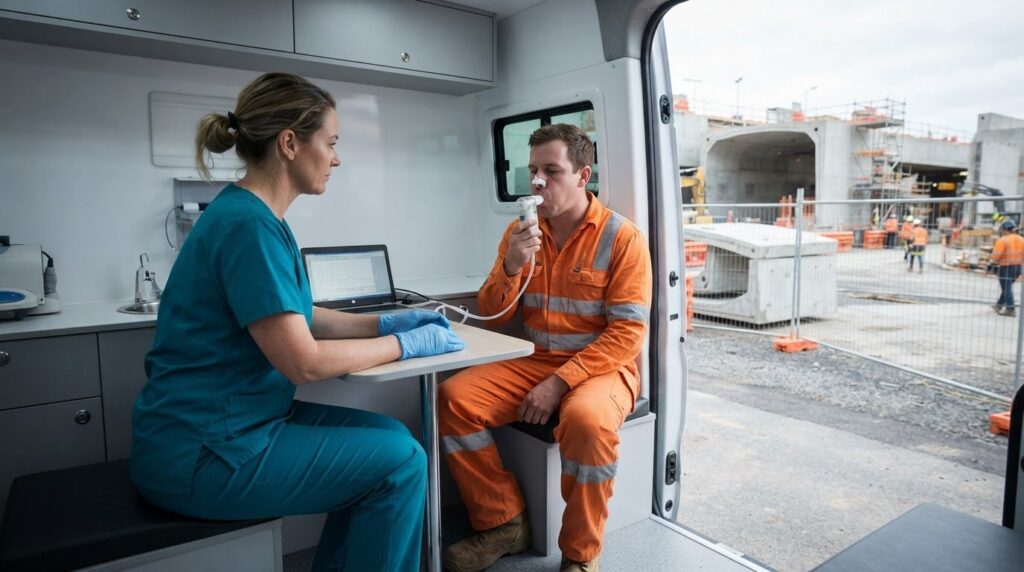
For mobile health surveillance in WestConnex workplaces, the requirement depends on the hazards workers may be exposed to and the risk to their health. According to SafeWork NSW, health monitoring is required for ongoing work with a Schedule 14 hazardous chemical when there is a significant risk to a worker’s health.
Managing assessments across active worksites can be challenging, especially when workers need different checks or leaving site for appointments would disrupt operations. Mobile health surveillance WestConnex work can bring occupational health assessments to the worksite, with checks selected to suit the substance or activity involved.
This article explains how workplace health monitoring applies in NSW, including requirements relating to hazardous chemicals, crystalline silica and asbestos. It also outlines what mobile assessments can involve and how Persona Health’s On-Site Health Surveillance and specialist medical assessments can support transport and infrastructure workplaces in Sydney, Melbourne, Gregory Hills and Parramatta.
Key Takeaways
- Assess whether ongoing work with a Schedule 14 hazardous chemical creates a significant risk to workers’ health, as this determines when health monitoring is required under NSW WHS rules.
- Plan mobile assessments around the worksite, worker roles and exposure profile to make health checks more practical for infrastructure teams.
- Consider each hazardous substance and high-risk activity separately, as the appropriate monitoring depends on the exposure involved.
- Use the WestConnex project’s locations and work activities to guide where assessments are needed and which workers may require monitoring.
- Match the assessment approach to the workforce’s needs, including whether on-site health surveillance or specialised medical assessments are appropriate.
Workplace health surveillance and monitoring
Workplace health monitoring responds to workers’ actual exposure risks, not simply a project name. For WestConnex work in Sydney, the key questions are which task and hazardous substance are involved, and what health effects need assessment.
NSW health monitoring regulation
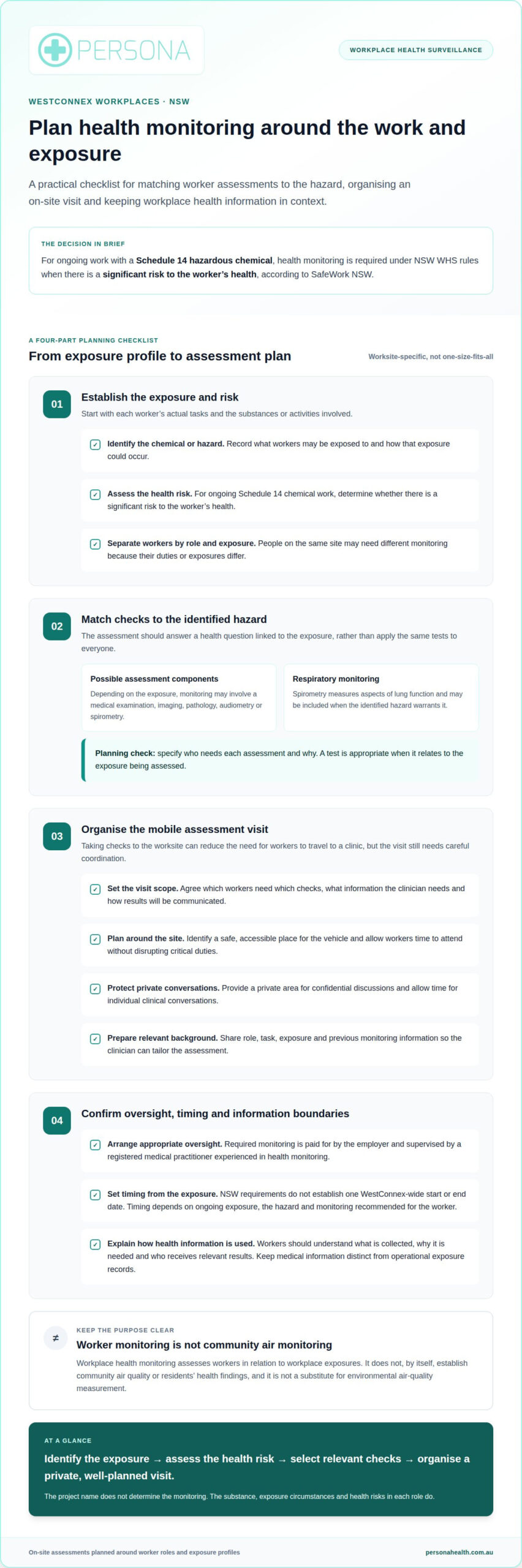
Under NSW WHS rules, according to SafeWork NSW, health monitoring is required for ongoing work with a Schedule 14 hazardous chemical when there is a significant risk to the worker’s health. The employer’s assessment should identify the chemical, how workers may be exposed, and whether that exposure creates the relevant health risk. Required monitoring is paid for by the employer and supervised by a registered medical practitioner experienced in health monitoring.
Monitoring depends on the hazard. Depending on the exposure, it may involve a medical examination, imaging, pathology, audiometry or spirometry. Spirometry measures aspects of lung function and may form part of respiratory monitoring when the identified hazard warrants it. Tests should relate to the exposure, rather than treating one test as suitable for every worker.
Community coverage and monitoring timeframe
WestConnex includes the M4 widening between Parramatta and Homebush, an underground extension between Homebush and Haberfield, and the New M5 tunnels connecting St Peters and Kingsgrove along the M5 East corridor. The M4-M5 Link connects underground motorway routes. These locations describe infrastructure, not a defined community health surveillance boundary.
NSW workplace health monitoring requirements do not establish a single WestConnex-wide start or end date. Timing depends on ongoing exposure, the identified hazard and the monitoring recommended for the worker. A workplace plan should link each assessment to the worker’s exposure and duties.
Health monitoring for WestConnex work is not inherently different from monitoring for another Sydney infrastructure project. The deciding factors are the hazardous substances, exposure circumstances and health risks in each role, not the project’s name. Two workers on the same site may need different monitoring if their tasks or exposures differ.
For required workplace monitoring, the employer pays, and a registered medical practitioner experienced in health monitoring supervises the process. The practitioner relates the assessment to the identified exposure and interprets relevant findings. This is worker health monitoring, not a general survey of residents or a substitute for environmental air-quality measurement.
Worker health surveillance results do not, by themselves, establish what air quality or community health reports have found. They assess workers in relation to workplace exposures. Community air monitoring and population health reporting answer different questions, so worker medical results should not be presented as findings about residents.
Workers should understand what health information is collected, why it is needed and who receives the relevant results. Employers should handle medical information carefully and keep it distinct from operational exposure records. Clear reporting arrangements help workers understand the purpose and limits of their assessment.
Residents seeking project environmental reports need information about community air monitoring, not individual workplace medical records. Workplace records relate to workers and their health assessments; they are not a resident complaint process or a source of project contact details. Keeping these information streams distinct helps clarify what each report can show.
For employers, an on-site health surveillance program should start with the work and exposure profile. For example, respiratory monitoring may be considered where the identified hazard can affect lung function, while other exposures may call for different examinations or tests. The chosen monitoring needs to match the risk being assessed.
Workplace health assessments delivered by mobile vans
A mobile assessment brings health checks to a workplace, so each worker does not need to travel to a clinic. For WestConnex contractors, this can help coordinate appointments around site access, shift patterns and the work being assessed. The vehicle is simply the assessment setting: planning is still needed to match checks to each worker’s role and exposure.
Start by matching each assessment to the purpose of the visit. A pre-arranged group, for example, may need medical examinations, spirometry or other tests identified through its exposure assessment. The appointment plan should specify who needs each assessment, what information the clinician needs and how results will be communicated. This avoids assuming every worker has the same duties and monitoring needs.
Worksite logistics also shape a useful visit. Organisers should identify a safe, accessible place for the vehicle, make time for workers to attend without disrupting critical duties and provide a private area for confidential conversations. A roster can group workers by role or assessment type while allowing time for individual clinical discussions. These practical details help structure a visit at a busy infrastructure site.
Before the visit, agree on the assessment scope and the information needed for each worker. Relevant details may include the role, tasks, exposure information and previous monitoring records. This context helps the clinician tailor the assessment instead of relying on a generic checklist. If a required test cannot be completed during the planned visit, document the next step clearly.
- Define the group: identify workers by job and exposure, not just by project site.
- Plan the location: arrange vehicle access, privacy and a practical appointment flow.
- Coordinate testing: match each test to the assessment purpose and relevant exposure.
- Close the loop: establish how clinical findings and any follow-up needs will be communicated.
Regional projects can use the same planning principles, but travel distances, site access and roster arrangements may affect scheduling. At WestConnex locations from Parramatta and Homebush towards St Peters and Kingsgrove, plan access for each site. Organise the mobile visit around the worksite’s actual layout and operational constraints rather than assuming every location can accommodate the same setup.
Living near WestConnex does not make residents eligible for occupational health surveillance. These assessments are arranged for workers according to their jobs and workplace exposures; they are not community health checks. Residents seeking personal health care need an appropriate healthcare service for their circumstances.
For a workplace visit, bring together the worker groups, assessment purpose and site logistics before setting the schedule. Discuss workplace assessment planning when you need to coordinate these details for a WestConnex worksite.
NSW coal mine worker assessments are set out in orders for workers entering and working in the industry. This orders-based framework applies to those workers’ assessments.
Hazardous substances and high-risk activities
WestConnex construction and maintenance tasks can involve different exposure profiles, so assessment starts with the work, not a generic site-wide checklist. Consider the substance present, how workers handle it, how exposure may occur and which roles perform the task. A tunnelling worker, for example, may face different exposures from someone handling materials during fit-out.
Crystalline silica needs careful consideration in relevant work. Stronger rules for processing crystalline silica substances under the model WHS laws have applied since 1 September 2024. Engineered stone benchtops, panels and slabs have been banned nationally in Australia since 1 July 2024. These facts do not remove the need to assess other silica-containing materials or processing activities.
For a practical assessment, map tasks to substances and workers. Cutting, drilling or grinding materials can create different exposure conditions from transporting sealed products. Record the material, task, controls in use and workers involved. This information helps determine whether health monitoring is relevant and what the assessment should address.
Asbestos work has specific monitoring considerations in NSW. Health surveillance covers workers before they start licensed asbestos removal work and at regular intervals afterwards. A plan should identify who performs licensed removal, when they begin and how required surveillance is scheduled. Asbestos presence alone does not describe each worker’s task or exposure, so role-specific records matter.
Lead risk work also has separate health monitoring requirements in NSW. Identify the work involving lead, the workers undertaking it and their exposure circumstances. Keep this assessment distinct from silica or asbestos planning. A single appointment may be convenient, but the medical assessment must still relate to the relevant hazard and work.
High-risk activities can change over a project’s lifecycle. Excavation, tunnelling, demolition, maintenance and material processing may involve different substances or work conditions. Review the exposure profile when tasks, materials or work methods change. For example, if a team moves from general site duties to processing silica-containing material, reassess its role and exposure.
- Identify the substance: use the material and task information for the specific work area.
- Link workers to tasks: record who performs processing, removal or other relevant duties.
- Plan by hazard: treat silica, asbestos and lead as separate monitoring considerations.
- Review changes: revisit the assessment when work methods or materials shift.
A clinic-based check may suit an individual follow-up, while a worksite program can help coordinate assessments for workers with related roles. The setting does not determine the monitoring requirement: the substance, task and risk remain central. For WestConnex contractors, clear exposure records help plan relevant checks without assuming every worker needs the same assessment.
Which communities and areas near WestConnex are included in health surveillance?
WestConnex spans several parts of Sydney, but a worker’s surveillance is linked to workplace exposure, not simply their suburb. The route includes the M4 widening between Parramatta and Homebush, an underground extension between Homebush and Haberfield, and the New M5 tunnels between St Peters and Kingsgrove along the M5 East corridor.
These locations help identify where project work takes place, but they do not define a community health surveillance boundary. A worker based in Parramatta or Homebush may need monitoring because of their duties; living near a tunnel does not automatically make a resident part of an occupational program.
The M4-M5 Link connects underground motorway routes. For workforce planning, consider the actual worksite and the tasks carried out there. A worker supporting tunnel construction, for example, may have a different exposure profile from a worker performing office duties near the same corridor. Location helps organise the assessment, but the work determines its relevance.
For contractors moving between WestConnex sites, records should identify each worker’s current role and work location. A transfer from an M4 work area near Parramatta to a task near St Peters may change the relevant exposure information. Keeping site and task details together helps maintain a clear record of which assessment relates to which work.
- Parramatta to Homebush: identify workers assigned to the M4 widening and associated work areas.
- Homebush to Haberfield: distinguish tunnel-related duties from other tasks along the underground extension.
- St Peters to Kingsgrove: record work connected with the New M5 and M5 East corridor.
- M4-M5 Link: account for workers moving between connected underground motorway routes.
These areas are reference points, not a list of suburbs whose residents automatically receive health checks. Occupational monitoring is organised around work and exposure. For example, living in Haberfield does not make someone eligible solely because the underground extension runs between Homebush and Haberfield.
Community concerns about environmental conditions are separate from workplace health surveillance. Residents asking about local air quality need community environmental information; a worker’s medical assessment relates to that person’s workplace exposure. Keeping these purposes separate prevents occupational results from being treated as a report on everyone living near the route.
For an employer coordinating teams across Parramatta, Homebush, Haberfield, St Peters and Kingsgrove, the practical first step is to map workers to sites and duties. This shows where to organise assessment appointments and which exposure records belong with each group. Workers’ home addresses alone do not establish a need for workplace monitoring.
What health conditions and environmental exposures does the program monitor?
Workplace health monitoring focuses on possible health effects linked to a worker’s exposure. It is not a general check of every condition, and a medical assessment does not measure air quality around a worksite. The relevant exposure and the worker’s duties guide which checks are suitable. For example, a respiratory assessment may be considered where the identified hazard could affect breathing.
Depending on the hazards, an assessment can include a medical examination, imaging, pathology, audiometry or spirometry. Spirometry measures aspects of lung function, while audiometry assesses hearing. These tests have different purposes. Neither is a universal screen or a direct measurement of a substance in workplace air.
Crystalline silica, asbestos and lead each require exposure-specific consideration. A worker processing silica-containing material, someone undertaking licensed asbestos removal and a person doing lead risk work have different tasks to assess. The monitoring plan should connect the worker, activity and substance before selecting a medical assessment. Sharing a worksite does not mean every worker needs identical checks.
Environmental exposure information helps explain why a particular health assessment is being considered. Useful details include the material, the task, how the work is carried out and which workers perform it. Records for material processing, for instance, provide different context from records for office duties at the same project. This information supports a relevant clinical assessment instead of an assumption based on location alone.
- Respiratory health: consider spirometry when the identified exposure and clinical purpose make it relevant.
- Hearing: audiometry may form part of monitoring where the hazard profile calls for hearing assessment.
- Clinical findings: examinations, imaging or pathology may be selected according to the hazard.
- Exposure records: link each assessment to the worker’s role, material and work activity.
A worker’s result and an environmental monitoring result answer different questions. Spirometry, for example, assesses aspects of lung function; it does not report the concentration of a substance in tunnel air. Environmental sampling describes conditions in a particular place and context, while health monitoring considers an individual worker. Keeping these records distinct helps employers interpret each appropriately.
Monitoring plans should reflect changes in work. If a worker moves from general duties to asbestos removal or lead risk work, reassess their role and exposure information. A clinician can then consider whether the existing assessment remains relevant or another type of monitoring is appropriate. Clear records make this review more practical.
In Australia, employers must conduct periodic health monitoring when employees may be exposed to certain hazardous substances at work. A clear link between the exposure and the worker is therefore important when planning suitable checks.
Persona Health: On-Site Health Surveillance
Persona Health provides On-Site Health Surveillance for workplace teams, with assessments planned around workers’ duties and identified exposures. Sydney locations include Parramatta, Rosebery, Gregory Hills and Dee Why, with a focus on Gregory Hills and Rosebery; Melbourne locations include Cairnlea and Craigieburn. Australia-wide mobile workplace services and a network of 100 affiliate clinics support employers coordinating assessments across sites.
The approach is employer-focused, with responsive customer service, fast turnaround times and modern digital reporting. Persona Health is accredited to ISO 9001, ISO 14001 and ISO 45001. For relevant work, Crystalline Silica Medicals can provide a focused assessment for workers with applicable exposures.
Contact Persona Health to discuss workplace health surveillance for your team.
Make your next workplace health decision practical
Planning mobile health surveillance WestConnex work starts with a clear picture of the tasks, workers and assessment purpose. Persona Health provides On-Site Health Surveillance, Pre-Employment Medicals and Crystalline Silica Medicals, as well as Workplace Injury Management when workplace injuries need coordinated support. Contact Persona Health to plan assessments around your team’s operational needs in Sydney, Melbourne, Gregory Hills or Parramatta.
For injury triage, InjuryQR is a FREE AI-powered service available to all Australian businesses. InjuryQR provides free posters, stickers, keyrings and fridge magnets to Australian businesses. Workers scan a QR code without downloading an app, describe an injury by voice, and answer AI follow-up questions. It can provide self-care advice, arrange telehealth appointments typically within 3-4 hours, direct a worker to an Emergency Department or instruct them to call 000. Certificates of Capacity can be issued immediately where appropriate. Clearer reporting and timely guidance can help reduce Lost Time Injuries and improve injury reporting.
A well-planned approach gives employers and workers a clearer path forward, shaped around the work and each person’s needs.
Frequently Asked Questions
What is the WestConnex mobile health surveillance program?
Mobile health surveillance WestConnex refers to occupational health assessments arranged for workers when their duties and workplace exposures make monitoring relevant, with mobile delivery bringing assessments to a worksite. It is not a general health screening programme for nearby residents. Employers can use Persona Health’s On-Site Health Surveillance to coordinate worker assessments, with clinical checks selected according to the work and the health risks being assessed.
What privacy protections and risks apply to people participating in health surveillance?
Tell participants what health information is collected, why it is needed and who receives the relevant results. Employers should handle medical information carefully and keep it distinct from operational exposure records.

Article by
Ian Nicholson
Ian is the Business Support Manager at Persona Health, where he plays a key role across IT, sales, marketing and business operations. With a broad skill set and a practical, solutions-focused approach, Ian helps drive the systems, communication and commercial strategy that support Persona Health’s continued growth across Australia.