
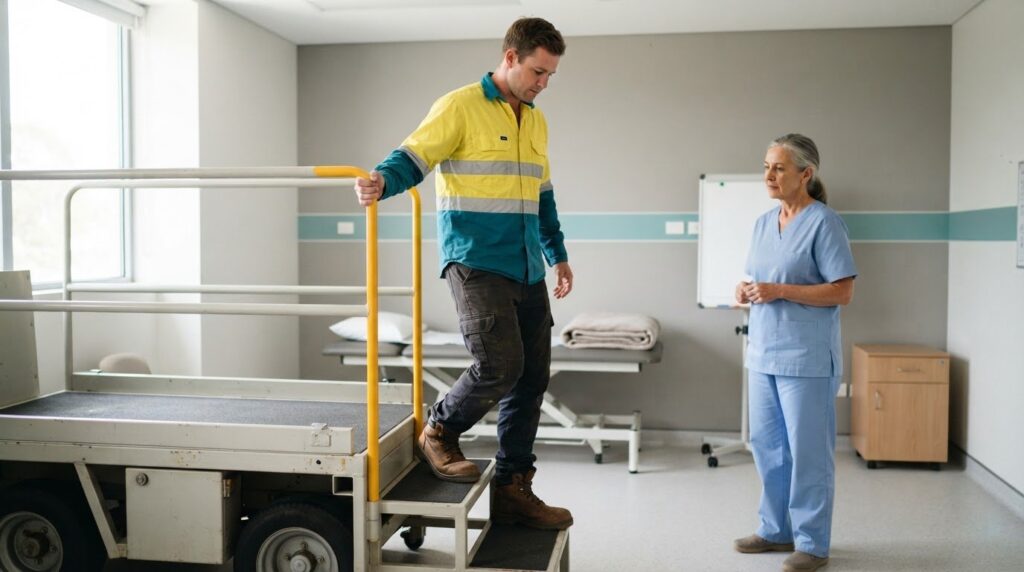
Working remotely does not remove the need to show you can safely meet your role’s requirements. A remote worker fitness for duty assessment considers your current capacity in relation to your job and may find you fit, fit with restrictions, temporarily unfit, or in need of further assessment information.
If illness, injury or a change in your health has affected your work, it is understandable to want clarity about what an assessment involves and what the outcome could mean. The focus is on your ability to perform your duties, not simply on a diagnosis.
This article explains when an employer may request an assessment, how it can be tailored to your role, and what possible outcomes mean in practice. It also explains how recommendations about restrictions or adjustments can inform workplace decisions and support a safe way forward.
Key Takeaways
- An assessment can clarify whether your current capacity matches your role’s essential duties, including when you work remotely.
- The assessment is tailored to the job and may consider its physical and cognitive demands, relevant health history and role-specific testing.
- Possible outcomes include fit, fit with restrictions, temporarily unfit or a request for further information.
- Recommendations may help guide temporary adjustments to duties or hours while supporting a safe, practical work plan.
- Clear information about the role and the reason for referral helps the assessment focus on the questions that matter.
When fitness for duty assessments may be required?
A remote worker fitness for duty assessment considers whether an employee can safely meet their current job requirements. An employer may request one after illness, injury or a prolonged absence, or in response to a workplace safety concern, including when duties are performed from home or an isolated location.
The cost depends on the referral, role requirements and any additional assessment components. A quote request determines the fee. For an employer-requested assessment, the employer should arrange payment as part of the referral and explain the payment arrangement before the appointment.
An assessment can support a return to work by identifying current functional capacity and restrictions relevant to the employee’s duties. Recommendations may guide a gradual return, temporary changes to hours, reduced lifting, alternative duties or redeployment if the employee cannot safely perform their usual role during recovery.
Employer Responsibilities and Workplace Safety
For a safety concern, the employer’s referral should describe the employee’s actual duties and the specific issue, such as driving, handling equipment or working alone. This helps focus the medical assessment on whether the employee can safely perform those tasks, rather than treating a diagnosis as the only measure of capacity.
Employers can use the findings to consider workplace risks and practical controls, including adjusted duties or closer supervision. The report provides information about work capacity and recommendations; employment decisions remain the employer’s responsibility.
Assessments for Isolated Remote Work
For an employee working alone or in an isolated location, the assessment should take account of the demands and conditions of that work. Relevant details include extended periods without direct support, travel to remote sites, safety-critical decisions and responding to incidents without colleagues nearby.
The practitioner can compare these demands with the employee’s functional capacity and identify relevant restrictions. For example, a temporary limit on site travel or a need for modified duties may affect whether the employee can safely return to an isolated worksite.
When an injury occurs, InjuryQR is a FREE AI-powered workplace injury triage service available to all Australian businesses. Free posters, stickers, keyrings and fridge magnets help make it accessible at work. A worker scans the QR code without downloading an app, describes the injury by voice, and responds to AI follow-up questions. Outcomes include self-care advice, a telehealth appointment typically within 3-4 hours, direction to an Emergency Department, or instructions to call 000. Certificates of Capacity can be issued immediately where appropriate. Early triage supports prompt reporting and treatment, which can help reduce Lost Time Injuries.
Workplace adjustments should relate to the assessment’s findings and the essential duties of the role. A restriction may be temporary, such as reduced hours during recovery, or may prompt consideration of alternative duties. Employers can use fitness for duty medical assessments to obtain role-focused information when capacity or safety concerns arise.
Assessment components and job-specific requirements
A medical assessment should consider an employee’s capacity against their actual duties, not an abstract idea of fitness. For remote work, that means looking at both the tasks performed and the conditions in which they are performed.
Legal Requirements for Assessments
In Australia, a fitness for duty assessment is not always legally required. It may help an employer meet workplace health and safety responsibilities when an employee’s capacity or the safety of others is in question. The referral should explain the concern and identify the duties involved, rather than simply requesting a general medical clearance.
Privacy and confidentiality risks arise when a report includes more medical detail than needed to explain work capacity. Employers should focus on the employee’s ability to perform the role and any relevant restrictions. Decisions should relate to job requirements, not assumptions based on a diagnosis.
Job Demands and Inherent Requirements
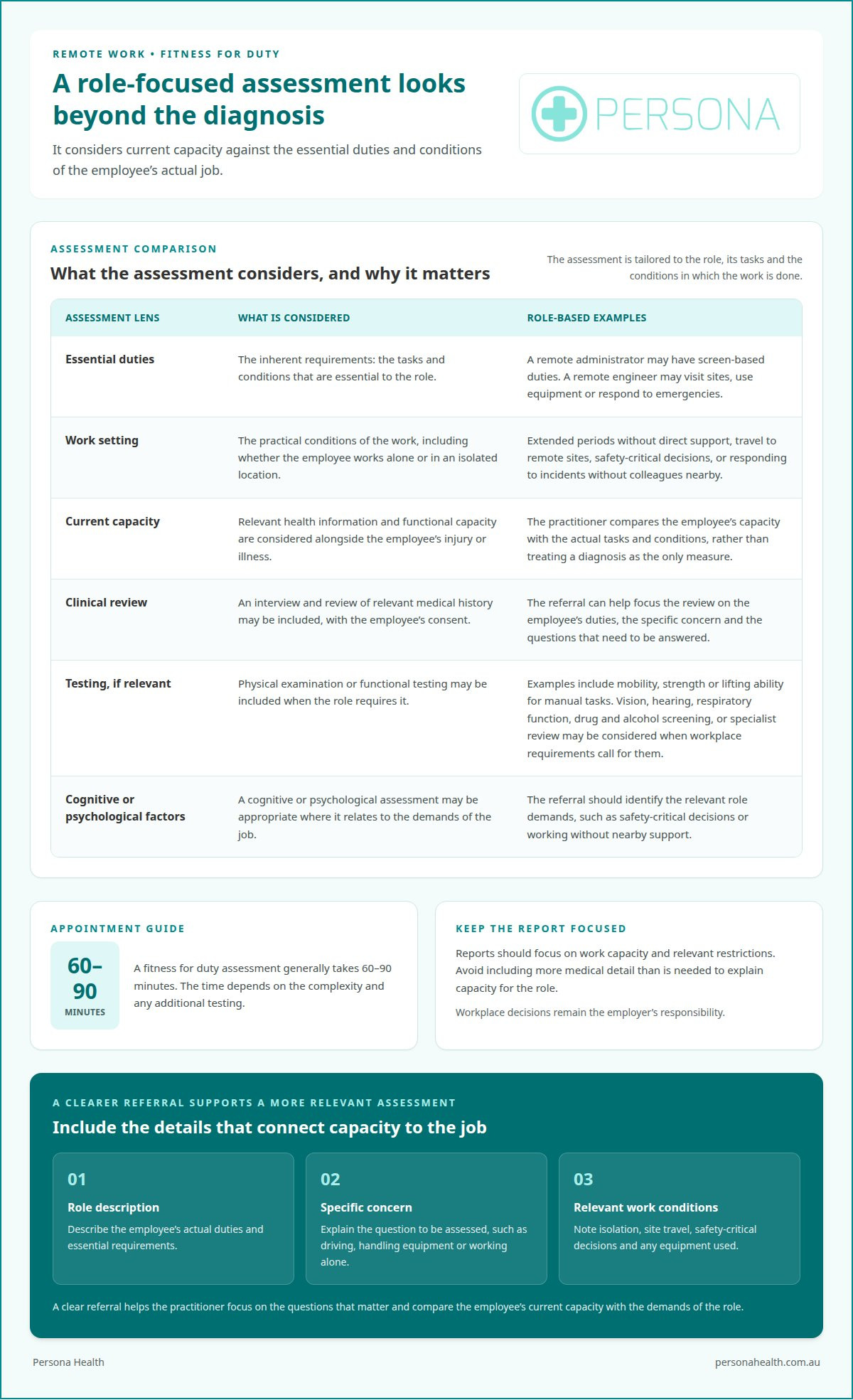
Inherent requirements are the essential tasks and conditions of a role. A medical assessment considers these demands alongside relevant health information, functional capacity and the employee’s injury or illness. For example, a remote administrator’s screen-based duties differ from a remote engineer’s site visits, equipment use or emergency response responsibilities.
The assessment may include a clinical interview and a review of relevant medical history, with the employee’s consent. A physical examination or functional testing may be included when the role requires it, such as assessing mobility, strength or lifting ability for manual tasks.
Other components depend on the work. Vision or hearing checks may be relevant to specific tasks. Drug and alcohol screening, respiratory function testing or specialist review may be considered when workplace requirements call for them. A cognitive or psychological assessment may also be appropriate if relevant to the job’s demands.
For remote employees, the referral should describe practical working conditions as well as tasks. The practitioner may need to know whether the employee works alone, makes safety-critical decisions, travels to sites or relies on particular equipment. These details help distinguish essential duties from tasks that could be temporarily adjusted.
A fitness for duty assessment generally takes 60-90 minutes, depending on complexity and additional testing. The appointment is more useful when the referral includes a clear role description, specific questions and relevant information about the employee’s current capacity. This helps keep the assessment focused on work-related needs.
To arrange a role-focused assessment, discuss the assessment requirements and the duties the employee needs to perform.
Fit, restricted, temporarily unfit and further-information outcomes
A fitness-for-work report connects the practitioner’s findings with the employee’s role demands. It may state that the person is fit, fit with restrictions, temporarily unfit, or that further information is needed.
Fitness Outcomes
Fit means the practitioner considers the employee able to perform the specified duties. Fit with restrictions means work can proceed within stated limits, such as reduced hours or avoiding a particular task. Temporarily unfit means the employee cannot currently perform the assessed duties. These outcomes describe present capacity, not a permanent judgement about a person’s abilities.
A further-information outcome means the practitioner needs relevant details before reaching a conclusion. This could involve clarification of the employee’s duties, current symptoms or treatment, or information from a treating practitioner. The report should specify what is needed to assess fitness for work.
Recommended Restrictions
Restrictions should relate directly to the assessed duties and findings. For example, a recommendation may limit lifting, adjust working hours or exclude a task the employee cannot yet perform safely. For a remote role, a restriction could address work that requires travel, site attendance or sustained concentration.
The employer can compare each recommendation with the employee’s actual tasks and decide how to organise work within those limits. If a restriction affects an essential duty, the report may help identify alternative tasks or redeployment options during recovery. Adjustments should reflect the practitioner’s advice and the demands of the role.
Employer Actions After an Outcome
After a fit outcome, the employer can plan a return to the assessed duties and communicate relevant arrangements. If restrictions apply, the next step is to map each limit to the employee’s tasks, agree on suitable adjustments and explain them clearly to the employee and relevant supervisor.
If the employee is temporarily unfit, the employer should follow the report’s guidance and consider when reassessment or further medical information may be appropriate. For a remote worker, this may mean pausing duties that cannot be performed within their current capacity while considering suitable alternative work.
Employers make the employment decision; the medical opinion informs it. The report generally focuses on work capacity, functional ability, restrictions and fitness outcomes, rather than detailed personal medical information unless authorised or required. Keep discussions and records focused on work-related recommendations.
When a new workplace injury needs triage, InjuryQR can support timely reporting. Its QR-based process helps direct workers to appropriate next steps, while a fitness assessment addresses capacity for the role. These serve different purposes: one responds to an injury, and the other informs decisions about work duties.
Review the agreed duties if the employee’s condition or role demands change. A new assessment may be useful when existing restrictions no longer match the work or further information changes the practitioner’s view of the employee’s capacity.
Occupational physician and psychiatrist assessments
An occupational medical assessment considers whether an employee can safely perform the essential duties of their role. Where physical, cognitive or psychological concerns affect capacity, the assessment can focus on the relevant demands and practical restrictions.
Occupational Physician Assessments
An occupational physician considers the employee’s health information alongside the work they need to perform. Depending on the referral and role, the assessment may include a clinical interview, relevant medical history, physical examination and functional testing. For a remote worker, the physician may consider screen-based tasks, site travel, equipment use or safety-critical decisions.
A useful referral describes the role, the concern prompting assessment and the specific questions to answer. Relevant reports from treating practitioners can help explain current symptoms or treatment. The resulting opinion focuses on work capacity, suitable duties and restrictions relevant to the employee’s job.
Incapacity Inquiries and Functional Screening
In Victoria, the Secretary or a delegate may commence an inquiry if an employee cannot perform their position’s duties because of physical or mental incapacity. This is distinct from a clinical assessment: the medical opinion informs the consideration of capacity, while the inquiry addresses the employee’s ability to perform the position.
Physical functional screening can assess movements linked to actual duties, such as lifting, carrying, mobility or sustained standing. A functional capacity evaluation focuses on specific physical movements or postures. For a remote employee who occasionally visits a worksite, screening may consider the physical tasks required during those visits, rather than assuming a desk-based role has no physical demands.
Psychological or psychiatric input may be considered when the referral raises relevant mental health concerns. Depending on the question, an assessment may explore current symptoms, cognitive function, fatigue or barriers to work. A specialist referral may be appropriate when further medical expertise is needed; the purpose remains to understand work capacity, not to make assumptions based on a diagnosis.
For physical or mental health concerns, the referral should connect the health question to a work task. For example, if concentration is affected, the assessment can consider duties requiring sustained attention or safety-critical decisions. If mobility is affected, it can consider the movements required for site access or equipment handling.
Employers generally receive information about functional ability, restrictions and fitness outcomes, rather than detailed personal medical information, unless specifically authorised or required. A clear report can state whether the employee can continue performing their duties safely, needs adjusted tasks, or requires further information before a conclusion can be reached.
Reasons for requesting a fitness for work assessment
An employer may request an assessment when a health concern could affect an employee’s capacity to perform their duties. The reason should relate to work, such as a recent injury affecting keyboard use or fatigue that may affect safety-critical decisions during remote work.
A referral can follow an injury or illness, whether it happened at work or elsewhere. For example, a worker returning after a significant illness may need an assessment of their current capacity before resuming site visits, driving or other essential tasks. The assessment helps clarify their functional ability in relation to those duties.
A prolonged absence is another common reason. After extended leave, an employer may need current medical information about whether the employee can return to their usual role, needs temporary restrictions or could perform alternative duties. The referral should explain the absence and identify the work questions that need answering.
Changes in health can also prompt a referral. Dizziness, fatigue or reduced concentration may affect tasks such as operating equipment, making time-sensitive decisions or working alone. A medical assessment can consider whether these concerns affect the employee’s ability to meet the inherent requirements of the role.
Workplace concerns should be specific and based on observed changes related to work. For instance, repeated difficulty completing a task after an injury may warrant an assessment of capacity, rather than assumptions about the employee’s diagnosis. A clear referral helps the practitioner address relevant duties and possible adjustments.
Performance or productivity concerns may have a medical component, but an assessment is not a substitute for ordinary performance management. It can help when a health condition may be affecting work capacity. The employer should describe the work impact and ask focused questions, without treating a medical referral as proof of misconduct.
A specialist referral may be appropriate when the employee’s physical or psychological needs call for further medical expertise. The assessment can consider whether the employee needs further support, restrictions, monitoring or a staged return. Its purpose is to clarify capacity and work-related recommendations, not to make a broad judgement about the person.
When an injury occurs, timely reporting and triage address immediate care, while a fitness assessment considers capacity for work. InjuryQR supports workplace injury reporting; workplace injury management can help employers manage the subsequent work-capacity and return-to-work process.
A useful referral states the reason for assessment, relevant duties, observed concerns and specific questions. For example, an employer can ask whether the employee can resume site travel, whether temporary task restrictions are appropriate or whether further information is needed. Focused questions help the assessment produce practical recommendations.
Persona Health
Persona Health helps employers connect occupational health information with practical workplace decisions. Its employer-focused approach includes responsive customer service, fast turnaround times and modern digital reporting. For injury-related work-capacity and return-to-work planning, Workplace Injury Management can support the next steps.
Persona Health has clinics in Parramatta, Rosebery, Gregory Hills and Dee Why in Sydney, and Cairnlea and Craigieburn in Melbourne, with a particular focus on Gregory Hills and Rosebery. Its targeted network of clinics and mobile workplace services support employers across these specific service locations. Other relevant services include Pre-Employment Medicals, Crystalline Silica Medicals and Cat 3 Rail Medicals.
Plan a clear next step
For a remote worker, a fitness for duty assessment is most useful when its purpose is clear from the outset. Employers can frame the referral around the employee’s current duties, the work-related concern and the questions that need a medical opinion. This gives the assessment a practical focus and helps connect its findings to workplace decisions.
Before proceeding, consider what information the practitioner needs to understand the role, including essential tasks performed away from the employee’s home. Relevant clinical information can also help explain current capacity. Once the report is available, use its recommendations to consider appropriate duties and adjustments, while leaving employment decisions with the employer.
Each person’s circumstances and work demands are different. A considered process can replace uncertainty with clear, role-related information and support a constructive discussion about the next step.
A clear referral is a practical starting point for a safe and considered way forward.
Frequently Asked Questions
What happens during a fit-to-work assessment?
The appointment usually starts with the practitioner clarifying the referral and the employee’s role. The employee can explain how their health affects particular tasks, while the practitioner considers relevant clinical information and any examination needed to answer the referral questions. The employer then receives a work-focused opinion. Bringing relevant reports from a treating practitioner can help clarify the assessment background.
What does the assessment cover?
The assessment depends on the referral questions and the work being considered. A role involving regular site visits may require consideration of travel and site access, while a desk-based role may centre on its cognitive demands. The assessment addresses the stated duties, rather than reviewing every aspect of an employee’s health or capacity outside work.
How is it different from a pre-employment medical?
The main difference is the employment stage and the decision being informed. A pre-employment medical takes place before a person starts a role and considers its inherent requirements. An assessment for an existing employee addresses a current work-capacity question, such as whether a change in health affects particular duties. The referral’s purpose guides what the practitioner examines and reports.
How long does it take?
A fitness for duty assessment generally takes 60-90 minutes, with complexity and additional testing affecting the appointment length. A worker attending for an interview alone may need a different amount of time from someone requiring functional testing or further screening. The referral’s scope helps the practitioner plan an appointment that covers the relevant work-related questions.
What does “fit for work” mean?
It describes the practitioner’s opinion about the employee’s capacity for the duties considered in the assessment. It is not a general statement that the person has no health condition or can perform every possible task. For example, an opinion about remote administrative duties does not automatically cover separate site-based tasks outside the referral.
When can an Australian employer require a remote employee to undergo a fitness for duty assessment?
A remote worker fitness for duty assessment may be requested when a genuine, work-related concern arises about current capacity, such as after an extended absence or a change affecting specific duties. A focused referral should identify the concern, the tasks involved and the questions requiring a medical opinion. This helps distinguish a role-related assessment from a request based on assumptions about someone’s health.
What Australian laws and workplace health and safety duties apply to fitness for duty assessments?
Relevant workplace health and safety requirements depend on the jurisdiction and the employer’s circumstances. Australian privacy requirements may also apply to handling health information, including the Privacy Act 1988 and Australian Privacy Principles where applicable. In practice, referral and reporting processes should be limited to information relevant to work capacity, with access to personal health details appropriately managed.
Can an employer require a medical examination or functional capacity assessment, and what consent is needed?
An employer may seek a medical opinion when a legitimate concern relates to an employee’s duties, but the request should explain its purpose and work-related questions. Any functional testing should relate to tasks relevant to the role. If the assessment involves reviewing medical history, the employee’s consent may be needed. The medical opinion informs the employer’s decision; it does not make that decision.

Article by
Ian Nicholson
Ian is the Business Support Manager at Persona Health, where he plays a key role across IT, sales, marketing and business operations. With a broad skill set and a practical, solutions-focused approach, Ian helps drive the systems, communication and commercial strategy that support Persona Health’s continued growth across Australia.