

Hiring administration often grows in the gaps between assessment steps, not just from the assessments themselves. Reducing hiring admin with a dedicated occupational health partner means coordinating recruitment assessments and service delivery through a more connected process, helping limit duplicated handling and clinical overheads. The exact approach depends on the roles you’re recruiting for and the health assessments they require.
It’s understandable to want clear, timely information without adding work for your hiring team. A well-organised occupational health process can make assessment requirements easier to manage while supporting a considered, role-relevant approach for each candidate.
This article explains how occupational health fits into recruitment, which assessments may be relevant, and how an integrated service can streamline administration. It also covers what to consider when selecting a partner and how to make the next step practical for your organisation.
Key Takeaways
- Map health assessment requirements to each role so recruitment steps are relevant and consistently organised.
- Bring assessment coordination and reporting into a clearer workflow to reduce duplicated administration and disconnected information.
- Choose assessments according to the role’s duties and health risks, rather than applying a one-size-fits-all process.
- Set clear responsibilities for referrals, candidate communication and report handling to help hiring teams track progress.
- Explore how an occupational health partner can support your recruitment process, from pre-employment medicals to specialist assessments for relevant roles.
Recruitment and occupational health integration
Recruitment and occupational health work best as connected stages, rather than separate requests managed across unrelated systems. When health information is spread across providers and internal platforms, hiring teams may face slower onboarding and a greater risk of missed requirements. A shared workflow gives recruiters a clear sequence: identify role requirements, arrange relevant assessments, track completion, then receive appropriate outcomes for the hiring decision.
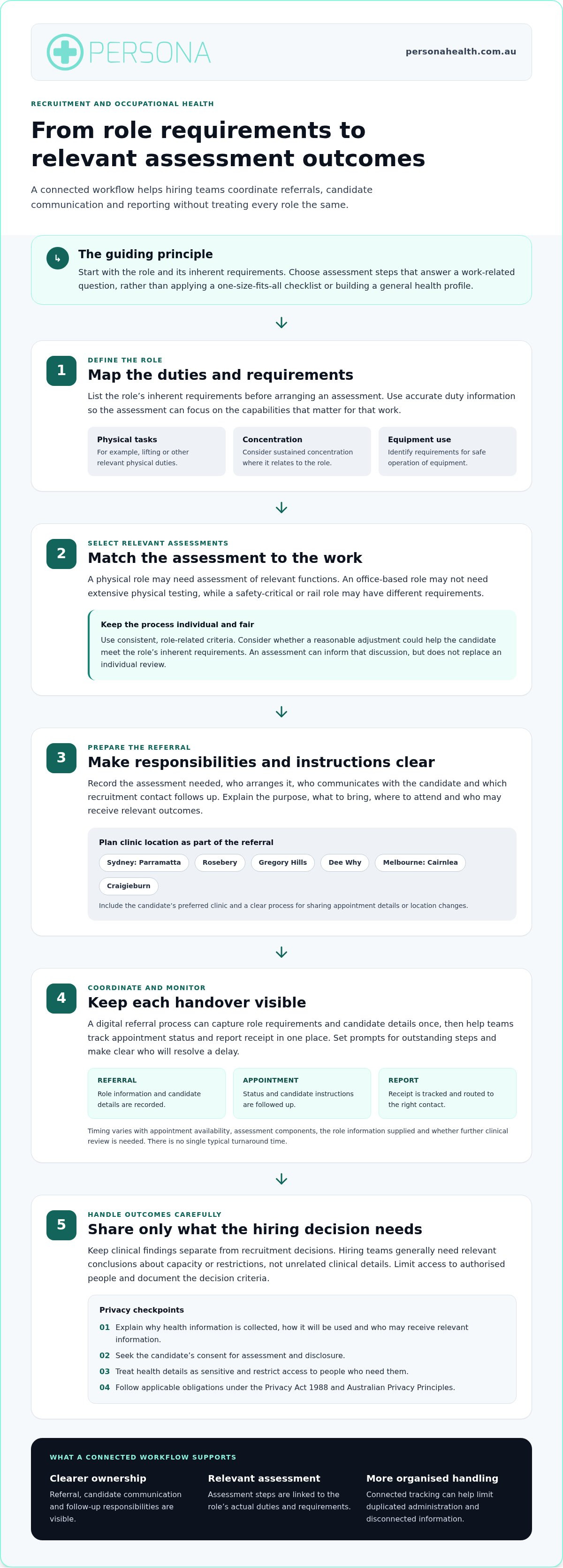
Start with the role, not a standard checklist. A position involving physical tasks may need an assessment matched to those duties, while a rail role may have different occupational health requirements. Record which assessment is needed, who arranges it, how the candidate receives instructions and which recruitment contact follows up. This makes responsibilities visible and helps prevent repeat referrals.
For Australian pre-employment medical information, explain why it is collected, how it will be used, and who may receive relevant information. Treat health details as sensitive, restrict access, and seek the candidate’s consent for assessment and disclosure. The Privacy Act 1988 and Australian Privacy Principles apply to organisations covered by them, so collection and handling should follow the organisation’s privacy obligations.
Delays can hold up onboarding, while inconsistent assessments may make candidates feel they have been treated differently for similar roles. Mishandled health information can also undermine trust and create privacy risks. Use role-related assessment criteria, give candidates consistent instructions and share only relevant outcomes with authorised hiring staff.
Workflow automation can make each step easier to monitor. Use a digital referral process to capture role requirements and candidate details once, then track appointment status and report receipt in one place. Set prompts for outstanding steps, such as sending appointment instructions or notifying the recruiter when a report is ready. Automation should organise administration, not replace clinical judgement or individual assessment.
Location planning matters when recruitment spans Australian cities. In Sydney, hiring teams can consider clinics in Parramatta, Rosebery, Gregory Hills and Dee Why. For Melbourne recruitment, Cairnlea and Craigieburn are location options. Include the candidate’s preferred clinic in the referral workflow, then set a clear step for communicating appointment details and any location changes. These practical details help recruiters coordinate assessments across sites.
Occupational health expertise also shapes a useful process. Clinicians assess the person against relevant role information, while recruiters manage scheduling and hiring decisions. Before referrals begin, define who supplies role details, who communicates with candidates, and how assessment outcomes return to the hiring team. Tailoring those steps to each role supports consistent candidate handling and a clearer process for employers. To discuss recruitment coordination, use the occupational health contact page.
Siloed health data across systems and providers can slow onboarding and increase employers’ risk of missed requirements. Keep the referral, appointment status and report receipt connected to the recruitment record, while limiting health information to those who need it. Review handovers when a step is delayed and make clear which team member will resolve it. This helps recruitment and occupational health teams coordinate follow-up without turning sensitive clinical details into general hiring information.
Occupational health assessments for recruitment
A recruitment assessment should answer a work-related question, not create a general health profile. Begin by listing the role’s inherent requirements, such as lifting, sustained concentration or safe operation of equipment. Then identify which assessment steps relate directly to those duties. Extensive physical testing may be unnecessary for an office-based role, while a safety-critical role may call for closer assessment of specific capabilities.
Australian employers should use consistent, role-related criteria and avoid decisions based on assumptions about a person’s health or disability. Consider whether a reasonable adjustment would allow the candidate to perform the role’s inherent requirements. An assessment can inform that discussion, but it should not replace an individual review of the candidate and the actual duties.
Plan the candidate journey before issuing a referral. Explain the assessment’s purpose, what to bring, where to attend and who will receive relevant outcomes. A role involving physical tasks, for example, may require accurate duty information so the clinician can assess relevant functions. Avoid asking for broad medical details that do not help answer the work-related question.
There is no single typical turnaround time for Australian pre-employment medicals or fitness-for-work assessments. Timing depends on appointment availability, assessment components, the role information supplied and whether further clinical review is needed. A straightforward assessment may move through the process differently from one requiring additional investigation, so hiring teams should track each step and communicate realistic updates.
To keep decisions fair and records useful, separate clinical findings from recruitment decisions. The hiring team generally needs relevant conclusions about capacity or restrictions, not unrelated clinical details. Set access permissions for each role, document the decision criteria and retain information according to the organisation’s privacy processes. These steps limit unnecessary circulation and make later reviews easier to follow.
A practical workflow can use four checkpoints: confirm role duties, select relevant assessment components, brief the candidate, then review the outcome against documented requirements. If a report identifies a limitation, consider how it relates to actual duties and whether adjustments could address it. This avoids treating every finding as an automatic pass-or-fail result.
For employers planning a consistent assessment pathway, discussing role requirements and referral steps can clarify what information clinicians need. A conversation through the occupational health contact page can help frame those practical questions before recruitment referrals begin.
North Yorkshire County Council reports that its occupational health referral turnaround time fell from 21 days to under 7 days, measured from referral submission to the manager receiving the report. This illustrates why teams should define the start and end points when monitoring progress: a figure is useful only when everyone understands which stages it covers. Review delays alongside the quality of role information and the relevance of requested assessments, rather than treating speed as the sole objective. Clear ownership of referrals and timely communication with candidates and managers can help the process remain understandable while keeping the assessment focused on the role’s requirements.
Client partnership and service delivery
Setting up a dedicated occupational health partnership starts with mapping recruitment needs, agreeing responsibilities and establishing referral and reporting processes. A hiring team recruiting drivers and office staff, for example, can define separate assessment pathways and assign a contact for each. Clear arrangements help recruiters know what happens next without managing every clinical detail themselves.
- Map role requirements. List the roles, relevant duties and assessment needs. A warehouse role and an administration role may need different pathways.
- Agree referral details. Set out the information recruiters provide, how candidates receive instructions, and how appointments are coordinated.
- Define communication. Name the recruitment contact and clinical contact, then agree how appointment updates and report outcomes are shared.
- Review the process. Check completed referrals for repeated requests, missed information or unclear handovers, then adjust the workflow.
These steps work best when workplace responsibilities are written down. A recruitment coordinator might submit referrals, while a designated manager handles role descriptions and hiring decisions. Clinical staff need accurate duties to assess the relevant work questions. Defining those boundaries reduces duplicated emails and prevents recruiters from interpreting clinical findings themselves.
Agree on a consistent way to manage candidate updates. Specify who tells candidates when an appointment is arranged, who follows up on missing details and who reports delays to the hiring team. Candidates should know where to direct practical questions, rather than receiving conflicting instructions from several workplace contacts.
Reporting arrangements also need careful definition. Specify which recruitment staff may receive an outcome, what information supports the hiring decision and how records are handled under the organisation’s privacy practices. A recruiter may need a work-related conclusion, while detailed clinical notes require appropriate confidentiality. Clear access rules make the handover more controlled.
For a workforce operating across locations, include appointment logistics in the service plan. Identify how candidates are directed to a suitable clinic or workplace assessment and how location changes are communicated. If hiring spans different roles or regions, a consistent referral template can capture essential details while allowing role-specific assessment instructions.
Agree on practical review measures before the first referrals. Track whether forms arrive complete, candidates receive clear instructions and handovers stall. Regular reviews between recruitment and clinical contacts can identify issues such as repeated data entry or unclear role information. The aim is a dependable process that supports clinical assessment while leaving employment decisions with the employer.
Reducing administrative and clinical overheads
Recruitment overhead often comes from repeated handling: recruiters chase appointments, re-enter candidate details and reconcile reports from different systems. A dedicated process can reduce these steps by keeping referrals, status updates and outcomes within a defined workflow. A consistent referral template, for example, can capture role duties and contact details once, reducing avoidable follow-up.
Compared with managing assessments in-house, a dedicated occupational health partner can take on clinical coordination while recruiters retain responsibility for hiring decisions. Using multiple providers may mean separate forms, contacts and reporting formats, leaving teams to spend more time joining information together.
Start by identifying where administration repeats. Review recent recruitment cases and note each handover, such as a missing job description, a rescheduled appointment or a report sent to the wrong contact. Then assign responsibility for each step. A recruiter might supply role details, while the clinical team coordinates the assessment and returns relevant outcomes through the agreed channel.
- Use a clear referral pathway. Capture role requirements, candidate details and the requested assessment together.
- Set update points. Decide who communicates appointment progress and how recruiters learn about outstanding information.
- Limit duplicate data entry. Reuse accurate referral information instead of asking candidates to repeat it across forms.
- Match assessment scope to the role. Provide clinicians with relevant duties, rather than requesting broad checks without a work-related purpose.
- Review exceptions. Track reschedules, incomplete referrals and additional clinical review to find recurring process gaps.
Referral quality also affects clinical overheads. If a clinician receives a generic role description, they may need clarification before assessing the relevant work demands. Specific details, such as regular equipment operation or manual tasks, provide clearer context and can reduce avoidable back-and-forth. They also help keep assessment components relevant to the position.
Standardised reporting can make outcomes easier for hiring teams to interpret. Agree on the information recruiters need, such as whether further discussion about work capacity is required, and restrict clinical detail to appropriate recipients. This supports focused decisions without turning recruiters into interpreters of medical information.
Monitor workflow performance using practical indicators rather than assumed savings. Check referral completeness, repeated requests, time spent following up and whether reports reach the authorised contact. If a particular role regularly causes delays, review its referral instructions and assessment requirements. These changes help direct clinical effort where it is relevant and reduce administrative work that adds no value to recruitment.
How can a dedicated occupational health partner reduce hiring administration in Australia?
A partner can make recruitment administration easier to manage by aligning clinical services with employer needs. Persona Health takes an employer-focused approach, with responsive customer service and modern digital reporting supporting communication between occupational health and hiring teams. Fast turnaround times can also help keep assessment steps moving, while clinical decisions remain grounded in the candidate’s role and individual circumstances.
For an Australian employer, begin by identifying the recruitment points that need clinical coordination. These may include assessment requests, candidate appointment arrangements, report delivery and questions about role requirements. Agree which contacts manage each point, then make the process clear to recruiters and candidates. This gives the hiring team a practical way to handle routine coordination and refer clinical questions appropriately.
Digital reporting can support a more orderly handover. A recruiter can receive the relevant report through the agreed channel and record that the assessment stage is complete. Clear reporting expectations also help the employer understand whether further clinical discussion is needed, without circulating unnecessary health information. Set access permissions before referrals begin and keep employment decisions with the employer.
Persona Health’s service model can support recruitment across different role types. An employer recruiting for a general position may need a different assessment pathway from one recruiting for rail or hazardous-material work. The hiring team can provide role details and agree which service is relevant, such as Pre-Employment Medicals, Cat 3 Rail Medicals or Crystalline Silica Medicals. This helps match the clinical process to the actual recruitment need.
- Set the service pathway: identify roles, relevant assessments and the recruitment contacts involved.
- Agree communication: establish how recruiters and candidates receive practical updates.
- Use digital reporting: define how relevant outcomes reach authorised hiring contacts.
- Review the experience: discuss recurring coordination issues and refine the process with the occupational health team.
Assess how well the arrangement works by reviewing referral completeness, repeated administration and the clarity of report handovers. Share specific examples with the occupational health contact, such as a role description that regularly needs clarification. This gives both teams a useful basis for improving the service pathway without weakening privacy or individual clinical assessment.
For employers, the value of a dedicated relationship is practical: clear communication, role-aware clinical support and reporting designed to fit recruitment operations. Persona Health’s employer-focused approach helps hiring teams coordinate assessments while retaining control of recruitment decisions. Your Success Matters.
Persona Health: Pre-Employment Medicals
Persona Health supports Australian hiring teams with Pre-Employment Medicals tailored to relevant role requirements. Share the position’s duties and assessment needs so the process can focus on information relevant to the work. For transport recruitment, Cat 3 Rail Medicals may also be relevant to the role.
For Sydney-based hiring, candidates can attend clinics in Gregory Hills or Rosebery. A coordinated assessment pathway can help your team manage referrals and receive work-related outcomes through a clearer process, while keeping employment decisions with the employer.
If you’re planning recruitment assessments, contact Persona Health to discuss a practical approach for your roles.
Build a recruitment process that can grow with your team
Reducing hiring admin with a dedicated occupational health partner starts with a process that fits your roles and can adapt as recruitment needs change. The next step is to identify where coordination currently slows down, then agree on a practical referral and reporting pathway. Persona Health offers Pre-Employment Medicals, Workplace Injury Management and Crystalline Silica Medicals to support relevant workplace needs.
For workplace injury triage, InjuryQR is a free AI-powered service available to Australian businesses. Workers scan a QR code without downloading an app, describe an injury by voice, and answer AI follow-up questions. It can guide them to self-care advice, telehealth, an Emergency Department or 000. Telehealth appointments are typically within 3-4 hours; Certificates of Capacity can be issued immediately where appropriate. Clear reporting can help identify issues early and support efforts to reduce Lost Time Injuries.
Discuss your recruitment requirements and the assessment pathway that suits your roles.
A well-designed process can give your team a clearer, more manageable way forward.
Frequently Asked Questions
Which pre-employment health assessments can an Australian occupational health provider manage?
Assessment options can include a medical history assessment, physical examination, drug and alcohol screening, and vision, hearing or respiratory tests. For example, a role involving rail work may require industry-specific components such as Rail Medicals CAT 1-3. Persona Health’s Pre-Employment Medicals can include a musculoskeletal examination and an optional cardiovascular fitness test. The employer should match the assessment scope to the position’s actual duties.
How can an employer integrate occupational health services with its recruitment or applicant tracking system?
Use a recruitment stage to signal when an assessment is needed, then connect it to the agreed referral method. Before launch, test the process with sample cases for a routine assessment, a rescheduled appointment and a referral needing extra clinical review. Confirm which status labels recruiters will see, such as “arranged” or “outcome received”, so they can interpret progress consistently without expecting the applicant tracking system to replace clinical records.

Article by
Ian Nicholson
Ian is the Business Support Manager at Persona Health, where he plays a key role across IT, sales, marketing and business operations. With a broad skill set and a practical, solutions-focused approach, Ian helps drive the systems, communication and commercial strategy that support Persona Health’s continued growth across Australia.