
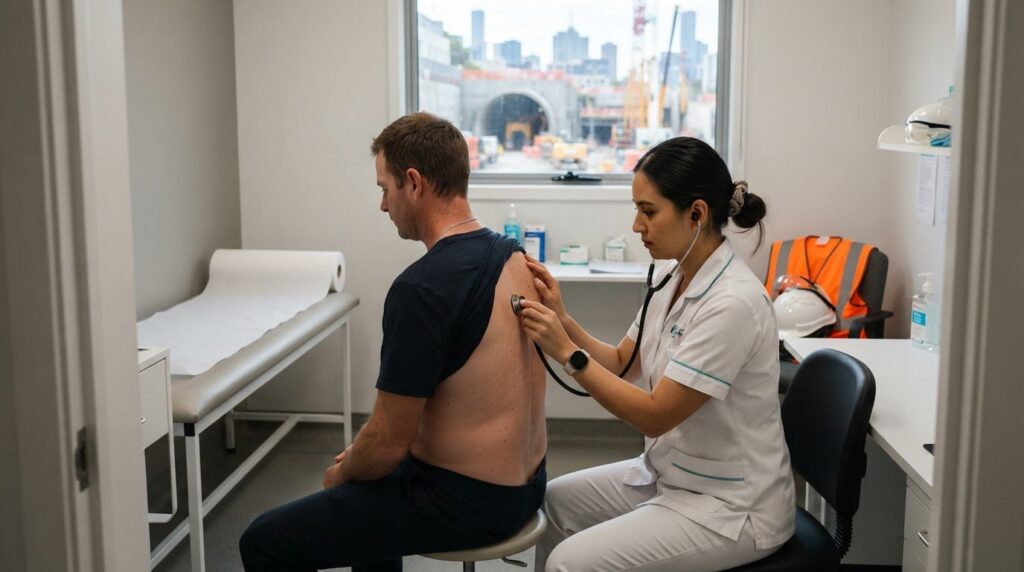
How many workers can an on-site medical team assess in one visit? For on-site medicals for tunnelling projects in Melbourne, there is no single headcount: capacity depends on the assessments required, the time each worker needs and how appointments fit around site operations. A well-planned visit starts with the project’s needs, not a one-size-fits-all number.
It’s understandable to want a clear schedule while keeping safety-sensitive work moving. The right assessment plan can coordinate worker screening with project demands and allow each person time for an appropriate review.
This article explains what worker assessments may include, how on-site medical teams can support tunnelling and construction projects, and what affects the number of people assessed during a visit. It also outlines how health monitoring relates to silica exposure and where services are available across Victoria, so you can plan the next step with greater clarity.
Key Takeaways
- Plan assessment capacity around the checks each role requires and how the visit can be scheduled around site operations.
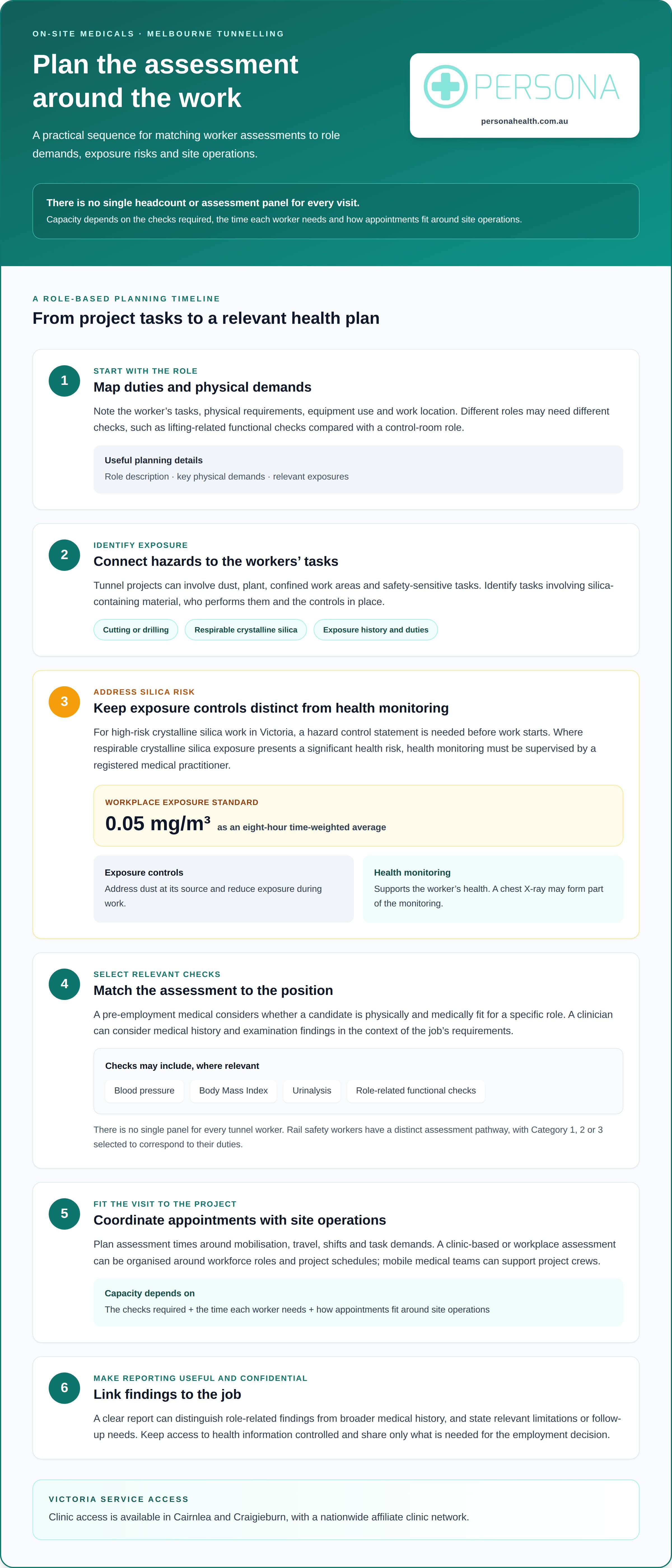
- Understand how silica exposure can affect health-monitoring needs, including the workplace exposure standard of 0.05 mg/m³ as an eight-hour time-weighted average.
- See how pre-employment assessments can consider a worker’s fitness for a specific role, with checks such as blood pressure, Body Mass Index and urinalysis.
- Find out how mobile medical teams can support project crews, alongside clinic access in Cairnlea and Craigieburn and a nationwide affiliate clinic network.
- Learn when Persona Health’s On-Site Health Surveillance may help organise health assessments for hazardous and safety-sensitive work.
Occupational health for hazardous and safety-sensitive workplaces
Tunnel projects combine dust, plant, confined work areas and safety-sensitive tasks. Occupational health assessments should match the hazards workers may encounter, rather than treating every role identically. For example, a worker exposed to respirable crystalline silica may need different health monitoring from someone whose main duties involve logistics or site coordination. A clinic-based or workplace assessment can also help organise screening around workforce roles and project schedules.
For Victorian projects, high-risk crystalline silica work needs a hazard control statement before work starts. Where respirable crystalline silica exposure presents a significant risk to health, the business must provide health monitoring supervised by a registered medical practitioner. These are the key requirements for tunnel worker health assessments described here; the monitoring may include a chest X-ray.
The workplace exposure standard for respirable crystalline silica is 0.05 mg/m³ as an eight-hour time-weighted average. That benchmark makes exposure controls central to a compliant workplace plan, but health monitoring and exposure control serve different purposes. Monitoring supports the worker’s health, while controls address dust at its source and reduce exposure during tasks such as cutting or drilling silica-containing material.
Respiratory health surveillance should reflect the worker’s exposure history and duties. A clinician supervising health monitoring can consider whether a chest X-ray forms part of the assessment. For a tunnelling workforce, start by identifying tasks involving silica-containing material, the workers performing them and the controls in place. This links occupational risks to the monitoring arranged for each role.
Coal Board medicals and silica health surveillance are related to occupational health, but they should not be treated as interchangeable labels. The appropriate assessment depends on the work, hazards and applicable requirements. Mining experience, previous exposure and current duties can all help define the assessment scope. Fatigue management also needs a practical connection to logistics: shift arrangements, travel to site, task demands and the timing of assessments can affect how a crew is organised. Medical assessment is one part of fitness-for-work planning, not a substitute for managing fatigue through work design.
For on-site medicals, project teams can organise the process by matching role requirements with relevant hazards, then arranging suitable assessment times and clinical oversight. This helps keep the medical plan relevant to the workforce, whether the project involves tunnelling, construction or mining-related tasks. Melbourne employers can find local service information through the Melbourne occupational health service page.
Pre-employment medical assessments for construction workers
For Victorian tunnel construction workers, assessment content should reflect each role’s physical and medical demands. The appropriate checks depend on the tasks involved and the worker’s duties.
Start with the role, rather than applying the same panel to every worker. Employers can map physical demands, equipment use, work location and relevant exposures before scheduling assessments. For example, a role involving regular lifting may need different functional checks from a control-room position. At a remote project, coordinate appointments with mobilisation, travel and shift arrangements.
Pre-employment medicals assess whether a candidate is physically and medically fit to perform the requirements of a specific role. A clinician can use the role information to guide the assessment, then consider the worker’s medical history and examination findings in context. Functional assessments may examine relevant capacities, such as movement or task-related physical ability, where these match the job demands. Fitness-for-duty evaluations should connect findings to the role rather than rely on a generic pass-or-fail label.
Results, reporting and confidentiality
Employers need a clear outcome they can use for the employment decision, while clinical details require careful handling. A useful report distinguishes role-related findings from the worker’s broader medical history and states any relevant limitations or follow-up needs. Keep access to health information controlled, and share only information needed for the decision. For Melbourne employers, pre-employment medical assessments can be planned around the position’s requirements.
Tunnel worker assessment requirements
There is no single assessment panel for every tunnel worker in Victoria. Select checks according to the job, its physical demands and relevant exposures. Crystalline silica health monitoring is a separate consideration where exposure presents a significant health risk. This role-based approach helps employers request relevant checks without assuming every worker needs identical testing.
Rail work has a distinct assessment pathway. Assessments for rail safety workers can include Category 1, 2 and 3 under the National Standard for Health Assessment of Rail Safety Workers. The category and assessment scope should correspond to the rail worker’s duties. These rail categories are not a substitute for assessing construction tasks outside rail work, such as manual duties or site access requirements.
Before booking, employers can provide a role description, key physical demands and relevant exposure information. The clinician can then align assessment steps with the position and explain the resulting report. To discuss how to organise assessments for a project workforce, get help planning role-specific assessments.
Medical history and physical examination
A tunnel-worker medical does not have one test panel for every candidate. Lung-function testing, hearing checks and drug screening may be included when the role and workplace risks call for them. The clinician uses job demands and relevant exposure information to shape the screening, rather than assuming every worker needs identical tests.
Medical history helps put examination findings in context. The clinician may ask about current health, past conditions, medicines, previous work and relevant exposures. For example, a history of dusty work can inform discussion of respiratory health, while previous musculoskeletal problems may matter for physically demanding tasks. The candidate’s answers help direct the assessment to issues relevant to the work.
A physical examination can include checks such as blood pressure, Body Mass Index and urinalysis. These are standard health checks identified for pre-employment assessments. They provide information for the clinical review, but should not be treated as a complete assessment of fitness for every tunnel role. The relevance of each finding depends on the worker’s health and the tasks being considered.
Where respirable crystalline silica exposure presents a significant risk to health, health monitoring supervised by a registered medical practitioner may include a chest X-ray. This monitoring is distinct from routine pre-employment screening. For a worker whose duties involve silica-containing material, exposure history and the project’s health-monitoring arrangements help determine the appropriate clinical pathway.
Functional checks should relate to actual duties. A candidate expected to climb, move equipment or work in restricted spaces may need a role-relevant assessment of physical capacity. Musculoskeletal symptoms can be discussed alongside those demands, helping the clinician consider how the person’s current health relates to the position. These checks do not replace workplace controls or an employer’s management of work design.
Results should be interpreted as a whole. A blood pressure reading, urinalysis result or reported symptom is one part of the candidate’s occupational health picture, not an automatic employment decision. The clinician considers relevant findings against the position’s requirements and records an outcome that supports a clear, role-related decision. The pre-employment medical process can include history-taking, examination and any additional checks selected for the role.
For construction employers, useful planning begins with a clear description of the work, known hazards and physical demands. That information helps the clinical team deliver screening that fits the position and supports worker wellbeing. It also helps distinguish Pre-Employment Medicals from exposure-related health monitoring, hearing checks, respiratory testing or drug screening arranged for specific workplace needs.
Melbourne and regional Victoria service coverage
For Melbourne projects, clinic appointments and workplace-based assessments offer different ways to organise worker screening. Persona Health’s Melbourne clinics are in Cairnlea and Craigieburn, with mobile workplace services available across Australia. The best arrangement depends on the project site, assessments required and whether workers can travel. A site-based visit may reduce travel away from work, while a clinic appointment may suit an individual worker or smaller group.
Persona Health also has Sydney clinics in Parramatta, Rosebery, Gregory Hills and Dee Why. Rosebery and Gregory Hills are key locations for employers arranging assessments in Sydney, while Cairnlea and Craigieburn serve Melbourne workers. For projects across multiple locations, a nationwide network of 100 affiliate clinics can help coordinate access alongside mobile workplace services. Location planning should account for where crews work and how appointments fit their rosters.
Different projects need different health services. A tunnel workforce may require pre-employment screening for new starters, while ongoing health monitoring may relate to workplace exposures. Drug and alcohol testing is a separate assessment employers may arrange for their workforce. Persona Health takes an employer-focused approach, with fast turnaround times, responsive customer service and modern digital reporting supporting the coordination of assessments across project locations.
Site logistics shape how workplace assessments are organised. A crew working staggered shifts, for example, may need appointment times that avoid disrupting essential work. A regional or remote site may require coordination around access and worker movement. Employers can provide a roster, site contact and role information so the clinical team can plan the appointment sequence and understand the project environment.
For a project spanning Melbourne and regional Victoria, employers can plan which workers attend a clinic and which groups may suit workplace visits. Consistent coordination across locations can help manage screening, while clinical checks remain relevant to each worker’s duties and health needs. The right arrangement depends on workforce distribution, site operations and assessment requirements.
Before scheduling, define the workforce groups, assessment types and preferred locations. For instance, a worker near Craigieburn might attend a clinic, while a team at a regional worksite could be assessed through mobile services. This distinction helps employers plan travel, roster coverage and appointment flow without assuming every project needs the same delivery method.
Victoria’s construction environments range from metropolitan tunnel sites to regional infrastructure projects. A tailored plan considers location, access, shift patterns and the purpose of each test. For ongoing projects, employers can organise a repeatable process for new starters and health monitoring, keeping arrangements aligned with workforce changes and site requirements.
Persona Health offers fast turnaround times, and on-site scheduling can be coordinated around the project’s roster, site access and assessment needs.
Onsite mobile medical teams
Mobile workplace assessments bring occupational health services to a project site instead of sending every worker to a clinic. For on-site medicals for tunnelling projects in Melbourne, the assessment plan should reflect the site, workforce and checks required.
Mobile medical team delivery
A mobile team coordinates appointments at the workplace, helping limit travel away from the project. Before the visit, employers can provide the site location, worker roles and required assessments. The team can use this information to plan appointment flow and identify suitable spaces for private consultations. Site access and shift times also shape practical arrangements.
For example, crews working across shifts may need appointments organised around handover times. A project with workers performing different tasks may need role-specific assessment pathways, rather than one identical screening process. Clinicians assess workers individually, and results relate to the checks performed. This helps employers plan workforce health activities alongside scheduled project work.
Provider options for project medicals
Melbourne employers can engage occupational health providers that deliver mobile workplace services. Those arranging on-site medicals for tunnelling projects in Melbourne should consider whether the service can organise the required checks around the worksite, worker roles and project schedule. Australia-wide mobile workplace services can also help employers coordinate assessments across multiple locations.
The assessment scope matters. A project requiring silica-related health monitoring needs a pathway suited to that purpose, while Pre-Employment Medicals address a different need. Sharing workforce details and assessment requirements helps define a service that fits the project. Employers can also plan how reports will be shared and appointments coordinated with site operations.
Arranging on-site medicals
There is no single scheduling time for every tunnelling project. Timing depends on the assessment mix, team capacity, location, site access and appointment schedule. A workforce list and clear assessment requirements help Persona Health plan the visit, while varied screening needs may require additional coordination.
Employers can start by setting out the project address, worker groups, role requirements and preferred appointment windows. They can also identify site entry arrangements and a project contact. These details give the mobile team a practical basis for planning and help workers understand where and when to attend.
For ongoing checks, scheduling can account for workforce changes and site activity. New starters and established crews, for example, may need different appointment pathways. A consistent process helps employers keep assessments organised as project requirements change, with mobile delivery supporting sites across metropolitan Melbourne and regional Victoria.
Persona Health: On-Site Health Surveillance
Persona Health provides on-site Health Surveillance for employers coordinating assessments in hazardous workplaces. Services include audiometry, spirometry, Drug and Alcohol Testing, heavy-metal screenings, skin checks, mobile ILO chest X-rays, and on-site vaccinations and serologies. This can help organise monitoring around the worksite and identified exposures, including crystalline silica risks. Learn more about Health Surveillance.
For other workforce needs, Pre-Employment Medicals support role-related screening, while an Independent Medical Examiner can provide an independent medical assessment. The right service depends on the purpose of the assessment and the worker’s circumstances. Persona Health focuses on matching the assessment to the workplace need, rather than treating every worker or project the same.
Contact Persona Health to discuss health surveillance for your project.
Set your project up for confident workforce planning
Planning on-site medicals for tunnelling projects in Melbourne is an opportunity to connect assessment planning with the work your crews will perform. As project tasks and workforce needs change, keep role requirements and relevant exposures central to decisions about screening and health monitoring.
Persona Health offers Pre-Employment Medicals, Crystalline Silica Medicals and Workplace Injury Management. InjuryQR is a free AI-powered workplace injury triage service available to Australian businesses, with free posters, stickers, keyrings and fridge magnets. Workers scan a QR code without downloading an app, describe an injury by voice, and answer AI follow-up questions. Outcomes can include self-care advice, telehealth, Emergency Department direction or instructions to call 000. Certificates of Capacity can be issued immediately where appropriate.
A considered plan gives your team a practical starting point for supporting worker health throughout the project.
Frequently Asked Questions
How many workers can you screen in a visit?
There is no fixed number: capacity depends on the assessments required and the time each worker needs. A group needing a limited set of checks can be scheduled differently from workers requiring several assessments or clinical reviews. For planning, provide the workforce list, role types and required checks. Persona Health can then plan appointment slots and discuss how the visit can fit around shift changes and site operations.
Which projects do you travel to?
Mobile workplace medical services can support projects across Australia, including construction and infrastructure worksites. Persona Health also serves employers in Melbourne and Sydney, with a national network for broader workforce coverage. Project needs may differ: a tunnelling site might require exposure-related health surveillance, while a logistics workplace may need role-related medical assessments. The location, worker roles and assessment requirements help shape how an on-site visit is organised.
Are pre-employment medicals mandatory for tunnelling workers in Victoria?
The information here does not establish that Pre-Employment Medicals are required for every tunnelling worker. Checks should relate to the role and its demands. This is separate from silica health monitoring: where respirable crystalline silica exposure presents a significant risk to health, the business must provide monitoring supervised by a registered medical practitioner. Employers should distinguish recruitment screening from exposure-related monitoring when planning assessments.
What medical standards apply to respirator, confined-space and underground work fitness assessments?
Assessment needs depend on the worker’s duties and the hazards involved; a single medical assessment should not be assumed to cover every task. For example, an assessment for respirator use is a different question from health monitoring for silica exposure. For rail safety workers, assessments can fall under Categories 1-3 of the National Standard for Health Assessment of Rail Safety Workers. Employers should define each task and assessment purpose clearly.
What information and site facilities should employers provide to help a provider prepare an on-site medical clinic for a Melbourne tunnelling project?
Provide the project address, site access arrangements, workforce list, role descriptions, shift schedule and required assessment types. Include relevant exposure information, such as work involving silica-containing materials, so the clinical team can plan appropriate checks. Identify a site contact and a suitable area for confidential consultations and assessments. Clear information helps Persona Health plan worker flow, understand site conditions and coordinate appointments around project operations.
What risks and limitations should employers consider when arranging on-site medicals for tunnel workers?
On-site assessments need suitable scheduling, site access and space, and the checks must match the clinical purpose. A medical assessment does not replace dust controls or other workplace risk controls. Employers should also distinguish Pre-Employment Medicals from health monitoring for significant silica exposure, which requires supervision by a registered medical practitioner. Assessment results relate to the checks performed and should be considered alongside the worker’s role and relevant workplace information.

Article by
Ian Nicholson
Ian is the Business Support Manager at Persona Health, where he plays a key role across IT, sales, marketing and business operations. With a broad skill set and a practical, solutions-focused approach, Ian helps drive the systems, communication and commercial strategy that support Persona Health’s continued growth across Australia.