
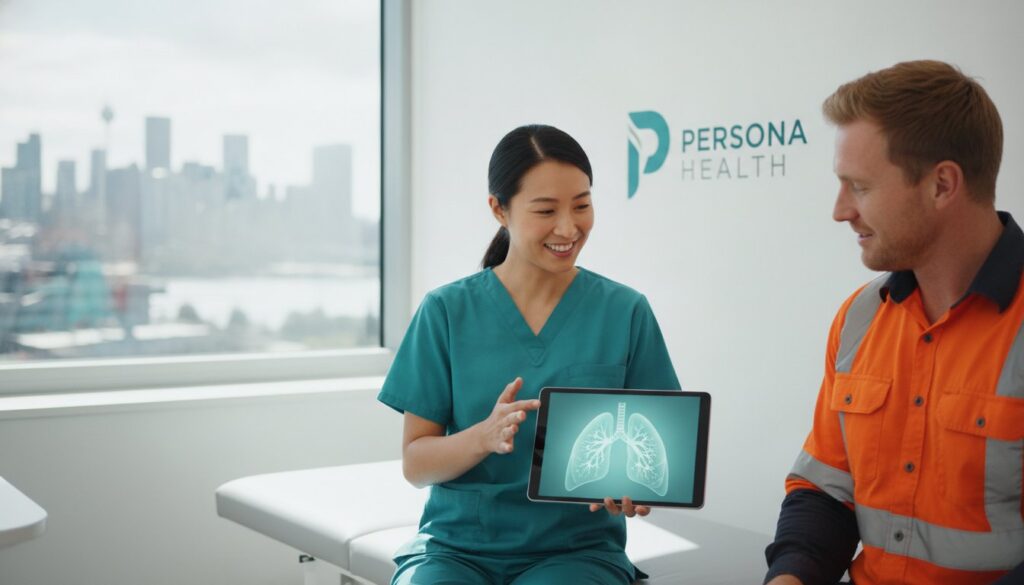
With researchers projecting that current workplace exposure levels could lead to more than 83,000 cases of silicosis across Australia, the pressure on employers to get safety right has never been higher. You likely recognise that managing health surveillance across multiple sites while keeping up with shifting WHS legislation is a significant logistical challenge. It is natural to feel concerned about long-term health liabilities and the complexity of ensuring every worker is properly screened.
Understanding the specific silica health monitoring requirements is the first step in moving from uncertainty to total compliance. This guide provides a clear roadmap for 2026, helping you navigate your legal obligations, the medical assessment process, and the practical steps needed to protect your workforce from respirable crystalline silica dust. At Persona Health, we specialise in translating these clinical standards into manageable workplace practices. We will examine the transition to new Workplace Exposure Limits (WELs), the increasing preference for high-resolution CT scans, and how efficient digital reporting can secure your health records for the future.
Key Takeaways
- Navigate the 2026 legislative landscape, including the national engineered stone ban and the transition to stricter Workplace Exposure Limits for all silica-generating activities.
- Understand the clinical progression of silica-related diseases and why proactive medical surveillance is the most effective way to manage long-term health liabilities.
- Identify the mandatory triggers for silica health monitoring requirements to ensure your business remains fully compliant with SafeWork Australia and state-specific regulators.
- Explore the components of a comprehensive medical assessment, from spirometry to the latest high-resolution imaging techniques preferred by occupational health specialists.
- Learn how to simplify the logistics of multi-site medicals by leveraging a national clinic network and modern digital reporting systems for better record-keeping.
What is Respirable Crystalline Silica and Why are Monitoring Requirements Increasing?
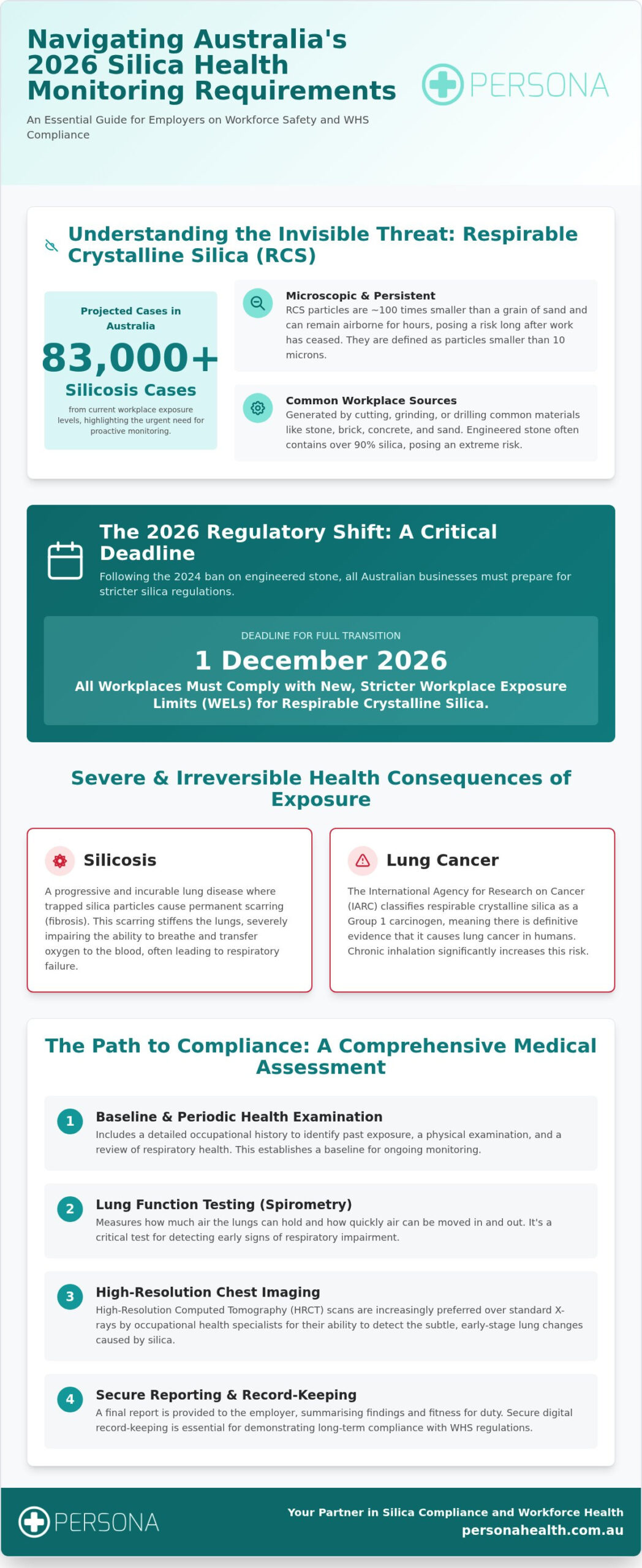
Respirable Crystalline Silica (RCS) is a microscopic hazard that is roughly 100 times smaller than a single grain of beach sand. When workers engage in mechanical processes like cutting, grinding, or drilling materials such as stone, brick, or concrete, they release these minute particles into the atmosphere. Because they are so small, they remain suspended in the air for long periods, often invisible to the naked eye. As a Person Conducting a Business or Undertaking (PCBU), you have a primary duty of care under Australian WHS legislation to ensure the health and safety of your workforce. This responsibility includes managing the risks associated with RCS through robust silica health monitoring requirements.
The year 2026 represents a critical turning point for Australian industry. Following the national ban on engineered stone in 2024, regulators have shifted their focus toward stricter enforcement across all sectors, including construction, mining, and natural stone masonry. By 1 December 2026, businesses must fully transition to the new Workplace Exposure Limits (WELs) for airborne contaminants. This peak in regulatory activity means that simply providing a mask is no longer sufficient; you must demonstrate active health surveillance to protect your team from The Health Risks of Silica Exposure and other debilitating conditions.
Naturally Occurring vs Manufactured Silica Hazards
Silica is a common mineral found in abundance across Australia, from Sydney’s iconic sandstone to the concrete used in Melbourne’s high-rises. While it occurs naturally in many materials, manufactured products often contain significantly higher concentrations of crystalline silica, sometimes exceeding 90%. Modern construction techniques, particularly the use of high-speed power tools without adequate water suppression or vacuum extraction, have increased the risk of dust aerosolisation. This makes it easier for workers to inhale high concentrations of dust in a short space of time, necessitating specialised Crystalline Silica Medicals to detect early signs of lung damage before they become irreversible.
The Invisible Danger: Why RCS is Different from General Dust
Standard dust particles are often trapped by the body’s natural defences, such as the hair and mucus in the nose and throat. However, RCS is different. These particles are small enough to bypass these filters and lodge themselves deep within the alveolar sacs of the lungs. Once there, the body cannot easily expel them, leading to permanent scarring and inflammation. Unlike heavier particles that settle quickly, fine RCS can remain airborne for hours after a task is completed, posing a risk to anyone in the vicinity. Respirable crystalline silica is officially defined as the fraction of silica dust small enough to reach the gas-exchange region of the lungs, typically involving particles less than 10 microns in diameter. This biological persistence is why silica health monitoring requirements are now a mandatory component of a safe Australian workplace.
The Health Risks of Silica Exposure: Why Surveillance is Essential
Inhaling respirable crystalline silica (RCS) initiates a silent, biological chain reaction within the human body. While the initial exposure might feel harmless, the long-term consequences are often devastating. Silicosis is the most well-known outcome; it’s a progressive and incurable lung disease where the lung tissue develops nodules and scarring, known as fibrosis, in response to the trapped silica. Over time, this scarring makes it increasingly difficult for the lungs to transfer oxygen to the blood, often leading to respiratory failure. For employers, meeting silica health monitoring requirements isn’t just about ticking a regulatory box; it’s about preventing a life-altering diagnosis for your team.
The risks extend far beyond scarring. The International Agency for Research on Cancer classifies crystalline silica as a primary carcinogen, meaning there’s definitive evidence that it causes lung cancer in humans. Chronic inhalation also significantly increases the likelihood of developing Chronic Obstructive Pulmonary Disease (COPD), which includes chronic bronchitis and emphysema. These conditions don’t just affect a worker’s immediate health; they severely curtail their career longevity and overall quality of life. Research also links chronic RCS exposure to systemic issues like kidney disease and autoimmune conditions, such as scleroderma and lupus, highlighting that the damage isn’t always confined to the chest cavity.
Types of Silicosis: Acute, Accelerated, and Chronic
Chronic silicosis is the most common form, typically appearing after 10 or more years of exposure to lower levels of dust. Accelerated silicosis develops much faster, often within 5 to 10 years, and has been a major concern in industries using high-silica products. The rarest and most severe form, acute silicosis, can occur within weeks or months of extremely high exposure levels. Because symptoms like shortness of breath or a persistent cough often don’t appear until significant damage has already occurred, regular Health Surveillance is the only reliable way to achieve early detection and intervention.
Secondary Complications and Worker Wellbeing
Workers with silica-damaged lungs are significantly more vulnerable to secondary infections, including tuberculosis and severe bouts of pneumonia. The emotional and financial toll on Australian families is profound when a breadwinner develops an occupational disease. It creates a ripple effect of uncertainty and stress that affects the entire community. A professional medical assessment is the only definitive way to confirm lung health and provide peace of mind for both the employer and the employee. If you’re looking to protect your workforce, Persona Health offers specialised Crystalline Silica Medicals that provide the clinical clarity you need to manage these risks effectively.
Australian WHS Regulations and the Engineered Stone Ban in 2026
Australian Work Health and Safety (WHS) regulations have undergone a seismic shift to address the rising rates of occupational lung disease. As a Person Conducting a Business or Undertaking (PCBU), you’re legally required to manage the risks associated with dust-generating tasks. One of the most critical silica health monitoring requirements often overlooked is the duty to maintain worker health records for at least 30 years. This long-term obligation exists because diseases like silicosis can remain latent for decades; having a robust digital record ensures that exposure history is preserved for the entire duration of a worker’s life. SafeWork Australia continues to refine the national exposure standards, but the practical responsibility for monitoring rests firmly with the employer.
Mandatory health monitoring is triggered whenever there’s a significant risk to a worker’s health due to respirable crystalline silica (RCS) exposure. This includes any work involving materials with 1% or more crystalline silica where dust is generated. If your air monitoring results approach or exceed the current workplace exposure standard of 0.05 mg/m³, you must provide a medical assessment. With the transition to new Workplace Exposure Limits (WELs) by 1 December 2026, many businesses are choosing to lower their internal thresholds now to ensure they aren’t caught out by future regulatory tightening.
SafeWork NSW and WorkSafe Victoria Compliance Standards
Businesses operating across Sydney and Melbourne must be mindful of state-specific nuances. Both SafeWork NSW and WorkSafe Victoria mandate that health monitoring must be supervised by a Registered Medical Practitioner, ideally one with specific expertise in occupational medicine. Failing to provide adequate surveillance or neglecting air monitoring can result in heavy penalties, including significant fines and enforceable undertakings. Utilising a professional partner for On-Site Health Surveillance ensures that your business remains compliant with these rigorous local standards while protecting your most valuable assets: your people.
The Engineered Stone Prohibition: 2026 Update
The national ban on the manufacture, supply, and installation of engineered stone containing 1% or more crystalline silica is now a permanent fixture of the Australian industrial landscape. While the ban has been in effect since July 2024, 2026 sees a heightened focus on “legacy work.” This refers to the repair, removal, or minor modification of stone installed before the ban. Such work is only permitted under strict controls, including mandatory water suppression and high-efficiency particulate air (HEPA) filtered extraction. Even when working with safer alternatives, the requirement for regular medical reviews remains a cornerstone of modern safety management in the construction and masonry sectors.
The Silica Medical Assessment: What Employers and Workers Should Expect
Meeting your silica health monitoring requirements involves a structured clinical pathway designed to catch early changes in lung health before they manifest as physical symptoms. A standard Crystalline Silica Medical begins with a detailed occupational history to map out previous exposure levels across different industries. This is followed by a physical examination focused on the respiratory system. The process is designed to be reassuring for the worker, providing an opportunity to discuss any concerns with an experienced clinician who understands the specific risks of their trade. For the employer, it provides the definitive data needed to confirm that current workplace controls are actually working.
The role of the Occupational Physician is central to this process. These specialists don’t just look at a “pass” or “fail” result; they interpret complex data to identify subtle trends in a worker’s health over time. If a result shows a decline in lung function, the physician provides expert guidance on whether the worker needs to be moved to a different area or if workplace dust controls require urgent review. This professional oversight is what transforms a simple check-up into a robust safety net for your business.
Clinical Tests: Spirometry and Radiology
Spirometry is a core component of the assessment, measuring the volume of air a worker can inhale and exhale, as well as the speed of that exhalation. It’s a sensitive tool for detecting early obstructive or restrictive patterns in the lungs. When it comes to imaging, the Australian clinical landscape in 2026 has largely shifted toward Low-Dose High-Resolution Computed Tomography (HRCT) as the preferred tool for early detection, as it offers far greater detail than traditional chest X-rays. The ILO (International Labour Organization) classification system for chest X-rays provides a standardised method for coding the presence and severity of dust-related lung abnormalities using a globally recognised scale of profusion.
Hierarchy of Controls and Workplace Safety
While medical assessments are vital, they sit alongside the hierarchy of controls. Personal Protective Equipment (PPE), such as P2 or P3 respirators, is strictly the last line of defence. Engineering controls like wet cutting and local exhaust ventilation (LEV) must always take priority because they remove the hazard at the source. To ensure PPE is actually effective, respirator mask fit testing is a non-negotiable requirement; a mask that doesn’t seal perfectly offers almost no protection against microscopic silica particles. Integrating Pre-Employment Medicals for all new staff allows you to establish a healthy baseline before any exposure occurs on your sites. To ensure your team is fully protected and your business is compliant, you can book a comprehensive Crystalline Silica Medical with our specialised occupational health team.
Persona Health: Your Partner in Silica Compliance and Injury Management
Managing the clinical and administrative weight of silica health monitoring requirements is a complex task for any Australian business. At Persona Health, we serve as your professional partner, providing a seamless ecosystem that bridges the gap between regulatory obligation and worker well-being. Our experienced Occupational Medicine physicians lead a team dedicated to providing clear, actionable health data. With our modern digital reporting systems, we ensure that the required long-term records are captured accurately and delivered with fast turnaround times, allowing you to maintain a high standard of safety without compromising operational efficiency.
Our national reach is a significant advantage for businesses with diverse workforces. We support our primary hubs with a 100-clinic affiliate network, ensuring that your teams receive a consistent standard of medical assessment regardless of their location. This national consistency is matched by our commitment to clinical excellence, ensuring that every assessment is performed to the highest Australian standards.
Clinic Locations and On-site Services
Accessibility is fundamental to a successful health surveillance programme. We operate clinics across Sydney in Parramatta, Rosebery, Gregory Hills, and Dee Why, while our Melbourne teams are based in Cairnlea and Craigieburn. For large-scale infrastructure projects or remote work sites, our mobile on-site health surveillance services bring our specialised equipment and medical team directly to you. This approach minimises downtime while ensuring total compliance. If an exposure incident is identified, our team provides expert guidance on Workplace Injury Management to support the worker’s recovery and your business’s continuity.
InjuryQR: AI-Powered Triage for the Modern Workplace
Immediate incident reporting is essential for reducing the severity of workplace injuries. We provide InjuryQR as a free AI-powered triage service that allows workers to scan a QR code with no app required. After scanning, the worker describes the incident by voice, and the AI-guided system provides instant next steps such as self-care, telehealth, or emergency direction. A primary benefit for employers is the immediate issuance of Certificates of Capacity where appropriate, which significantly reduces Lost Time Injuries (LTIs) and improves the quality of incident reporting. You can order free physical InjuryQR assets, including posters and magnets, to ensure your team has instant access to this proactive care tool.
Securing Your Workforce and Compliance for 2026
The transition to new Workplace Exposure Limits represents a significant shift for Australian industry, but it is a challenge that can be managed with the right clinical support. By integrating robust silica health monitoring requirements into your safety culture, you are not only meeting your legal obligations but also demonstrating a profound commitment to the individuals who build your business. Proactive surveillance remains the most effective tool for identifying respiratory changes before they become life-altering, allowing you to manage health risks with precision and empathy.
Persona Health is ready to support your organisation with specialised medical assessments, fast digital reporting, and a national clinic network that spans Sydney, Melbourne, and beyond. Whether you need baseline screenings for new starters or a comprehensive on-site surveillance programme for a major infrastructure project, our team of experienced occupational health professionals is here to help. Book your specialised Crystalline Silica Medical with Persona Health today, or contact our team to request a quote and speak with our experts about your specific occupational health requirements. We look forward to partnering with you to create a safer, healthier workplace for every Australian worker.
Frequently Asked Questions
What is the difference between silica and crystalline silica?
Silica is a common mineral found in the earth’s crust, but crystalline silica is the specific form that becomes hazardous when crushed into respirable dust. While non-crystalline silica is often found in glass or gels, it is the crystalline variety found in stone and concrete that causes permanent lung scarring when inhaled. Distinguishing between the two is essential for identifying which materials on your site fall under strict regulatory oversight.
How often do my workers need silica health monitoring under Australian law?
Most workers require an initial baseline medical before they commence any high-risk tasks, followed by annual reviews of their respiratory health. The frequency of more intensive tests, such as radiological imaging, is determined by the level of exposure and the specific silica health monitoring requirements set by state regulators. Adhering to this schedule ensures that any changes in lung function are identified at the earliest possible stage.
Is silicosis reversible if it is detected early during a medical?
Silicosis is a permanent condition because the fibrous scar tissue that forms in the lungs cannot be reversed or removed. However, early detection is life-saving because it allows for the immediate cessation of exposure, which can prevent the disease from progressing into more severe respiratory failure. This makes regular medical surveillance the most critical tool in your safety arsenal.
Does a standard dust mask provide enough protection against RCS?
A basic nuisance dust mask is entirely inadequate for protecting against respirable crystalline silica, as the particles are small enough to pass straight through the material. Workers must be provided with properly rated P2 or P3 respirators that are specifically designed to filter out microscopic mineral dust. These respirators are only effective when used as part of a comprehensive respiratory protection programme that includes regular maintenance and training.
What are my legal obligations if a worker returns an abnormal silica medical result?
If a medical report indicates a work-related abnormality, you are legally required to notify your state WHS regulator, such as SafeWork NSW or WorkSafe Victoria, immediately. You must also conduct a thorough review of your workplace risk controls and air monitoring data to identify and rectify the source of the exposure. Supporting the worker through this process is a mandatory part of your duty of care as a PCBU.
Do I need to provide silica medicals for sub-contractors on my site?
While the direct employer is usually responsible for the medical costs, the principal contractor has a shared duty to ensure all workers on their site are healthy and safe. You should verify that every sub-contractor has current health surveillance records before they begin any task that generates dust. This collaborative approach ensures that silica health monitoring requirements are met across the entire project lifecycle.
What is the 30-year record-keeping rule for silica health monitoring?
Australian law requires employers to keep health monitoring records for 30 years because silica-related diseases often have a very long latency period. Symptoms may not appear until many years after a worker has left your employment or moved into a different industry. Secure digital storage is the most reliable way to ensure these records remain accessible and legible for the duration of this three-decade requirement.
How does a respirator mask fit test help with silica compliance?
A fit test provides clinical confirmation that a specific respirator creates an airtight seal against a worker’s unique facial structure. Without a fit test, there is a high risk that microscopic dust will leak into the mask through small gaps, rendering the protection useless. Regular fit testing is a non-negotiable requirement for compliance with Australian safety standards and ensures your PPE is actually performing its intended function.

Article by
Ian Nicholson
Ian is the Business Support Manager at Persona Health, where he plays a key role across IT, sales, marketing and business operations. With a broad skill set and a practical, solutions-focused approach, Ian helps drive the systems, communication and commercial strategy that support Persona Health’s continued growth across Australia.