
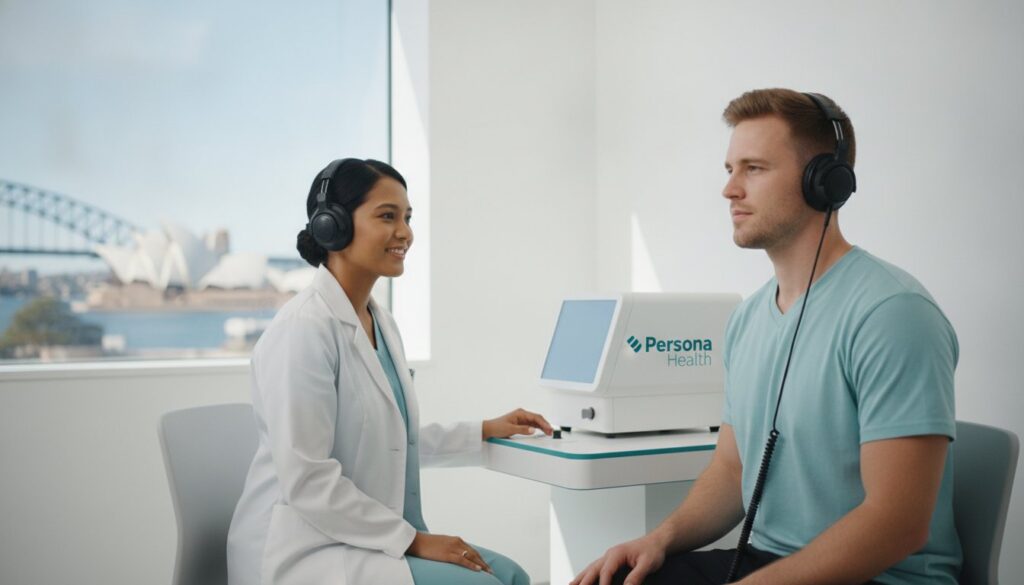
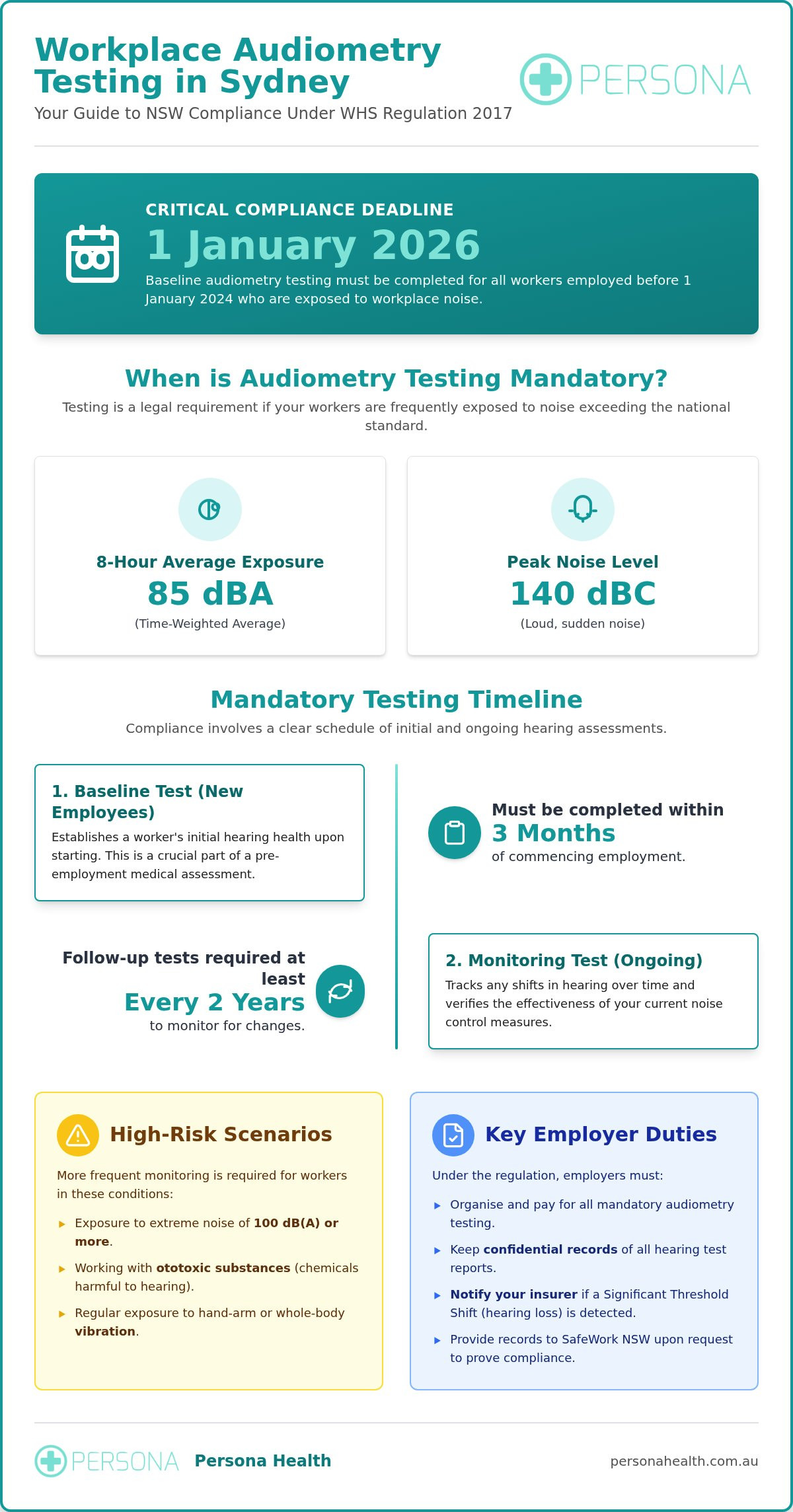
If you are managing a team in a noise-heavy environment, the 1 January 2026 deadline for mandatory workplace audiometry testing sydney is no longer a distant requirement; it is a critical compliance milestone that demands your immediate attention. We recognise that trying to interpret the specific nuances of Clause 58 within the NSW WHS Regulation 2017 can be a source of significant frustration. Between managing employee downtime and the headache of organising complex health records, it’s easy to feel overwhelmed by the administrative weight of workplace health and safety.
The good news is that meeting your legal obligations doesn’t have to disrupt your operations. This guide is designed to help you discover how to meet SafeWork NSW hearing health regulations while protecting your most valuable asset: your people. By partnering with the experienced team at Persona Health, you can ensure your business remains fully compliant while actively reducing your long-term workers’ compensation risk. We will preview the essential 2026 testing frequencies, explain how we deliver mobile and clinic-based services across Sydney, and show you how a modern approach makes health surveillance the simplest part of your week.
Key Takeaways
- Understand the mandatory requirements under the Work Health and Safety Regulation 2017 and why the 1 January 2026 deadline is a critical milestone for your existing workforce.
- Learn how professional workplace audiometry testing sydney streamlines your compliance journey while providing the clinical accuracy needed to protect your team from noise-induced hearing loss.
- Discover the logistical differences between mobile on-site testing and clinic-based assessments to choose the most efficient and cost-effective path for your specific business location.
- Identify the necessary steps to take when a Significant Threshold Shift is detected to ensure proper injury management, noise control reviews, and regulatory reporting.
- Explore how integrating hearing health with broader surveillance programs can reduce your administrative burden and lower your overall workers compensation risk.
Understanding Workplace Audiometry Requirements in NSW
The regulatory landscape for noise management in New South Wales has undergone significant changes that every business owner must understand. Under Clause 58 of the Work Health and Safety (WHS) Regulation 2017, providing workplace audiometry testing sydney is no longer a voluntary safety measure but a strict legal mandate. This requirement applies to any Person Conducting a Business or Undertaking (PCBU) where workers are exposed to noise levels exceeding the national exposure standard. To gain a foundational understanding of the clinical side of these assessments, you can read more about What is Audiometry and how it identifies early hearing shifts before they become permanent disabilities.
The trigger for mandatory testing is the “85 decibel rule”. This standard is defined as an 8-hour time-weighted average (TWA) of 85 dBA, or a peak noise level of 140 dBC. If your workplace environment reaches these levels, you must provide a baseline hearing test for new employees within three months of them starting their role. This initial assessment is vital; it provides a clear record of the worker’s hearing health before they are exposed to your specific site noise profile, which is a key component of any robust pre-employment medicals strategy.
To better understand this concept, watch this helpful video:
Mandatory Frequency for Hearing Tests
Compliance is an ongoing commitment rather than a one-off task. Following the baseline assessment, SafeWork NSW requires a follow-up monitoring test at least every two years. This biennial schedule allows employers to track any changes in hearing sensitivity over time, ensuring that current noise control measures, such as earplugs or sound barriers, are actually effective. If a noise survey indicates that noise levels have increased or if control measures have changed, you may need to increase this frequency to protect your team adequately.
In high-risk scenarios, more frequent monitoring is necessary. This includes workers exposed to extreme noise levels of 100 dB(A) or more, or those working with ototoxic substances and vibration. Failing to meet these deadlines can lead to significant legal consequences for Sydney businesses, including heavy fines and increased liability for workers compensation claims if hearing loss is later detected.
The Role of SafeWork NSW
As we approach the critical 1 January 2026 deadline, SafeWork NSW is prioritising the enforcement of these regulations. For any worker employed before 1 January 2024, their baseline testing must be finalised before the 2026 cutoff. This is part of a broader effort to reduce the prevalence of noise-induced hearing loss (NIHL) across Sydney’s industrial sectors. Employers are also required to keep confidential records of all hearing test reports and notify their insurer if a permanent threshold shift is identified.
Persona Health simplifies this process by integrating hearing checks into our comprehensive on-site health surveillance programmes. Our digital reporting systems are designed to meet the rigorous standards expected by SafeWork inspectors, providing you with clear, professional records that prove your compliance. Whether you choose our clinics in Parramatta or Rosebery, or opt for our mobile services, we ensure your business meets every reporting obligation without the stress of managing complex medical data yourself.
The Audiometric Testing Process: What Your Workers Can Expect
When your team arrives for their workplace audiometry testing sydney, the process begins long before they put on a pair of headphones. Accuracy in hearing assessments relies heavily on a period of ‘quiet time’ preceding the test. Under the NSW Workplace Audiometry Requirements, workers should ideally have 16 hours of noise-free time before their baseline or monitoring assessment. This ensures that any temporary threshold shifts caused by a recent shift don’t skew the results; if this isn’t possible, high-quality hearing protection must be worn strictly leading up to the appointment.
The environment where the test occurs is equally critical. As of 1 January 2026, all audiometric testing must take place in accredited facilities that meet rigorous acoustic standards. This usually means a soundproof booth or a quiet room that has been professionally verified for ambient noise levels. At Persona Health, we ensure our Sydney clinics in Parramatta, Rosebery, Gregory Hills, and Dee Why provide these clinical conditions to guarantee reliable data for your health records. If we are visiting your site via our mobile service, we meticulously calibrate our equipment to the specific acoustic profile of the location.
The test itself is a non-invasive process called pure tone air conduction audiometry. The worker listens to a series of tones at various frequencies and volumes, pressing a button each time they hear a sound. We test a standard range from 500 Hz to 8000 Hz to capture the full spectrum of human speech and industrial noise impact. Once the test is complete, our clinicians provide immediate feedback, explaining the results so the worker understands their own hearing health journey and how to better use their protective equipment.
AS/NZS 1269.4 Standards Explained
Maintaining compliance means ensuring your provider adheres to AS/NZS 1269.4:2014, the Australian Standard for occupational noise management. This standard dictates everything from equipment calibration to the specific training required for the person conducting the test. Persona Health’s medical team consists of experienced professionals who prioritise clinical excellence; this ensures that the data you receive is both legally defensible and medically accurate. Our employer-focused approach means we don’t just tick a box; we provide high-quality care that reflects your commitment to staff well-being.
Understanding the Audiogram Report
An audiogram is a visual graph of a person’s hearing. The vertical axis measures intensity in decibels, while the horizontal axis tracks frequency in hertz. A ‘normal’ result shows thresholds between 0 and 20 decibels across all frequencies. Our reports clearly distinguish between conductive hearing loss, often caused by physical issues in the ear, and sensorineural hearing loss, which is typically the result of long-term noise exposure. If you’re looking to streamline your reporting, our on-site health surveillance systems provide digital access to these records instantly.
On-Site Mobile Testing vs Clinic-Based Assessments in Sydney
Deciding on the best delivery method for workplace audiometry testing sydney depends on your team size and site location. For large-scale industrial projects in Western Sydney, mobile solutions offer unmatched convenience. Smaller businesses or those near the city often find that clinic-based assessments provide better flexibility for individual staff members. It’s about finding the balance between clinical precision and operational efficiency.
Mobile testing units function as professional clinics on wheels. These vehicles require a stable, level parking area and usually a standard power outlet to operate their internal systems. While mobile mobilisation involves a service fee, it often pays for itself by eliminating employee travel time. Bringing the assessment to a site in Wetherill Park or Marsden Park ensures your team stays productive while meeting their legal obligations.
Clinic-based testing remains the gold standard for precision. These facilities are designed to meet the rigorous acoustic standards mandated for 2026, providing a perfectly quiet environment for every test. This is often the most sensible choice for businesses that cannot accommodate a large testing van on their premises. It also allows for a more controlled clinical experience for workers who may require additional follow-up assessments.
Benefits of Mobile Audiometry for Large Sites
On busy manufacturing or construction sites, minimising disruption is a priority. Our mobile service allows us to test multiple workers per hour in a high-throughput workflow. This approach is particularly effective for businesses racing to meet the 1 January 2026 deadline for existing employees. We offer this mobile reach across Greater Sydney, ensuring even remote sites receive the same clinical excellence as our metro centres.
Why Clinic-Based Testing Suits Metro Businesses
For teams in the inner suburbs, our Persona Health centres in Parramatta, Rosebery, and Dee Why provide a convenient and professional solution. Clinic visits are the most efficient way to handle pre-employment medicals, which must be completed within three months of a worker starting. This setup allows new hires to book individual appointments that fit their schedule. These visits integrate naturally with broader on-site health surveillance needs, such as monitoring for silica or asbestos exposure.
Managing Hearing Health and Significant Threshold Shifts
A Significant Threshold Shift (STS) is a critical clinical finding during workplace audiometry testing sydney. It represents a change in hearing sensitivity compared to the baseline test, specifically a loss of 10 decibels or more at 2000, 3000, and 4000 Hz in either ear. When our clinicians identify an STS, it acts as an early warning system. It signals that the current noise control measures may be failing or that a worker’s hearing protection is either inadequate or being used incorrectly. By choosing a professional provider for your workplace audiometry testing sydney, you gain more than just a report; you gain a partner in proactive risk reduction.
Your duty as an employer doesn’t end with the test; it begins with the results. If an STS is detected, SafeWork NSW expects you to investigate the cause. This might involve reviewing your noise survey data, checking the maintenance of machinery, or re-evaluating the grade of Personal Protective Equipment (PPE) provided. Distinguishing between a temporary threshold shift, which can recover after rest, and a permanent threshold shift is vital. This is why we emphasise the importance of quiet time before a re-test. If the shift persists, it confirms permanent damage, requiring immediate intervention to prevent further deterioration of the worker’s quality of life.
Next Steps After Identifying Hearing Loss
Once permanent hearing loss is confirmed, the priority shifts to preservation and support. This often involves referring the worker to an occupational physician for a more detailed diagnostic assessment. You may need to adjust their work duties to reduce further noise exposure or provide advanced hearing conservation training. Effective injury management is essential here; it ensures the worker remains productive while their health is protected, ultimately reducing the complexity of potential workers compensation claims. If you have identified hearing shifts in your team, contact Persona Health today to discuss our specialist injury management pathways.
Record Keeping and Privacy
Managing sensitive health data requires a high level of diligence. Under the Privacy Act 1988, employers must ensure that audiometric records are stored securely and accessed only by authorised personnel. In NSW, these records must be retained for the duration of the worker’s employment to track long-term health trends. Persona Health’s digital reporting systems provide a secure, employer-focused solution for this administrative burden. Our platform allows you to access historical data instantly, making it easy to compare results over time and demonstrate full compliance during a SafeWork NSW inspection.
Why Choose Persona Health for Your Sydney Audiometry
Choosing a partner for workplace audiometry testing sydney is about more than just finding a provider with a soundproof booth. It’s about ensuring your business is supported by a clinical team that understands the high-stakes nature of Sydney’s industrial sectors. We don’t view hearing tests as a siloed obligation. Instead, we integrate them into our comprehensive on-site health surveillance programmes. This means while we are assessing your team’s hearing, we can simultaneously manage monitoring for crystalline silica or asbestos, significantly reducing the administrative burden on your safety officers and minimising the time workers spend away from their roles.
Our approach is built on the belief that occupational health should be empathetic and supportive. We recognise that for many workers, a medical assessment can be a source of anxiety. Our clinicians take the time to explain the results of the audiogram, providing practical advice on how to use hearing protection effectively. This human-centric focus, combined with our fast turnaround times for digital reports, ensures that you meet your 1 January 2026 compliance goals without sacrificing the well-being of your workforce.
InjuryQR: Modernising Workplace Safety
Safety in the modern workplace requires modern tools. We provide our clients with access to InjuryQR, a free AI-powered triage service designed to handle incidents the moment they occur. When a worker is injured, they simply scan a QR code on a site poster or magnet. There is no app to download or complex form to fill out. The worker describes the injury using their voice, and the AI provides immediate, guided next steps. This could include self-care advice, a telehealth referral, or emergency direction if the situation is critical.
For Sydney employers, the benefits of InjuryQR are measurable. It leads to faster incident reporting and a significant reduction in Lost Time Injuries (LTIs) by ensuring workers receive the right level of care immediately. The system can even facilitate the issuance of Certificates of Capacity where appropriate. To help you implement this on your site, you can order free physical InjuryQR assets, such as high-visibility posters and magnets, to ensure your team always has access to help when they need it most.
Our Sydney Clinic Network and Mobile Reach
Our physical presence across Sydney ensures that your team is never far from expert care. You can visit us at our well-equipped clinics in Parramatta, Rosebery, Gregory Hills, or Dee Why. Each site is staffed by an experienced medical team dedicated to providing a professional and welcoming environment. If your workforce is spread across the state or the country, you can also access our 100-clinic affiliate network, which maintains the same high clinical standards for your regional workers.
Experience the Persona Health difference: a service that is fast, professional, and deeply empathetic. We provide the stability of an established medical practice with the agility of a modern professional partner. Whether you are a small metro business or a large-scale industrial operation, our employer-focused digital reporting systems make managing your workplace audiometry testing sydney requirements simpler and more secure than ever before.
Securing Your Workforce and Compliance for 2026
The transition toward the 1 January 2026 compliance deadline represents a significant step forward for hearing conservation in New South Wales. By prioritising workplace audiometry testing sydney, you aren’t just ticking a regulatory box; you’re actively safeguarding the long-term well-being of your people. We’ve explored the necessity of baseline assessments, the logistical choice between mobile and clinic-based testing, and the clinical importance of managing threshold shifts before they become permanent disabilities.
At Persona Health, we pride ourselves on being a modern professional partner that simplifies these complex requirements. Our expert medical team, led by occupational specialists, provides fast turnaround times for compliance reports so you can focus on your core operations. Additionally, all our clients benefit from free InjuryQR triage, ensuring your team has immediate support for any workplace incident. Whether you visit us in Rosebery or utilise our Australia-wide mobile reach, you’re in expert hands.
Contact Persona Health today to book your Sydney audiometry testing and ensure your business is ready for the future. Protecting your team’s hearing today builds a more resilient and productive workplace for tomorrow.
Frequently Asked Questions
How often is audiometric testing required in NSW workplaces?
Under current NSW WHS legislation, employers must provide hearing tests at least every two years for workers who are required to use hearing protection. This biennial schedule allows you to monitor for gradual changes and ensure your noise control strategies remain effective. If a noise survey indicates a significant increase in site noise levels, or if there is a change in machinery, you should increase this frequency to protect your workforce from accelerated hearing loss.
Does a pre-employment medical include a hearing test?
Yes, we routinely include a hearing assessment as a core component of our pre-employment medicals across our Sydney clinics. This initial test is essential because it establishes a valid baseline before the worker is exposed to your specific workplace noise. By capturing this data within the first three months of employment, you satisfy SafeWork NSW requirements and ensure you aren’t held liable for any hearing impairment that existed before the worker joined your team.
What happens if a worker fails their audiometry test?
If a Significant Threshold Shift is detected, the first step is to organise a follow-up test after a period of strictly enforced quiet time to rule out temporary fatigue of the ear. If the hearing loss is confirmed as permanent, the employer must investigate the cause and review existing noise controls and PPE. Our team then assists with a structured injury management plan to prevent further deterioration while maintaining the worker’s productivity on site.
Can we conduct hearing tests in a quiet office instead of a booth?
No, a standard office environment rarely meets the stringent acoustic requirements set by Australian Standards. From 1 January 2026, SafeWork NSW mandates that all workplace audiometry testing sydney must be conducted in accredited facilities, such as soundproof booths or rooms that have passed professional acoustic verification. Using a non-compliant space can lead to inaccurate results, potentially masking early signs of hearing loss or creating false positives that lead to unnecessary and costly medical referrals.
What is the difference between a baseline and a monitoring test?
A baseline test is the first audiogram a worker receives, providing a “gold standard” record of their hearing health at a specific point in time. A monitoring test is every subsequent assessment used to compare against that original baseline. This comparison is the only reliable way to identify a Significant Threshold Shift. Without an accurate baseline, it’s impossible to prove whether a worker’s hearing loss occurred during their time with your business or was a pre-existing condition.
How much does workplace audiometry testing cost in Sydney?
The cost of audiometric testing varies based on whether you require a mobile unit for a large group or individual appointments at our Parramatta or Rosebery clinics. Mobile services generally involve a mobilisation fee but offer a lower cost per head for large teams by eliminating the expense of staff travel and downtime. We provide transparent, employer-focused pricing that reflects the clinical quality of our assessments; please contact our Sydney team for a quote tailored to your specific site roster.
Are employers required to pay for workplace hearing tests?
Yes, the Person Conducting a Business or Undertaking (PCBU) is legally obligated to pay for all audiometric testing required under the WHS Regulation. This includes the cost of the baseline test for new starters and the ongoing monitoring tests every two years. Employers must also allow workers to attend these appointments during their normal working hours. Providing these tests at no cost to the employee is a fundamental requirement for maintaining compliance with SafeWork NSW hearing conservation standards.
How long does a standard workplace hearing assessment take?
A standard workplace hearing assessment takes approximately 15 to 20 minutes per worker. This duration includes the initial history taking, a physical ear examination to check for obstructions, and the actual air conduction test across all required frequencies. Our clinicians also use this time to explain the audiogram results to the worker and provide education on the correct fitment of their hearing protection. This efficient process ensures high-quality clinical data without causing significant delays to your daily production schedule.

Article by
Ian Nicholson
Ian is the Business Support Manager at Persona Health, where he plays a key role across IT, sales, marketing and business operations. With a broad skill set and a practical, solutions-focused approach, Ian helps drive the systems, communication and commercial strategy that support Persona Health’s continued growth across Australia.