

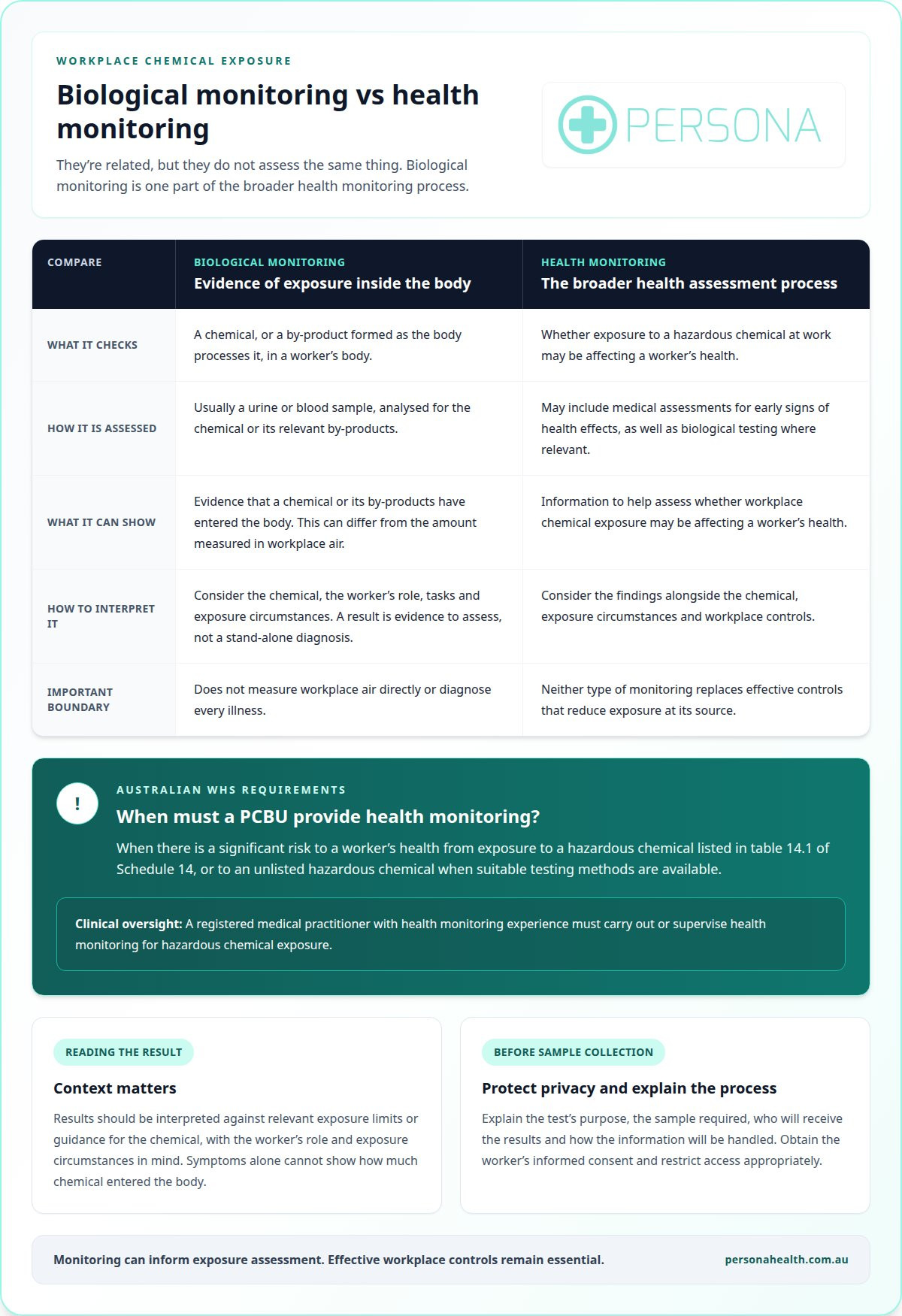
A workplace health check and a biological monitoring test aren’t the same thing. For workplace biological monitoring in Melbourne, the key distinction is that biological monitoring measures a chemical or its by-products in a worker’s body, usually through urine or blood testing. Under Australian WHS requirements, a PCBU must provide health monitoring when there’s a significant risk to a worker’s health from exposure to a hazardous chemical listed in table 14.1 of Schedule 14, or to an unlisted hazardous chemical when suitable testing methods are available.
It’s understandable that the terms seem interchangeable: both relate to workers’ health, but they assess different things. Health monitoring is the broader process; biological monitoring is one way to check for evidence of exposure inside the body. Neither replaces effective workplace controls.
This article explains what health monitoring means at work, how biological monitoring works and how it differs from health surveillance. You’ll also learn when monitoring may be required under Australian WHS laws and what to consider when arranging it in Melbourne.
Key Takeaways
- Biological monitoring checks for a chemical or its by-products in a worker’s body, while health surveillance is a broader process.
- Learn when Australian WHS requirements call for health monitoring, including exposure to certain listed or unlisted hazardous chemicals.
- Monitoring can help assess exposure, but it doesn’t replace effective workplace control measures.
- Understand how monitoring responsibilities in Victoria relate to the risks, the chemical involved and the available testing methods.
- Find out which factors shape the cost of monitoring and when a medical assessment may be relevant to your workplace.
What is health monitoring?
Health monitoring checks whether exposure to a hazardous chemical at work may be affecting a worker’s health. Biological monitoring is one part of this process: it measures a chemical or its by-products in the body, commonly through urine or blood tests.
Testing for chemical exposure
Biological monitoring uses medical tests to look for a chemical or a substance produced as the body processes it. For example, a laboratory may analyse a urine or blood sample after a worker handles a hazardous chemical. The test helps assess internal exposure, which can differ from the amount measured in workplace air. Results need to be interpreted in context, including the chemical, task and exposure circumstances.
Exposure and potential health effects
Workers can inhale hazardous chemicals in contaminated air. Depending on the chemical and exposure circumstances, health effects may involve the lungs or other body systems. Airborne dust or vapour may be relevant when assessing exposure, but symptoms alone cannot show how much chemical entered the body. Biological monitoring can provide another piece of evidence.
Health monitoring is broader than biological testing. It may include medical assessments for early signs of health effects, while biological monitoring focuses on exposure inside the body. For Melbourne workplaces, biological monitoring can inform an assessment when workers handle, use or may inhale hazardous chemicals. It does not measure workplace air directly, diagnose every illness or replace controls that reduce exposure at its source.
Australian WHS requirements call for health monitoring when there is a significant risk to a worker’s health from exposure to a hazardous chemical listed in table 14.1 of Schedule 14. Monitoring may also be required for an unlisted hazardous chemical when exposure presents a significant risk and suitable testing methods are available. A registered medical practitioner with health monitoring experience must carry out or supervise health monitoring for hazardous chemical exposure.
Privacy matters because biological samples and results contain personal health information. Before collection, explain the test’s purpose, the sample needed, who will receive the results and how the information will be handled. Obtain the worker’s informed consent and restrict access appropriately.
The collection method depends on the test. A practitioner may arrange a urine or blood sample for laboratory analysis. As result timing depends on the test and laboratory processing, agree on how findings will be communicated before collection.
Interpret results against relevant exposure limits or guidance for the chemical, taking the worker’s role and exposure circumstances into account. A result is evidence to assess, not a stand-alone diagnosis or proof that workplace controls are adequate.
Melbourne employers can consult WorkSafe Victoria for Victorian workplace guidance and Safe Work Australia for national model guidance. The Melbourne occupational health page provides local context for workplace health services.
Which Melbourne providers offer workplace biological monitoring services?
Workplace biological monitoring in Melbourne generally involves coordinated clinical assessment and sample testing. An occupational health service can connect workplace exposure, the worker’s medical assessment and the relevant test. A registered medical practitioner with health monitoring experience must carry out or supervise health monitoring for hazardous chemical exposure. A laboratory may analyse a blood or urine sample, while the practitioner interprets the result in context.
The right arrangement depends on the chemical and the purpose of monitoring. A test suited to one substance may not measure another, so the provider needs to know which chemical workers encounter and how exposure occurs. For example, a task involving chemical vapour may call for a different assessment from one involving skin contact. Share the chemical’s name, workplace tasks and existing exposure information when discussing the testing plan.
Before arranging a service, clarify who will manage each part of the process. The clinic, medical practitioner and laboratory may have separate roles. A clear plan helps prevent gaps between sample collection, clinical interpretation and communication of findings. Ask how the provider will explain the test to workers and how results will inform the employer’s next steps.
- Clinical oversight: Confirm a registered medical practitioner with health monitoring experience will carry out or supervise the monitoring.
- Test suitability: Discuss whether the proposed test measures the chemical or its relevant by-products.
- Sample arrangements: Establish whether workers attend a clinic or another collection setting, and how samples reach the laboratory.
- Results pathway: Agree who receives clinical findings and how workplace actions will be communicated.
WorkSafe Victoria provides guidance on Victorian workplace safety, while Safe Work Australia develops national model guidance. These organisations help explain the regulatory context, but they do not replace clinical testing. Melbourne employers can use their guidance to frame questions about exposure risks, then discuss the specific chemical and proposed monitoring with a qualified occupational health service.
Start by preparing a short exposure summary. Include the chemical’s name, the task that creates exposure, whether airborne contact is possible and any existing controls. List the roles of workers who may be exposed, too. This gives the clinician useful context and helps determine whether biological testing fits the health monitoring plan.
After testing, results need clinical interpretation alongside the work activity and exposure circumstances. A laboratory result alone does not explain how exposure occurred or whether workplace controls need review. The provider’s process should connect test findings with relevant clinical advice and a clear way to address any concerns.
Australian employers must provide medical surveillance when workers are exposed to harmful substances such as isocyanates. Discuss this obligation with an occupational health service when planning monitoring.
When is biological monitoring required under Australian WHS laws?
Under Australian WHS requirements, health monitoring is necessary when a worker faces a significant health risk from exposure to certain hazardous chemicals. Biological monitoring may form part of that process when testing can appropriately assess exposure. The legal trigger is health monitoring, not an automatic requirement for the same biological test in every workplace or for every chemical.
For a chemical listed in table 14.1 of Schedule 14, a person conducting a business or undertaking (PCBU) must provide health monitoring when exposure creates a significant risk to a worker’s health. The assessment must consider the chemical and the work, rather than relying only on a job title. For example, workers handling a listed chemical in a production task may have different exposure circumstances from workers in nearby offices.
Health monitoring may also be required for an unlisted hazardous chemical if exposure presents a significant health risk and suitable testing methods are available. Both conditions matter. Identify the chemical and consider how workers may be exposed, then determine whether an appropriate test can assess the relevant risk. A biological test is useful only when it can provide relevant information about that chemical and exposure pathway.
A registered medical practitioner with health monitoring experience must carry out or supervise the monitoring process. The practitioner’s role is important when selecting and interpreting tests, especially when results need to be considered alongside work tasks and exposure circumstances. A sample result alone does not establish that risks are adequately controlled.
Lead and asbestos have health monitoring requirements that differ from those for other hazardous chemicals. Employers dealing with either substance should consider its specific requirements rather than assuming the general chemical monitoring approach applies unchanged. The chemical or material determines which monitoring provisions need consideration.
A practical decision sequence for a Melbourne workplace is:
- Identify the hazardous chemical and the tasks that could expose workers.
- Assess whether exposure creates a significant risk to health.
- Check whether the chemical appears in table 14.1 of Schedule 14, or whether suitable monitoring is available for an unlisted chemical.
- Arrange appropriate health monitoring under the supervision of an experienced registered medical practitioner.
Health monitoring does not replace effective workplace controls. A biological result cannot make an unsafe exposure acceptable or take the place of reducing exposure at its source. Employers should use monitoring alongside control measures, then respond to findings by reviewing the relevant work and exposure conditions. For a Melbourne employer, WorkSafe Victoria provides the state workplace safety context; national model WHS guidance helps explain the broader framework.
What are employers’ and workers’ responsibilities for workplace biological monitoring in Victoria
Employers should consider the chemical involved, potential exposure and the work being done when deciding whether monitoring is appropriate. Australian WHS requirements call for health monitoring when exposure creates a significant risk to health from a chemical listed in table 14.1 of Schedule 14. Monitoring can also be required for an unlisted hazardous chemical when suitable testing methods are available.
Employers should identify who may be exposed and arrange a relevant assessment. A registered medical practitioner with health monitoring experience must carry out or supervise health monitoring for hazardous chemical exposure. Give the practitioner useful workplace context, including the chemical name, tasks involved, possible exposure routes and controls already in place.
Workers can help make the process accurate by describing their tasks and following the clinician’s instructions for any assessment or sample collection. For example, a worker who handles a chemical directly should explain the task, how often contact occurs and what protective measures are used. Workers should raise possible exposure concerns with their employer so they can be considered in the workplace risk assessment.
Handle health information carefully. Employers should explain why monitoring is being arranged, what the assessment involves and how findings will be communicated. Limit access to personal results to appropriate recipients. The medical practitioner interprets clinical findings; the employer uses relevant information to consider workplace action while protecting the worker’s privacy.
Monitoring does not replace effective exposure controls. Employers should manage chemical risks at their source, rather than treating a test as proof that conditions are safe. If results indicate a concern, review the relevant task, exposure route and existing controls, then consider what changes are needed. Workers can help by reporting changes to tasks or control measures.
For injury reporting and workplace response, InjuryQR is a separate, FREE AI-powered triage service available to all Australian businesses. It provides free posters, stickers, keyrings and fridge magnets. Workers scan a QR code without downloading an app, describe an injury by voice, then respond to AI follow-up questions. Outcomes can include self-care advice, a telehealth appointment, direction to an Emergency Department or instructions to call 000. Telehealth appointments are typically within 3-4 hours. Certificates of Capacity can be issued immediately where appropriate. This supports earlier reporting and can help reduce Lost Time Injuries (LTIs).
In Melbourne, employers can use WorkSafe Victoria guidance to understand Victoria’s workplace safety context. Workers and managers can then agree on clear communication: who arranges monitoring, how appointments are managed and how workplace concerns are raised. Documenting these steps helps keep the process clear without confusing medical findings with responsibility for workplace controls.
How much does workplace biological monitoring cost in Melbourne
The cost of workplace biological monitoring in Melbourne depends on the case and is provided after a quote request. Key factors include the chemical being assessed, the suitable test, sample collection arrangements, clinical oversight and laboratory analysis. Blood and urine tests have different collection and analysis needs, so the chemical and purpose of monitoring shape the scope.
The type of health monitoring also affects what needs to be arranged. A biological test measures a chemical or its by-products in the body, while a broader medical assessment may involve additional clinical steps. For example, assessing exposure to a hazardous chemical requires a plan that identifies the relevant test and how a practitioner will interpret the findings.
The number of workers and their exposure circumstances can affect the work involved. A group performing the same task with the same chemical may need different coordination from workers in varied roles across separate sites. A clear list of roles, locations and tasks helps define who needs assessment and supports an accurate quote scope.
Collection logistics matter, too. Clinic appointments, workplace collection arrangements and sample handling can all affect how monitoring is organised. For a Melbourne workplace, provide the site location and explain whether workers can attend a clinic or need another arrangement. The chosen test and laboratory process also determine the steps required to collect and assess samples.
- Clinical component: whether a practitioner’s assessment or supervision is included.
- Testing component: which sample and laboratory analysis suit the chemical.
- Coordination component: how appointments or workplace collection will be arranged.
- Reporting component: how findings will be interpreted and communicated.
These details help you compare like with like. A quote covering sample collection alone differs from one that also includes clinical oversight and interpretation. Ask how the proposed test relates to the named chemical and what workplace information the practitioner needs, including the task, exposure route and existing controls.
For budgeting, prepare the chemical name, worker roles, site locations and preferred collection arrangements before requesting a quote. Include whether the assessment concerns one task or several. These details help define the work required, rather than relying on a broad estimate that may not reflect the workplace’s exposure profile.
A biological test is one part of health monitoring, not a substitute for effective exposure controls. State the intended purpose of testing in your request, such as assessing exposure to a particular hazardous chemical. That context helps define a relevant scope and makes the proposed costs easier to understand.
Persona Health: Pre-Employment Medicals
Persona Health offers Pre-Employment Medicals in Melbourne and on-site Health Surveillance for distinct workplace needs. Health Surveillance is relevant when employers are arranging monitoring for chemical exposure; pre-employment assessments address a candidate’s health in relation to a role. Persona Health also offers Crystalline Silica Medicals.
Melbourne clinics are in Cairnlea and Craigieburn. Sydney locations include Parramatta, Rosebery, Dee Why and Gregory Hills, with a particular focus on Rosebery and Gregory Hills. Employers can also access Australia-wide mobile workplace services and a network of 100 affiliate clinics nationwide. Fast turnaround times, responsive customer service, employer-focused support and modern digital reporting help businesses coordinate occupational health needs across locations.
If you’re considering biological monitoring, choose a service that matches the workplace question and exposure. Contact Persona Health to discuss the next step for your team.
Make monitoring part of your ongoing risk plan
Treat biological monitoring as one input to an ongoing workplace risk plan, not a stand-alone event. For workplace biological monitoring in Melbourne, keep the assessment connected to the tasks workers actually perform. When chemicals, processes or work arrangements change, review whether the monitoring approach still reflects the exposure risks and answers the questions it was meant to address.
A practical next step is to assign responsibility for keeping exposure information current. Record the relevant chemical, affected tasks, controls and monitoring arrangements in a format supervisors can use. Make sure workers know how to raise concerns and understand how health findings will inform workplace decisions. This creates a clearer link between clinical advice and the day-to-day work environment.
If you’re planning a new assessment or reviewing an existing programme, discuss the workplace context and the outcome you need. A focused conversation can help identify an appropriate next step for your circumstances.
An ongoing, considered approach helps you make informed decisions for your workers and workplace.
Frequently Asked Questions
What is workplace biological monitoring in Australia?
Biological monitoring assesses whether a worker has absorbed a hazardous chemical by measuring the chemical or a related substance in their body. A clinician considers the worker’s role and exposure circumstances when arranging and interpreting a suitable test. For example, contact with a substance during a particular task may help explain a result. Biological monitoring adds information about internal exposure; on its own, it does not identify where exposure occurred.
What biological monitoring tests are used for workplace chemical exposure?
Tests commonly analyse urine or blood for a specific chemical or its by-products. The appropriate sample and laboratory analysis depend on the substance, so there is no single test for every workplace chemical. The clinician uses the worker’s exposure information to select a suitable method and interpret the result. These tests differ from examinations that assess possible health effects rather than chemical levels in the body.

Article by
Ian Nicholson
Ian is the Business Support Manager at Persona Health, where he plays a key role across IT, sales, marketing and business operations. With a broad skill set and a practical, solutions-focused approach, Ian helps drive the systems, communication and commercial strategy that support Persona Health’s continued growth across Australia.