

A workplace drug testing consultation helps employers shape a program around the work, the risks and the people affected, while setting out how results will be handled. For urine workplace testing, the listed Australian standard is AS/NZS 4308:2023. Clear procedures also help distinguish an initial not-negative result from a confirmed result that may need further review.
It’s understandable to want a consistent, fair and practical process, especially when a result could affect someone’s work. Choosing a sample type, explaining what happens after a non-negative result and understanding the role of a Medical Review Officer are all part of getting the program right.
This article explains how a drug testing consultation can guide program design, what confirmatory testing and MRO reviews involve, and how Australian standards and NATA accreditation fit into the discussion. You’ll also learn what to consider when setting up workplace procedures, so employers, workers and WHS teams can plan clear next steps.
Key Takeaways
- Treat an initial not-negative result as a step in the testing process, then use confirmatory testing to clarify what it means.
- Choose a sample type and workplace procedure that reflect the job, its risks and the needs of workers and WHS staff.
- Understand when a Medical Review Officer may be involved and how their review helps interpret confirmed results.
- Use the relevant Australian testing standard as a reference point, and consider how NATA accreditation relates to the testing process.
- For a nearby service, consider how workplace testing can fit alongside pre-employment and rail medical assessments.
Confirmatory testing for not-negative results
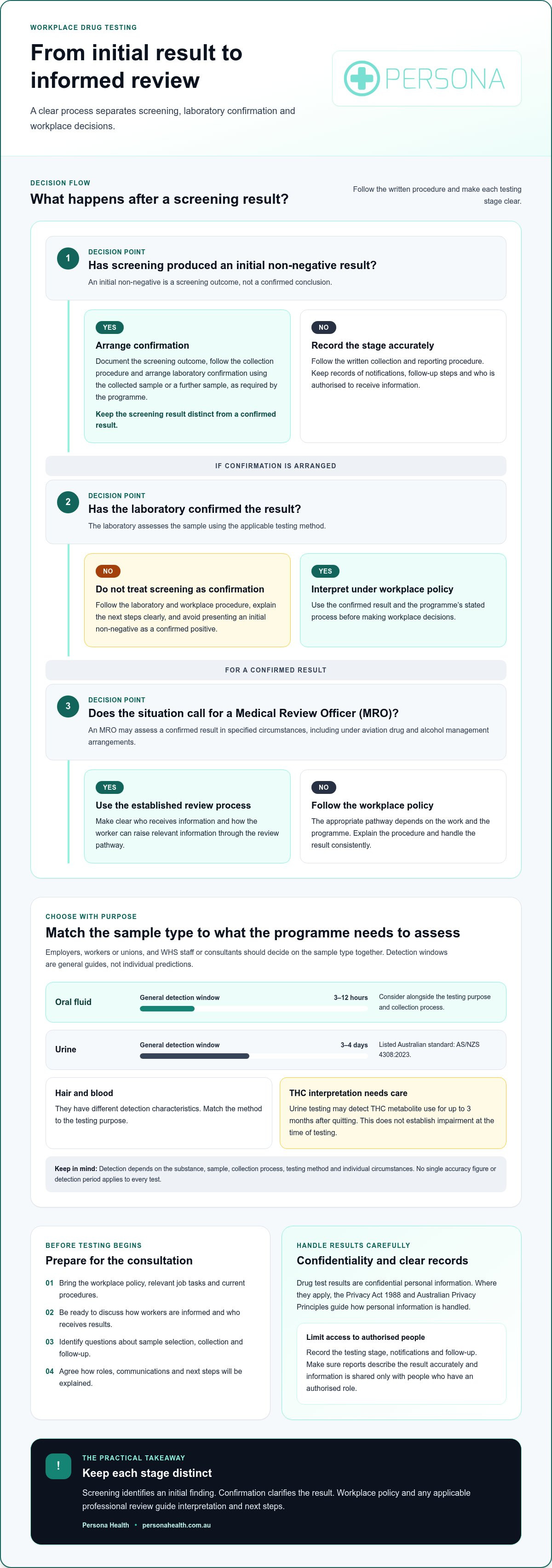
A non-negative screening result is an initial finding, not a confirmed conclusion. The next step is confirmatory testing through the relevant laboratory process. This distinguishes a screening response from a verified result before workplace decisions are made. Employers should follow their written procedure, explain the next steps clearly and record how the sample and result are handled.
Keep the stages distinct. First, document the screening outcome and follow the collection procedure. Next, arrange confirmation using the collected sample or a further sample, as required by the program. The laboratory assesses the sample using the applicable testing method. A confirmed result can then be interpreted under the workplace policy, rather than treated as interchangeable with an initial screen.
Sample type affects what a test can detect. Urine testing generally has a detection window of 3-4 days, while oral fluid testing generally has a window of 3-12 hours. These are general windows, not a personal prediction. The substance, testing method and individual circumstances influence whether a sample produces a detectable result.
THC requires particular care in interpretation. Urine testing may detect THC metabolite use for up to 3 months after quitting. That does not establish impairment at the time of testing. A workplace response should distinguish evidence of prior exposure from fitness for a particular task, using the program’s stated process and relevant professional review.
Drug test results are confidential personal information. In Australia, the Privacy Act 1988 and Australian Privacy Principles guide personal-information handling where they apply; access should be limited to people with an authorised role, such as designated workplace personnel involved in the process.
Before communicating an outcome, check that the report accurately identifies the testing stage and result. For example, don’t describe an initial non-negative result as a confirmed positive. Record notifications, follow-up steps and who is authorised to receive information. Clear records support consistent decisions if a worker asks how the result was reached.
Workplace procedures should explain how a worker can raise relevant information through the established review process. A Medical Review Officer may assess a confirmed result in specified circumstances, including under aviation drug and alcohol management arrangements. The appropriate pathway depends on the work and policy, so employees should know who receives information and how questions are handled.
Keep separate screening purposes clear in workplace communications. For instance, pre-flight COVID testing is a different screening context and should not be confused with drug-test confirmation. A drug testing consultation can help employers set out the steps, roles and communications that apply when an initial result requires further assessment.
Drug and alcohol testing consultation and program design
A workplace program should reflect the tasks, risks and people involved. Consultation helps employers set practical procedures before testing begins.
Available Drug Testing Services
Workplace testing may use urine, saliva, hair or blood samples. Each sample type suits different testing purposes, so employers should identify what their program needs to assess. Employers, workers or unions, and WHS staff or consultants should decide on the appropriate sample type together. For example, a program focused on recent use may need a different approach from one examining a longer period.
Test Accuracy and Detection Times
No single accuracy figure or detection period applies to every test. Results depend on the sample, substance, collection process and testing method. Urine testing generally has a detection window of 3-4 days, while oral fluid testing generally has a window of 3-12 hours. These are general guides, not individual predictions. Hair and blood tests have different detection characteristics, so match the method to the testing purpose.
Preparing for a Consultation
Bring the workplace policy, relevant job tasks and questions that need decisions. Include current procedures, how workers are informed and who receives results. Employers can note whether they need advice on sample selection, collection or follow-up. Workers attending personally can bring the result notice and note concerns or relevant medicines to discuss through the appropriate clinical review process.
A GP can discuss alcohol or other drug concerns and refer you to suitable specialist support. The right pathway depends on your health needs and the support you’re seeking.
For confidential support or treatment in Australia, speak with a GP or a state or territory alcohol and other drug service. They can discuss options such as counselling or specialist care. Keep a request for clinical support separate from an employer’s workplace testing procedure.
Workplace safety planning can also include InjuryQR, a FREE AI-powered workplace injury triage service available to all Australian businesses. Workers scan a QR code without downloading an app, describe an injury by voice, and answer AI follow-up questions. InjuryQR offers self-care advice, telehealth appointments typically within 3-4 hours, Emergency Department direction, or instructions to call 000. Certificates of Capacity can be issued immediately where appropriate. Prompt triage supports earlier care, improves reporting and can help reduce Lost Time Injuries (LTIs). Free posters, stickers, keyrings and fridge magnets help workplaces make the service visible.
Employers new to testing should seek guidance from an occupational health consultant or accredited laboratory when setting up and managing procedures. Consultation can bring employers, workers or unions, and WHS staff together to decide on sample choice, communication and result pathways. Record the decisions in the program so staff understand their responsibilities and workers know what to expect.
Medical Review Officer consultations and result interpretation
A Medical Review Officer (MRO) provides a clinical review of drug-test results within defined workplace processes. The review helps distinguish laboratory findings from the workplace decision that follows.
Medical Review Officer Consultations
Under Australian Civil Aviation Safety Regulations 1998, an organisation must consult an MRO in specified circumstances. These include a positive confirmatory drug test under its drug and alcohol management policy, as set out in subpart 99B. This requirement applies within the specified aviation framework, not automatically to every workplace testing program.
An MRO consultation considers the confirmed result and relevant medical information. The officer may contact the worker to discuss the result and any explanation relevant to its interpretation. For example, a worker may provide information about prescribed medicines. The MRO assesses that information in the context of the test and applicable procedures, then communicates the review outcome through the appropriate reporting pathway.
Employers should define the MRO’s role in their written policy. State who arranges the review, how the worker is notified, what information may be requested, and who receives the outcome. In an aviation program, align these steps with the organisation’s drug and alcohol management policy and subpart 99B. In other workplaces, the policy should explain the review route without implying aviation rules apply.
Interpreting or Disputing Results
If you receive a positive result or dispute a report, ask for the written result and the next step under the workplace policy. Check whether the document identifies a screening result or a confirmed result. Keep your response factual and provide relevant information through the stated review process. An initial screen is not equivalent to laboratory confirmation.
Write down the points you want reviewed. These might include a possible sample identification issue, a question about the collection process or information about prescribed medication. Give the relevant dates and documents to the designated reviewer. A clear account helps the reviewer address the specific concern rather than a general disagreement.
For employers, pause before describing a result as final if the required review is incomplete. Record when the worker was notified, what documents were provided and which policy steps were followed. For example, if an aviation employee disputes a positive confirmatory result, the organisation’s MRO consultation pathway and drug and alcohol management policy are central to handling the review.
Keep communication measured and consistent. Tell the worker who will receive their information, how they can raise a concern and what happens next. Apply the same written procedure to comparable cases. A documented process supports clear decisions while allowing the MRO to interpret clinical information separately from workplace management.
NATA accreditation and Australian testing standards
Australian workplace testing decisions should reflect the sample, test method and relevant workplace program. For urine testing, the listed workplace standard is AS/NZS 4308:2023. Understanding how this standard and laboratory accreditation fit together helps employers assess whether their procedures are clearly specified.
Australian workplace drug-testing rules depend on applicable industry requirements, the state or territory framework and workplace policy. Employees should be told how testing works, how results are handled and what process applies if they want to raise a concern. A written policy helps explain these steps.
AS/NZS 4308:2023 is the listed standard for urine drug testing in workplace settings. Employers can use it as a reference when documenting urine-testing procedures and discussing laboratory methods. It should not be treated as a universal standard for every sample type. A program using oral fluid, hair or blood testing needs to identify the relevant method and process for that sample.
NATA accreditation and a testing standard address different parts of quality. Accreditation relates to a laboratory’s recognised scope of work, while a standard sets out requirements for a particular testing area. When reviewing laboratory documentation, match the listed accreditation scope to the sample and testing activity required. For example, a urine-testing program should not assume that a laboratory’s accreditation covers every other sample type or method.
Employers can make the review practical by recording the decisions behind the program. Identify the sample type, screening and confirmation pathways, who handles results and how a worker can raise a concern. Then compare these procedures with the laboratory’s stated methods and relevant accreditation scope. This can reveal gaps, such as a policy that names urine testing but leaves confirmation responsibilities unclear.
Workers can ask which standard and testing process apply to the sample being collected. Check whether the result is an initial screen or a confirmed finding, and follow the workplace procedure for questions or disputes. A clear explanation should identify the next step and appropriate contact, rather than treating every test as if it used the same method.
Consultation facilitated by Persona Health can bring employers, workers or unions, WHS staff and laboratory representatives into the same discussion. They can clarify what AS/NZS 4308:2023 covers, how NATA accreditation relates to the chosen testing activity, and how results move through the program. Recording those decisions gives staff a usable reference when procedures are applied.
Employers should ensure that any specific standard named in policy directly applies to the work under discussion.
The National Standard for Health Assessment of Rail Safety Workers is dated 2017. In rail settings, that reference should be considered alongside, not confused with, the sample-specific testing method and laboratory accreditation scope. Employers can record the health-assessment reference separately from drug-testing procedures, including the sample involved and the laboratory’s stated scope. This keeps a named health-assessment standard from being treated as evidence about a particular drug-testing method. Workers can be given a clear explanation of which process applies to their situation and where questions should be raised. Keeping these records distinct makes the basis of decisions easier to explain.
Where can I get a drug testing consultation near me in Australia?
For local workplace testing in Sydney, Melbourne, Gregory Hills or Parramatta, first identify whether you need an employer program discussion or testing for workers. Persona Health provides Drug and Alcohol Testing, with clinics in Parramatta, Rosebery, Gregory Hills and Dee Why in Sydney, and Cairnlea and Craigieburn in Melbourne. Your location and workforce arrangements can help determine a practical way to organise testing.
In Sydney, Gregory Hills and Rosebery are useful locations to consider when planning worker access. Parramatta and Dee Why offer additional Sydney clinic locations. In Melbourne, Cairnlea and Craigieburn provide local clinic options. Choose a location that suits the people attending and the worksite arrangements, then plan how staff will receive clear information about the process.
For employers, the discussion can focus on how testing fits the work being done. Prepare the roles covered, current procedures and questions about coordinating a program across sites. A local consultation can bring these practical considerations into one discussion, including how workers will access testing and who will coordinate the workplace process.
Persona Health’s network includes 100 affiliate clinics nationwide, and Australia-wide mobile workplace services can support employers planning testing at work locations. For example, a business with staff across several sites can consider whether clinic attendance or mobile service better fits its workforce and site arrangements.
When deciding where to begin, separate workplace program planning from questions about an individual result. Employers can prepare their policy and operational questions. Workers can follow the relevant workplace process and use its named contact for result-related queries. This distinction directs each discussion to the appropriate pathway.
Before arranging a discussion, note the site location, roles involved and decisions you need to make. These might include how testing is organised across shifts or how workers receive information. A concise list helps keep the conversation focused on practical requirements rather than assumptions about a one-size-fits-all approach.
Employers can also consider whether their current procedure works consistently across locations. A process used in Gregory Hills may need clear coordination with teams in Parramatta or another state. Documenting responsibilities and communication steps gives local managers a shared reference while allowing arrangements to reflect each worksite.
To explore workplace testing options and locations, review Persona Health’s drug and alcohol testing service as part of planning your next step.
Where road-use roles are involved, employers may also want to check the applicable testing context before setting procedures. Australian road-use drug and alcohol testing is governed by the Austroads publication Assessing Fitness to Drive 2016 and relevant state legislation. This offers a point of reference when preparing questions about how workplace procedures relate to driving duties, while the relevant state and role should remain part of the discussion.
Another issue to raise is how testing and reporting are described. The Australian Government Building Code 2013 is cited in connection with reporting benzodiazepines in oral fluid testing. Employers can include this context in questions about reporting and communication, while keeping policy discussions separate from an individual worker’s result. Asking the provider how a particular testing process is documented can help clarify expectations before workplace procedures are put into practice.
Persona Health: Pre-Employment Medicals
Persona Health provides Pre-Employment Medicals to help employers assess health requirements relevant to a role. They can form part of a broader recruitment process where the job has defined physical or health demands. For rail positions, Cat 3 Rail Medicals address the specific assessment pathway for rail safety workers.
Consider occupational medical assessments alongside a clearly documented workplace testing program. Keeping each process distinct helps employers explain what an assessment covers and how it relates to the role.
Build a clear next step for your workplace
A well-designed testing process should be practical to use, not just complete on paper. Set out who owns each step, how workers are informed and how questions about results are handled. A focused drug testing consultation can help turn those decisions into a procedure that suits your workplace and the roles involved.
Persona Health offers Pre-Employment Medicals, Workplace Injury Management and Crystalline Silica Medicals. These services support employers addressing different occupational health needs alongside a considered approach to workplace testing.
Take the next step by outlining the work, questions and procedures you want to discuss. A clear starting point makes it easier to shape a process staff can understand and apply.
With a considered plan in place, you can move forward with greater clarity and confidence.
Frequently Asked Questions
What does a drug testing consultation involve in Australia?
A consultation helps clarify how testing fits a workplace’s roles and operations. For example, an employer might use the discussion to assign responsibility for coordinating testing and communicating arrangements to staff. Before meeting, note the roles involved, current procedures and decisions still needed. This preparation gives the discussion a practical focus and turns agreed actions into responsibilities workers and managers can follow.

Article by
Ian Nicholson
Ian is the Business Support Manager at Persona Health, where he plays a key role across IT, sales, marketing and business operations. With a broad skill set and a practical, solutions-focused approach, Ian helps drive the systems, communication and commercial strategy that support Persona Health’s continued growth across Australia.