

Commercial drivers of trucks, public passenger vehicles and vehicles carrying dangerous goods may need to meet higher medical standards. Applicants for a commercial driver authorisation must submit a medical certificate with their application. The assessment considers whether your health supports safe driving in your role.
It’s understandable to want clear guidance before booking, especially when your work and licence requirements depend on getting the assessment right. This guide explains who may need a commercial driver medical and what to expect, so you can prepare with confidence.
You’ll learn how the Austroads Fitness to Drive standard informs the assessment, what the medical may cover and what to bring to your appointment. We’ll also explain how to arrange an assessment and what may happen afterwards, including when further information or a review is needed before the medical certificate is completed.
Key Takeaways
- Drivers of trucks, public passenger vehicles and vehicles carrying dangerous goods may need to meet higher medical standards.
- Medical review timing can depend on your driving role, health status and identified conditions.
- Prepare your paperwork before the appointment, including relevant health information and any forms for the doctor.
- The Austroads Fitness to Drive standard helps guide assessment of health in relation to safe driving and the vehicle class.
- Persona Health’s Pre-Employment Medicals can help employers assess a person’s health in relation to a role.
Who needs a commercial driver medical?
Professional drivers of trucks, public passenger vehicles and vehicles carrying dangerous goods may need to meet higher medical standards. A commercial driver medical considers whether your health supports safe driving in the vehicle and role involved. Applicants for a commercial driver authorisation must provide a medical certificate when required as part of their application.
A commercial driver medical differs from a standard driver’s licence medical because commercial driving can involve larger vehicles, passengers or dangerous goods. The doctor considers your specific driving role and relevant health factors, rather than assuming every licence holder has the same requirements.
Medical review frequency depends on the applicable licensing requirements and your circumstances. Some drivers may need yearly reviews based on their role, health status or identified conditions. A certificate’s validity period and its submission deadline are separate considerations, so clarify the purpose of the assessment when arranging it.
Vehicle class helps clarify who may need an assessment. MR, HR, HC and MC are examples of classes associated with commercial driving that may require regular medical reviews under road laws. The vehicle matters: driving a heavy combination vehicle involves different demands from operating a light rigid vehicle.
Passenger transport drivers may also need an assessment. Drivers of public passenger vehicles, including people applying for commercial passenger authorisation, must meet higher medical standards. Taxi and other passenger transport roles involve responsibility for passengers, so the assessment relates to the work and authorisation, not simply the vehicle’s size.
Private driving follows a different pathway. You don’t need a commercial assessment solely because you hold a standard licence and drive a private vehicle. A medical assessment may still be relevant if a health condition could affect safe driving or a licensing process requires medical information. The doctor considers your circumstances, including eyesight and driving demands.
Commercial driver fitness-to-drive assessments consider whether health factors could affect tasks such as seeing road conditions, staying alert, controlling the vehicle or responding safely. The assessment is specific to the driver and role. A passenger vehicle driver and an MC-class truck driver, for example, may have different driving demands to discuss with the doctor.
To arrange an assessment, book with a GP who conducts commercial driver medicals. Explain whether you need a commercial vehicle certificate or passenger transport assessment, and bring the relevant application form. After the assessment, the GP completes the certificate or form for your licence class.
If more information is needed, the certificate may not be finalised at the first appointment. Further information or a review may be required before completion. Providing accurate details about your licence class, vehicle and driving role helps the doctor assess the relevant requirements and complete the correct paperwork.
Appointment booking and clinic opening hours
When arranging a commercial driver medical, state the assessment’s purpose and the vehicle or passenger transport role involved. Give the clinic your licence class and say whether you have a form from a licensing authority or employer. This helps identify the paperwork needed for the appointment. Keep your booking confirmation handy for the appointment time and clinic address.
Listed weekday appointment availability begins at 7:00 am. Tuesday and Thursday appointments are listed until 8:30 pm. These hours can help with planning around work, but use the opening hours for the clinic where your appointment is booked. For occupational health appointments in Sydney, Melbourne, Parramatta or Gregory Hills, follow the relevant clinic’s booking details rather than assuming another location has identical hours.
Plan your arrival using the appointment instructions:
- Arrive 10 minutes before your scheduled appointment.
- If you can’t print the required forms, arrive 15-20 minutes early to complete them at the clinic.
- Allow time for travel and check the address shown in your confirmation.
Arriving early gives you time to check in and complete paperwork before the medical begins. If forms need to be completed at the clinic, bring the requested details, such as your licence class and the reason for the assessment. Read each question carefully and provide accurate answers about your health and current medicines.
Bring your current driver licence and any assessment form or application paperwork supplied for the appointment. If you wear glasses or contact lenses while driving, bring them along. A current medicine list and relevant medical reports can also help explain your health history. Keep these items together so you can provide the right information when asked.
Before setting out, compare your confirmation with the paperwork you plan to bring. Check the clinic address, appointment time and form requirements. Complete the sections asking for your details, while leaving sections intended for the doctor. If an employer or licensing authority supplied the paperwork, bring every page.
For a renewal appointment, have your certificate details and reason for the review ready. For a new authorisation, take the application material you’ve been given. At check-in, explain whether your appointment relates to a commercial vehicle or passenger transport role. This helps the clinic direct your paperwork appropriately.
If you need to change your appointment, use the clinic’s booking contact details and provide your scheduled time. For appointments in Sydney, Melbourne, Parramatta or Gregory Hills, refer to the location in your confirmation. Clear booking information and organised documents help you make effective use of your appointment time.
Austroads Fitness to Drive standard
The Austroads Fitness to Drive standard guides medical assessments of a driver’s fitness to drive. In Queensland, it helps frame whether a person’s health is compatible with the demands of their commercial driving role. This is not simply a general health check: the doctor considers your circumstances and the vehicle or authorisation involved.
For a commercial driver, the standard provides a consistent reference point for considering health information alongside driving duties. A heavy vehicle driver and a public passenger vehicle driver may face different work demands. The medical assessment needs to relate to the role being performed, rather than assume every driver has identical tasks.
A health questionnaire is a practical starting point. Answer accurately, including details of relevant health conditions, treatment and medicines. The doctor uses your answers to identify matters for discussion or further information. For example, if you report a condition that may affect your driving, explain how it’s managed and bring relevant reports or details to the appointment.
The assessment considers fitness in context. A health issue does not automatically mean you cannot work. What matters is how it could affect safe driving, the duties involved and the information available to assess its impact. The doctor may need additional information or a review before completing the medical certificate or licence form.
Some drivers may need yearly medical reviews, depending on their role, health status and identified conditions. That review period is separate from the Queensland requirement for commercial drivers aged 75 and over to submit a medical certificate annually. The Austroads standard informs the medical assessment; the driver’s applicable licensing requirements determine when a certificate must be submitted.
During the appointment, explain the driving you actually do. A driver who spends long periods operating an MC-class vehicle should describe those duties, while a passenger transport driver should explain their passenger-facing role. This detail helps the doctor relate the fitness assessment to your work and licence class.
If the doctor needs further information, ask which records or reports would help address the specific issue. Bring the requested material to any follow-up, and make sure the medical form identifies the correct licence class. Clear, complete information supports a relevant assessment and helps the doctor determine whether the certificate can be completed.
The standard is a framework for considering fitness, not a one-size-fits-all checklist with the same outcome for every driver. For a Queensland assessment, complete the health questionnaire honestly, describe your commercial driving duties and provide relevant medical information. This helps focus the assessment on your health and driving role.
Medical conditions affecting safe driving
A commercial driving assessment considers how your health affects the tasks involved in driving. Relevant abilities include seeing road users, staying alert, making decisions and controlling the vehicle. For a passenger vehicle driver, the assessment also considers the responsibility of carrying passengers. The doctor needs a practical picture of your usual duties, not just a list of diagnoses.
Be specific when describing a health concern. Explain what happens, when it happens and whether treatment changes it. For example, describe whether a change in eyesight affects your ability to read signs or notice hazards. If symptoms vary during a shift, explain when they occur and which driving tasks they affect. Clear examples help the doctor understand the connection between health and work.
Medicines are relevant too. Bring a current list and explain when you take each one. Tell the doctor about effects such as drowsiness or difficulty concentrating, if you experience them. Don’t stop or change prescribed treatment for the appointment. Instead, discuss how your treatment and symptoms relate to your ability to drive safely.
Previous medical information can help explain a condition’s history and management. Bring relevant reports or treatment details, including the treating professional’s name where applicable. If a condition has changed since your last assessment, describe what changed and when. For example, explain whether symptoms have become more frequent or your treatment has been adjusted.
Use the appointment to raise concerns that could affect safe driving, including:
- Changes in eyesight or difficulty seeing while driving.
- Symptoms that affect alertness, concentration or decision-making.
- Physical difficulties that affect controlling or entering a vehicle.
- Treatment or medicines that affect how you feel during a shift.
These examples help organise the discussion; they aren’t a diagnosis or a pass-or-fail checklist. A medical assessment considers your health information alongside your licence class and actual driving duties. Describe the vehicle you operate, your work pattern and any tasks you find affected. This gives the doctor a clearer basis for assessing your fitness.
If you have a permanent or long-term medical condition likely to affect safe driving, Australian drivers must notify the relevant department. A driver who fails to notify the department may face a penalty of more than $6000. Discuss the condition openly during your assessment and explain any steps already taken to manage its effect on driving.
Before attending, write down your questions and gather relevant treatment details. During the assessment, focus on how your health affects specific driving tasks, rather than assuming a diagnosis alone answers the question. The doctor can then consider the information in relation to your role and identify whether more details are needed to complete the assessment.
Documents and items to bring
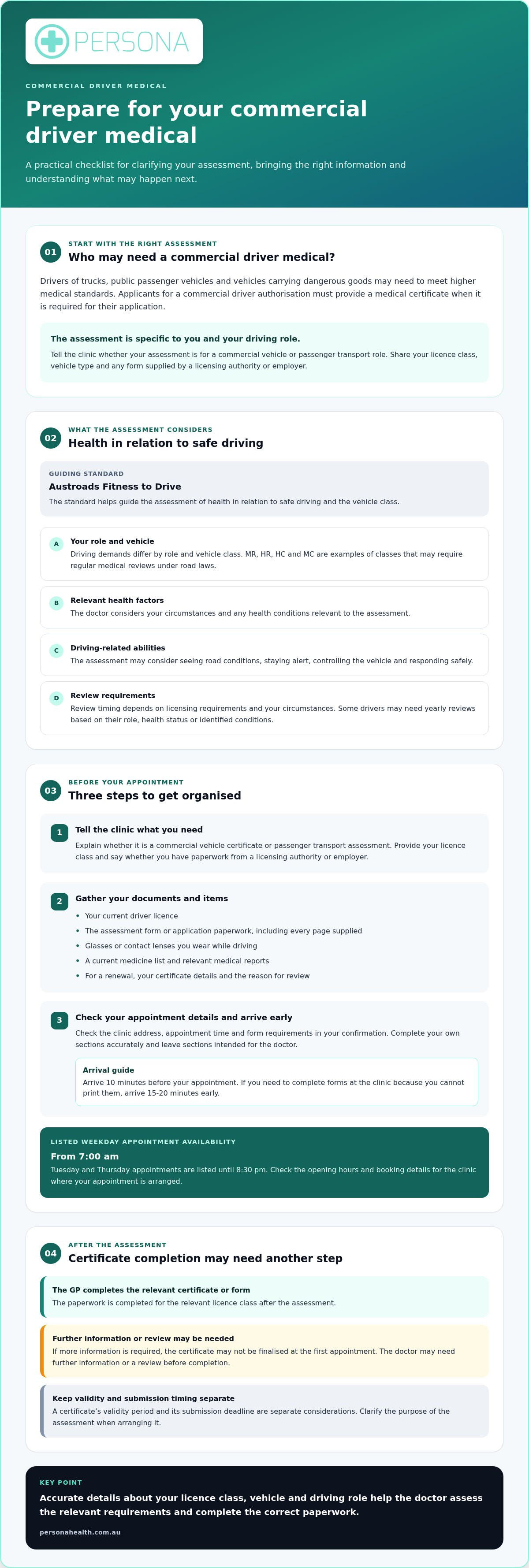
A well-prepared appointment gives the doctor useful information about your licence, driving duties and health. Gather your documents before leaving home, and keep forms flat and easy to find. For a commercial assessment, the correct medical certificate or licensing form matters because it must match your licence class and the assessment’s purpose.
Use this checklist to organise your appointment folder:
- Your current driver licence, showing the relevant class.
- The medical certificate, assessment form or application paperwork you were given.
- A completed health questionnaire, if one was provided before the appointment.
- A current list of medicines, including how and when you take them.
- Relevant reports or letters from your treating doctor or specialist.
- Glasses or contact lenses you use while driving.
Check every page of the form before attending. Include employer paperwork if your employer supplied it, and keep any instructions with the form. If you’re applying for a commercial driver authorisation, bring the application material you have. The doctor needs to know the assessment’s purpose and the vehicle class involved.
Make sure your health information is clear and current. A medicine list is more useful when it includes medicine names and dosing instructions. If a specialist has provided a report about a condition that could affect driving, bring the relevant pages. Don’t rely on memory alone for dates, treatment changes or medicine names.
For eyesight checks, bring the glasses or contact lenses you normally wear behind the wheel. If you use different pairs for different tasks, bring the pair you use for driving. This helps the doctor understand the vision correction you rely on while operating a vehicle.
Keep private health details together rather than mixing them with unrelated paperwork. Place reports in a separate folder or sealed envelope, then give them to the doctor when discussing the relevant condition. If an employer provided the form, keep it separate from personal medical documents until the clinic requests it.
Before you leave, compare the paperwork with your booking details. Confirm that the form names the right assessment, and check whether every section for you is complete. Leave medical sections for the doctor. If you cannot print a form, arrive 15-20 minutes early to complete forms before your appointment.
At check-in, tell the clinic if you’ve forgotten an item or need help understanding a form. Be ready to explain your vehicle class, driving duties and reason for the assessment. If the doctor needs further information, note exactly which report or detail is required so you can arrange a focused follow-up.
Persona Health: Pre-Employment Medicals
Persona Health provides Pre-Employment Medicals to help employers assess a candidate’s health against role requirements. This is distinct from a commercial driver medical certificate, so clarify which assessment your employer or licensing application requires.
Clinics are located in Parramatta, Rosebery, Gregory Hills and Dee Why in Sydney, and Cairnlea and Craigieburn in Melbourne. Persona Health also has 100 affiliate clinics nationwide and provides Australia-wide mobile workplace services. Fast turnaround times, responsive customer service and modern digital reporting support employers coordinating assessments across locations.
For employer-requested candidate assessments, Pre-Employment Medicals may be the relevant next step. Contact Persona Health to discuss your assessment needs.
Take your next step with confidence
When arranging a commercial driver medical on the Gold Coast, ensure you identify the specific assessment required and prepare your relevant details beforehand. While Persona Health does not conduct face-to-face driving assessments on the Gold Coast, we support businesses nationwide with comprehensive Workplace Injury Management. InjuryQR is a free AI-powered workplace injury triage service available to Australian businesses, complete with free posters, stickers, keyrings and fridge magnets. Workers can simply scan a QR code without downloading an app, describe an injury by voice, and answer AI follow-up questions. The service can provide self-care advice, arrange telehealth, direct someone to an Emergency Department or advise calling 000. Telehealth appointments are typically organised within 3 to 4 hours, and Certificates of Capacity can be issued immediately where appropriate. Early guidance supports proper reporting and helps reduce Lost Time Injuries.
Organise the next step that fits your needs.
Clear information and timely action can help you move forward with confidence.
Frequently Asked Questions
What to expect?
Expect to discuss your driving role, relevant health history and any current treatment with the doctor. The assessment considers how your health relates to the vehicle and duties involved. You may be asked about symptoms, medicines or eyesight, and the doctor may review your questionnaire and supporting medical information. If more details are needed, provide them before the medical certificate or licence form is finalised.
Which licence types do you assess?
Commercial driving examples include MR, HR, HC and MC vehicle classes. Assessments may also relate to public passenger vehicles or vehicles carrying dangerous goods. Tell the clinic your exact licence class and whether the assessment is for a commercial vehicle or passenger transport authorisation. This helps identify the relevant form and driving duties for the appointment. Your class alone doesn’t describe every task you perform.
What medical examination is required for a commercial driver licence in Queensland?
Queensland applicants for a commercial driver authorisation must submit a commercial driver medical certificate with their application. A GP completes the certificate or form for the relevant licence class after assessing your health in relation to the driving role. Bring your application paperwork and identify the authorisation you’re applying for. The doctor may need additional information or a review before completing the form.
What are Queensland commercial driver medical fitness standards?
Queensland commercial drivers must meet higher medical standards than drivers assessed for ordinary private driving. The Austroads Fitness to Drive standard informs the assessment of whether health may affect safe driving. The doctor considers your role, vehicle demands and relevant health information together. For example, a condition’s effect on alertness or eyesight matters in relation to the driving tasks involved, not as a diagnosis alone.
What documents should I bring to a commercial driver medical appointment?
Bring your current driver licence, medical form or application paperwork, and any health questionnaire supplied before the appointment. A current medicine list and relevant reports from your treating doctor or specialist can help explain your health history. Bring the glasses or contact lenses you use while driving. Keep the documents together, including every page intended for the doctor.
How do I book a commercial driver medical on the Gold Coast?
To book a commercial driver medical on the Gold Coast, contact a clinic that conducts these assessments and state the appointment’s purpose. Give your licence class and explain whether you need a commercial vehicle or passenger transport assessment. Have any licensing paperwork ready when booking. Once your appointment is arranged, note the clinic address and arrival time, and prepare the required forms and health information beforehand.
How long does a commercial driver medical examination take, and when are results provided?
The examination time depends on your health history, driving role and the information available at the appointment. Completing the form may take longer if the doctor needs reports, clarification or a further review. The GP completes the medical certificate or licence form after assessing the relevant information. Bring requested records and complete the questionnaire carefully, as missing details may mean further information is needed before the paperwork is finalised.
What happens if I have a medical condition or take medication as a commercial driver in Queensland?
Tell the doctor about relevant conditions, symptoms and medicines, including how treatment affects you during driving duties. Bring a medicine list and reports that explain management or recent changes. A condition doesn’t automatically determine the assessment; its effect on safe driving and the role are considered. Australian drivers with a permanent or long-term condition likely to affect safe driving must notify the relevant department. Failure to notify may attract a penalty of more than A$6000.

Article by
Ian Nicholson
Ian is the Business Support Manager at Persona Health, where he plays a key role across IT, sales, marketing and business operations. With a broad skill set and a practical, solutions-focused approach, Ian helps drive the systems, communication and commercial strategy that support Persona Health’s continued growth across Australia.