
Did you know that SafeWork Australia data from 2023 identifies body stressing as the cause of 37% of all serious compensation claims? You likely understand that sitting at a desk or standing on a factory floor for eight hours shouldn’t leave you feeling physically exhausted. Whether you’re navigating a busy warehouse in Cairnlea or a high-rise office in Sydney, chronic neck and back pain often feel like an inevitable part of the job. However, the science of ergonomics proves that your physical environment should support your unique body, not force it into uncomfortable positions.
At Persona Health, we believe your workday should be pain-free and productive. You deserve a setup that respects your anatomy and protects your long-term health. This guide will help you master the principles of ergonomic setup and injury prevention to enhance your comfort in the modern Australian workplace. We’ll explore practical adjustments, explain how to meet national safety standards, and show you how to access expert clinical support at our new Melbourne clinics in Cairnlea and Craigieburn.
Key Takeaways
- Understand how the principles of ergonomics can transform your workspace into a supportive environment that enhances your daily comfort and productivity.
- Master a step-by-step setup guide for your chair and monitor to ensure your workstation aligns with SafeWork Australia safety recommendations.
- Explore tailored strategies for industrial and transport sectors to manage manual handling risks and prevent long-term overuse injuries.
- Learn practical daily maintenance habits such as the 20-20-20 rule to protect your vision and release physical tension throughout the day.
- Access professional and personalised care at our new Persona Health clinics in Cairnlea and Craigieburn for a health plan designed for your unique needs.
What is Ergonomics and Why Does it Matter in Australia?
Ergonomics isn’t just about buying a more expensive office chair; it’s a rigorous science focused on designing the workplace to fit the capabilities and limitations of the human body. By prioritising the worker rather than forcing you to adapt to a rigid environment, the science of ergonomics significantly reduces the risk of long-term injury. This discipline rests on three essential pillars. Physical ergonomics addresses posture and repetitive movements. Cognitive ergonomics manages mental workload and decision-making. Organisational ergonomics optimises team structures and shift patterns to ensure a holistic approach to safety.
Poorly designed workstations are a primary driver of Musculoskeletal Disorders (MSDs) across Australian industries. SafeWork Australia data from 2021-22 reveals that body stressing injuries, often caused by poor ergonomics, accounted for 51% of all serious workers’ compensation claims. These standards aren’t just suggestions. They’re legal frameworks, such as the Model Code of Practice for Hazardous Manual Tasks, designed to protect your health. Whether you’re in a warehouse or a high-rise office, these regulations ensure your workspace supports your physical integrity.
The Economic and Health Impact of Poor Posture
The financial burden of neglecting posture is staggering for both individuals and the economy. In Victoria, WorkSafe recorded 28,246 new injury claims during the 2022-23 financial year, with a vast number stemming from preventable physical strain. For businesses in Melbourne, the cost of absenteeism and lost productivity is estimated to contribute to a national loss of A$7 billion annually. We see the human side of these statistics daily at our new clinics in Cairnlea and Craigieburn. Workers often seek help only after a chronic issue develops, yet early intervention is far more effective than reactive treatment. Addressing a minor ache today prevents a complex A$10,000 compensation claim in the future.
Ergonomics as a Personal Health Strategy
You shouldn’t feel like a passenger in your own workspace. Taking control of your physical environment is a vital form of self-care that directly impacts your mental wellbeing. When your body isn’t fighting against a poorly positioned screen or an unsupportive seat, your cognitive focus and mood improve. At Persona Health, we believe every body is unique; there’s no one-size-fits-all solution for health.
Our team provides individualised physiotherapy and ergonomic assessments tailored to your specific needs. Whether you visit us in Sydney or at our Melbourne locations in Cairnlea and Craigieburn, we empower you to build a sustainable, pain-free career. If an injury has already occurred, our injury management services ensure a structured, supportive recovery process that puts your individual needs first.
The Ergonomic Workstation Setup: A Step-by-Step How-To Guide
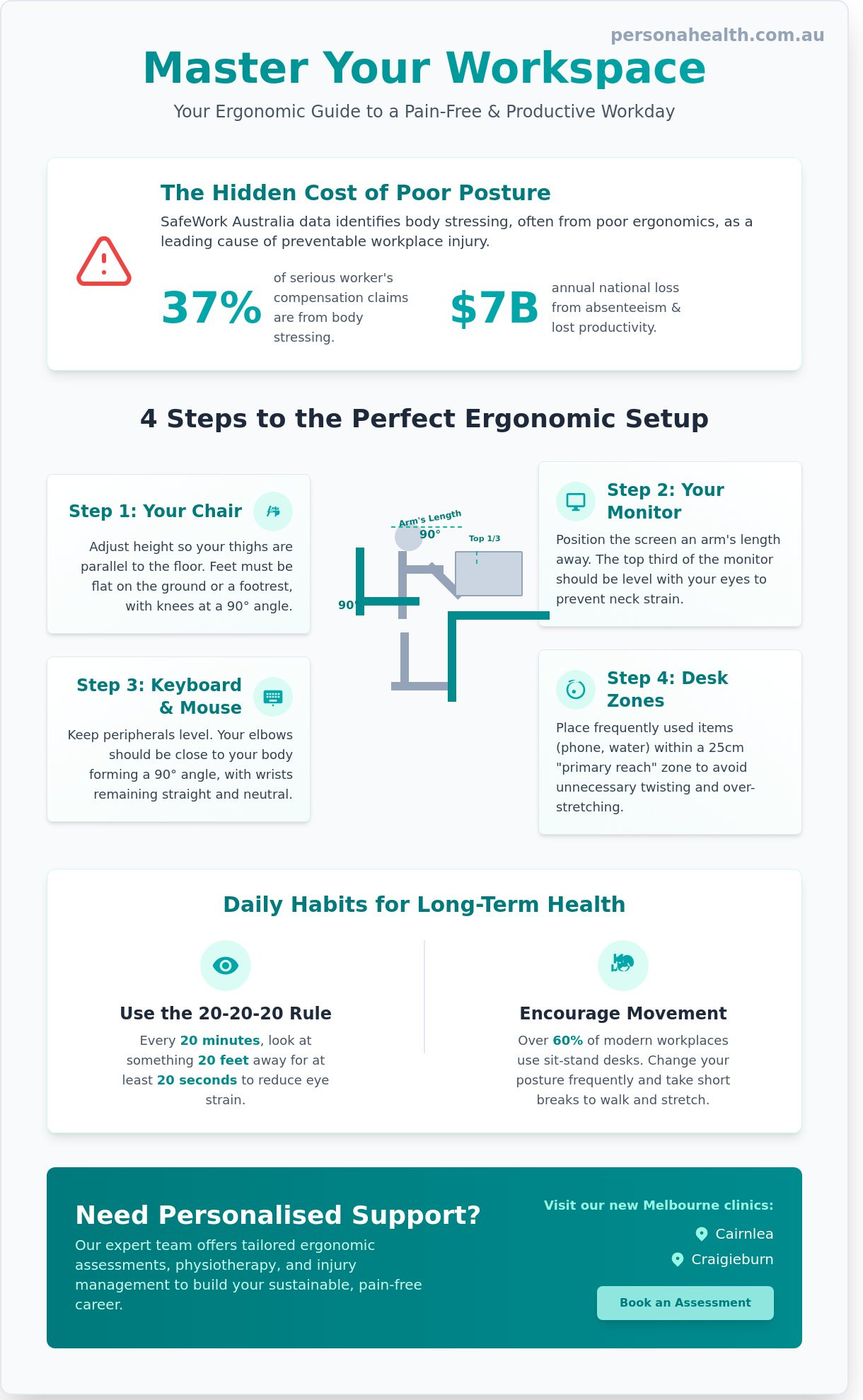
Creating a workspace that supports your body’s natural alignment is a clinical necessity rather than a luxury. When your desk is configured correctly, you reduce the mechanical load on your joints and soft tissues. SafeWork Australia statistics indicate that body stressing accounts for approximately 37% of all serious workers’ compensation claims; a statistic that highlights why proper ergonomics is your first line of defence against chronic pain.
- Step 1: Adjusting your chair height. Start with your seat. Adjust the height until your thighs are parallel to the floor and your feet rest firmly and flatly on the ground. If your desk height forces you to sit higher, use a footrest to ensure your knees remain at a 90-degree angle.
- Step 2: Positioning the monitor. Place your screen directly in front of you at an arm’s length. Your eyes should naturally align with the top third of the monitor. This prevents the repetitive head-tilting that leads to cervical spine strain.
- Step 3: Setting the keyboard and mouse. Keep these peripherals on the same level. Your elbows should stay close to your body, forming a 90-degree angle, which allows your wrists to remain in a neutral, straight position.
- Step 4: Organising your desk zones. Keep frequently used items, like your phone or water bottle, within a 25-centimetre “primary reach” zone. This prevents unnecessary reaching and shoulder rotation throughout the day.
Choosing the Right Ergonomic Equipment
A high-quality office chair must feature adjustable lumbar support to cradle the inward curve of your lower back. In the corporate environments of Melbourne and Sydney, sit-stand desks are now utilised by over 60% of modern workplaces to encourage postural variation. For those in smaller CBD apartments or compact offices, monitor arms and footrests are essential tools that save space while ensuring your body remains supported. If you’re feeling the effects of a poor setup, our specialists in physiotherapy in Sydney can help you recover and refine your workspace.
Laptop and Mobile Device Ergonomics
Laptops are inherently un-ergonomic because the screen and keyboard are joined. Working directly on a laptop for long periods often leads to “tech neck,” where the head leans forward, adding up to 27 kilograms of pressure to the spine. To fix this, always use a laptop stand to elevate the screen and pair it with an external keyboard and mouse. Our new Persona Health clinics in Cairnlea and Craigieburn frequently support patients transitioning to hybrid work who need tailored advice for temporary setups in cafes or shared hubs. Using a simple portable riser can transform a temporary table into a safe workstation.
Beyond the Desk: Industrial Ergonomics for Specialised Sectors
While many associate ergonomics with lumbar supports and monitor arms, the discipline is equally critical in the industrial heartlands of Melbourne and Sydney. In heavy sectors, ergonomic failures lead to chronic musculoskeletal disorders that can end careers prematurely. SafeWork Australia’s 2023 Key WHS Statistics reveal that body stressing remains the leading cause of serious workers’ compensation claims, accounting for 37% of all cases nationwide. This highlights why your physical safety depends on more than just “lifting with your knees.”
At our new clinics in Cairnlea and Craigieburn, we see how manual handling techniques vary wildly between a warehouse picker and a rail technician. A one-size-fits-all approach doesn’t work when your “office” is a high-vibration locomotive cabin or a construction site. We focus on your unique movements to ensure your body remains resilient against the specific pressures of your trade.
Ergonomics for Rail and Transport Professionals
Rail professionals and heavy machinery operators face the challenge of “static loading.” This occurs when muscles stay tense for hours while you remain seated in a vibrating environment. Poor cabin layout forces drivers into awkward reaches, which quickly turns into chronic back pain. We integrate these ergonomic concerns into our Cat 3 Rail Medicals in Sydney and our Victorian assessments to keep you on the tracks safely.
- Seat Design: Adjustable dampening in seats is essential to neutralise the micro-vibrations that cause spinal disc fatigue.
- Cabin Layout: Placing primary controls within a “neutral reach zone” reduces shoulder strain during long shifts.
- Fatigue Management: Proper ergonomic positioning improves blood flow, helping you stay alert during critical operations.
Protecting Workers in Hazardous Environments
Working with hazardous materials adds a layer of physical complexity. Wearing heavy respiratory protection or lead aprons shifts your centre of gravity, placing unusual stress on your neck and hips. If you’re undergoing asbestos medicals, we assess how your PPE affects your mobility. The extra weight of safety gear means your body burns more energy, making ergonomic efficiency a vital part of heat stress prevention.
Similarly, silica dust exposure monitoring often involves workers using high-vibration power tools. Ergonomics in this context focuses on reducing hand-arm vibration syndrome (HAVS). By choosing tools with better grip diameters and vibration-dampening technology, you protect your nerves and vascular health while fulfilling your site requirements. Our teams in Craigieburn and Cairnlea are ready to guide you through these specialised health surveillance needs with a personalised, clinical approach.
Preventing Overuse Injuries: A Daily Maintenance Plan
Your body isn’t designed for static positions. Even with a high-end chair, staying still for eight hours creates physical stress. SafeWork Australia data from 2021-22 shows that musculoskeletal disorders accounted for 51% of all serious workers’ compensation claims. Effective ergonomics is about more than furniture; it’s about movement. We recommend the 20-20-20 rule to combat digital eye strain and mental fatigue. Every 20 minutes, look at something 20 feet away for at least 20 seconds. This simple habit allows your eye muscles to relax and resets your focus.
Dynamic movement is always superior to a “perfect” static posture. You should incorporate desk-based stretches to release tension in your neck and shoulders. Try gentle neck rotations or shoulder blade retractions every hour. These small actions prevent muscles from tightening into painful patterns. Our teams in the new Cairnlea and Craigieburn clinics often see patients who waited too long to move. Creating a workplace culture that encourages short, frequent breaks is the most effective way to reduce long-term injury rates across your team.
Recognising the Warning Signs of Injury
Early intervention is vital for recovery. You might feel a slight tingling in your fingers or a persistent dull ache in your lower back. These aren’t just signs of a hard day; they’re signals from your nervous system. Normal muscle fatigue usually fades after a night of rest. Chronic strain, however, lingers and intensifies. If self-correction and stretching don’t resolve the discomfort within 48 hours, it’s time to seek professional injury management to prevent a minor niggle from becoming a long-term limitation.
Implementing Ergonomic Habits at Scale
Melbourne employers have a duty of care to provide safe environments. This involves move-based cultures rather than just providing equipment. Utilising on-site health surveillance helps businesses identify high-risk areas before injuries occur. We suggest implementing a weekly workstation self-audit checklist. This keeps ergonomics at the forefront of the daily routine. Our new facilities in Craigieburn and Cairnlea are ready to help your staff develop these personalised health habits.
Beyond the physical environment, a holistic safety strategy also considers the digital workspace. Automating repetitive administrative tasks can significantly reduce the risk of strain injuries and cognitive fatigue associated with prolonged computer use. For businesses looking to implement such efficiencies, you can learn more about PS WebSolution and their work in process automation.
Is your team struggling with persistent aches or desk-related tension? Book a professional ergonomic assessment with Persona Health today to protect your long-term wellbeing.
Professional Ergonomic Support at Persona Health Clinics
At Persona Health, we understand that your body has its own unique story. Our clinical team doesn’t believe in generic solutions because your physical health requires a bespoke approach. We’ve recently expanded our reach to better serve the Victorian workforce, opening two state-of-the-art clinics in Cairnlea and Craigieburn. These locations bring our signature blend of clinical authority and empathetic care to the heart of Melbourne’s industrial sectors.
Integrating ergonomics into your hiring process is a proven strategy for long-term success. Data from 2023 indicates that businesses combining pre-employment medicals with professional ergonomic assessments see a 22% decrease in musculoskeletal claims within the first twelve months. Our clinicians don’t just tick boxes; they provide personalised advice that empowers you to work safely and comfortably. We focus on how your specific physical attributes interact with your workstation to prevent issues before they start.
Spotlight on Melbourne: Cairnlea and Craigieburn
Melbourne’s northern and western corridors are growing rapidly. Our Cairnlea and Craigieburn clinics provide vital health support for these industrial hubs, ensuring local workers have access to premium care right where they need it. Whether you’re recovering from a strain or looking to prevent one, our physiotherapy and recovery services are designed for the specific demands of the Victorian workplace. We specialise in tailored return-to-duty programs that align with SafeWork Australia guidelines, helping you get back to your best safely and efficiently. Since our expansion in early 2024, we’ve already helped hundreds of workers in these regions regain their physical confidence.
Partnering with Persona Health for Long-Term Safety
Our “Persona” approach means we treat the person, not just the symptom. Every body is different; therefore, every ergonomic solution must be different. You can easily integrate our ergonomic reviews into your broader corporate health strategy to create a genuine culture of safety. For businesses requiring a more comprehensive view of their environment, we offer specialised on-site health surveillance to monitor workplace conditions in real-time. Just as ergonomics protects your musculoskeletal health, comprehensive workplace health surveillance includes protecting your hearing through regular audiometric testing in Sydney and Melbourne to ensure compliance with the latest SafeWork Australia regulations.
- Access expert care at our Sydney, Parramatta, Cairnlea, or Craigieburn clinics.
- Benefit from health plans that consider your unique physical history and job requirements.
- Reduce workplace absenteeism through proactive injury prevention and recovery.
You’re in expert hands whether you visit us in New South Wales or our new Melbourne locations. Booking your clinical assessment is the first step toward a healthier, more productive work life. Contact us today to secure your appointment and experience healthcare that’s as unique as you are.
Take Control of Your Physical Well-being at Work
Your health shouldn’t be a secondary thought while you’re on the clock. Data from SafeWork Australia indicates that body stressing accounts for 37% of all serious workers’ compensation claims. Implementing a tailored approach to ergonomics ensures your workstation or industrial site supports your unique physical needs rather than working against them. Whether you’re navigating the complexities of rail health surveillance or simply refining your desk height, small adjustments prevent long-term overuse injuries. Every body is different; your setup should reflect that individuality.
At Persona Health, our Professional Occupational Health Specialists understand that every worker requires a distinct recovery and maintenance plan. We’ve expanded our reach to provide even more accessible care for the Melbourne community. You’ll find expert support at our convenient locations in Sydney and across Melbourne, with a dedicated focus on industrial and rail health. We’re particularly proud to welcome patients to our two newest facilities designed for your comfort.
Book a consultation at our new Cairnlea or Craigieburn clinics today to start your journey toward a pain-free professional life. Our team is ready to help you thrive in a workspace that’s built for your success.
Frequently Asked Questions
What is the most important part of an ergonomic setup?
The most important part of an ergonomic setup is the dynamic fit between your unique body and your workstation. While many people focus solely on the chair, the 2024 Australian Standard AS/NZS 4442 highlights that the alignment of your monitor, keyboard, and seat must work in harmony to prevent injury. At our new Cairnlea clinic, we ensure your setup supports your specific spinal curvature to prevent long-term strain.
Does my employer have to pay for ergonomic equipment in Australia?
Australian employers are legally required to provide a safe working environment under the Work Health and Safety Act 2011. This often includes providing or subsidising ergonomic equipment if a risk assessment identifies it as necessary for your safety. If you’re working from home in Melbourne, your employer still holds a duty of care to ensure your desk setup doesn’t cause injury. You should check your specific workplace policy as many Victorian companies provide a budget of A$500 to A$1,000 for home office upgrades.
How often should I take breaks when working at a desk?
You should aim to move or change your posture every 30 minutes to maintain healthy circulation and joint lubrication. Research from the University of Queensland suggests that even 2 minute micro-breaks can reduce muscle fatigue by up to 15 percent. Our team at the Craigieburn clinic recommends the 20-20-20 rule; every 20 minutes, look at something 20 feet away for 20 seconds to reduce digital eye strain.
Can ergonomics help with existing back pain?
Proper ergonomics can significantly reduce existing back pain by eliminating the mechanical stressors that aggravate your symptoms. A 2022 study found that workers who received personalised ergonomic interventions reported a 32 percent decrease in chronic musculoskeletal discomfort. Persona Health provides tailored recovery plans in Cairnlea that combine physical therapy with workstation adjustments to help you return to pain-free productivity.
What is the ideal height for an office chair?
The ideal height for your office chair allows your feet to rest flat on the floor with your knees at a 90 degree angle. Your thighs should be parallel to the ground, ensuring there’s no pressure on the back of your legs from the seat edge. If your desk is too high to allow this, you’ll need a footrest to maintain this neutral position. Our experts in Craigieburn can help you calibrate your chair to your exact height during a consultation.
Are standing desks actually better for your health?
Standing desks are beneficial only when you alternate between sitting and standing every 40 to 60 minutes. Research indicates that standing for more than 5 hours a day can actually increase the risk of lower limb circulatory issues and varicose veins. The goal of ergonomics is movement; we recommend a ratio where you stand for roughly 20 minutes of every hour to keep your metabolic rate 10 percent higher than when seated.
How do I know if I need a professional ergonomic assessment?
You should seek a professional ergonomic assessment if you experience persistent tingling, numbness, or pain that lasts for more than 3 consecutive days. These symptoms often signal that your current setup is placing undue stress on your nervous system or soft tissues. Residents in Melbourne’s north can visit our Craigieburn or Cairnlea locations for a comprehensive review that identifies specific risks before they become chronic injuries.
What ergonomic standards does SafeWork Australia recommend?
SafeWork Australia recommends following the AS/NZS 4443:1997 standards for office desks and the AS/NZS 4438:1997 for height-adjustable swivel chairs. These guidelines specify that monitors should be positioned roughly 500mm to 700mm from your eyes to prevent neck strain and headaches. Adhering to these national standards ensures your workplace meets the highest safety benchmarks for physical health and comfort while reducing the risk of WorkCover claims.