

What if the true cost of a workplace injury isn’t the insurance claim itself, but the weeks of uncertainty that follow while waiting for a GP appointment or a delayed medical report? For many local businesses, the friction within the NSW workers compensation system often feels like a second injury to the organisation. Effective workplace injury management sydney requires more than just filling out forms; it demands a proactive approach that balances strict SIRA compliance with genuine, clinical care for your team.
We understand that rising premiums and the complexity of the 2026 legislative updates, such as the increased 25% WPI threshold for psychological injuries, can feel overwhelming. You want to support your staff through a smooth recovery without being buried in paperwork or facing avoidable lost time. This guide provides a clear roadmap to navigating the current NSW landscape, reducing Lost Time Injuries (LTIs), and ensuring your business remains compliant with evolving WHS legislation. We will explore how modern triage tools and expert medical oversight can transform your return to work outcomes while fostering a culture of stability and trust.
Key Takeaways
- Understand the essential steps of the return to work process to ensure your business remains compliant with the latest NSW WHS legislation and SIRA requirements.
- Discover how proactive workplace injury management sydney reduces lost time and helps stabilise your workers compensation premiums through early clinical intervention.
- Learn why choosing an occupational health physician over a standard GP leads to more durable recovery outcomes and faster workplace reintegration for injured staff.
- Find out how to use InjuryQR to provide your workers with immediate AI-guided triage and instant Certificates of Capacity where appropriate.
- Gain insights into accessing Persona Health’s Sydney-wide clinic network and mobile services to support your staff regardless of their job site location.
What is Workplace Injury Management in Sydney?
Effective workplace injury management sydney is far more than a simple set of administrative tasks; it is a sophisticated, coordinated process designed to support the person behind the claim. This framework integrates medical treatment, vocational rehabilitation, and administrative coordination to assist workers after an incident. The overarching goal is to achieve a safe, durable, and timely return to work (RTW) for Sydney employees, ensuring they can reintegrate into their roles with confidence and physical stability. This multidisciplinary approach is a core component of Occupational safety and health, focusing on the recovery phase of the employment lifecycle.
In New South Wales, these activities must align strictly with the Workers Compensation Act 1987 and the Workplace Injury Management and Workers Compensation Act 1998. These laws provide the legal foundation for how injuries are reported, treated, and compensated. The State Insurance Regulatory Authority (SIRA) acts as the primary overseer, regulating the Sydney workplace rehabilitation landscape to ensure that both employers and insurers meet their obligations to the injured worker. When managed correctly, this system protects the worker’s health while safeguarding the business’s operational continuity.
To better understand how the system manages complex situations and disputes, watch this helpful video from the Workers Compensation Commission:
The Importance of Early Intervention
The first 24 hours following a workplace incident are often the most influential for long-term recovery outcomes. Clinical research consistently shows that immediate assessment and support significantly reduce the likelihood of a worker developing chronic pain or long term disability. Rapid intervention addresses the physical injury while also managing the worker’s psychological response, preventing the “disability mindset” that can occur when a person feels abandoned by their employer. From a commercial perspective, early reporting and treatment directly mitigate the “Premium Impact” for Sydney businesses. Claims that are managed proactively from day one typically result in lower costs and fewer days of lost productivity, which keeps your workers compensation premiums stable.
Key Stakeholders in the Sydney System
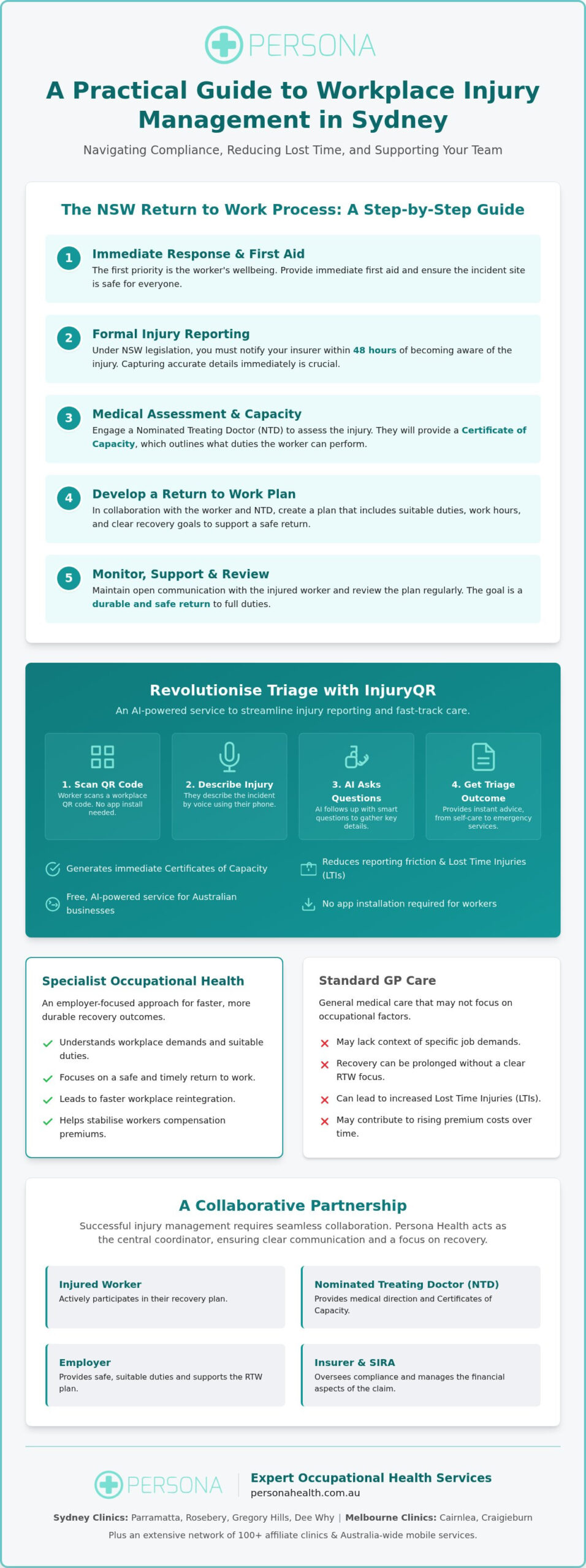
Successful workplace injury management sydney requires a collaborative partnership between several key parties. The employer is responsible for providing suitable duties, while the injured worker is expected to participate actively in their recovery plan. Central to this is the Nominated Treating Doctor (NTD), who provides the medical direction and the all important Certificate of Capacity. For more complex cases where recovery has stalled, a Sydney based Injury Management Consultant (IMC) may be engaged to provide an independent clinical review. Persona Health serves as the vital link between these stakeholders, ensuring that communication remains clear, clinical care is prioritised, and the path back to work is always the primary focus.
The Return to Work Process: A Step-by-Step Guide for NSW Employers
When an incident occurs, the first few minutes dictate the trajectory of the entire claim. Your immediate priority is the provision of first aid and ensuring the site is safe. Once the worker is stabilised, formal incident reporting must commence. Under NSW legislation, you are required to notify your insurer within 48 hours of becoming aware of a workplace injury. This is where modern tools like InjuryQR become invaluable, allowing workers to report injuries via a simple voice-to-text interface, ensuring that details are captured accurately and immediately while the event is fresh.
The next critical step is selecting a Nominated Treating Doctor (NTD) who understands the specific physical and psychological demands of your industry. While workers have the right to choose their own GP, many businesses find that general practitioners lack the occupational health expertise required for complex workplace injury management sydney. A doctor who understands the nuances of the Sydney job market can more accurately assess what duties a worker can safely perform, preventing unnecessary time away from the tools. Our team at Persona Health works closely with employers to ensure that clinical assessments are aligned with actual workplace requirements.
Once medical advice is received, you must develop a tailored Return to Work Plan in consultation with the employee. This document is not just a piece of compliance paperwork; it is a supportive roadmap that outlines the specific duties, hours, and restrictions for the worker. Monitoring their progress is an active, ongoing task. You should regularly review the worker’s recovery and adjust their duties based on the latest medical evidence. For many organisations, professional workplace injury management sydney services provide the clinical oversight needed to ensure these transitions are both safe and durable.
Creating a Suitable Duties Register
Identifying “light duties” can be challenging in high-pressure environments. A suitable duties register pre-identifies modified roles, such as administrative support in a transport depot or safety auditing on an infrastructure site. NSW legislation requires employers to provide suitable employment that is as close as possible to the worker’s pre-injury role. For example, a driver with a shoulder injury might transition to yard coordination or logistics planning while they undergo rehabilitation. Having these options ready reduces friction during the recovery process.
Navigating the Certificate of Capacity
The SIRA-approved Certificate of Capacity is your primary tool for managing a claim. You must look beyond the “No Capacity for Work” box and focus on the “Capacity for Some Work” section, which details what the worker can do. If a doctor issues a total incapacity certificate but you have suitable duties available that meet the clinical restrictions, you have the right to discuss this with the NTD. Clear communication between the employer and the doctor often reveals that a worker is capable of more than initially thought, provided the right supports are in place.
The process concludes only when the worker reaches their pre-injury status or a stable “maximum medical improvement” is achieved. Throughout this journey, maintaining an empathetic but efficient approach ensures the staff member feels valued while the business minimises the impact of the injury on its operations.
Specialist Occupational Health vs. Standard GP Care
Many Sydney employers find themselves caught in a frustrating cycle of vague medical certificates and seemingly endless time off. While a local GP is excellent for general health concerns, they often lack the specific training required to navigate the nuances of the NSW workers compensation system. A standard 15-minute consultation rarely allows enough time for a doctor to understand the physical demands of a high-risk role, such as a rail worker in Parramatta or a logistics coordinator in Rosebery. Specialist workplace injury management sydney focuses on “Fitness for Work” rather than just symptom management, ensuring that the clinical path is always aligned with the practical realities of your specific job site.
Occupational Physicians bring a unique perspective that balances clinical expertise with a deep understanding of employer obligations. They provide significantly faster turnaround times for medical reports and specialist referrals, which is essential for meeting SIRA’s strict reporting timelines. Instead of simply advising a worker to “rest for two weeks,” a specialist assesses the worker’s residual functional capacity. This approach often identifies ways a staff member can remain at work in a modified capacity, which is vital for maintaining their mental wellbeing and connection to the workplace. It’s about looking at the person’s strengths and what they can achieve, rather than just their limitations.
The ROI of Specialist Injury Management
The financial impact of a Lost Time Injury (LTI) extends far beyond the immediate medical bills. For a Sydney business, an LTI involves indirect costs such as lost productivity, the expense of training temporary replacements, and the inevitable rise in insurance premiums. By engaging a specialist from the outset, you reduce the risk of “doctor shopping,” where workers may inadvertently seek out conflicting medical advice that delays their recovery. Persona Health provides fast, employer-aligned clinical reporting that cuts through the noise, helping you regain control of your claims costs while ensuring your staff receive the highest standard of care.
Functional Capacity Evaluations (FCE)
An FCE is an objective, evidence-based assessment that measures a worker’s physical ability to perform specific tasks required by their role. Using these evaluations within your workplace injury management sydney strategy protects both the worker and the business from the risk of premature return and subsequent re-injury. It moves the return to work conversation from subjective opinions to hard data, showing exactly how much a worker can safely lift, push, or pull. This level of detail is crucial for ensuring a safe and durable return to work, providing peace of mind for everyone involved. You can learn more about how we implement these assessments by visiting Persona Health Injury Management.
InjuryQR: Revolutionising Workplace Triage in Sydney
The moment a worker is injured, the clock starts ticking on both their recovery and your potential claim costs. Traditional workplace injury management sydney often relies on the worker finding a clinic that is open, which can lead to unnecessary delays or expensive trips to the Emergency Department for minor strains. To bridge this gap, Persona Health offers InjuryQR, a free, AI-powered triage tool designed to provide immediate clinical guidance at the point of injury. It’s a modern solution that ensures your staff aren’t left wondering what to do next during those critical first minutes.
The process is designed for maximum simplicity. A worker simply scans a QR code located on a poster or magnet, describes their injury using their voice, and receives AI-guided next steps. There is no app to download and no complex registration process, making it 100% accessible for workers on Sydney construction sites, in busy Parramatta warehouses, or at Rosebery logistics hubs. By removing the barriers to reporting, you ensure that every incident is captured accurately and immediately, which is fundamental for maintaining your WHS compliance and meeting SIRA’s 48-hour notification window.
One of the most significant advantages of this digital approach is the immediate issuance of Certificates of Capacity where appropriate. As we discussed in earlier sections, the certificate is the engine that drives the return to work process. By facilitating an instant clinical assessment via telehealth or AI triage, InjuryQR can provide the necessary documentation to start modified duties straight away. This prevents the worker from falling into a cycle of total incapacity simply because they couldn’t get a GP appointment until the following week.
Benefits of Digital Triage for Sydney Businesses
Implementing digital triage significantly reduces the burden on the public health system by redirecting minor injuries away from local Emergency Departments. For a Sydney business, this means lower claim costs and a dramatic reduction in Lost Time Injuries (LTIs). The system also improves the quality of your incident reporting, providing a clear, timestamped record of the event. To help you integrate this into your safety culture, we provide free physical assets, such as posters and magnets, which can be placed in tea rooms, workshops, or vehicle cabins across your Sydney operations.
Improving the Worker Experience
Injury doesn’t always happen during office hours. Whether your team is working a night shift in Gregory Hills or a weekend project in Dee Why, they deserve access to professional support. InjuryQR provides 24/7 guidance, empowering workers with clear self-care instructions or direct links to telehealth consultations when needed. This immediate care reduces anxiety and reinforces the message that their health is your priority. If you want to see how this technology can support your broader safety strategy, we recommend speaking with our team about integrating workplace injury management sydney solutions into your business.
Expert Injury Management Services Across Sydney
Effective workplace injury management sydney requires a physical presence that matches the geographical spread of your operations. Sydney is a sprawling metropolis, and expecting an injured worker to travel across the city for a clinical review can add unnecessary stress to their recovery. Persona Health addresses this by maintaining strategic clinic locations in Parramatta, Rosebery, Gregory Hills, and Dee Why. This ensures that whether your team is based in the industrial heartland of the west or the commercial hubs of the inner south, they have local access to high quality occupational health care. For businesses with a mobile workforce or sites beyond the metropolitan area, our network of 100 affiliate clinics and Australia wide mobile services provide a consistent standard of care regardless of the location.
Our clinical team doesn’t just manage general injuries; we provide specialised medical assessments that are critical for specific industries. This includes Cat 3 Rail Medicals for the transport sector and Commercial Driver Medicals for heavy vehicle operators. These assessments ensure that your workers meet the stringent safety standards required by Transport for NSW and relevant national regulations. By centralising these services with your injury management provider, you benefit from a medical team that already understands the physical demands of your workers’ roles, leading to more accurate fitness for duty decisions and faster turnaround times for all employer reporting.
Integrated Occupational Health Solutions
We believe that injury management is most effective when it is part of a full employment lifecycle approach. This begins with robust Pre-Employment Medicals to ensure that a worker is physically suited to their role from day one. When combined with our On-site Health Surveillance Sydney services, we can help you monitor workers exposed to hazardous materials such as crystalline silica and asbestos. This proactive monitoring identifies potential health issues before they become workers compensation claims, protecting your staff and your business from long term liability under NSW WHS legislation.
Why Sydney Employers Choose Persona Health
The complexity of the NSW workers compensation system means that generic medical advice is rarely sufficient. Our medical team possesses a deep, practical understanding of SafeWork NSW and SIRA requirements, ensuring that every report and recommendation is compliant and actionable. We have invested heavily in modern digital reporting systems that keep HR teams and safety managers informed in real time. You don’t have to chase us for updates; our systems deliver the information you need to make informed decisions about your workforce. Above all, we maintain a commitment to empathetic care. We recognise that behind every claim is an individual who wants to return to their normal life. By prioritising their recovery through a tailored, clinical approach, we create better outcomes for the worker and more stable premiums for the employer.
Building a Resilient Workforce Through Proactive Care
Effective workplace injury management sydney is no longer just about reacting to incidents; it’s about creating a culture where recovery is supported by technology and clinical expertise from the very first minute. By integrating tools like InjuryQR for immediate triage and partnering with SIRA-approved medical professionals, you can cut through the administrative complexity that often stalls a worker’s return to health. As we have explored, the combination of early intervention and specialist occupational oversight provides the clarity needed to reduce lost time and stabilise insurance premiums in an evolving legislative environment.
At Persona Health, we prioritise fast turnaround clinical reporting and empathetic, individualised care across our extensive Sydney clinic network. Whether you are navigating the new 2026 legislative thresholds or looking to modernise your incident response, our team acts as your expert occupational health partner. Contact the Persona Health team in Sydney today for expert injury management support and discover how our free InjuryQR triage service can transform your safety outcomes. We look forward to helping you support your team’s recovery with confidence and clinical precision.
Frequently Asked Questions
What are the legal requirements for injury management in Sydney?
In New South Wales, your legal obligations are primarily governed by the Workers Compensation Act 1987. You must have a return to work program in place, notify your insurer of any workplace injury within 48 hours, and provide suitable employment that matches the worker’s current capacity. Failing to meet these requirements can lead to penalties from SafeWork NSW or SIRA and may negatively impact your insurance premiums.
How do I choose a workplace rehabilitation provider in NSW?
You should select a provider that is SIRA-approved and demonstrates a deep understanding of your specific industry’s physical demands. A high quality provider acts as a proactive partner rather than just an administrator. Persona Health focuses on clinical leadership and early intervention to ensure that workplace injury management sydney is handled with both efficiency and empathy, leading to more durable return to work outcomes.
What is the difference between a GP and an Occupational Physician for workers comp?
While a standard GP focuses on general medical care, an Occupational Physician specialises in the complex relationship between health and the workplace. Specialists understand the nuances of Sydney job sites and focus specifically on a worker’s “Fitness for Work” rather than just symptom management. This targeted approach results in more accurate work restrictions, faster reporting, and a more effective recovery process for your staff.
How can InjuryQR help my Sydney business reduce LTI rates?
InjuryQR reduces Lost Time Injury (LTI) rates by providing immediate, AI-guided triage at the point of incident. By offering workers instant self-care instructions or directing them to telehealth, it prevents minor injuries from escalating due to lack of direction. This immediate care ensures that workers feel supported from the first minute, often allowing them to remain at work in a modified capacity rather than taking unnecessary leave.
What should be included in a Sydney Return to Work plan?
A compliant Return to Work plan must include the worker’s recovery goal, a clear description of their modified duties, and any specific physical restrictions. It should also detail the support provided by the employer and include a schedule for regular progress reviews. This document serves as a formal agreement between you and your worker, ensuring everyone is aligned on the path back to full pre-injury duties.
Can I insist an injured worker sees a Persona Health specialist in Sydney?
Under NSW legislation, the worker has the right to choose their own Nominated Treating Doctor (NTD). However, you can recommend they see an occupational health specialist for an initial assessment to ensure they receive expert care tailored to their role. If a claim becomes complex, you also have the right to request an independent medical examination or engage an Injury Management Consultant to provide a clinical review of the case.
How do workplace injuries affect my insurance premiums in NSW?
Your premiums are directly influenced by the cost and duration of your claims through the “experience adjustment” process. Proactive workplace injury management sydney reduces these costs by facilitating a faster, safer return to work. By minimising the time a worker spends on weekly payments and preventing secondary psychological issues, you can maintain more stable and predictable insurance costs for your business.
What is a SIRA-approved Certificate of Capacity?
The Certificate of Capacity is the only medical certificate recognised under the NSW workers compensation system. It is a formal document issued by the doctor that details a worker’s capacity for work and any necessary restrictions. This certificate is the primary tool used by employers and insurers to determine suitable duties and ensure that the return to work process is based on objective clinical evidence.

Article by
Ian Nicholson
Ian is the Business Support Manager at Persona Health, where he plays a key role across IT, sales, marketing and business operations. With a broad skill set and a practical, solutions-focused approach, Ian helps drive the systems, communication and commercial strategy that support Persona Health’s continued growth across Australia.